Cart
0
For a small counter, a drying mat usually wins. For bigger loads and glassware, a dish rack is often better. The choice depends on how quickly dishes dry, how much space you can spare, and how easy the setup is to keep clean. If you want a mat now, browse kitchen textiles at Homable.
TL;DR:
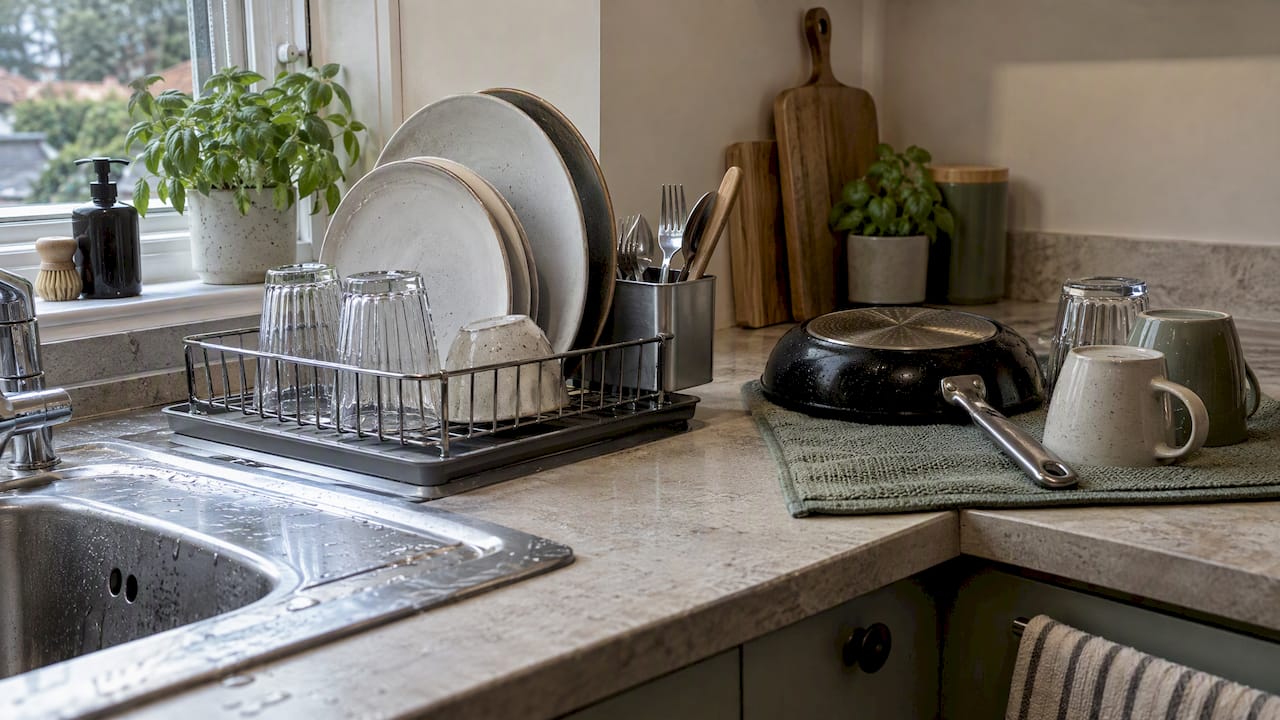
- A small rack can hold plates and glasses upright, while a nearby mat takes pans, chopping boards, and overflow when guests come over.
- Wash a mat used daily regularly, let it air completely before storing, and replace it if odors return or the fabric stays waterlogged.
- Folding or over sink racks save counter space, while mats can go in drawers or hang between uses to dry fully.
- Fabric mats may be machine washable, but tumble drying can shrink fabric or damage backing, so follow the care label and air dry unless permitted.
- Stainless steel racks resist rust, but coated wire can chip and expose metal; replace a rack if its coating flakes or rust appears.
Table of Contents
- What are the quick pros and cons of each option?
- How quickly does each one dry your dishes?
- How do you keep a rack or mat clean and free from mould?
- How much space do a rack and a mat need?
- Which materials last longest, and when should you replace them?
- How do you choose between a rack and a mat?
- Our view: keep it simple and keep it dry
- Where can you find a washable drying mat?
- FAQ
- Sources
What are the quick pros and cons of each option?
Here is the short version, so you can shortlist before reading the detail.
Dish racks
- Upright items sit in open air, so plates and glasses tend to dry faster.
- The footprint is larger, and many racks need a permanent spot beside the sink.
- A tray can collect water, so it needs emptying and wiping.
- Racks suit big loads, because every plate has its own slot.
Drying mats
- The footprint is small, and a mat rolls or folds away when the dishes are done.
- The fabric soaks up drips, which protects the counter.
- A mat can stay damp if you leave it bunched up or never launder it.
- Items lie flat, so they dry more slowly than they do upright.
Different households show how this plays out:
- Single person or couple: a mat is usually enough. You wash a few plates and mugs, then put the mat away.
- Family: a rack copes better with frequent washing up, and a spare mat underneath catches the overflow.
- Glassware lovers: a rack keeps glasses upright and apart, and that spacing protects thin rims from knocks.
None of these is a hard rule. If you only hand wash occasionally, a mat will serve you well even in a large family home. If you wash up after every meal, a rack earns its space.
How quickly does each one dry your dishes?
Racks generally win on speed, because they hold items upright with air moving around them. Water runs off a tilted plate instead of pooling, and a glass stood on its rim drains and dries from the inside out. For a heavy load, that airflow matters.
Mats work differently. They absorb water and then rely on evaporation, so the fabric decides how long everything stays wet. In a test-style roundup of racks and mats, large, absorbent, machine-washable polyester mats dried quickly, while the testers also found that racks and mats each have trade-offs depending on your space and what you are drying. In everyday terms, microfibre and other quick-dry fabrics let go of moisture sooner than thick cotton.
A few habits improve the result with either option:
- Leave a small gap between items so air can reach every surface.
- Tilt glasses and bowls slightly so water runs off instead of pooling inside.
- On a mat, stand tall items on their side or against something, rather than letting them sit in a puddle.
- Turn the mat, or shift items around as they dry, so the damp patches have time to dry.
If you are testing a new setup, try the same load on each for a few days and note which one is dry by the time you next cook. That tells you more than any spec sheet.
How do you keep a rack or mat clean and free from mould?
Air drying is widely seen as the most sanitary way to dry dishes, and the accessory underneath needs the same care. Damp reusable cloths are known to encourage bacteria, and a soggy mat or a tray full of stale water does the same job. Government guidance stresses washing and drying kitchen cloths regularly rather than leaving them damp, and the same logic applies here.
A simple routine keeps things fresh:
- Racks: wipe the frame, lift out the cutlery holder and tray, rinse them, and dry each part before putting it back.
- Mats: machine wash when the label allows it, then air the mat fully before storing it.
- Frequency: launder a mat regularly if you use it daily, and wipe the tray and rack every few days.
The core habit is simple: never leave the accessory persistently damp. If a mat is still wet in the evening, hang it over a tap or a chair back. Only fold or roll it away once it is completely dry, because a damp roll in a cupboard is where musty smells start.
How much space do a rack and a mat need?
A rack takes up a fixed block of counter, although over-sink and foldable designs reduce that. An over-sink rack uses space you would not otherwise use, and a folding rack shrinks for storage. A mat is flatter still: it lies on the worktop when needed and rolls or folds into a drawer afterwards.
Portability is the mat’s real strength. In a rental or a small flat, you can put it out for a wash-up and clear the worktop afterwards. A rack is easier to leave out permanently, which suits a kitchen where the sink area is already busy and dishes pile up through the day.
Where you keep each one matters too. Racks can hang on a wall hook or sit stacked in a cupboard when folded. Mats go in a drawer, over a rail, or on a hook by the sink so they air between uses.
If you have the room, combining the two is flexible. A small rack handles plates and glasses, while a mat beside it takes pans, chopping boards and anything that does not fit upright. That way you are not forced to choose when guests come over.

Which materials last longest, and when should you replace them?
Rack materials differ in how they age. Stainless steel resists rust and keeps its look for years. Coated wire is often cheaper, but the coating can chip over time, and exposed metal is where rust and grime start.
Mats come mainly in microfibre, polyester and silicone. Microfibre and polyester soak up water well and are usually machine washable, which makes them easy to keep fresh. Silicone does not absorb, so water runs off to the edge instead, and it wipes clean in seconds. Check each label before washing, since care instructions vary.
Replace an item when it tells you to:
- Staining that will not shift after a wash.
- A smell that returns even when the mat is clean and dry.
- A fabric that stays waterlogged, or a rack with flaking coating or rust.
Rotating two mats spreads the wear, so each one lasts longer.
How do you choose between a rack and a mat?
Ask yourself five questions:
- How often do you cook and wash up by hand each day?
- What do you dry most: plates and glasses, or pans and boards?
- How much counter space can you spare?
- Would you rather put a mat through the washing machine or wipe a rack?
- Does the look of the kitchen matter to you?
Then match your answers to a profile:
- Small flat: a mat, stored away after use.
- Family kitchen: a rack plus a spare mat for overflow.
- Glassware-focused: a rack, with glasses upright and spaced.
- Occasional cook: a mat, since you rarely need the capacity of a rack.
When you shop, look for a machine-washable fabric, a quick-dry finish, a non-slip backing, and a drip tray if you choose a rack. Mid-range options usually balance durability and cost well. Very cheap mats tend to thin out and hold water, so a modest step up is often worth it.
Our view: keep it simple and keep it dry
We think kitchen accessories should look good and work hard. The best mat is one you are happy to leave on the worktop and happy to throw in the wash. One tip from us: keep spare mats and rotate them, so one is always airing while another works.
— Cristiano
Where can you find a washable drying mat?
If a mat suits your kitchen, our kitchen mats collection is the place to start. Browse the collection for a mat that suits your kitchen. Tea towels such as our designs can add a finishing touch.
We would also suggest owning spare mats and a tray to protect the counter, so a mat can dry while another is in use. When you are ready, browse the full range on our homepage and pick what suits your kitchen.
FAQ
Can a dish drying mat go in the dryer?
It depends on the label. Many fabric mats are machine washable, but tumble drying can damage backings or shrink the fabric. Air drying is the safer choice unless the care label says a dryer is fine.
Is it better to towel dry or air dry dishes?
Air drying is widely considered the more sanitary option. Damp reusable towels can pass bacteria between dishes, so if you do towel dry, use a clean cloth and change it often, as GOV.UK cleaning guidance suggests.
Are dish drying mats hygienic?
Yes, when you keep them dry. Wash the mat regularly, hang it up to air between uses, and never store it damp. A mat left wet in a heap is the one that causes problems.
Why do people use a drying rack?
A rack holds dishes upright with air flowing around them, so they drain and dry quickly. It also keeps plates and glasses separate and saves space on the worktop compared with piling items flat.