Cart
0
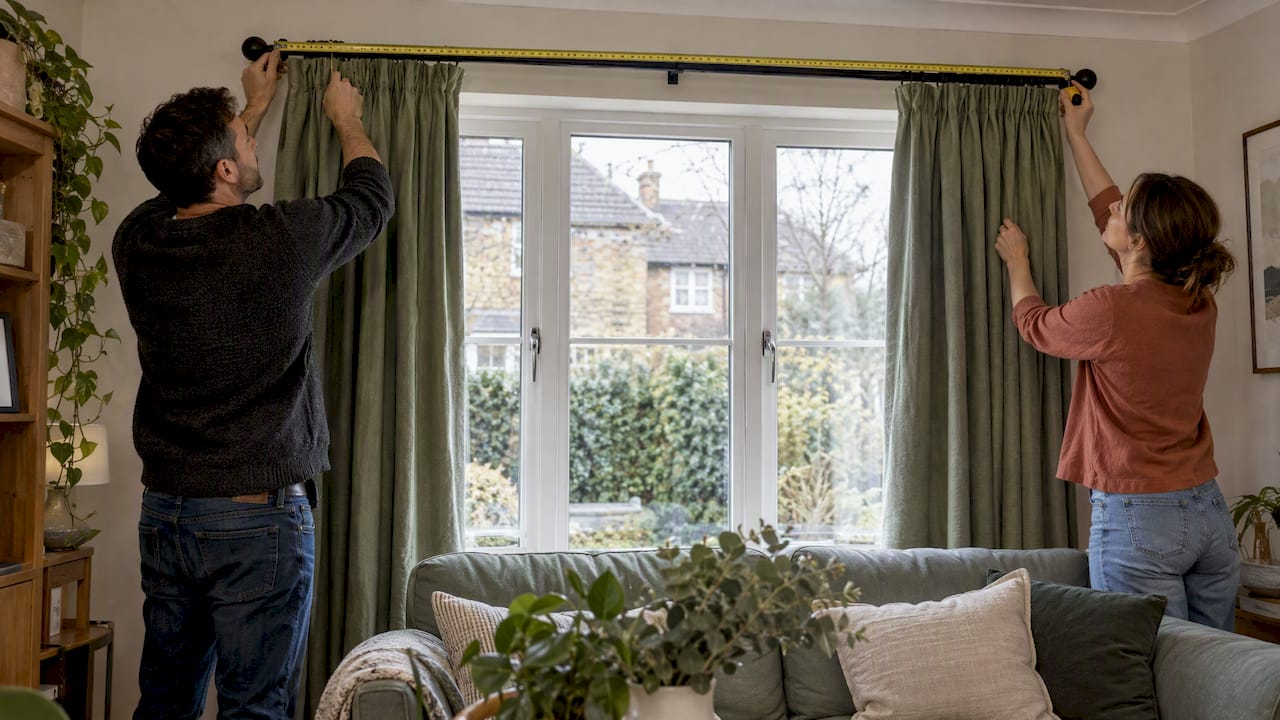
Measure the full width of your pole between the finials, or the full length of your track, then multiply it by 1.5 to 2 for fullness. Next, measure the drop from the right point for your heading, such as the bottom of an eyelet or the top of a tab. Use a steel tape, measure twice, and leave suitable clearance above the window and any radiator.
TL;DR:
- Use 2× fullness for standard coverage, up to 2.5× for richer gathers, and check whether listed width covers one panel or the pair.
- Measure the drop according to the heading: eyelets start at the bottom, tabs at the top, and pencil pleats at the track top or hook eye.
- Choose a ready made drop slightly longer than your measurement; hemming is straightforward, while a curtain that is too short is hard to fix.
- If a radiator sits beneath the window, leave about 3cm of clearance above it so curtains do not block heat circulation.
- For bay windows, measure each straight track section separately; at French or sliding doors, allow curtains to clear handles or stack beyond the opening.
Table of Contents
- What tools do you need before you start measuring?
- How do you measure curtain width for a pole or track?
- Where do you start measuring the drop?
- How high and how wide should you fix the pole or track?
- How are ready-made curtains sized, and what should you check when buying?
- How can you shorten curtains without a sewing machine?
- What is the quick checklist for measuring curtains?
- How do you measure curtains for bay windows, French windows and sliding doors?
- Which curtain heading should you choose, and how does it affect measuring?
- Do you measure lined and unlined curtains differently?
- What are the most common curtain measuring mistakes?
- Why does measuring twice matter so much?
- Where can you buy curtains once you have your measurements?
- FAQ
- Sources
What tools do you need before you start measuring?
Getting the kit right stops most errors before they begin. A steel tape measure is the one non-negotiable item, because cloth or plastic tapes can bend or stretch and give you a wrong figure. Everything else just makes the job quicker and less fiddly.
- A steel tape measure, ideally one that locks so it holds its length.
- A pencil and paper, or a notes app, so you record each figure straight away.
- A step-ladder, plus a helper to hold the tape end on tall windows.
- Your phone camera, to photograph the tape against the pole or track for reference when ordering.
Fit the pole or track first, or at least mark exactly where it will sit. Measuring from an imagined position is how drops end up too short. Once the hardware is on the wall, every figure you take is a real one.
How do you measure curtain width for a pole or track?
Measure the pole or track, never the window. On a pole, measure the span between the finials. On a track, measure its full length. The Ideal Home measuring guide is clear that the window opening itself is not the basis for your calculation, and using it usually leaves curtains looking stretched and thin when closed.
- Fit or mark your pole or track, allowing an overhang each side of the window frame.
- Measure the pole between the finials, or the whole track length, and write it down.
- Choose your fullness: 1.5× for a modest look, 2× as the standard, up to 2.5× for a rich, gathered effect.
- Multiply the pole or track width by that figure to get the total curtain width you need.
- Check whether the listed width is per panel or for a pair, then divide or compare accordingly.
Take a worked example. Say your track is 2.0m long and you want standard 2× fullness. You need 4.0m of total curtain width. If the curtains you like are sold as a pair of panels, each panel should be about 2.0m wide. If the listing shows a single panel width, you will need two.
Pro Tip: Photograph the tape end sitting on the finial and again at the far finial, so you can check the figure later without climbing back up.
Where do you start measuring the drop?
The drop starts at the hanging point of your heading, not at the top of the fabric. Your heading style decides that point, and getting it wrong shifts your whole finish. The Spruce curtain guide says to measure from the hanging point that suits your heading down to your chosen finish.
- Eyelet: measure from the bottom of the eyelet, as the pole passes through the ring.
- Pencil pleat on a track: measure from the top of the track.
- Pencil pleat on a pole: measure from the eye of the hook as it sits on the pole.
- Tab top: measure from the top of the tab.
Then pick your finish. A sill-length curtain typically stops just above the sill. Floor-length curtains can finish at or near the floor, depending on the look you want. A puddle finish adds several centimetres of extra fabric to pool on the floor. If a radiator sits under the window, leave suitable clearance above it.
For a polished, expensive look, longer curtains that just touch or slightly graze the floor are recommended by designers. Whatever finish you choose, our guide to UK curtain length rules goes deeper on the three spots worth measuring.
How high and how wide should you fix the pole or track?
Placement changes how tall the window looks and how much glass you reveal. Get it right and the curtains frame the window instead of crowding it.
- Height: mount the pole or track above the top of the window frame. On a tall ceiling you can go higher to add to the feeling of height.
- Side overhang: extend the pole or track beyond each side of the window, so open curtains can stack back off the glass.
- What counts for fabric: only the span between the finials goes into your width calculation. The finials themselves are decoration.
That side overhang matters more than people expect. When curtains stack across the glass, a bright window ends up looking like a small, dim one. The Spruce suggests allowing an overhang on each side when you want to reveal more of the window. If you plan to fix hardware yourself, our curtain installation workflow walks through the mounting steps.
How are ready-made curtains sized, and what should you check when buying?
Ready-made curtains are listed as width × drop, and they are usually sold in pairs. The first thing to confirm is whether the stated width is for one panel or the full pair. Mixing that up is the commonest way to end up with curtains that look half as full as you planned.
- Compare your calculated total width with the listing, panel by panel.
- Compare your measured drop with the listed drop for the heading type, since eyelets, pleats and tabs start at different points.
- If you are between sizes, buy slightly longer. It is far easier to take length off than to add it.
- Check fittings before you order: eyelet diameter must suit your pole thickness, and some ready-made ranges list a maximum rail diameter, as noted in Which? blackout advice.
Buying a touch long gives you room to adjust. If the finish is slightly too long, you can hem it. A curtain that is too short can be difficult to adjust.
How can you shorten curtains without a sewing machine?
You do not need a machine to fix an over-long curtain. Lay the curtain flat on a big table or a clear floor, then mark the new length across the whole width, not just at one point. The Ideal Home shortening guide suggests pinning the new length and securing it with iron-on hemming tape, and measuring twice before you remove any excess.
- No-sew: mark and pin the new hem, fold it, then fix it with iron-on hemming tape. Leave some extra fabric for a neat finish.
- Sewn hem: fold twice to make a neat hem, then stitch with matching thread.
- Finish: press or steam the hem so it lies flat and looks professional.
- Accuracy: pin right across the full width and measure again before you cut.
Pro Tip: Use pins with bobbled heads, as they are easy to spot in the fabric and easy to remove before you iron.
What is the quick checklist for measuring curtains?
Keep this order and you will not miss a step: fit or mark the pole, measure the full pole or track width, apply your fullness multiplier, measure the drop from the heading point, allow for radiator clearance, then measure again and photograph the tape.
| Finish | Measure from | Clearance |
|---|---|---|
| Sill length | Bottom of eyelet or top of tab | just above the sill |
| Floor length | Top of track or eye of hook | at or near the floor |
| Above a radiator | Heading point for your style | suitable clearance above the radiator top |
| Puddle | Heading point for your style | Several centimetres of extra length |
| Step | Action |
|---|---|
| 1 | Fit or mark the pole or track |
| 2 | Measure the full width and apply fullness |
| 3 | Measure the drop and note the heading type |
| 4 | Measure twice, label and photograph |
When you order, keep a note of your heading type. Ready-made curtains list their own start point, and matching it to yours is what makes the numbers comparable.
How do you measure curtains for bay windows, French windows and sliding doors?
The principle stays the same: measure the hardware, not the glass. What changes is how many pieces of hardware you have.
Bay windows usually take either a flexible track that follows the curve or a bay pole with corner joints. Measure the full run along the track or pole, through each angle, and apply your fullness multiplier to that total. Because you cannot see all of the track from one position, measure each straight section separately and add them, so the tape never sags around a corner. Fit the curtains so they stack at the ends and clear the side windows when open.
French windows have doors that swing into the room, so the track or pole needs to sit high enough for the curtain to clear the door handles and swing. Allow the usual side overhang so you can pull the curtains well back off the glass, and decide whether you want them to stop just above the floor to avoid catching on the threshold.
Sliding doors often call for a wider stack-back, since you need the whole opening free when the door slides. Extend the track well past the frame on the side the door opens, and consider floor-length curtains for a clean look. Measure the track end to end, then apply your fullness.
For all three, measure the drop from the heading point to a finish that suits how the area is used. If you want a metric-focused follow-up, our curtain size guide in millimetres covers how to read and record figures for different homes.
Which curtain heading should you choose, and how does it affect measuring?
Your heading decides where the drop starts and how much fabric you need, so pick it before you measure the drop. Eyelet curtains hang from rings and give a clean, even fold, with the measurement starting at the bottom of the eyelet. Pencil pleat headings gather into uniform folds on a track or pole hooks, starting at the top of the track or the eye of the hook. Tab tops hang from fabric loops, so you measure from the top of the tab.
Fabric type adds its own considerations. Thermal curtains are designed to keep heat in, which is why a full drop and good clearance from radiators matter. Leave suitable clearance above a radiator. Blackout curtains work best when they overlap the window generously. An overhang and a drop that reaches the floor may help reduce gaps around the window. If you want a blackout effect, check fit details such as pole diameter before you order, as Which? points out for ready-made ranges.
Sheer curtains are lighter and often hang as a second layer behind heavier curtains. They can use more fullness for a soft, billowing look, so lean towards the higher end of the multiplier. If you plan to layer curtains with blinds, measure the blind to fit the window recess and measure the curtain from the pole as usual, since the two sit at different depths.
Wherever you land, record the heading type next to your drop figure. A drop measured for eyelets will not match the same listing for pleats.
Do you measure lined and unlined curtains differently?
The measuring points do not change. Width still comes from your pole or track plus fullness, and the drop still starts at the heading point. What changes is how the curtain behaves once hung.
Lined curtains are heavier and hang straighter, with a fuller, more structured fall. Because of that weight, they tend to settle slightly after hanging, so measure your drop carefully and consider whether you want a little length in reserve. Unlined curtains are lighter and can move more in a draught. They also let more light through, so a bit of extra width helps them look full when closed.
Fullness is where lining matters most in practice. Lined fabric drapes well at standard 2× fullness, while lighter unlined fabric often looks best towards 2× or beyond, to avoid a thin look. In both cases the logic from the Ideal Home guide holds: calculate from the pole or track and apply a fullness factor, rather than basing it on the window opening.

If you plan to hem a lined curtain, take extra care. The lining and outer fabric need to be folded and secured together, so mark carefully and pin across the full width. Check against the shortening guide before you start, and measure twice. Jot down whether the pair you buy is lined or unlined, because that choice affects both appearance and how forgiving the length will be.
What are the most common curtain measuring mistakes?
Most mistakes come down to a handful of habits, and all are easy to fix before you order.
- Measuring the window instead of the pole or track. The window is not your basis. The pole or track is.
- Skipping fullness. Curtains with no gather look flat and thin, so always apply a multiplier.
- Measuring the drop from the wrong point. Eyelets, pleats and tabs each start somewhere different.
- Fitting the pole after measuring. Measure only once the hardware is on the wall or clearly marked.
- Forgetting the radiator. Leave about 3cm above it so heat can circulate.
- Misreading panel width. Confirm whether the listing is per panel or for a pair.
- Measuring once. Measure twice, because a stretched or sagging tape can throw out a whole order.
- Using a soft tape. A steel tape holds its length, as the Ideal Home guide advises.
If a wall is uneven, take measurements in a few places and use the most accurate one. Which? makes the same point in its fitted furniture advice, noting that fixed features and uneven surfaces cause fit issues when they are not recorded.
Why does measuring twice matter so much?
A centimetre or two does not sound like much, but it decides whether curtains look tailored or off. A drop that is too short may leave a visible gap at the floor and can be difficult to lengthen. A width that ignores fullness looks thin from the day you hang it. Both are avoidable by taking care and measuring again.
My view is that most people underestimate how forgiving a longer curtain is, and overestimate how easy a short one is to rescue. If you are torn between two sizes, go longer and hem. And if a window is awkward, such as a wide bay or a door that swings, there is no shame in asking a fitter to check your numbers before you commit.
If you want a second opinion on your figures, the guides we have written on measuring in millimetres and on length rules are a good place to cross-check.
— Cristiano
Where can you buy curtains once you have your measurements?

Once your width and drop are noted, we make it simple to match them to a ready-made panel. Our range includes bamboo curtains and related accessories.
- Check the listed width and drop against your calculated figures, for example on our bamboo curtain product page.
- Browse the full range on the Homable homepage and check the delivery terms.
- Use our installation workflow when you are ready to hang them.
FAQ
How do you properly measure for curtains?
Measure the full width of your pole between the finials, or the full length of your track, then apply a fullness multiplier. Measure the drop from the hanging point of your heading to your chosen finish. Use a steel tape and measure twice, as set out in the Ideal Home guide.
What are the standard curtain drop sizes?
Ready-made curtains come in a set of listed drops, and the right one depends on your window and finish. Measure your own drop first, then pick the nearest listed size that is slightly longer, since you can hem a curtain but cannot add length. Always compare against the drop on the product page.
How do you measure a curtain pole?
Measure the span between the two finials, leaving the finials themselves out. That figure is your pole width for the fullness calculation. Extend the pole beyond each side of the window so open curtains can stack clear of the glass.
How much fullness do curtains need?
A fullness of 1.5× gives modest coverage, 2× is the standard, and up to 2.5× produces a very full, gathered look, according to Ideal Home. Multiply your pole or track width by your chosen figure to find the total curtain width.