Cart
0
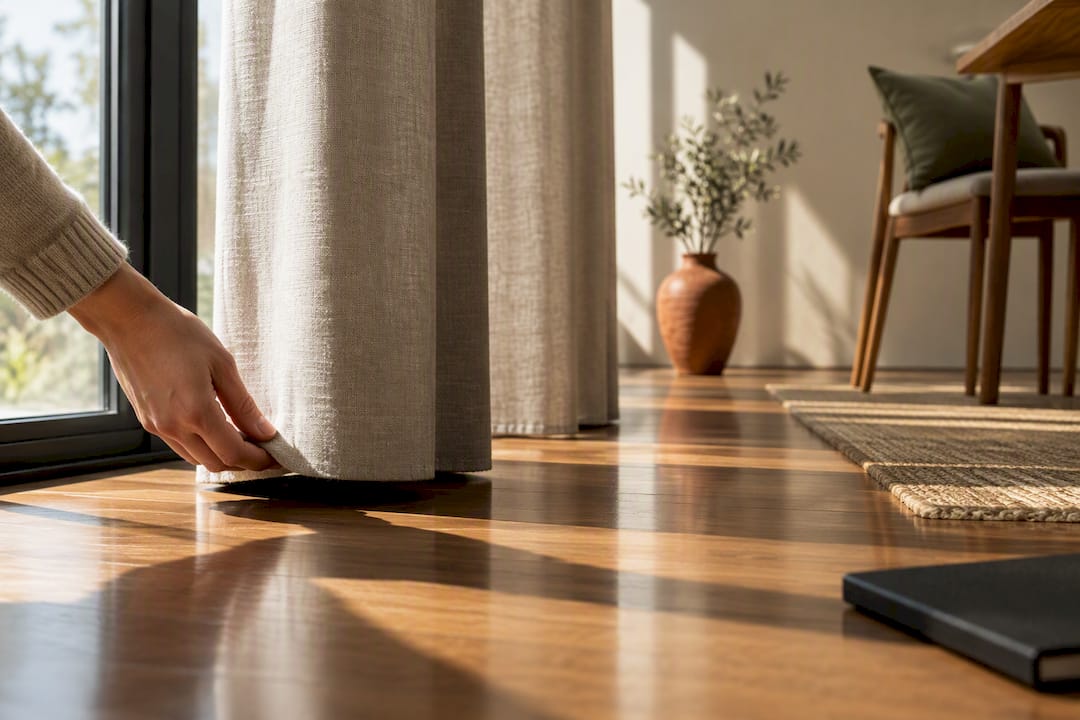
The designer default is floor-length: let your curtains hover a small fraction of an inch above the floor or just kiss it. For formal rooms, puddle a few inches instead, while kitchens and bathrooms work better at sill or apron length. Whatever finish you choose, measure from the actual hanging point (ring, clip, or rod-pocket top) down to the floor, checking three spots across the width before you cut or order.
TL;DR:
- Most curtains should hover 0.25 to 0.5 inches above the floor for practicality and style, with puddles reserved for formal rooms only.
- Always measure from the true hanging point, check three spots across the width, and add or subtract length based on chosen finish before hem or ordering.
- Kitchens and bathrooms need shorter, sill-length or apron-length curtains to avoid damage from moisture, splashes, and heat.
- For wider or oddly shaped windows, buy panels with 1.5 to 2 times the rod width for proper fullness, and consider multiple narrower panels for better folds.
- Mount curtain rods 4 to 8 inches above the window frame, and recalculate the drop from that height to prevent uneven or ill-fitting curtains.
Table of Contents
- What are the designer curtain length rules for each finish?
- How do you measure curtain drop correctly?
- Which curtain length suits kitchens, bathrooms and bay windows?
- How much fabric width and fullness do curtains need?
- How does rod height change the length you need?
- What are the most common curtain length mistakes?
- Why trust this guide from Homable
- The one habit that separates good curtains from bad ones
- Shop curtains and finish the job properly
- Sources
- FAQ
What are the designer curtain length rules for each finish?
Interior designers work with four standard finishes, and each has an exact clearance. Hover sits 0.25 to 0.5 inches off the floor, the safest all-round choice. Kiss just grazes the floor at 0 inches. Break allows 1 to 2 inches of fabric to fold gently, a look borrowed from tailored trousers. Puddle pools 3 to 6 inches of extra fabric on the floor, and designers reserve this for formal rooms where the curtains rarely get disturbed.
The trade-offs matter more than the numbers. A puddle looks luxurious in a dining room or a rarely-used sitting room, but it collects dust, gets kicked by children, chewed by curious pets, and scorched if it drapes anywhere near a radiator. Homes with heavy foot traffic do better with a float finish, which avoids dust build-up and daily wear that a puddle simply cannot dodge.
Here’s the quick reference:
- Hover: 0.25 to 0.5 inches above the floor, best for busy households
- Kiss: exactly floor length, a clean and neutral default
- Break: 1 to 2 inches of soft fold, tailored and forgiving of small errors
- Puddle: 3 to 6 inches of pooled fabric, formal rooms only
Pro Tip: When you’re stuck between two lengths, buy longer and hang higher. A curtain that’s slightly too long can be hemmed or left to break; one that’s too short can’t be fixed without buying fabric to match.
How do you measure curtain drop correctly?
Getting the drop right starts before the tape measure comes out.
- Install or mark the rod first. Curtain length depends entirely on where the rod sits, so fit the bracket or at least mark its final position before measuring anything.
- Decide your finish. Choose hover, kiss, break, or puddle now, because each adds a different amount to the raw floor measurement.
- Measure from the true hanging point. This means the bottom of the ring, the clip, or the top of the rod-pocket, not the rod itself, down to the floor.
- Take three measurements. Check the left, centre, and right of the window, because floors and skirting boards are rarely perfectly level. For a hover or float finish, use the shortest of the three so the curtain never drags.
- Do the maths. If your shortest measurement is 92 inches and you want a 0.5-inch hover, order or hem to 91.5 inches. If you want a 4-inch puddle, add 4 inches instead.
- Bridge the gap between standard sizes. When your ideal number falls between ready-made panel lengths, the safer move is buying the next longer size and hemming down, never rounding down to a shorter panel.
- Run the paper test. Once hung, slip a sheet of paper under the hem. If it slides through freely at a hover finish, or catches slightly at a kiss, your length is correct.
Your basic toolkit is a steel tape measure, a pencil, a spirit level for the rod, and a step stool. The paper test takes thirty seconds and catches mistakes before you’ve committed to a hem.
Which curtain length suits kitchens, bathrooms and bay windows?
Living rooms, bedrooms, and dining rooms almost always look better floor-length. It’s the finish that reads as intentional rather than accidental, and it works whether you choose hover, kiss, or something more dramatic for a formal space.
Kitchens and bathrooms break that rule for good reason. Sill-length or apron-length curtains keep fabric away from sinks, splashes, and hot hobs, and they’re easier to keep clean in a room that generates steam and grease daily. A floor-length curtain next to a kitchen sink is asking for trouble.
Bay windows and rooms with several windows on the same wall need a different kind of discipline: consistency. Keep the rod height and the hem length identical across every window on the same sightline, even if the windows themselves are slightly different sizes. One curtain sitting an inch higher than its neighbour is the sort of thing your eye catches immediately, even if you can’t say why the room looks off.
A few practical cautions worth flagging:
- Never puddle curtains near a radiator; scorching and discolouration happen faster than most people expect.
- Avoid puddles in bathrooms and kitchens, where damp and splashes will ruin fabric quickly.
- In homes with dogs or toddlers, a float finish is more forgiving than a kiss or puddle. Homable’s guide to pet-friendly home decor covers this in more detail if you share your home with an enthusiastic chewer.
How much fabric width and fullness do curtains need?
Length gets most of the attention, but width decides whether curtains look tailored or thin and flat when drawn.
The rule designers lean on is fullness of 1.5 to 2 times the width of the window or the rod, whichever is wider. At 1.5 times you get a reasonably gathered look; at 2 times you get the fuller, more luxurious drape most show homes use.
- Measure your rod width, not just the glass, since the rod usually extends beyond the frame.
- Multiply that width by 1.5 for a modest gather, or by 2 for a fuller look.
- Divide the result by the width of a single panel to work out how many panels you need. Two panels that fall short often look better replaced with three, spreading the fullness more evenly rather than stretching two panels too thin.
- Add stack-back allowance: extend the rod several inches beyond each side of the frame so open curtains sit clear of the glass instead of blocking light.
Pro Tip: If your window is unusually wide, don’t just buy one enormous panel. Two or three narrower panels hang with better folds and are far easier to draw than one heavy, oversized curtain.
How does rod height change the length you need?
Where you mount the rod isn’t a minor detail. It resets the whole calculation.
Designers generally suggest mounting the rod 4 to 8 inches above the window frame, or as close to the ceiling as the room allows. The higher the rod, the taller the window appears, and the longer the curtain needs to be to still reach your chosen finish at the floor.
- Standard rooms: mount 4 to 8 inches above the frame for a balanced look without ordering unusually long panels.
- Low ceilings or a desire for height: mount near the ceiling, but recalculate the drop from that new point rather than reusing an old measurement.
- Bracket spacing: for spans over roughly 60 inches, add a centre support bracket to stop the rod sagging under fuller panels.
- Header style changes where you measure from: eyelet curtains are measured from the bottom of the ring, while rod-pocket styles are measured from the top of the pocket, not the fabric edge.
Get the rod height locked in before you order fabric. Changing it later means re-hemming or replacing curtains entirely.
What are the most common curtain length mistakes?
Most curtain problems trace back to one of three errors, and all three are fixable.
- Too short. This is the single most common mistake and the hardest to disguise. If new curtains fall short, hemming isn’t an option, so budget for longer panels next time and hem down rather than risk buying too little.
- Too narrow. Thin, stretched-looking panels usually mean not enough fullness. Add a centre panel, choose wider ready-made widths, or increase pleating to hit that 1.5 to 2 times multiplier.
- Uneven floors. If one side of the curtain drags and the other floats, you likely measured only once. Check left, centre, and right, then hem to the shortest measurement, or move to a float finish if your home sees heavy daily traffic.
Why trust this guide from Homable
Homable’s contributor Cristiano brings the practical, no-nonsense approach to home styling that runs through Homable’s curtain resources, from the curtain size guide to the full installation workflow. Both cover measuring, hanging, and finishing in more depth than a single article can, and both are built around the same designer principles used here: measure from the hanging point, check more than once, and hang higher rather than shorter.
The one habit that separates good curtains from bad ones
Most curtain advice fixates on the wrong number. People obsess over whether to hover, kiss, or puddle, when the real failure point is almost always the measuring, not the style choice.
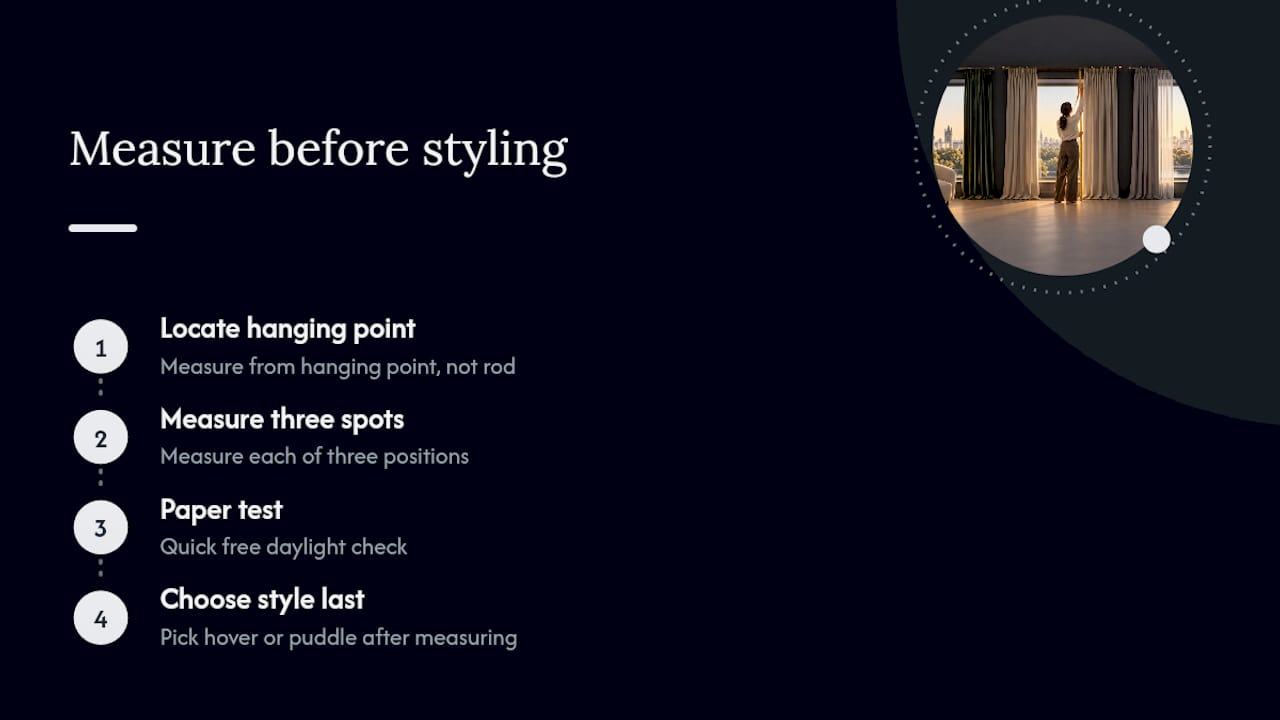
The habit that actually prevents disasters is the three-spot measurement, taken from the true hanging point rather than the rod itself. Skip that step, and it doesn’t matter whether you wanted a hover or a puddle. You’ll get an uneven, badly-fitting curtain regardless.
The paper test deserves more attention than it gets, too. It costs nothing, takes seconds, and catches the kind of small error that’s invisible on a tape measure but obvious the moment curtains are hung and lit by daylight. If there’s one thing worth prioritising over any style debate, it’s this: get the hanging point right, measure three times, then worry about hover versus puddle. Function first, aesthetics second. Readers who follow that order rarely need to rehem anything.
— Cristiano
Shop curtains and finish the job properly
Homable stocks ready-made curtain options, including natural bamboo styles, so you can put these length rules into practice without waiting on a bespoke order. Browse the curtain collection for panels like the bamboo curtain in 100x220cm or the 90x200cm bamboo curtain, both practical starting points if your measurements land close to a standard size.

If your ideal drop falls between sizes, hem down from the next size up rather than settling for a length that’s too short, and lean on the curtain size guide for the full mm-to-inch conversion tables. Product ranges are built around this kind of practical decision making, offering room-ready lengths at accessible prices. Check current collections and measure your window carefully, then order a size that matches your hanging point, not just your window frame.
Sources
- Curtain length rule: Where your curtains should actually end | One Home Therapy
- Curtain length guide: How long should curtains be? | Decoriosity
- This simple ‘paper test’ will guarantee your curtains are always the right length | RealSimple
FAQ
What is the proper length for curtains to hang?
Most rooms look best with curtains that hover a small fraction of an inch above the floor or just kiss it at 0 inches, following the standard hover and kiss definitions designers use. Formal rooms can go longer with a several inches puddle, while kitchens and bathrooms usually work better at sill length.
What are the standard curtain lengths sold ready-made?
Ready-made panels commonly come in 63, 84, 96, 108, and 120 inches. If your measurement falls between two of these, buy a longer size and hem it if needed rather than choosing a shorter panel that risks falling too short.
What are the most common curtain hanging mistakes?
The biggest mistakes are hanging curtains too short, choosing panels too narrow for proper fullness, and measuring only once on an uneven floor. Fixing them means buying longer panels, adding fullness with a centre panel or extra pleating, and always taking three measurements across the width before hemming.
Should 84 inch curtains touch the floor?
An 84-inch panel touches the floor only if your ceiling-to-floor drop happens to match that measurement exactly, which is common in standard UK rooms with lower ceilings. Always measure from the actual hanging point rather than assuming a standard size will fit your window without checking.
How high should curtain rods be mounted?
Rods generally sit 4 to 8 inches above the window frame, or as close to the ceiling as the room allows for a taller effect. Mounting higher means measuring the drop again from that new point, since it changes the length of panel you need to buy.