Cart
0
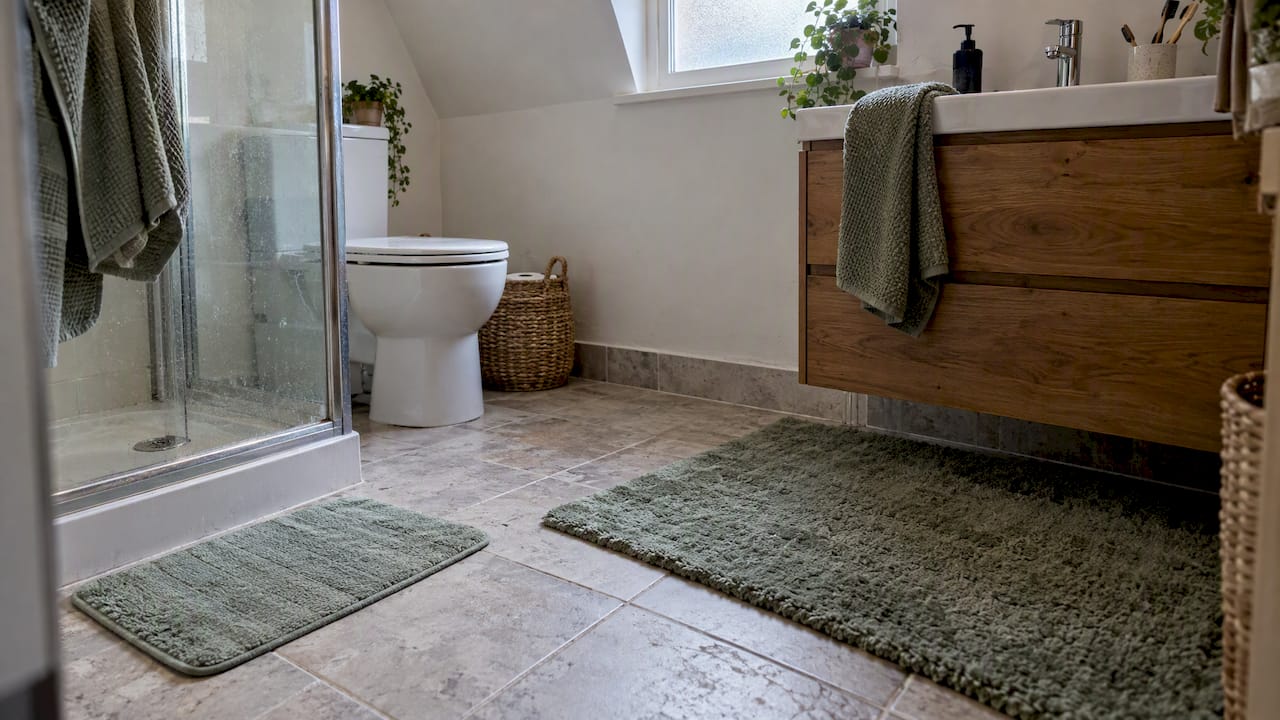
A bath mat is for wet-foot safety: an absorbent, non-slip landing for stepping out of the shower or bath. A bath rug is for comfort and style: a larger, plusher floor covering for standing areas away from direct splashing. Labelling varies between retailers, so check construction and backing rather than trusting the product name, and look for references to BS 8445 or SATRA testing when safety matters.
TL;DR:
- Retail labels vary, so inspect backing, absorbency, pile, and care instructions; rubber or latex backing and washable construction matter more than the product name.
- Under BS 8445:2012, a mat needs an angle of insecurity of 20 degrees to earn a slip resistant rating; 14 to 19 degrees means moderate grip.
- Cotton or microfibre may suit contact with wet feet, while memory foam and deep pile dry more slowly; reserve bamboo, jute, and flatweave for lighter exposure.
- Place an absorbent mat at the shower or bath exit, then use a rug by the vanity or along a wall away from splashes.
- Air mats fully after washing and between uses, and follow care labels because heat can damage rubber backing while trapped moisture encourages mold and odor.
Table of Contents
- What separates a bath mat from a bath rug?
- Which materials dry fastest and which feel best underfoot?
- How big should a bath mat be and where should it go?
- What do BS 8445 and SATRA actually require for slip resistance?
- How do you wash and dry mats without ruining them?
- A simple checklist: safety first, then style
- How long do mats and rugs actually last?
- Does bathroom humidity change how materials perform?
- Are natural or synthetic materials better for the environment?
- Which styles suit which bathroom themes?
- What should you expect to pay for each type?
- Bath mat versus bath rug at a glance
- What do most bathroom shoppers actually choose?
- Where to find mats and rugs that match this guide
- FAQ
- Sources
- Standards and test bodies to check for safety and care claims
What separates a bath mat from a bath rug?
A bath mat is typically small, made from absorbent fibres or ribbed rubber, and sits right where wet feet land after a shower or bath. Its job is to soak up water fast and grip the floor so you do not slip. A bath rug is usually larger, softer underfoot, and chosen for how it looks rather than how quickly it dries. It often sits in front of a vanity or runs along a wall rather than directly in the splash zone.
The trouble is that retailers use these words loosely. A product labelled “bath rug” might have a rubber backing and absorbent pile that make it perfectly suited to wet feet, while a “bath mat” might be a thin decorative piece with no grip at all. As SATRA notes, construction, backing and care instructions tell you far more about intended use than the name on the packaging.
Before buying, scan the label for:
- Backing material: rubber or latex suggests wet-area use; a woven or fabric backing suggests décor.
- Absorbency claims: “quick-dry” or “super absorbent” points to a functional mat.
- Care instructions: machine-washable items are built for frequent wetting; dry-clean-only items are not.
- Thickness and pile: low pile dries faster; deep pile favours comfort over drainage.
Which materials dry fastest and which feel best underfoot?
The fabric and backing determine whether a floor covering handles water well or simply feels good to stand on.
Cotton and microfibre are common choices for wet-foot mats. Their absorbency, drying time and care requirements vary by product, so check the construction and care instructions. Memory foam and deep-pile rugs sit at the other end of the spectrum: they feel plush and cushioned, but the dense structure traps moisture rather than releasing it. Review testing found that memory foam and some plush cotton rugs can feel soft but are often less absorbent and slower to dry than mats built specifically for wet-foot use, which makes them better suited to areas with less direct splashing.
Rubber and synthetic backings can provide grip. Check the product’s construction and care instructions when choosing a mat for an area where feet will be wet. Bamboo, jute and woven flatweave pieces sit in the decorative camp: they dry quickly because they do not hold water in dense fibres, but they offer less cushioning and are better suited to zones with lighter water exposure, such as beside a vanity.
- Cotton and microfibre: may suit wet-foot contact, depending on the product’s construction and care instructions.
- Memory foam and deep pile: comfortable but slower-drying, best kept away from heavy splashing.
- Rubber and synthetic backings: can provide grip; follow the product’s care instructions.
- Bamboo, jute and flatweave: decorative options that may suit areas with less direct water exposure.
Pro Tip: If you want both safety and softness, choose an absorbent top layer paired with a tested non-slip backing and easy-care washing instructions rather than trading one quality for the other.
How big should a bath mat be and where should it go?
Size and placement matter as much as material. A mat that is too small leaves part of your foot on cold tile; one placed in the wrong spot does nothing for safety.
As a rule, a bath mat belongs directly at the exit point of a shower or bath, where water first lands on the floor. A smaller mat can sit in front of the vanity if you want a second landing zone, and a bath rug works well for general floor coverage in a larger bathroom where warmth and style matter more than wet-foot protection.
To measure for the right fit:
- Measure the width of your bath or shower opening and add a few centimetres on each side for coverage.
- Account for door swing so the mat does not catch on a shower door or bath screen.
- Choose a mat that provides enough standing area beside the fixture without overwhelming the floor.
Our bath mat size guide walks through this measuring routine in more detail if you want to avoid returns.
What do BS 8445 and SATRA actually require for slip resistance?
Slip resistance is not a matter of opinion. In the UK, BS 8445:2012 sets out test methods and classifications for bath and shower mats, including a ramp-based method that measures the angle at which a test subject loses footing.
A mat tested under BS 8445:2012 needs an angle of insecurity of 20 degrees or greater to be classed “slip resistant”, while a result of 14 to 19 degrees indicates only moderate, comfort-level grip rather than genuine slip resistance. That distinction is easy to miss when a product simply says “non-slip” on the packaging.
“Anti-slip” and “non-slip” labels have historically lacked a formally agreed assessment method, so shoppers should look for meaningful test information and instructions rather than treating marketing language as proof of safety.
SATRA
Before trusting a mat near water, check for:
- A stated backing type, such as rubber or latex.
- A reference to BS 8445 testing or a documented angle of insecurity.
- A standing area suited to the fixture it sits beside.
- Care instructions for preserving the backing and grip.
How do you wash and dry mats without ruining them?
Care routines differ sharply by material, and getting it wrong is the fastest way to end up with a mouldy or flattened mat.
Care instructions vary by material and product. Check the label before washing cotton, microfibre, wool or jute mats, since some may need gentler cleaning to protect their fibres and backing.
Drying matters just as much as washing. Air mats out fully after each wash and, where possible, after daily use, standing them upright or draping them over a rail rather than leaving them flat on the floor. Tumble-drying is fine only when the care label permits it, since heat can break down rubber backings. Avoid folding a damp mat and storing it away: trapped moisture breeds mould and odour within days.
- Follow the care label when washing cotton, microfibre, wool, jute and other natural-fibre mats.
- Air-dry mats thoroughly after washing to help avoid trapped moisture.
- Replace a mat once the backing cracks, flattens, or odour persists after washing.
A simple checklist: safety first, then style
Choosing between a mat and a rug gets easier once you separate the decision into clear steps rather than judging by looks alone.
- Decide the job first. If the covering sits where feet will be wet, you need a safety-focused mat. If it sits in a dry zone for comfort or warmth, a rug is the better fit.
- Match material and backing to that job. For wet-foot areas, pick absorbent fabric paired with a tested non-slip backing. For comfort zones, prioritise pile depth, size and colour instead.
- Check the washcare and safety documentation. Confirm the item is machine-washable if it will see frequent wetting, and look for any reference to recognised slip testing or clear care labelling before buying.
Pro Tip: When you are unsure which category a product falls into, treat anything placed near a shower or bath as a safety item and prioritise a tested non-slip backing over how it looks.
How long do mats and rugs actually last?
Durability depends far more on how often a covering gets wet than on its price tag. A mat used at a shower exit may show wear in its backing before the fabric fails. Check the backing for damage and follow the product’s care instructions.
A bath rug in a drier zone may last longer because it is exposed to less direct water. Deep-pile and memory foam rugs may flatten with use, depending on their construction and care.
Natural fibres like jute and bamboo may suit areas with less direct water exposure; check the product’s care instructions before using them in wet-foot areas. Rubber-backed cotton or microfibre mats may suit wet areas, but durability depends on the product and how its backing is cared for. Matching the material to its actual usage conditions, rather than buying on looks alone, is the single biggest factor in how long any floor covering lasts.
Does bathroom humidity change how materials perform?
Bathrooms are among the most humid rooms in a home, and that ambient moisture affects floor coverings even when they are not directly stepped on with wet feet. Humidity and ventilation can affect how quickly a mat dries, so a mat may stay damp longer in a steamy, poorly ventilated bathroom.
This matters most for deep-pile and foam materials, which already dry slowly. In a humid bathroom, slow drying may contribute to mould and musty odours developing within the fibres. Natural materials like jute and bamboo generally cope better with ambient humidity than with direct soaking, since they are designed to release moisture rather than absorb it.
Good ventilation, whether from an extractor fan or an open window, makes a meaningful difference to how well any material performs over time. If your bathroom tends to stay steamy after showers, leaning towards quick-dry materials and improving airflow will do more for hygiene than switching brands.
Are natural or synthetic materials better for the environment?
Material choice carries environmental trade-offs worth weighing alongside function and style. Natural fibres such as bamboo and jute are renewable and biodegradable, which appeals to anyone trying to reduce the long-term footprint of home accessories. Bamboo is a natural fibre that may appeal to shoppers considering the environmental trade-offs of bathroom materials.
Cotton, especially organic cotton, is also biodegradable, though conventional cotton farming can be resource-intensive. Synthetic microfibre and rubber-backed mats may last well in wet conditions, but their end-of-life impacts differ from those of natural fibres.
There is no single correct answer here: a durable synthetic mat that lasts years may have a smaller overall footprint than replacing a natural-fibre mat repeatedly because it cannot handle constant wet-foot use. Choosing a material suited to its actual job, rather than buying on sustainability branding alone, tends to deliver the best outcome both practically and environmentally.

Which styles suit which bathroom themes?
Bath mats and rugs do more than serve a function: they are often the easiest way to tie a bathroom’s look together without a renovation. A clean, minimalist bathroom may suit a mat with a simple texture and neutral tones.
Natural and coastal-themed bathrooms pair well with bamboo or jute rugs, whose woven texture and earthy colour echo the materials often used elsewhere in that style, such as wood accents or stone tiling. Our hand-woven jute bathroom mat fits this aesthetic while still offering a non-slip construction.
For a softer, more traditional look, plush cotton rugs in warmer tones or patterns suit bathrooms built around comfort rather than minimalism. Bamboo mats bridge both worlds reasonably well, since their natural tone works in Scandinavian-inspired spaces as easily as in more rustic settings; our bamboo bath mat collection reflects that versatility. Matching material to theme is ultimately a styling choice, but it is one that works best once the safety requirements of the wet zone are already settled.

What should you expect to pay for each type?
Price varies by material, size and construction rather than by whether something is called a mat or a rug. Prices for cotton and microfibre mats vary with the product’s construction and retailer. Rubber-backed mats built specifically for wet-area safety often cost a little more, since the backing adds a manufacturing step beyond a plain fabric pad.
Prices for natural-fibre rugs, including bamboo and jute, vary with their construction and retailer. Prices for deep-pile and memory foam rugs vary with their size, density and retailer.
Value for money ultimately depends on matching the product to its job rather than chasing the lowest price. A cheap decorative mat placed at a wet shower exit will likely need replacing far sooner than a slightly pricier mat built with a tested non-slip backing, making the latter the better long-term value despite the higher upfront cost.
Bath mat versus bath rug at a glance
| Factor | Bath mat | Bath rug |
|---|---|---|
| Primary purpose | Wet-foot safety | Comfort and décor |
| Typical placement | Shower or bath exit | Vanity area or general floor |
| Common backing | Rubber or latex | Fabric or woven backing |
| Drying speed | Varies by product | Varies by product, particularly with construction |
| Washcare | Check the care label | Check the care label |
| Best for | Direct water exposure | Low-exposure, styling zones |
Pros of prioritising a mat include reliable grip and fast drying, with the trade-off being a smaller footprint and less plush feel. Pros of prioritising a rug include greater comfort and stronger decorative impact, with the trade-off being slower drying and less reliable slip resistance in wet zones. Choosing correctly usually means using both: a tested mat where feet land wet, and a rug where the floor just needs to look and feel good.
What do most bathroom shoppers actually choose?
For a shower exit, consider an absorbent mat with suitable backing and care instructions. For a vanity area or guest bathroom, bamboo or woven rugs may suit the look. Check the retailer’s delivery terms and payment information when placing an order. Bathroom collections can group both types together if you want to compare styles side by side.
Where to find mats and rugs that match this guide
Once you know which job you are solving for, finding the right piece is straightforward. For wet-foot safety, our bath mat sets combine absorbent fabric with non-slip backing in one package. For style and comfort, our natural bamboo rug and wider bamboo rugs collection suit vanity areas and general bathroom floors alike.
- Pair a non-slip mat at the shower exit with a decorative rug elsewhere for the best of both.
- Check the retailer’s delivery terms and payment information before ordering.
- Our bath linen collection offers coordinated sets if you prefer a matched look throughout.
Browse the full range at Homable to find the combination that fits your bathroom.
FAQ
Is it a good idea to use a rug as a bath mat?
A rug may suit wet-foot use if its construction and backing are appropriate, but check the product’s test information and care instructions rather than relying on its label. Check the backing, care label and test information rather than assuming a rug is suitable for a shower exit simply because it is placed on the floor.
What is the difference between a rug and a mat?
A mat is often chosen for function, while a rug is often chosen for comfort and appearance; product size, absorbency and backing vary. In bathrooms, this translates to mats sitting at wet-foot exit points and rugs covering drier areas for style.
Do people still use rugs in their bathrooms?
Yes, bath rugs remain common for adding warmth and style to bathroom floors, particularly in front of a vanity or along a wall away from direct splashing. They are typically paired with a dedicated non-slip mat at the shower or bath exit rather than used alone in wet zones.
Are bath rugs meant to get wet?
Whether a bath rug can handle dampness or splashes depends on its construction and care instructions. For areas that get wet regularly, such as a shower exit, a mat with a tested non-slip backing and quick-drying fabric is the safer choice.
Sources
- Avoiding accidents with bath and shower mats
- BS 8445:2012 | 31 Mar 2012 | BSI Knowledge
- 16 Best Bath Mats of 2026 - Reviewed
Standards and test bodies to check for safety and care claims
For slip-resistance claims, check a mat against BS 8445:2012 and SATRA’s guidance on anti-slip labelling. Independent product reviews and the item’s own washcare label offer useful secondary checks before you buy.