Cart
0
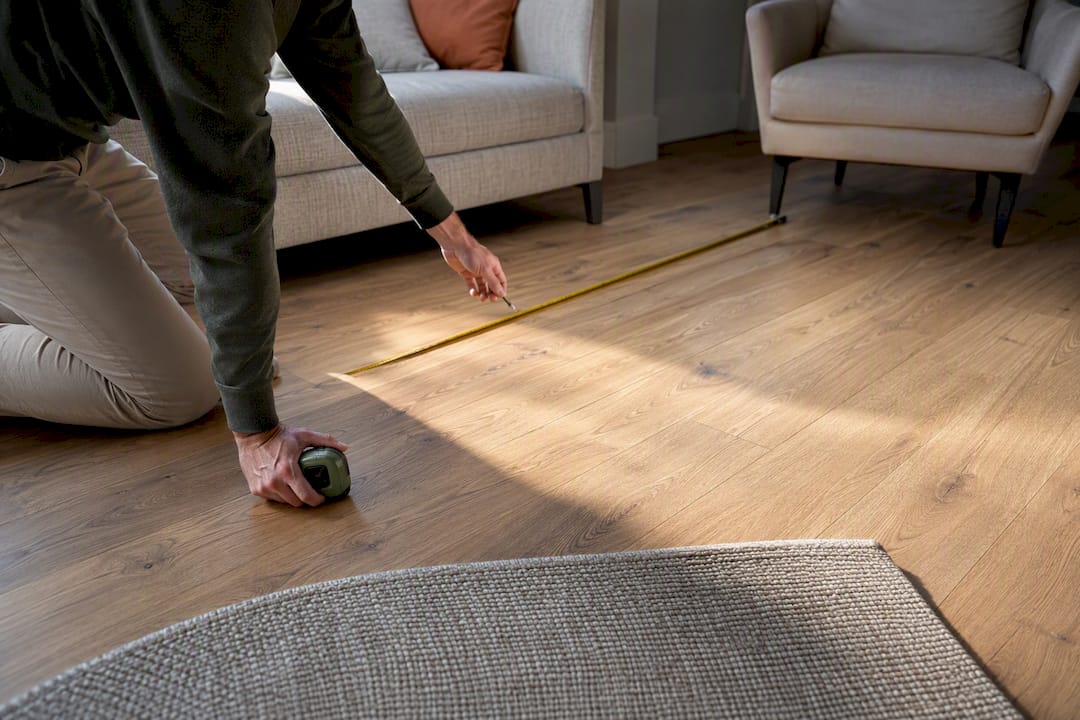
Place a rug large enough to anchor your seating, ideally one that takes at least the front legs of your sofa, or all furniture legs when the room allows it. Three placement options cover almost every living room: all legs on, front legs on, and all legs off. Which one works for you depends on room size, sofa scale, and how much floor you want to show.
TL;DR:
- Use a rug at least 20 to 30 centimeters beyond the sides of the sofa for proper framing, and size up if between options to ensure it looks intentional.
- Place the rug so that the sofa’s front legs are on it with 15 to 30 centimeters of visible rug beyond the sides for a balanced appearance.
- Align rectangular rugs with the room’s main axis or focal point, leaving at least 45 to 60 centimeters of clearance for traffic flow.
- The tape-test method provides a quick, cost-effective way to verify rug size before purchasing by visualizing the layout in the actual room.
- Secure rugs with appropriate underlay on hard floors or carpet, and rotate regularly to prevent movement and maintain appearance over time.
Table of Contents
- How do you choose the right rug size for a living room?
- Should the sofa sit on the rug or in front of it?
- How should you orient a rug in your living room?
- What’s the quickest way to check a rug size before buying?
- How do you style a rug so it looks intentional?
- How do you keep a rug secure and looking good over time?
- Design rules are guidelines, not gospel
- Where to find rugs that fit your layout
- Sources
- FAQ
How do you choose the right rug size for a living room?
Start by measuring the seating area, not just the sofa. Pull out a tape measure and note the total width your sofa and chairs occupy, including any side tables tucked into the arrangement, then add margin on every side.
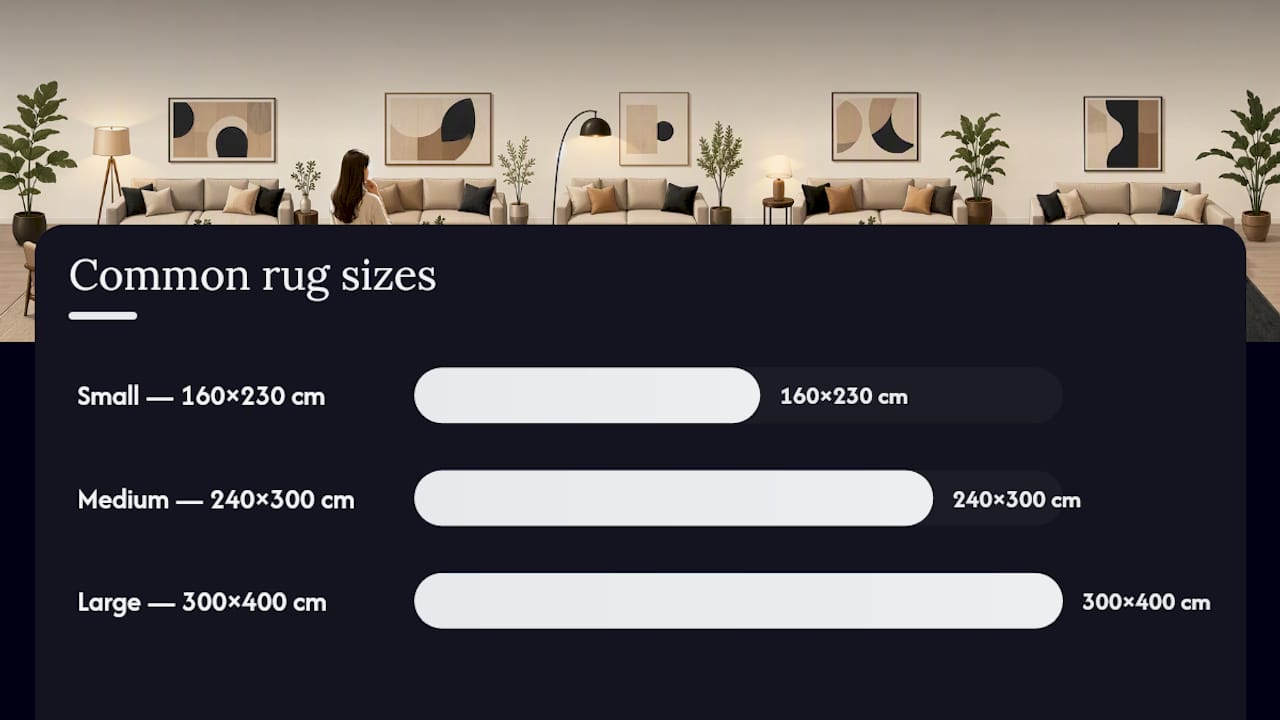
The most common guidance from designers is that a rug should extend at least 20 to 30 centimetres beyond the sides of a sofa to frame the seating properly and stop the layout looking pinched. For a typical three-seater sofa around 200 centimetres wide, that pushes you towards a rug in the 240 x 300 centimetre range once you factor in an armchair or two facing it. Smaller snugs might work with a 160 x 230 centimetre rug; larger open-plan living rooms often need 300 x 400 centimetre or bigger.
Floor-to-wall margins matter too. Leaving roughly 10 to 40 centimetres of bare floor between the rug edge and the wall keeps the room feeling grounded rather than cramped, with the wider margin suiting larger rooms where you want an airier look.
- Measure the full seating footprint, not just the sofa cushions
- Add 20 to 30cm of rug beyond each side of the sofa as a baseline
- Leave 10 to 40cm of floor visible between rug and wall, scaling with room size
- When two sizes seem close, size up rather than down
Pro Tip: If you’re stuck between two rug sizes, always take the larger one. A rug that’s slightly too big reads as intentional; one that’s too small makes the whole room look unfinished, no matter how nice the sofa is.
Should the sofa sit on the rug or in front of it?
There are three workable layouts, and none of them is wrong, they just suit different rooms.
All legs on the rug is the most cohesive look. Every piece of seating furniture sits fully on the rug, which visually ties the whole grouping together. It needs a genuinely large rug, usually 280 centimetres or more on the longest side, so smaller living rooms often can’t pull it off without the rug swallowing the floor.
Front legs on is the layout most people end up using, and for good reason. The front legs of the sofa and chairs rest on the rug while the back legs stay on bare floor, with at least 15 to 30 centimetres of rug visible beyond the sofa’s sides. It grips the furniture visually without demanding an oversized rug, which makes it the easiest option for mid-sized rooms.
All legs off works only with a genuinely generous rug that fills most of the seating footprint, or as a deliberate accent piece under a coffee table, never as a rug that’s simply too small for the job. Design experts frame these as flexible guidelines rather than fixed rules, the goal is a unified seating area, not slavish adherence to one method.
- All legs on: most cohesive, needs a large rug
- Front legs on: the practical middle ground for most rooms
- All legs off: only with a full-footprint rug or as a clear accent
Pro Tip: Whatever you pick, commit to it across the whole seating group. A sofa with all legs on and an armchair with all legs off in the same layout reads as an accident, not a choice.
How should you orient a rug in your living room?
Orientation usually follows the room’s strongest axis. Align a rectangular rug with the longest wall or the main seating line unless a fireplace, bay window, or television wall pulls the eye somewhere else, in which case the rug should point towards that focal feature instead.
Rectangular rugs suit square-on furniture arrangements against a wall. Round rugs work better under a circular coffee table or in a conversation-style layout with chairs angled inward, where a rectangle would fight the shapes around it.
- Align the rug with the seating axis or the room’s longest wall
- Point the rug towards a fireplace or TV wall if that’s the dominant focal point
- Leave at least 45 to 60cm of walkway clearance around rug edges in traffic routes
- Keep coffee tables centred on the rug with roughly equal margin on all sides
What’s the quickest way to check a rug size before buying?
Guessing rarely works, even experienced decorators pull out tape before committing to a rug. The fastest and cheapest way to avoid a costly return is a simple visual test.
- Mark out the exact footprint of the rug you’re considering on the floor using painter’s tape, corner to corner.
- Push your sofa and chairs into their normal positions around the taped outline.
- Sit down. View the layout from every seat, not just standing in the doorway.
- Photograph it from a few angles, images often reveal a too-small rug faster than the eye does in the room.
- If you’re torn between two sizes, tape both out and go with the larger.
This painter’s-tape method takes about ten minutes and settles arguments about “will it fit” before any money changes hands. Homable’s own tape-test walkthrough runs through common UK sofa dimensions if you want a starting point rather than measuring from scratch.
Pro Tip: Do the tape test at the time of day you actually use the room. Rugs read differently under evening lamp light than they do in midday sun through the window.
How do you style a rug so it looks intentional?
A rug earns its place through pattern, colour, and texture, not just size. Layering a textured neutral rug under a smaller patterned one adds depth and protects the base layer from wear, a trick borrowed straight from hotel lobbies and boutique interiors.
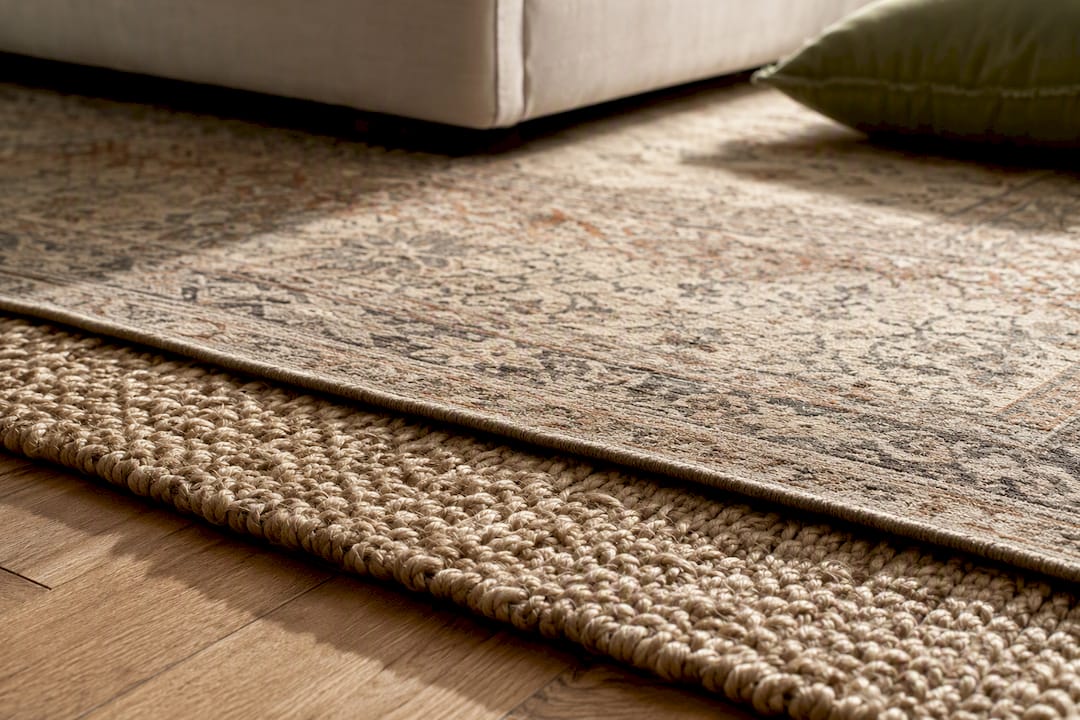
Match pattern scale to room size: a busy, small-scale print can look chaotic across a large floor, while an oversized geometric print can overwhelm a compact snug. Neutrals ground bold sofa fabrics; bolder rugs work best when the furniture around them stays plain.
Designers routinely warn against mixing placement styles within one seating group, since an inconsistent approach is one of the fastest ways to make an otherwise well-chosen rug look like an afterthought.
- Layer a patterned rug over a larger neutral one for depth and protection
- Scale pattern size to the room, not just to personal taste
- Use one dominant colour from the rug elsewhere in the room (cushions, throws) to tie the scheme together
- Keep the same placement logic across every piece of seating in the group
For colour pairing specifically, Homable’s rug colour checklist is worth a look before you commit to anything bold.
How do you keep a rug secure and looking good over time?
Movement and curling edges are the two most common complaints, and both are solvable with the right underlay. On hard floors, a rubber-backed anti-slip underlay stops sliding; on carpet, a grip-mesh underlay keeps the rug flat rather than bunching against the pile.
Rug underlay and grippers are recommended for both flooring types, for safety on hard floors and to prevent rucking on carpet. Check clearance at doors before finalising position, a rug that catches on a door swing is a trip hazard waiting to happen.
- Use rubber-backed underlay on hardwood, tile, or laminate
- Use grip-mesh underlay on carpet to stop bunching
- Vacuum weekly and spot-clean spills immediately
- Rotate the rug every six months for even wear
Pro Tip: If your rug won’t lie flat near a doorway, trim the underlay back slightly rather than the rug itself. It’s a five-minute fix that solves most tripping complaints. For carpeted rooms specifically, Homable’s guide on securing a rug on carpet covers the fix in more detail.
Design rules are guidelines, not gospel
Every measurement in this piece is a starting point, not a boundary. The rooms that work best are the ones where the rug placement matches how people actually sit and move, not where someone followed a rule to the centimetre.
If there’s one thing worth committing to, it’s consistency. Pick front-legs-on or all-legs-on and apply it across the whole seating group rather than mixing approaches out of indecision. That single choice does more for a room’s cohesion than any specific rug dimension. Homable’s product range and its tape-test guidance are built around that same idea: measure with intent, then commit.
— Cristiano
Where to find rugs that fit your layout
A curated range of bamboo and neutral rugs designed to work across all three layouts described above is available, without the guesswork of trawling endless generic catalogues.

Run the painter’s-tape test first using the step-by-step walkthrough, then browse Homable’s rug and home accessory collection to find a size and texture that matches your measurements. Orders over £100 ship free, and the range includes natural bamboo weaves alongside softer neutral options for layering. Once you’ve settled on dimensions, head to the Homable homepage to check current stock and get your new rug on its way.
Sources
- Rug placement: A designer’s guide to layout and size | King Living
- How to choose the right rug size for your living room | Martha Stewart
- Should a sofa sit on the area rug? Experts weigh in | Livingetc
- 11 area rug rules and how to break them | Houzz
FAQ
What is the rule for rugs in a living room?
The most common guideline is to let a rug extend at least 20 to 30 centimetres beyond each side of the sofa, either taking the front legs or all the legs, so the seating area reads as one connected group rather than several floating pieces.
What is the 2/3 rule for living rooms?
This isn’t a standard, fixed rule in most designer guidance, the more consistent principle is proportional coverage: the rug should span most of the seating group’s footprint rather than sitting as an isolated island in the middle of the floor.
What is the rug rule for sofas?
Front legs on the rug with 15 to 30 centimetres visible beyond the sofa’s sides is the most widely used approach, since it visually anchors the sofa without requiring an oversized rug.
What are the trends for living room rugs in 2026?
Layered neutral bases topped with a smaller textured or patterned rug are increasingly popular, alongside natural weaves like bamboo, which suit the current shift towards warmer, texture-led living rooms. A bamboo rug range reflects that same move towards natural materials.
Should all four sofa legs be on the rug or off it?
Either works, all four legs on suits larger rooms with a big enough rug, while all four legs off suits a smaller accent rug under a coffee table, but mixing the two styles within one seating group tends to look unplanned.