Cart
0
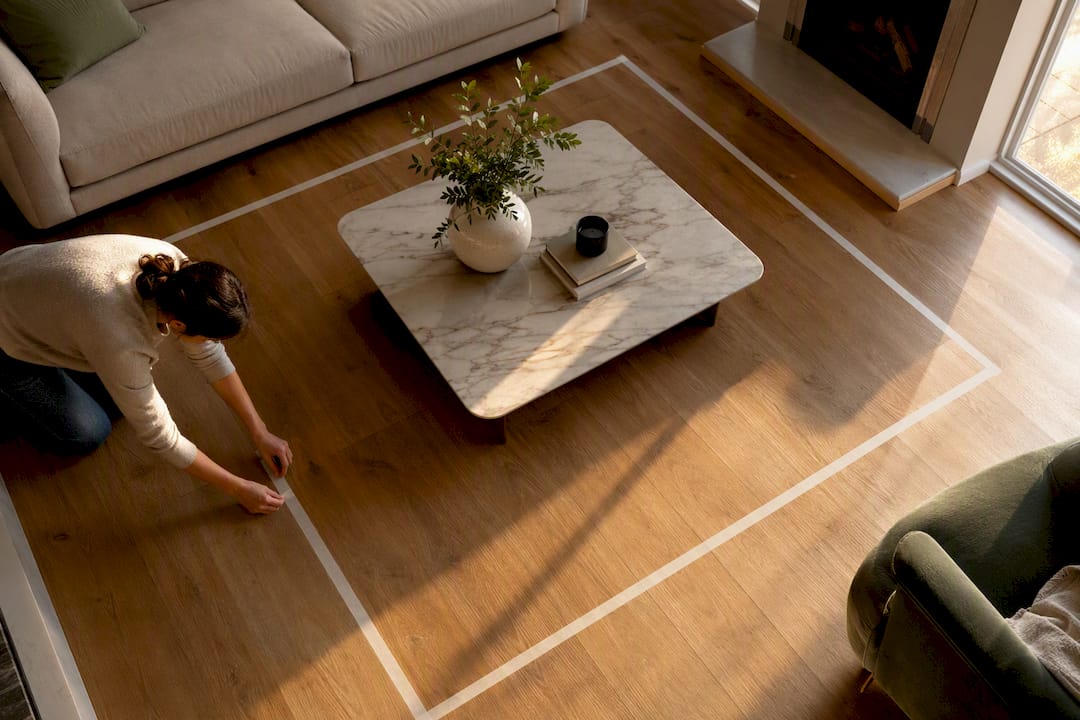
Size your rug to the seating group, not the room, and when you’re torn between two sizes, buy the larger one. Most UK living rooms typically use a few common rug sizes, and the fastest way to confirm which one works for you is to tape the outline straight onto the floor before you order anything.
TL;DR:
- Always measure the seating group’s shape after final arrangement, adding 30 to 45cm of clear floor space on each side before choosing a rug size.
- Opt for a slightly larger rug when torn between sizes, as it appears intentional; avoid undersized rugs, which look like mistakes.
- Use taped outlines to test rug fit in your space for a day or two, ensuring circulation and furniture placement work well before purchasing.
- Standard rug sizes from 120x170cm to 305x425cm suit different room types, but matching the rug width closely to the sofa’s width is crucial.
- For open-plan rooms, define seating zones with a 305x425cm rug or multiple rugs, rather than stretching one rug across the entire floor.
Table of Contents
- What size rug do you need for your living room?
- How do you measure the seating group before buying?
- Which rug placement suits your room best?
- What are the standard rug sizes and what do they suit?
- Sofa, coffee table and circulation: a quick compatibility check
- How Homable helps you find the right rug size
- Does rug texture change how a room feels?
- Which rug materials actually hold up in a living room?
- Getting the balance right between size and traffic flow
- Why the size-up rule beats most of the advice you’ll read online
- Ready to measure, tape and shop with confidence?
- Sources
What size rug do you need for your living room?
The room number on your floor plan matters less than the footprint of your sofa, chairs and coffee table. That said, most people want a rough starting point before they start measuring properly, so here’s how room size typically pairs with rug size in UK homes.
- Small room (up to around 3.5m x 3.5m): 120×170cm or 160×230cm, usually with a front-legs-on layout to avoid swallowing the floor.
- Standard living room (roughly 3.5m to 4.5m across): 160×230cm or 200×290cm, which covers most three-piece suites comfortably.
- Medium to large room (4.5m to 5.5m): 200×290cm or 245×305cm, giving enough spread for all legs on the rug.
- Large room (over 5.5m): 275×365cm, the size most design guides point to for bigger footprints or an all-legs-on arrangement.
- Open plan or L shaped living space: 305×425cm, or two rugs used to zone the seating area from the dining or walkway space.
Move up a size if you’ve got a sectional sofa, a chunky pattern that needs room to breathe, or an open-plan layout where a small rug will look like an afterthought floating in the middle of the floor. Move down only if the room is genuinely tight and a bigger rug would block doors or leave no walking space at all. If you’re stuck between two, the size-up rule holds. A rug that’s slightly too big reads as a deliberate choice; one that’s too small looks like it arrived by accident.
How do you measure the seating group before buying?
Forget the room dimensions on your floor plan. What matters is the shape your furniture actually makes once it’s arranged the way you want to live with it.
- Push the sofa, armchairs and coffee table into their final positions first, not where they happen to be sitting now.
- Mark the outer edges of that seating group with masking tape on the floor, treating it as one combined shape.
- Measure the length and width of that shape, then add roughly 30 to 45cm of visible floor on each side for the rug to breathe into.
- Decide whether you want all furniture legs sitting on the rug or just the front legs, since that changes the target size by a fair margin.
- Round up to the nearest standard size rather than down, especially if the measurement falls awkwardly between two.
An all legs on layout needs a noticeably bigger rug than a front legs on one, because every piece of furniture has to sit fully within the rug’s edges rather than just touching it.
Pro Tip: Once you’ve taped out a candidate size, live with it for a day or two before you order. Walk round it, sit on the sofa, glance at it in the evening light. Taped outlines catch problems that a tape measure alone never will, and it’s a habit worth borrowing from professional stagers.
Which rug placement suits your room best?
There are three ways to sit furniture on a rug, and each one calls for a different size.
- All legs on: every piece of seating furniture sits fully on the rug. This needs the biggest rug of the three but gives the most cohesive, grounded look, and it’s the go-to for larger or open-plan rooms.
- Front legs on: only the front legs of the sofa and chairs touch the rug, with the back legs on bare floor. This is the most forgiving option for medium and smaller rooms because it works with a wide range of sizes.
- Coffee table only: a smaller rug sits just under the coffee table, framed by the seating around it rather than under it. This suits tight rooms or a secondary seating zone, but it can look stranded in a large space.
Whichever you choose, aim to leave around 30 to 45cm of exposed floor between the rug’s edge and the wall. Go narrower in a small room, wider in a big one. Skip the border entirely and a room starts to feel like the rug was cut to fit rather than chosen for it.
In a small flat, front legs on with a slightly larger rug than you’d expect usually beats coffee-table-only, since it makes the room read bigger rather than chopped up. Layering a smaller patterned rug over a large neutral jute one is also a decent workaround if you love a bold design but the room is genuinely too tight for it at full size.
What are the standard rug sizes and what do they suit?
Retailer listings tend to use the same handful of metric sizes again and again, so it helps to know what each one is actually built for.
- 120×170cm: accent rug for a small snug, a reading corner, or layered in front of a fireplace rather than under the whole seating group.
- 150×215cm: compact living rooms with a two-seater sofa and a single armchair.
- 160×230cm: the entry point for most three-piece suites in a standard UK terrace or flat living room.
- 200×290cm: the size that suits the widest range of British living rooms, comfortably fitting a three-seater sofa with two armchairs in a front-legs-on layout.
- 245×305cm: medium to large rooms where you want all legs on, or a slightly generous front-legs-on fit.
- 275×365cm: larger living rooms, L-shaped sectionals, or all-legs-on layouts with a coffee table and side chairs included.
- 305×425cm: open-plan spaces or rooms that need to visually separate a seating zone from a dining or hallway area.
The rule that trips people up most is width. Match the rug’s width to the sofa’s width before you worry about depth, aiming for the rug to extend past the sofa by at least 6 to 12cm on each side. A rug that’s narrower than the sofa sitting on top of it always looks wrong, no matter how good the length is.
Shape matters too. Rectangular rugs suit rectangular seating arrangements, which covers most UK living rooms. Round rugs work well under a round coffee table or in a reading nook, but rarely under a full three-piece suite. Runners belong in hallways and narrow galley-style rooms rather than the main seating area, and square rugs are worth considering only in a room that’s genuinely close to square itself.
Sofa, coffee table and circulation: a quick compatibility check
Before you commit to a size, run through a short checklist against your own room’s numbers.
- Sofa width vs rug width: the rug should be wider than the sofa by roughly 6 to 12cm on each side, not narrower.
- Coffee table placement: the table should sit fully on the rug with a few centimetres of clearance on each side, never balanced on the rug’s edge.
- Walkway clearance: leave at least 60 to 75cm of clear floor for the main routes through the room, rug or no rug.
- Door swings: check the rug doesn’t catch on any door as it opens, particularly in smaller flats with tight door arcs.
- Border consistency: the 30 to 45cm gap to the wall should feel roughly even on all visible sides, not wider on one side than another.
If none of the standard sizes quite fit, custom sizing is worth the extra cost for an awkward or irregular room, though it usually means a longer lead time and a higher price than an off-the-shelf option. Layering two rugs, a large neutral base with a smaller patterned one on top, is the cheaper workaround and it’s genuinely popular for exactly this reason.
Pro Tip: If you’re renovating or reworking the whole room layout, settle the furniture positions first and the rug size last. Choosing the rug before the layout is one of the most common ways people end up with the wrong size.
How Homable helps you find the right rug size
The rules above hold whether you’re shopping in a showroom or scrolling on your phone: measure the seating group, add your border, and size up when torn. Homable’s rug pages let you filter by size and shape directly, so you can search 200×290cm or 275×365cm rather than scrolling through everything on offer. Several ranges also come in washable or pet-friendly weaves, useful if the living room doubles as the dog’s favourite spot.
Orders over £100 ship free across the UK, with a straightforward returns process if a size doesn’t sit right once it’s home. For more on matching a rug to your existing flooring and furniture, Homable’s guide to contemporary rug design is worth a read before you buy. Written with input from Cristiano.
Does rug texture change how a room feels?
Pile height affects a room’s mood almost as much as its colour. A low, flat weave reads as tidy and modern, sits flush under furniture legs, and works hard in a room that gets a lot of foot traffic. A deep pile shag or a thick wool weave feels indulgent underfoot but tends to make furniture legs sink slightly and can look untidy in a room with a lot of foot traffic.
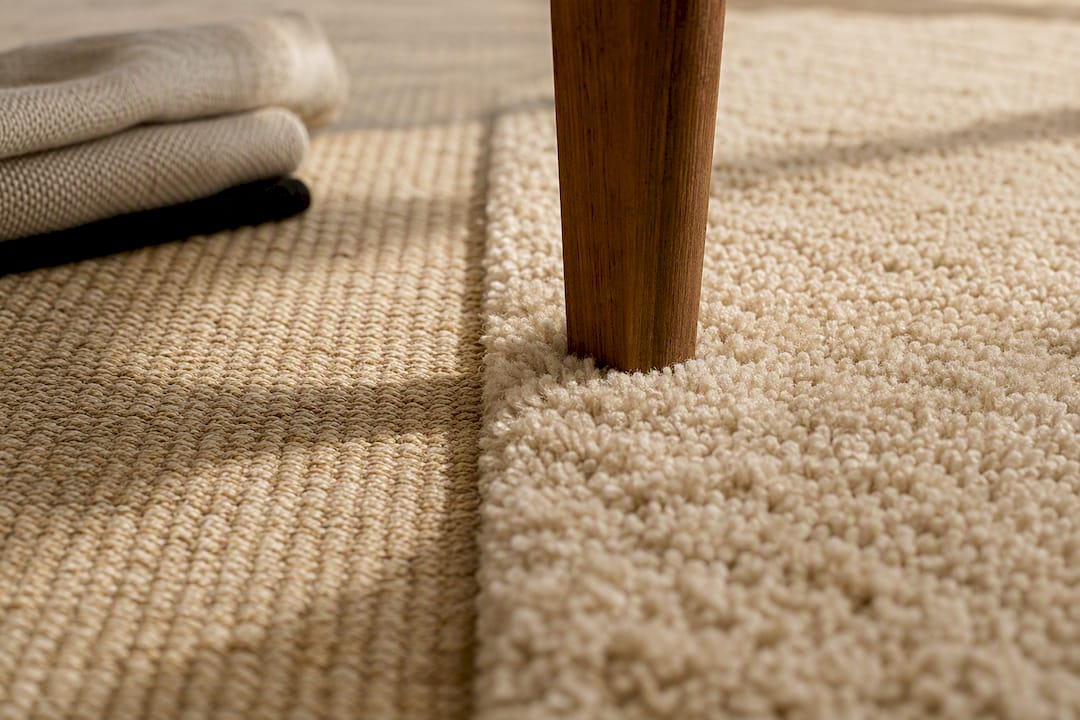
Texture also changes how the size of a rug reads visually. A flat weave in a bold colour can look smaller than it is because the eye reads the edges sharply. A dense, textured neutral rug tends to look larger and softer than its actual dimensions, which is worth bearing in mind if you’re deciding between two adjacent sizes. If you’re already close to the border between, say, 200×290cm and 245×305cm, a plush, pale rug can make the smaller size feel adequate where a flat, dark one might not.
Furniture placement gets trickier with high pile too. Chairs with castors or a coffee table on thin legs can wobble on a deep pile, so if you’re planning to move furniture around often, a low or medium pile is the more practical choice regardless of the size you land on.
Which rug materials actually hold up in a living room?
Wool remains the most durable all-rounder for a living room floor, resisting crushing and staining better than most synthetic alternatives, though it comes at a higher price point. Wool blends split the difference, keeping some of wool’s resilience while bringing the cost down.
Synthetic weaves, particularly polypropylene and polyester, have improved a great deal and now offer genuinely good stain resistance and a lower price, making them a sensible choice for a family living room or anywhere pets spend time. Several are fully machine washable, which matters more than most buyers expect once a rug has lived through a couple of British winters and muddy paws.
Jute and sisal look fantastic as a neutral base layer, but they’re rougher underfoot and less forgiving of spills, so they suit a hallway or a layering base better than the main rug under a sofa where people sit barefoot. Cotton flatweaves are light, easy to wash, and a good match for a small room or a rental where a hefty wool rug isn’t practical to move.
Whatever the material, check the pile against your flooring. A rug on a hard floor benefits from a proper rug pad underneath, both to stop it sliding and to protect the finish, something worth checking with a flooring specialist if you’re unsure what your particular floor can handle.
Getting the balance right between size and traffic flow
A rug that’s too big for a room eats the walkways and makes the space feel cramped, even though the instinct with an oversized rug is usually the opposite: to think bigger automatically means grander. A rug that’s too small does the reverse damage, leaving furniture stranded on bare floor and making a decent-sized room look pokier than it actually is.
The traffic flow test is simple. Stand at the main door into the room and trace the route you’d naturally walk to the sofa, the kitchen doorway, or wherever else people cross the space regularly. That route needs clear floor, rug or otherwise, of at least 60 to 75cm. If your candidate rug size blocks that route or forces people to walk on and off the rug repeatedly in a few strides, it’s the wrong size for that room, regardless of how good it looks against the sofa.
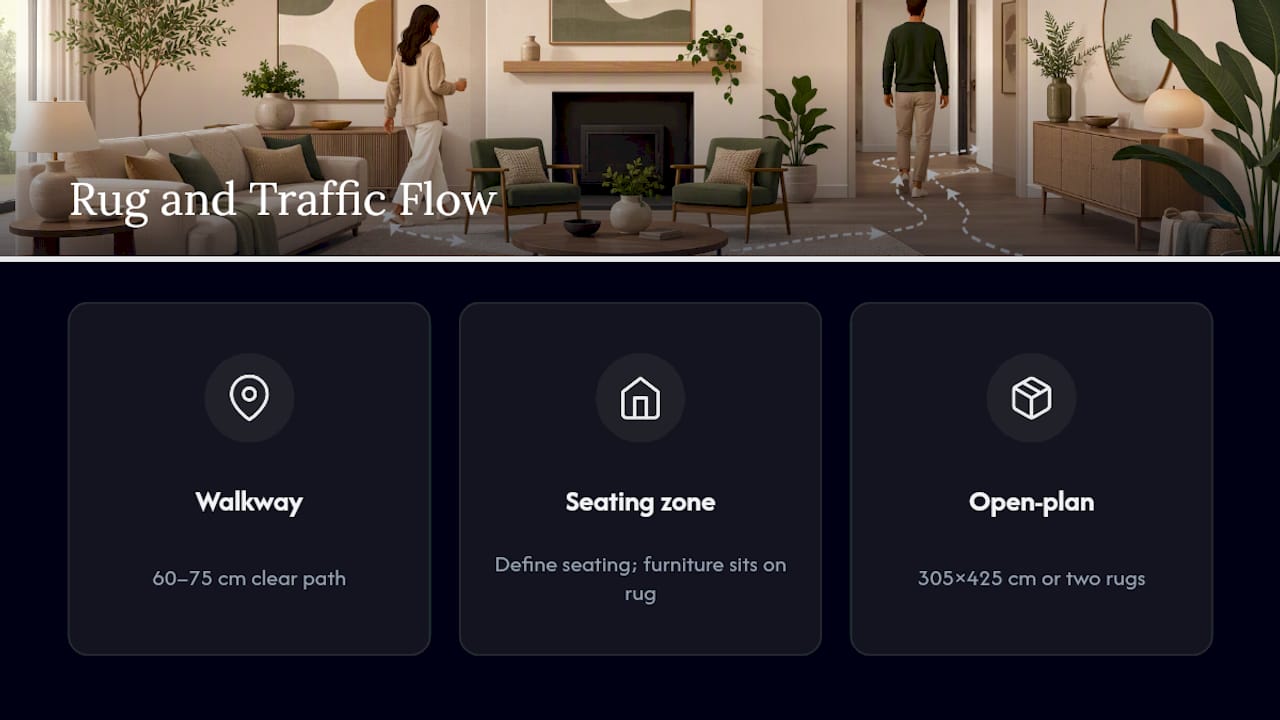
Open-plan spaces need a different mindset entirely. Rather than one rug trying to do everything, most open-plan living rooms work better with a rug that defines the seating zone specifically, leaving the dining or kitchen area on bare floor or a separate rug. This is where the 305×425cm size and the two-rug approach both earn their keep. Overcrowding a rug boundary into a walkway zone, or trying to stretch one rug across a whole open-plan floor, tends to look busy rather than deliberate. Sizing to the zone, not the whole floor, keeps the room feeling organised rather than covered.
Why the size-up rule beats most of the advice you’ll read online
Most rug guides hedge. They give you a table of room sizes and let you guess the rest, which is how so many living rooms end up with a rug that’s technically fine but visually shrinks the space. The evidence from designers is consistent on this point: buying too small is by far the more common mistake, and it’s the one that actually shows.
What gets underrated is how forgiving a slightly oversized rug is compared with a slightly undersized one. A rug that runs 10cm bigger than strictly necessary just looks generous. A rug that runs 10cm smaller looks like a mistake the moment you walk into the room, because the eye reads the gap between rug and furniture as unintentional.
If there’s one thing worth prioritising above the metric sizes and the border rules, it’s this: measure your actual seating group with the furniture in its final position, tape the floor before you buy, and round up rather than down when the numbers land between two standard sizes. Everything else, pile height, material, shape, is genuinely secondary to getting that one decision right.
— Cristiano
Ready to measure, tape and shop with confidence?
Grab a roll of masking tape before you open another browser tab. Mark out your two front runners on the floor, sit with them for a day, and you’ll know which size actually works long before you’ve spent a penny.

Once you’ve settled on a size, Homable’s rug collection lets you filter straight to it, whether that’s 200×290cm for a standard three-piece suite or 275×365cm for a bigger, open-plan room. Orders over £100 come with free UK delivery, and if the taped outline turns out to be slightly off once the rug arrives, returns are straightforward. Start with the Homable rug range and search by the size you’ve already measured, and for wider styling ideas once the rug’s down, the room-by-room decor guide is a good next stop.