Cart
0
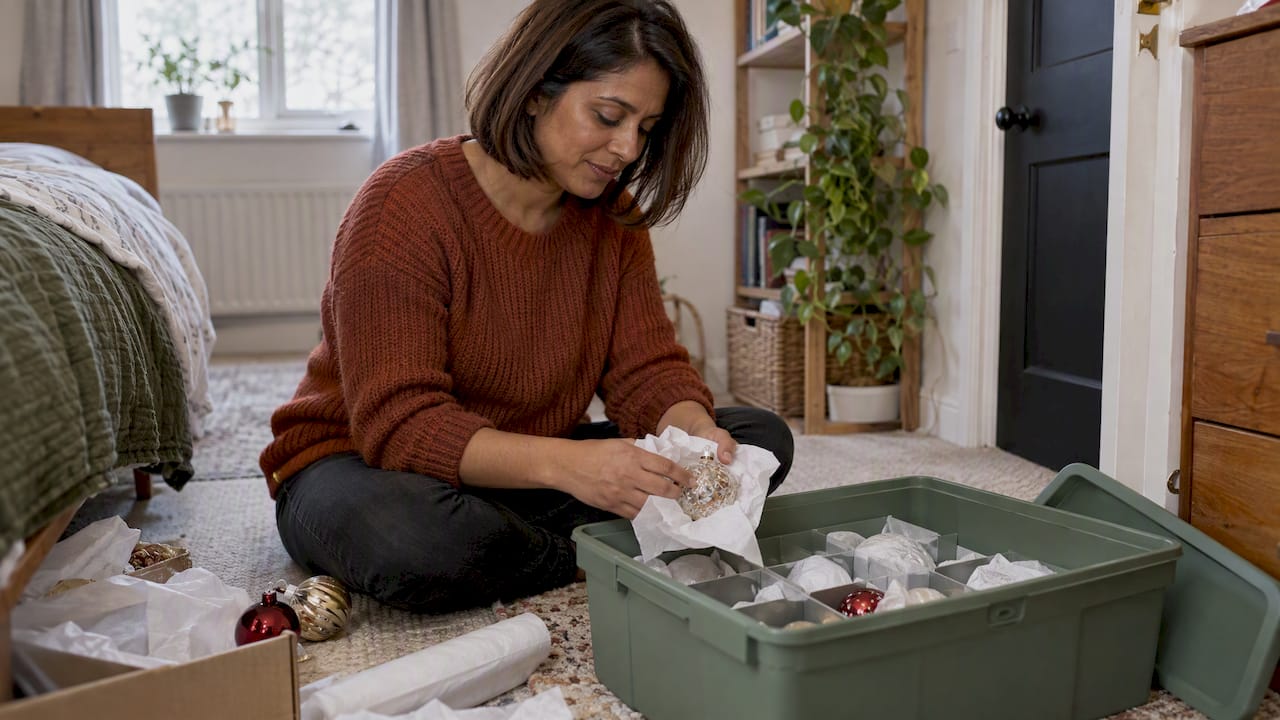
The best way to store seasonal ornaments is to clean them, wrap each piece individually, pack them in a sturdy lidded container with dividers, and keep that container somewhere with steady temperature and humidity. Most breakages and stains happen in the packing and the place, not in the box you choose. This guide covers all of it, with the reasoning behind each step so you can adapt it to a small flat or a big family home.
TL;DR
- Wrap every fragile ornament separately in acid-free tissue or bubble wrap. Skip newspaper, because the ink can transfer onto finishes.
- Choose rigid, lidded plastic bins or compartment boxes over soft, old cardboard, and never overfill them.
- Store them in a stable indoor space, such as a wardrobe or under a bed. Avoid places where temperature and damp swing sharply.
- Keep relative humidity near 45% (give or take 5) for valuable glass and ceramic pieces, and use silica gel if you can’t control the room.
- Label by room or theme so next year’s unpacking takes minutes, not an evening.
Table of Contents
- Why ornaments get damaged in storage
- Before you pack: clean, sort and edit
- How to wrap ornaments properly
- Choosing the right container
- Where to keep them
- Ideas for different kinds of ornaments
- Label so you can find things next year
- A step-by-step packing day plan
- Our perspective: store for the next decorating, not just the end of this one
- Storage for the rest of the home, and where we can help
- Common mistakes to avoid
- FAQ
- Sources
Why ornaments get damaged in storage
Conservators who look after museum glass and ceramics say the primary danger to these materials is physical force. Glass and ceramic objects are easily broken, chipped or scratched, and other risks such as humidity or light matter mainly once the object is physically safe. That order of priorities is useful at home. Before you worry about the perfect room, make sure nothing can knock against anything else.
In practice, damage tends to come from four things:
- Clanking. Loose baubles in a tub rub and knock, which causes chips and scuffs.
- Crushing. A heavy box stacked on a weak one, or a lid forced shut over an overfull tray.
- Moisture and dirt. Dust and damp left on a piece will still be there in eleven months.
- Sudden environmental change. Moving pieces from a warm lounge to a cold outbuilding, which we cover below.
Every recommendation that follows tackles one of those four.
Before you pack: clean, sort and edit
The packing season is also the best time to decide what you actually want to keep. Lay everything out on a table or the floor and sort into three piles: keep, repair, let go. Anything cracked, shedding glitter in clumps or no longer to your taste doesn’t deserve storage space.
For the keep pile:
- Dust gently. A soft, dry brush or a clean microfibre cloth is enough for most ornaments. Skip sprays and wet wipes on painted or glittered surfaces.
- Let everything dry. Anything that has been near a damp window, a fireplace or a drinks table should be fully dry before it goes into a sealed container.
- Remove metal hooks. They can scratch painted finishes over a long stay in a box. Keep the hooks in a small labelled bag or pot instead.
- Check anything electrical. If a decoration takes batteries, take them out before storing, so leaks cannot damage it.
- Group by theme or room. Gold and neutral pieces together, children’s handmade ornaments together, the delicate heirlooms in a box of their own.
That last point matters more than it sounds. Putting your most fragile pieces in one dedicated box means you never have to dig through them to reach the robust ones.
How to wrap ornaments properly
Wrapping is where you earn most of your protection. Professional organisers interviewed by House Beautiful advise wrapping each ornament in tissue or bubble wrap so fragile pieces survive to the next season. Individual wrapping stops the micro-abrasions that come from pieces clanking together, which is the reason we never recommend dropping unwrapped baubles into a tub, however tightly packed.
What to wrap with
| Material | Good for | Watch out for |
|---|---|---|
| Acid-free tissue paper | Painted glass, ceramics, anything with a delicate finish | Needs a few layers for heavy pieces |
| Bubble wrap | Larger, heavier or oddly shaped ornaments | Keep the smooth side against painted surfaces |
| Clean soft cloth (tea towels, spare cotton) | Reusing what you already own, padding gaps | Must be dry and clean |
| Newspaper | Nothing delicate | The ink can transfer and stain finishes |
The newspaper warning is worth repeating, because it is the most common household shortcut. Conservation guidance is that acid-free tissue is the standard, and printed paper can mark delicate surfaces. If you only have newsprint to hand, use it as outer padding around a box, never against the ornament itself.
A simple wrapping routine
- Lay a sheet of tissue flat and place the ornament in the centre.
- Fold the corners in, then roll the ornament gently, adding a second sheet for anything painted or heavy.
- Tuck any protruding parts (arms, wings, stems, hangers) inside the wrap rather than leaving them exposed.
- Secure with a little low-tack tape on the paper, never on the ornament.
- Place it in a compartment or against a divider, never loose.
When handling, follow a rule museum conservators use: carry one item at a time and never lift by projecting parts such as arms, legs or wings. It sounds fussy until a wooden figure’s arm comes off in your hand.
Choosing the right container
There is no single best box, but there is a clear order of preference.
1. Rigid plastic bins with tight lids. The same House Beautiful piece reports that organisers favour stackable plastic bins with lids over traditional cardboard, because plastic resists moisture and keeps out dust, dirt and pests, while cardboard is porous. Clear bins let you see what is inside, and opaque ones keep light off pieces that fade.
2. Compartment boxes and trays. For round baubles, a box with removable trays and dividers is hard to beat. Each bauble gets its own cell, and you can lift a whole tray out at once. They are less useful for irregular ornaments, such as figurines or items on stands.
3. Original packaging. If an ornament came in a fitted box with a moulded insert, keep it. That insert was shaped around the piece. Where the box is still sound, it is often the best protection that piece will ever have.
4. Sturdy cardboard boxes. Fine for sturdy items in a dry, stable room, as an inner box inside a bin, or for single decorations. They are the weakest option for long periods in anywhere humid.

5. Soft zipped bags. Good for wreaths, garlands and artificial tree branches, which are squashable. Not for glass.
Packing the container
- Put the heaviest, sturdiest pieces on the bottom and the lightest on top.
- Fill voids with scrunched tissue so nothing shifts when the box is lifted.
- Stop when the lid closes without pressure. If you have to lean on it, remove something.
- Don’t stack more than two or three bins, and put the heaviest at the bottom.
- Choose a size you can lift comfortably. A bin you can’t carry down the stairs safely will get dragged, and dragging breaks things.
Where to keep them
The box matters, but the room matters as much. Museum guidance on storage is blunt: stable environmental conditions are the most important consideration. Their general figures are around 45% relative humidity (give or take 5 points) and about 21°C (70°F, give or take 2°F in the original text).
You don’t need museum conditions for a box of baubles, but you can borrow the principle: choose the most stable room you have. In most UK homes that means:
- A wardrobe shelf or the top of a cupboard in a spare room. Interior rooms away from external walls tend to be steadier.
- Under a bed, in a low, lidded box.
- Under the stairs, if it is dry and not on an external wall.
- A loft, garage or shed only if it is dry and well insulated. Lofts get hot in summer and sheds and garages get cold and damp in winter, so we would only use them for robust, low-value items.
The acclimatisation trap
Here is the part people miss. Conservators warn that rapid changes in temperature or humidity can stress glass and ceramic, and that stability matters more than reaching an ideal. In plain terms: an ornament that has sat in a warm living room for six weeks shouldn’t be sealed up and moved straight to a freezing shed. If the only space you have is a cold one, let the sealed box sit in a cooler room for a day or two first, and do the reverse when you bring it back: let it warm up before unwrapping.
Keeping humidity in check
For valuable or sentimental glass and ceramic pieces, the Met’s guidance is to aim for roughly 45% relative humidity with minimal fluctuation. Where a room can’t deliver that, silica gel packets inside a sealed container can buffer moisture, though the same source notes that conditions below 30% or above 60% relative humidity risk permanent damage. A small digital hygrometer costs little and tells you what your wardrobe or spare room is really doing. If it reads far outside that band, move the box before you buy any more gadgets.
Ideas for different kinds of ornaments
Not everything is a round bauble. Here is how we would handle the common categories.
Glass baubles. Individual tissue, then a tray with dividers. Pack heavier baubles on the lower tray. Some conservators suggest storing glass pieces upside down to limit condensation affecting paint, which is a sensible habit with hand-painted pieces if the box allows it.
Wooden and metal figures. These are tougher but have protruding parts. Wrap them individually and give them a bin of their own so they cannot dent the delicate ones. If a figure sits on a base, wrap base and figure together so the join isn’t stressed.
Handmade and children’s ornaments. Salt dough, paper and glitter pieces are fragile in a different way. Use a shallow box, a single layer, tissue between, and a label with the year and the child’s name. They are often the pieces you would least like to lose.
Lights. Wind them around a piece of card or a reel rather than stuffing them in a bag, and test them before you pack so you don’t open a dead set next year.
Wreaths and garlands. Soft bags or flat boxes. Don’t crush them under heavier bins.
Larger decorative ornaments. Standing pieces used as year-round or seasonal accents, such as our ornaments collection, are best wrapped in bubble wrap or cloth and stored upright in a bin with padding on all sides, or in their original box if you have it.
Label so you can find things next year
Storage only works if retrieval is easy. A few habits make a big difference:
- Label two sides of every box, not only the lid, so you can read it while stacked.
- Number the boxes and keep a list on your phone: “Box 1: tree baubles. Box 2: mantel and table. Box 3: lights.”
- Put the items you decorate first, such as the lights and the tree skirt, in the box most easily reached.
- Add a short note inside the lid of anything you edited, like “missing one red bauble, replace before December”.
- Take a quick photo of your favourite display before you dismantle it. It saves a lot of guessing next year.
A step-by-step packing day plan
If you want a routine rather than a list of principles, here is how a typical packing session runs for a family home.
- Gather supplies first. Tissue, bubble wrap, bins, dividers, labels and a marker. Setting up a station avoids half-packed boxes.
- Work room by room. Take decorations down in one room, pack them, label the box, then move to the next.
- Sort as you go. Make the keep, repair and let-go piles as pieces come down, not afterwards.
- Clean and dry. Wipe, brush and let dry before wrapping.
- Wrap and place. Fragile first, in trays; sturdy next; padding last.
- Close, label, photograph. Note the contents and take a photo of the inside of the box if it helps.
- Store in the steadiest spot available. Heaviest at the bottom, lids on, away from radiators and external walls.
Set aside an hour per room and you won’t feel rushed into shortcuts.
Our perspective: store for the next decorating, not just the end of this one

At Homable we sell decorative ornaments, storage baskets and home accessories, so we spend a lot of time thinking about how things live in a home across the whole year, not just on display day. Our view is that good storage is part of good styling. If decorations are easy to put away and easy to find, you will actually use them, rotate them and enjoy them. If they are a tangled mess in a loft, you will buy new ones instead.
We also think the most useful question isn’t “which box is best?” but “what will I do next September?” A system you can repeat quickly beats a perfect system you abandon. That is why we favour fewer, clearly labelled containers, a dedicated box for fragile pieces and a short list of what lives where. For softer, non-fragile items that aren’t glass, such as throws, garlands and kids’ toys, open or lidded baskets in a hall, bedroom or playroom can keep seasonal bits to hand without hiding them in the loft. If you’d like more ideas on this theme, our guides on decorative storage solutions and how to set up seasonal décor go into more detail.
— Cristiano
Storage for the rest of the home, and where we can help
Once the baubles are sorted, the next problem is usually everything around them: wrapping paper, children’s craft pieces, spare cushions and blankets. A few baskets make a big difference there. Our kids storage baskets work well for soft toys and playroom overflow, and the round storage basket suits throws, garlands or textiles that don’t need a rigid box. If you are replacing or adding display pieces for the season, browse our ornaments too. We don’t sell fitted bauble trays, so for fragile glass we would still point you to a rigid lidded bin with dividers, as described above.
If you want a broader plan for the whole house, our storage solutions checklist walks through room by room.
Common mistakes to avoid
- Packing while items are still damp or dirty. Dust, moisture and residue turn into mould and marks in storage.
- Using one big box for everything. The sturdy items end up crushing the delicate ones.
- Overfilling trays. If bauble caps press against the one next door, they will mark.
- Choosing the loft by default. It’s easy to reach but often the least stable room in the house.
- Skipping labels. Unlabelled boxes lead to opened, repacked and broken contents.
- Throwing away original boxes. Fitted packaging is often the best protection you have.
FAQ
What is the best way to store Christmas ornaments?
Clean and dry them, wrap each piece separately in acid-free tissue or bubble wrap, and pack them in a rigid lidded container with dividers. Keep the container in a stable, dry indoor space. Individual wrapping matters most, because it stops ornaments rubbing and clanking together.
Is plastic or cardboard better for ornament storage?
For long-term storage, plastic bins with tight lids are generally the better choice, as organisers note that plastic resists moisture, dust and pests while cardboard is porous. Cardboard still works for robust items in a dry room, or as an inner box. Keep original fitted boxes where you have them.
Can I store ornaments in the loft or garage?
You can, but it isn’t ideal for anything fragile or valuable. These spaces tend to swing in temperature and humidity, and conservation guidance says sudden changes can stress glass and ceramic. A wardrobe, spare-room shelf or under-bed box is usually steadier. If the loft is your only option, use sealed bins and silica gel, and let boxes adjust to room temperature before opening.
How do I stop baubles from breaking in storage?
Wrap each one individually, use a box with dividers, fill gaps so nothing shifts, and avoid overfilling. Put heavier items at the bottom and don’t stack bins too high. Carry boxes you can lift comfortably, and handle one ornament at a time when unpacking.
Should I take batteries out of decorations before storing them?
Yes, it is sensible to remove batteries from any battery-powered decoration before it goes into storage, so a leak can’t damage the piece. Store spare hooks and batteries separately and label the bag.
Sources
- Caring for ceramic and glass objects, Canadian Conservation Institute
- Professional organisers reveal how they store their holiday decorations, House Beautiful
- Appendix P: Curatorial care of ceramic, glass and stone objects, US National Park Service
- The Care and Handling of Art Objects, Metropolitan Museum of Art (2019)