
Cart
0

Start by decluttering room by room, then switch to a mix of closed storage and multi-functional furniture, and finish with a five-minute evening reset. That order matters: buying baskets before you’ve sorted anything just gives clutter somewhere new to hide. Homable, House Beautiful and professional organiser guidance all agree that quick wins come fast, but real change needs a habit, not a haul.
TL;DR:
- Buying storage containers before decluttering results in hiding clutter rather than reducing it, so sorting items into categories beforehand is essential.
- Measuring space accurately and choosing storage based on how frequently items are used ensures long-term functionality and avoids purchasing inappropriate units.
- Establishing small routines like a five-minute nightly reset and weekly basket clearing prevents clutter from rebounding and promotes ongoing tidiness.
- In homes with kids or pets, rotating toy bins and using labeled, low-access containers makes tidying easier and reduces mess spread.
- Combining open and closed storage strategically, along with visual editing on shelves and sightline management, creates a calmer, less cluttered living room appearance.
Table of Contents
- What are the best living room clutter solutions?
- How do you choose storage that actually fits your living room?
- Daily, weekly and monthly routines that stop clutter returning
- Living room storage solutions for homes with kids or pets
- How do you hide visual clutter without hiding everything?
- Practical storage picks and a shopping checklist
- What actually keeps a living room tidy long-term
- Where to find storage that fits your living room
- Sources
- FAQ
What are the best living room clutter solutions?
The truth about most living room storage ideas is that they only work once you’ve already thrown out the stuff you don’t need. Buying a basket before that step just gives your clutter somewhere nicer to hide. Livingetc’s decluttering guidance recommends sorting everything into categories, books, media, throws, chargers, before you even think about containers, so you never end up buying storage for things you were about to bin anyway.
Below are 20 living room storage ideas, ranked by how often they solve a real problem rather than just look good in a catalogue photo.
- Round woven baskets for throws and cushions. Works in any size room, family or childfree. Budget band. A round storage basket tucked by the sofa hides bulky textiles in seconds.
- Storage ottomans that double as a footstool and a lid-topped box. Best for small flats where furniture has to earn its keep. Moderate cost.
- Lift-top coffee tables for remotes, coasters and laptop chargers. Ideal for open-plan living rooms with heavy daily traffic.
- Slim media cabinets with closed doors to hide cables, consoles and DVD clutter. Better for larger rooms; a slim version works in flats too.
- Wall-mounted shelving for books and display pieces, freeing floor space entirely. Works well in rented homes with limited furniture budgets.
- Behind-sofa console tables for lamps, coasters and a catch-tray. Keep depth to around 12cm and the height a touch lower than your sofa back so it doesn’t crowd the silhouette.
- Under-sofa storage bins. Measure clearance first; a shallow 4 to 5 inch gap only fits flat trays, while 7 inches or more allows rolling bins for bulkier items.
- Cord organisers, cable boxes or clip channels, for the tangle behind the TV unit. Budget fix, big visual payoff.
- Remote trays on the coffee table or console, small but genuinely reduces daily searching.
- Toy baskets with lids, positioned low so children can reach them without help.
- Lidded fabric bins for blankets, spare cushions or seasonal decor. Closed storage hides mismatched colours.
- Floating shelves styled sparingly, three to five objects per shelf, not fifteen.
- Peg rails near the entryway to catch bags, keys and coats before they land on the sofa arm.
- Wall hooks inside cupboard doors for headphones, chargers or dog leads.
- Over-door organisers on any nearby closet, useful in small flats with no spare cupboard space.
- Magazine racks or slim floor baskets, an easy budget catch for post and reading material.
- Nesting tables that collapse the footprint of two or three side tables into one stack.
- Storage benches with lift seats, good for hallway-adjacent living rooms doubling as a shoe-drop zone.
- Decorative boxes on shelving that hide odds and ends behind a good-looking lid, budget and design-led at once.
- A DIY “clutter bucket”, one basket you empty daily into its proper home. Free if you already own a basket; the simplest of all these living room storage ideas.
A few of these cost nothing beyond effort: repurposing a kitchen tray as a remote catch, or an old shoebox covered in leftover fabric as a lidded bin. Small-space versions almost always mean going vertical, with wall shelves and hooks over floor furniture, while family homes benefit more from low, lidded, kid-accessible bins than from anything with a fiddly latch.
How do you choose storage that actually fits your living room?
Measuring first sounds obvious, but it’s the step most people skip, and it’s exactly why so many storage purchases end up abandoned in a shed. Before you buy anything, check the height, depth and walkway clearance around the space you’re filling. A bin that’s two centimetres too tall for under-sofa clearance is a bin you’ll never use.
Decide open versus closed storage by what you’re storing, not by what looks nice in a showroom. Closed storage suits unattractive or mismatched items, cables, board games, odd socks, while open shelving works for curated, intentional displays you’re happy to look at daily.
Match access frequency to location. Daily-use items belong somewhere you can reach without bending or shifting furniture; seasonal or occasional items can go in harder-to-reach hidden storage, since hidden storage only works well when it’s still genuinely accessible for what you actually use.
Run through this before you buy:
- Measure the exact space, height, width and depth, and bring the numbers with you when shopping.
- Check the material and whether it’s wipeable or washable.
- Confirm the return policy, especially for anything bought online sight-unseen.
- Weigh cost against longevity: a £15 bin that warps in a year costs more than a £40 one that lasts a decade.
Pro Tip: Measure under-sofa clearance with a tape measure before you shop, not after. A gap under 5 inches limits you to flat trays; 7 inches or more opens up rolling bins for bulkier items.
Daily, weekly and monthly routines that stop clutter returning
Storage only works if you maintain it. Do these three routines and the room stays tidy without a weekend blitz every month.
- Five-minute evening reset. Clear surfaces, return remotes to their tray, fold throws back onto the sofa arm. Organisers and designers consistently point to this daily habit as the single biggest factor in keeping a room from sliding back into chaos.
- Weekly “move-out” basket. Keep one basket by the door; anything that belongs in another room goes in it, and you empty it fully once a week.
- Monthly purge. Pick a day, go through every container, and sort into keep, donate or discard. If a basket has become a catch-all with no clear category, that’s your signal to purge, not to buy a bigger basket.
- One-in, one-out. New decorative object or storage piece comes in, an old one leaves. This alone prevents the slow creep that undoes months of good habits.
Living room storage solutions for homes with kids or pets
Toy rotation solves more than a full toy box ever will. Organisers recommend limiting containers and rotating what’s accessible rather than trying to store every toy at once.
- Start with three to four labelled containers, rotate weekly, and store the “off-duty” ones in a cupboard or under a bed.
- Choose soft baskets or lidded bins on low, open shelves so children can put things away without help.
- Label bins by category, blocks, cars, art supplies, so tidying becomes a game rather than a chore. Labels and one-in, one-out rules genuinely increase the odds items get put back, particularly with children.
- Keep small parts, batteries or anything choking-hazard sized in a lidded box on a higher shelf, out of reach of both kids and curious pets.
Pro Tip: A rotation of three or four bins beats one giant toy chest every time, fewer choices out at once means less mess spread across the floor.
How do you hide visual clutter without hiding everything?
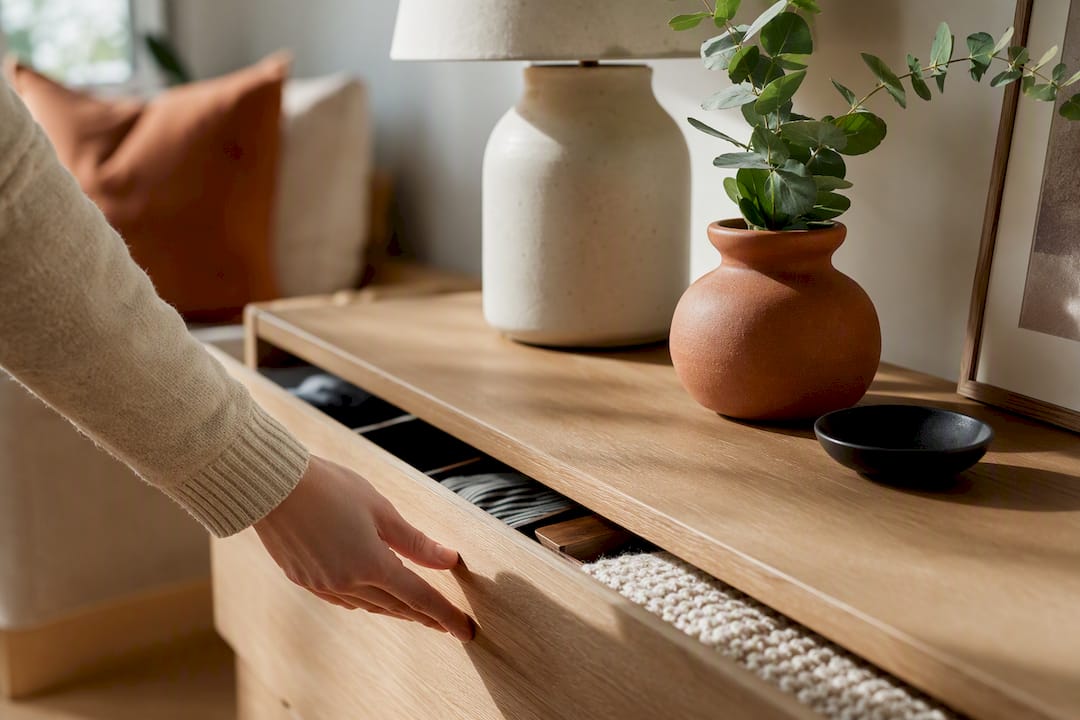
Visual clutter usually isn’t about having too much stuff. It’s about too many competing focal points fighting for attention at once, and resolving sightlines does more for a calm room than removing half your belongings.
On open shelves, group objects in odd numbers, three or five rather than two or four, vary the height, and leave breathing space between groupings. A shelf styled with editing in mind reads as curated; one crammed edge to edge reads as clutter regardless of how nice the objects are.
- Paint cord covers to match the wall, or route cables through a labelled cable box behind the TV unit.
- Keep phone chargers in one labelled spot rather than plugged in wherever’s convenient.
- Establish a “no-clutter” zone, one shelf or one corner that stays empty, to give the eye somewhere to rest.
- Switch to closed storage anywhere mismatched colours or textures are breaking up the room’s palette.
One detail worth knowing: a five-minute nightly reset does more to prevent visual clutter building up than any single piece of furniture you could buy.
Practical storage picks and a shopping checklist
Matching product to problem beats buying whatever’s trending. For hiding throws and cushions fast, round baskets do the job; for cables and mismatched odds and ends, a lidded bin or slim console with closed storage works better than open shelving ever will. Bamboo rugs are worth considering too, not for storage but for visually zoning an open-plan room, they mark out a “living” area distinct from a dining or work corner without adding a single extra item.
Before you buy anything:
- Measure the space and bring exact dimensions shopping, online or in-store.
- Choose materials that wipe clean, fabric that’s washable, wood or bamboo that’s sealed.
- Check the return policy before committing to anything bulky or expensive.
- Confirm shipping costs and delivery timeframes upfront, especially for furniture pieces.
- Favour multi-functional furniture over single-purpose pieces wherever your square footage is tight.
Readers furnishing a full room from scratch might also find stylish storage examples for modern homes useful for seeing how these categories look once installed.
What actually keeps a living room tidy long-term
Most people treat decluttering as an event: a Saturday spent filling bin bags, followed by relief, followed six weeks later by the same mess creeping back. That cycle happens because the storage never matched the room’s actual use, or because no one built a habit around it. Routine and fit beat any single big clear-out. A basket that’s the wrong size for what you own becomes a catch-all within a fortnight; a five-minute reset done nightly does more over a year than four exhausting weekend purges. Small, boring habits are what actually work. Trust them over any dramatic overhaul.
— Cristiano
Where to find storage that fits your living room
Various e-commerce sites stock categories such as storage baskets, ornaments, bamboo rugs and roller blinds, and shelving, chosen for design as much as function, so a lidded bin or a console table can hide clutter without looking like it’s hiding anything.

Some online retailers offer promotions like free shipping on orders over £100 and secure checkout options, so filling out a room’s storage in one go might avoid juggling separate deliveries or dodgy payment pages. If you’re starting with the basics, browse baskets, rugs and shelving categories to see what fits your measurements, or go straight to a round storage basket if throws and cushions are your first target. Measure your space, check the categories against the list above, and order what actually matches what you need to hide.
Sources
- 5 essential living room organization rules to follow in 2026, according to experts
- How to declutter a living room — Livingetc
- Living room visual clutter removal | Architectural Digest
- How to add storage to a living room without clutter
FAQ
How do you hide clutter in a living room?
Use closed storage, lidded bins, ottomans, slim consoles, for anything mismatched or unattractive, and reserve open shelves only for items you’ve deliberately styled. Cord covers and cable boxes handle the tech clutter that makes rooms feel messiest.
What should you remove first when decluttering a living room?
Start with anything that doesn’t belong in the room at all, items from other spaces, broken objects, duplicates, then move on to genuine excess within categories like books, media and throws.
How do you declutter a room without feeling overwhelmed?
Work in short sessions and sort by category rather than trying to finish the whole room at once; a five-minute evening reset done consistently achieves more than one exhausting all-day purge.
How do you clear a room full of clutter?
Sort everything into keep, donate and discard piles by category before buying a single storage container, then fit closed storage to whatever’s left, following the category-first method rather than guessing at container sizes upfront.
Does Homable sell living room storage?
Yes, Homable stocks storage baskets, bamboo rugs, shelving and related home accessories; current prices and options are listed on the Homable website.