Cart
0
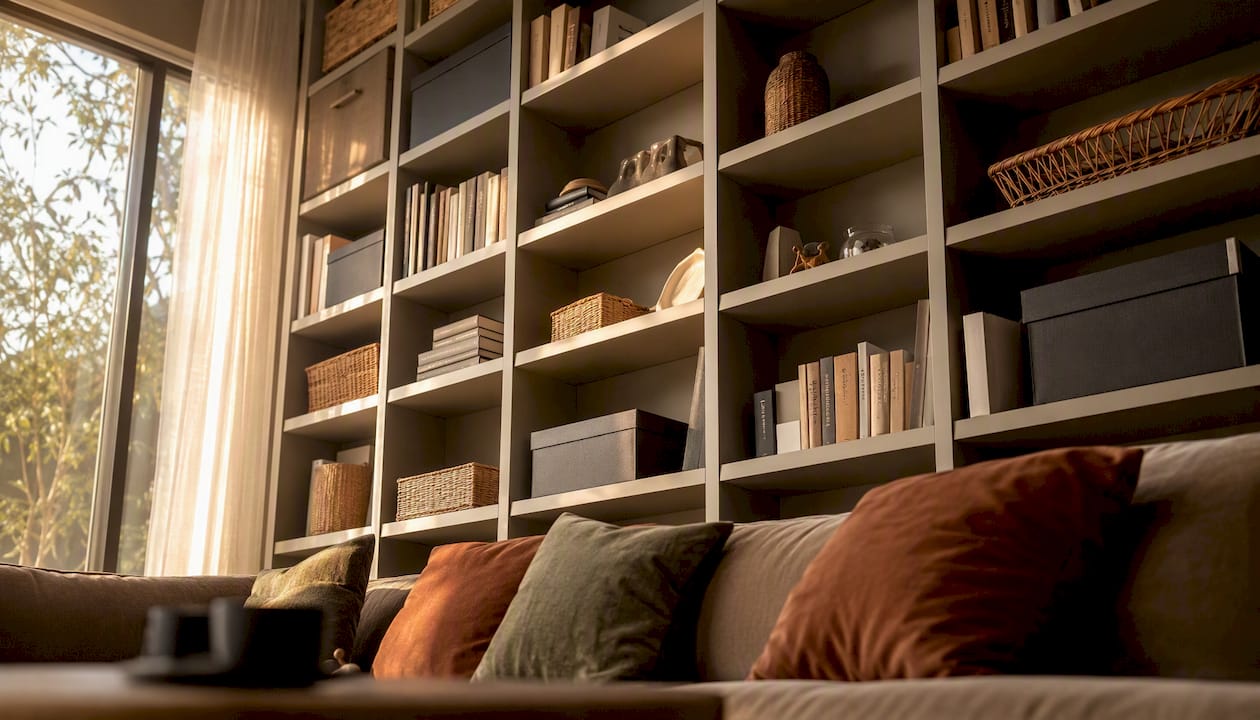
The single most effective move you can make is to combine vertical shelving systems with multipurpose furniture and hidden built-ins. That trio adds meaningful capacity without touching your floor plan. Think floor-to-ceiling shelving in the living room, a storage ottoman at the foot of the bed, and a set of under-stair drawers where a dead corner used to be. A2B Moving’s packing research shows that a well-loaded space fits 30–40% more than a poorly loaded one simply by using full vertical height — the same principle applies inside your home.
Here is what this guide covers:
- Vertical wall and door systems with sizing notes
- Multipurpose furniture picks and what to check before buying
- Awkward-nook conversions (under stairs, sloped ceilings, alcoves)
- Shelving and modular systems compared
- Hidden and built-in storage with measurement callouts
- A declutter workflow to do before you spend a penny
- Styling rules so storage looks intentional, not chaotic
- Budget fixes you can install today
- Designer rules of thumb backed by research
Pro Tip: Start with one wall. Measure floor to ceiling, note any sockets or radiators, then plan your system around what is already there. Committing to a single wall first stops the project from stalling.
Key takeaways
The single most effective approach to creative storage designs is to combine vertical systems, multipurpose furniture, and hidden built-ins — in that order, before spending on anything else.
| Point | Details |
|---|---|
| Vertical space first | Using full wall height can add 30–40% more capacity than a poorly loaded space. |
| Multipurpose furniture | Storage ottomans, beds with drawers, and benches with lids conceal clutter without adding footprint. |
| Declutter before buying | Sort items unused in the past year before investing in any new storage system. |
| Mix open and closed storage | Display intentional items on open shelves; hide functional clutter behind closed doors or in baskets. |
| Homable collections | Homable stocks decorative baskets, lidded boxes, and shelf accessories suited to the ideas in this guide. |
Table of Contents
- 1. How to maximise vertical space with floor-to-ceiling systems
- 2. Furniture that hides storage: ottomans, beds and benches
- 3. Turn awkward nooks into the most useful spots in your home
- 4. Which shelving system actually suits your space?
- 5. Hidden and built-in storage that keeps surfaces clear
- 6. Declutter before you organise: a workflow that actually saves money
- 7. When to display and when to hide: styling rules for storage
- 8. Cheap and fast fixes you can install today
- 9. Designer rules of thumb and research-backed tips
- Homable’s storage collections: where to start
- Sources
1. How to maximise vertical space with floor-to-ceiling systems
Vertical storage is the easiest way to add capacity without changing a room’s footprint, and it is consistently underused. Architectural Digest’s small-space storage guide places floor-to-ceiling shelving and over-door racks among the highest-impact solutions for compact homes.
A well-loaded storage space commonly fits 30–40% more than a poorly loaded one, illustrating the gains from utilising vertical height. A2B Moving
Sizing notes worth keeping:
- Standard shelf spacing for books: 28–32 cm between shelves
- Plates and kitchen items: 35–40 cm clearance
- Wall hooks for coats: fix the top hook at roughly 180 cm from the floor so adults and children can both reach
- Leave at least 30 cm between the top shelf and the ceiling for safe loading and retrieval
Fixed vs freestanding: owners who can drill into walls get the most from floor-to-ceiling fitted systems, which carry heavier loads and look cleaner. Renters are better served by tall freestanding units (bookcases, ladder shelves) that move out on leaving day. Either way, anchor anything over 150 cm tall to a wall stud — a top-heavy unit falling is a serious hazard.
Over-door organisers and pegboard rails are the renter’s best friends: no drilling, immediate capacity, and they come down in minutes. Pegboards work especially well in kitchens and home offices where tools and accessories change regularly.
Pro Tip: Before buying a tall unit, check your ceiling for coving or light fittings that reduce usable height. A unit that looks right in a showroom can sit 15 cm short of your ceiling and waste the very space you were trying to capture.
2. Furniture that hides storage: ottomans, beds and benches
Architectural Digest makes the case clearly: multipurpose furniture conceals clutter and anchors a room’s aesthetic at the same time. A storage ottoman does the work of a coffee table, a footrest, and a linen chest simultaneously.
Top pieces by room:
- Living room: lift-top coffee tables (typically 40–45 cm internal depth) and storage ottomans with removable trays
- Bedroom: beds with under-frame drawers (standard drawer depth: 20–25 cm) or hydraulic lift bases for bulkier items like duvets
- Hallway: benches with hinged lids — look for a piano hinge rather than two small hinges, which fail under repeated use
- Dining room: sectionals or window-seat banquettes with storage chaises underneath
Buy vs DIY quick check:
Before buying, measure the internal cavity, not just the external frame. A bed advertised as having “under-bed storage” may have only 15 cm of clearance — too shallow for anything except flat boxes. For DIY benches, MDF with a piano hinge and a foam-topped lid is a weekend project that costs a fraction of a bespoke piece.
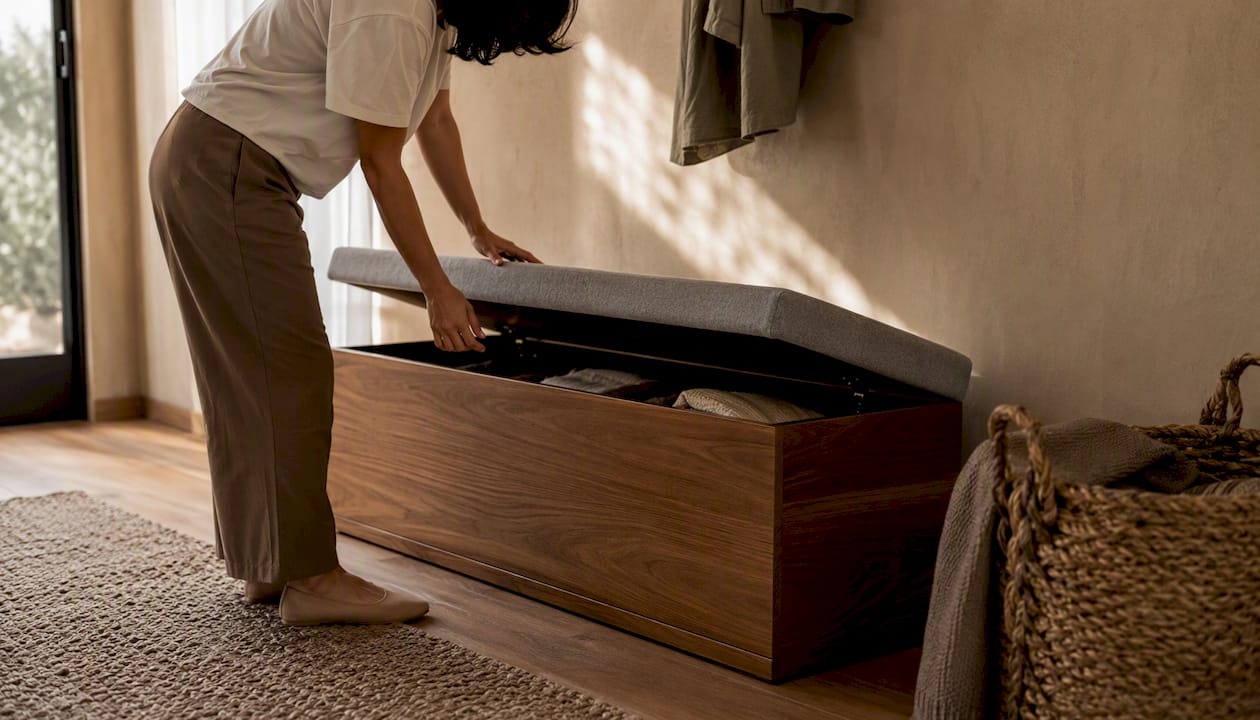
Pro Tip: Avoid storage ottomans with fabric-lined interiors and no rigid base. They look good in photos but the base sags within months under any real weight. Look for a plywood floor inside the cavity.
3. Turn awkward nooks into the most useful spots in your home
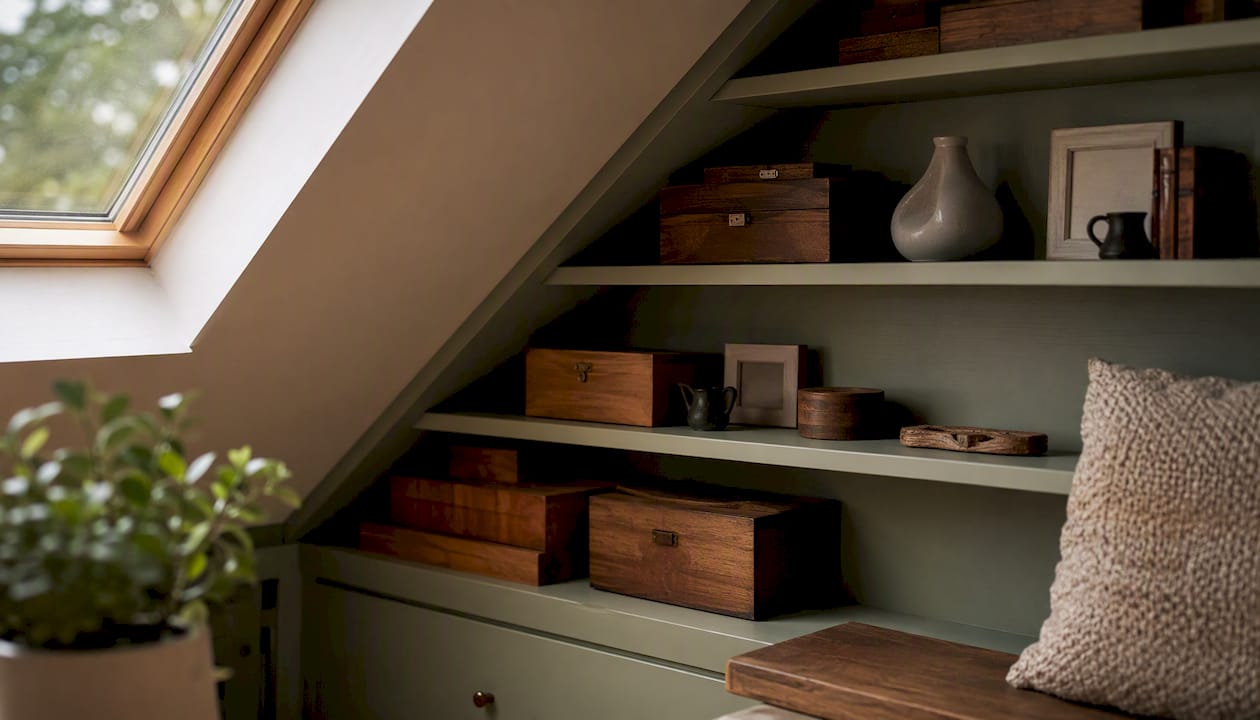
Awkward spaces are often the highest-value storage opportunities in a house. Under-stair voids, sloped eaves in loft rooms, recesses beside a chimney breast, and the dead space above door frames all offer usable volume that most homeowners simply ignore.
| Location | Typical usable depth | Best use | DIY or carpenter? |
|---|---|---|---|
| Under stairs | 60–90 cm | Pull-out drawers, shoe racks, wine storage | Carpenter for drawers; DIY for shelves |
| Sloped eaves | 40 cm (at knee height) | Seasonal items, suitcases, children’s toys | Modular kits work well |
| Alcove beside chimney | 30–45 cm | Shelving, built-in wardrobe | Either, depending on finish |
| Above door frame | 25–35 cm | Baskets, rarely used items | DIY with floating shelf brackets |
| Window seat recess | 40–60 cm | Blankets, books, board games | DIY with hinged lid |
Before you build anything:
- Use a cable and pipe detector (available for under £30) before drilling or cutting into any wall or floor
- Check with your building’s management company if you are in a flat — structural changes may need approval
- Sloped-ceiling cubbies in loft rooms often sit directly under roof tiles; check for moisture before lining with timber
For under-stair drawers with a clean finish, a carpenter is worth the cost. For simple shelving in an alcove or a window seat with a hinged lid, a confident DIYer with a circular saw and a drill can manage it over a weekend using pre-primed MDF.
4. Which shelving system actually suits your space?
Choosing the right shelving system comes down to three things: how much weight you need it to carry, how often the contents change, and whether you want the items visible or hidden.
| System | Installation complexity | Best rooms | Contents visible? |
|---|---|---|---|
| Floating shelves | Low–medium | Living room, bedroom, bathroom | Yes |
| Full wall system (uprights + brackets) | Medium | Study, kitchen, utility room | Yes |
| Pegboard rail | Low | Kitchen, home office, craft room | Yes |
| Modular cube boxes | Very low | Children’s room, living room | Mixed (open + baskets) |
| Boxed shelving unit | Very low | Any room | Mixed |
Floating shelves suit curated displays: a row of plants, a few books, a ceramic piece. They look clean but carry less weight than bracket systems — typically 10–15 kg per shelf depending on the fixing and wall type. Full wall systems with steel uprights and adjustable brackets handle heavier loads (books, kitchen equipment) and let you reconfigure shelf heights as your needs change.
Modular cube systems, inspired by approaches like the BoBoX concept of tool-free, lightweight assembly, are the most flexible option for renters or anyone whose storage needs shift regularly. Add a basket to a cube and it becomes closed storage; leave it open and it becomes a display shelf.
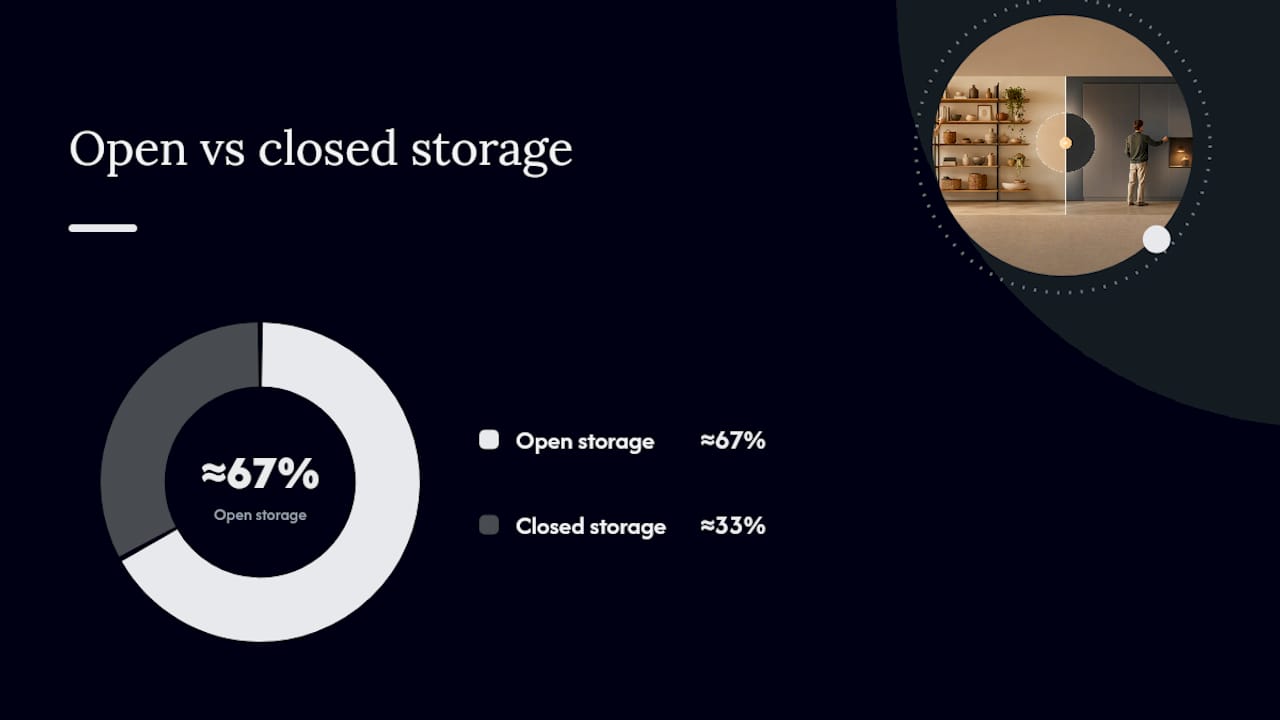
Pro Tip: Mix open and closed storage on the same wall. A rule of thumb from interior designers: roughly one-third closed (baskets, boxes, doors) to two-thirds open keeps a wall looking curated rather than either sterile or chaotic.
- Style open shelves with items grouped by colour or material
- Use matching baskets on lower shelves to hide everyday clutter
- Reserve eye-level shelves for the things you actually want to see
5. Hidden and built-in storage that keeps surfaces clear
Built-in and hidden storage keeps surfaces clear while preserving a calm, uncluttered look — the kind of room that photographs well and feels genuinely restful to live in.
Concrete ideas with measurements:
- Under-bed drawers: standard clearance needed is 18–22 cm. Beds with built-in drawers typically offer 20 cm of internal depth; hydraulic lift bases give access to the full under-frame volume (often 35–40 cm)
- Recessed shelving: built between wall studs (typically 35–40 cm apart in UK timber-frame construction), these sit flush with the wall surface and add depth without projecting into the room
- Built-in benches: a hallway bench with a 40 cm internal cavity holds shoes, scarves, and sports kit without a single item visible from the door
- Floor drawers: possible in some older properties with suspended timber floors, but always check joist direction and spacing with a structural engineer before cutting
International design features document inventive built-in concepts — under-floor toy boxes, stair storage, moving walls — that translate directly to domestic homes. Houzz: World of Design — Creative Storage Solutions
Before any built-in project: check for wiring, plumbing, and moisture. A damp wall behind a built-in bench will rot the timber within a couple of years. Recessed shelving between studs is safe in most internal walls but should never be attempted on an external wall without checking insulation implications.
Pro Tip: For under-bed storage, measure the gap between the floor and the bed frame before buying drawer units. Many “universal” under-bed boxes are 15 cm tall — fine for flat items, useless for folded jumpers.
6. Declutter before you organise: a workflow that actually saves money
The Spruce’s whole-home storage guide makes the point plainly: decluttering first prevents you from spending money on storage for things you do not need. It is the single step most people skip, and it is why new shelving units fill up within weeks.
The four-step workflow:
- Empty the space completely. You cannot assess what you have while it is still in the cupboard.
- Sort into four groups: keep, donate, recycle, bin. Anything unused in the past year goes in one of the last three.
- Group what remains by category (all books together, all kitchen tools together) before deciding where each group lives.
- Assign a home for each category and label it — a label maker or even a strip of masking tape with a marker is enough.
Time targets help: allow 20 minutes per drawer, 45 minutes per cupboard, and a full morning for a wardrobe. Anything longer and decision fatigue sets in.
Pro Tip: Use uniform boxes throughout a single storage zone. Matching sizes stack cleanly, maximise the available volume, and make it obvious at a glance when something is out of place. Keep a simple inventory sheet inside the lid of any box that goes out of sight — a handwritten list of contents takes 90 seconds and saves 10 minutes of searching later.
For a room-by-room [home organisation checklist](https://homable.co.uk/blogs/news/storage solutions checklist the complete home guide), [Homable’s complete guide](https://homable.co.uk/blogs/news/storage solutions checklist the complete home guide) walks through every space in sequence.
7. When to display and when to hide: styling rules for storage
Storage can be decorative. Apartment Therapy recommends proudly displaying selected personal items on open shelves to turn storage into a curated feature, provided the display is intentional and organised.
The practical rule: display things you chose deliberately (books, ceramics, plants, a few framed photos). Hide everything functional (chargers, cleaning supplies, spare batteries). The moment a shelf holds both a beautiful vase and a roll of tape, the vase loses.
Styling principles that hold up:
- Group items in odd numbers (three or five objects read as a composition; two read as a pair left on a shelf)
- Vary height within a group: one tall item, one mid-height, one low
- Use baskets on lower shelves to contain clutter while adding texture
- Limit your colour palette on open shelves to two or three tones — books with their spines facing inward create a neutral backdrop if the covers clash
For small-space styling ideas that translate directly to product choices, [Homable’s guide](https://homable.co.uk/blogs/news/storage solutions checklist the complete home guide) to [decorative solutions for small spaces](https://homable.co.uk/blogs/news/decorative solutions for small spaces stylish tips) is worth a look.
8. Cheap and fast fixes you can install today
Some of the highest-return storage changes cost very little and leave no trace when you move out. HGTV’s space-saving solutions feature consistently highlights hooks, over-door organisers, and rolling trolleys as the most effective low-cost interventions.
Quick wins by cost:
- Adhesive hooks (low cost): rated for 1–5 kg depending on brand; ideal for keys, bags, and light coats. Renter-safe — remove with dental floss and a hairdryer
- Over-door shoe organisers (low cost): hang on any standard door; hold shoes, cleaning products, craft supplies, or children’s toys
- Slim rolling trolleys (low–medium cost): fit into the 10–15 cm gap beside a fridge or washing machine; three tiers of storage from a footprint smaller than an A4 sheet
- Vacuum storage bags (low cost): compress seasonal duvets, winter coats, and spare bedding to roughly one-third of their original volume
- Wicker or wire baskets (low–medium cost): drop into any open shelf or cube unit to create instant closed storage with texture
Renter tip: none of the above require a drill or permanent fixing. The adhesive hook market has improved significantly — Command strips from 3M, for example, hold reliably on painted plaster and remove cleanly. Always check the weight rating on the packet before loading.
For a full [space-saving checklist](https://homable.co.uk/blogs/news/space saving solutions checklist maximise style space) covering every room, [Homable’s guide](https://homable.co.uk/blogs/news/storage solutions checklist the complete home guide) covers the quick wins in sequence.
9. Designer rules of thumb and research-backed tips
Three rules that hold across almost every home:
Prioritise vertical first. Before buying a new piece of furniture, look up. Most rooms have 60–90 cm of usable wall height above the highest existing shelf or unit. That gap, fitted with a simple shelf and bracket, adds meaningful capacity for almost nothing.
Mix open and closed storage in every room. Open storage invites display and makes retrieval fast. Closed storage handles the clutter. A room with only open storage looks busy; a room with only closed storage feels sterile.
Measure before you buy — every time. A well-loaded space fits 30–40% more than a poorly loaded one when vertical height is used properly. The same logic applies to furniture: a unit that is 5 cm too wide for an alcove wastes the alcove entirely.
Safety reminder: wall-mounted shelving should be fixed into studs or masonry with appropriate fixings. A floating shelf on a plasterboard wall with only plasterboard plugs will hold decorative items but will fail under books or kitchen equipment. Check the wall type before buying fixings, and always follow the manufacturer’s weight rating.
Sustainably sourced and lightweight materials — timber, powder-coated steel, recycled composites — are increasingly the standard for modular systems, as research published in Frontiers in Sustainability highlights when examining material choices for flexible built environments.
Pro Tip: To calculate how much linear shelving a room needs, add up the wall length available (minus doors, windows, and radiators), then multiply by the number of shelf levels you can fit vertically. A 3 m wall with four shelf levels gives 12 linear metres of storage — enough for roughly 400 paperbacks or a full kitchen’s worth of dry goods.
A note from Homable
At Homable, the thinking behind every product we stock comes back to one question: does it earn its place? A storage piece that looks good but holds nothing useful is just clutter with better packaging. That is why the collections on Homable lean towards pieces that are both genuinely functional and worth looking at — storage baskets with real texture, decorative boxes that work as hard as they look, and accessories that pull a room together rather than filling it up.
Homable’s storage collections: where to start
The ideas in this guide map directly to products you can browse and order today. Homable stocks [stylish storage solutions](https://homable.co.uk/blogs/news/transform your home with stylish storage solutions) across the categories that matter most for small and medium-sized homes: decorative baskets, lidded boxes, shelf accessories, and room organisers that sit comfortably between functional and beautiful.

If you are starting with a single room, the most practical first step is to measure one wall, pick one system from the shelving section above, and order the baskets or boxes to fill the closed-storage slots. Free shipping applies on orders over £100, which typically covers a full set of matching baskets for a living room or bedroom. For professional fitted storage systems, home organisation specialists can handle bespoke closet builds if your project goes beyond what modular products cover.
Browse Homable’s curated collections at Homable and use the room-category filters to find pieces matched to your space.
Sources
- 9 Genius Storage Ideas for Small Spaces in 2026 | Architectural Digest
- 49 Storage Ideas for Your Entire Home
- Maximising Space in Your Storage Unit: Expert Tips