Cart
0
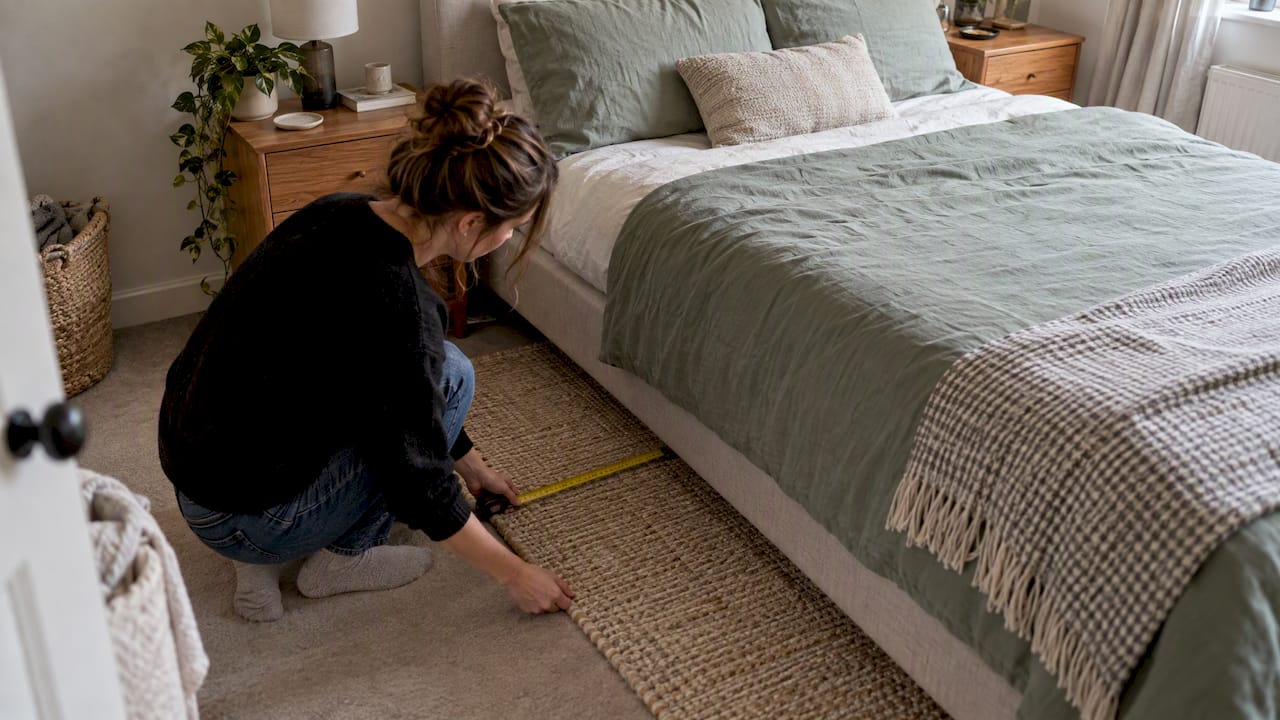
A bedroom rug should generally extend about 45 to 60cm beyond the sides and foot of the bed, giving your feet a warm landing spot the moment they touch the floor. For a standard double or king bed, that usually means a rug somewhere between 200cm by 250cm and 250cm by 300cm. The right choice also depends on which of three placement styles you prefer: full coverage, lower two-thirds, or a simple runner at the foot of the bed.
TL;DR:
- A rug should extend 45 to 60cm beyond the bed on each side for proper coverage, meaning a double bed typically needs about 200cm by 250cm.
- Full coverage under the entire bed suits larger rooms and creates a luxurious feel, while lower two-thirds or runners work better in smaller or more practical spaces.
- Measure your room precisely and mark the intended rug size on the floor before purchasing to ensure proper fit and clearance.
- Flatweave or low-pile rugs are easier to maintain and better suited for under-bed coverage, whereas deeper pile rugs are ideal as bedside accents.
- In rooms with strong existing flooring or limited space, choosing a smaller or shaped rug like a round or runner can enhance style without sacrificing practicality.
Table of Contents
- Recommended rug sizes by bed type
- Placement options and when to use each
- How to measure and test rug size at home
- Materials, pile and practical considerations
- Our practical checklist for getting rug sizing right
- Rug shape options and how they affect bedroom aesthetics
- Colour and pattern selection tips to complement bedroom decor
- Care and maintenance specific to different rug materials in bedroom settings
- Finding the balance between style and function
- Rugs and accessories that match this guide
- FAQ
- Sources
Recommended rug sizes by bed type
Matching rug size to bed size is mostly arithmetic once you know the 45 to 60cm rule. Add that margin to both sides and the foot of the mattress, then round up to a size that is actually sold.
- Single or twin bed (90cm x 190cm): a rug around 120cm x 180cm to 150cm x 210cm works well, especially in a child’s room or guest bedroom.
- Small double (120cm x 190cm): aim for 160cm x 230cm, enough to clear the sides without overwhelming a smaller room.
- Double or full bed (135cm x 190cm): a 200cm x 250cm rug is the common sweet spot, covering the sides generously and leaving space at the foot.
- King bed (150cm x 200cm): 230cm x 320cm or 250cm x 300cm gives proper breathing room on all three exposed sides.
- Super king bed (180cm x 200cm): go up to 250cm x 350cm, or larger, since a smaller rug will look pinched under such a wide frame.
One widely cited guideline is that a bedroom rug should extend 45 to 60cm beyond the bed on each exposed side, which is the figure behind every size above. A double bed is 135cm wide, so adding 60cm to each side brings you to 255cm, close to the 250cm rugs sold for that layout.
If your bedroom is generously proportioned, or you want a showpiece rather than a frame for the bed, sizing up a notch rarely looks wrong. Homes & Gardens notes that it is usually better to choose the largest rug your room and budget allow, since an undersized rug tends to look stranded rather than deliberate. In a tight box room, though, a smaller rug confined to the lower two-thirds often reads better than a large one that leaves almost no floor showing around the edges.

Placement options and when to use each
Bedroom rugs generally follow one of three layouts, and each suits a different room shape or budget.
- Everything on: the rug sits under the entire bed, including the legs and usually the bedside tables, creating a single, grounded surface. This works best in larger bedrooms where a 250cm or wider rug is practical, and it gives the most luxurious, hotel-style result.
- Lower two-thirds: the rug starts roughly where the bedside tables end and runs to the foot of the bed, leaving the head of the bed on bare floor. Ideal Home recommends this layout for smaller bedrooms, since it still anchors the room without needing an oversized rug, and it suggests leaving roughly 7 to 20cm of visible flooring between the nightstand and the rug edge.
- Lower third or runners: one or two runners sit at the sides or foot of the bed rather than a single large rug. This suits rooms with a strong existing floor, such as a patterned carpet or reclaimed boards, where you want texture underfoot without covering the whole surface.
Whichever layout you choose, avoid letting the rug edge cut across the middle of a bedside table; designers are clear that the edge should sit fully under the table or fully clear of it, never halfway. A rug that is too narrow for the bed is the single most common mistake, closely followed by one that is deep enough lengthways but too narrow to clear both sides evenly.
Pro Tip: Lay the rug out before committing to a layout: a rug that looks generous in a shop or online photo can still fall short once your bed frame and nightstands are in the room.
How to measure and test rug size at home
A tape measure and a roll of masking tape will tell you more than any size chart.
- Measure your bed and the clear floor around it, noting the distance from each bed edge to the nearest wall, wardrobe or door swing.
- Add 45 to 60cm to each exposed side of the mattress dimensions to get your target rug size, then check that figure against stock sizes.
- Mark the rug’s footprint on the floor with masking tape or sheets of newspaper, matching the exact length and width you are considering.
- Walk the room and stand on the taped line, checking how it feels getting in and out of bed, and whether drawers, bench seating or the door still open freely.
- Adjust before you buy, shifting the marked rectangle slightly or trying the lower two-thirds option if the full-size mockup feels tight.
This same tape-and-mockup approach works for other rooms too. If you want a fuller walkthrough, our guide to testing living room rug placement covers the same method in more detail, and this piece on testing rug size with tape is worth a look before you order.
Materials, pile and practical considerations
Pile height matters more in a bedroom than almost anywhere else in the house, since you are walking on it barefoot and often half asleep.
- Low pile or flatweave suits full under-bed coverage, since it will not interfere with drawers, bed frame legs or door swings.
- Deeper pile feels best as a bedside accent rug in the lower-third or runner layout, where comfort matters more than clearance.
- Rug pads are worth adding on carpet as well as hard floors, since designers advise using a pad to stop slipping and add stability underfoot, not just on wood or tile.
- Check door and furniture clearance before buying a thick or shaggy rug, as very high pile can catch on doors or bedside furniture.
- Over underfloor heating, a thinner, breathable material lets heat through more efficiently than a dense, heavily backed rug.
Pro Tip: If you are torn between two pile heights, pick the lower one for anything that sits under furniture, and save the plush pile for the open floor you actually stand on.
Our practical checklist for getting rug sizing right
Three mistakes come up again and again: a rug too small for the bed, one that is long enough but too narrow to clear both sides, and a rug edge that lands under the middle of a nightstand instead of beside or beneath it fully. All three are avoidable once you measure first and commit to one placement style.
- For sleek, low-profile bedrooms, a flatweave or bamboo rug sits well under the full bed without adding bulk.
- For a softer landing spot, a smaller pile rug works at the bedside in a lower-third layout.
- For slip resistance, pair any bedroom rug with a dedicated non-slip solution rather than relying on the rug’s own backing.
Our contributor Cristiano put this checklist together after seeing the same three sizing errors recur across reader questions.
Rug shape options and how they affect bedroom aesthetics
Rectangular rugs are the default for good reason: they mirror the shape of the bed and make the 45 to 60cm rule straightforward to apply on every side. A rectangular rug in the everything-on layout reinforces the bed as the room’s main shape, which suits most bedroom layouts.
Round rugs break that symmetry deliberately. Shaped or round rugs change how the spacing rule applies, since there is no single straight edge to measure from, and they tend to work best as a bedside accent rather than a full under-bed cover. A round rug beside a square nightstand also softens a room full of straight lines, which is worth considering in a boxy or symmetrical bedroom.
Runners suit narrow bedrooms or rooms where the bed sits against a long wall, giving length without demanding the width a full rectangular rug would need. Two matching runners, one on each side of the bed, can look more considered than one slightly undersized rectangular rug, particularly in a room where a single large rug would not fit the available floor.

Whichever shape you choose, a bedroom rug works best as a visual anchor that frames the bed. One styling view holds that the rug should introduce colour, pattern or texture while still reading as part of the bed’s footprint, rather than floating as a separate element in the middle of the room.
Colour and pattern selection tips to complement bedroom decor
A bedroom rug carries more visual weight than almost any other soft furnishing in the room, simply because of its size. Start with the walls and bedding: a neutral, textured rug, such as a natural bamboo or flatweave weave, lets patterned cushions or a bold headboard stay the focal point, while a patterned rug works better in an otherwise plain room.
Darker rugs hide marks well in a well-used bedroom and tend to make a large floor area feel more grounded, while lighter, natural tones keep a small room feeling open. If your flooring is already a strong colour or pattern, such as a dark wood or a patterned carpet, a plain rug in a complementary tone usually reads better than two competing patterns.
Texture does some of the same work as colour. A woven bamboo or sisal-look rug introduces warmth and visual interest without the busyness of a printed pattern, which is useful in bedrooms that already have patterned curtains or a decorative headboard. Reserve a strong pattern for rooms with otherwise simple, solid-coloured furnishings, where it has room to stand out rather than compete.
Care and maintenance specific to different rug materials in bedroom settings
How you clean a bedroom rug depends almost entirely on what it is made from, and getting this wrong shortens its life quickly.
Flatweave and bamboo rugs are generally the easiest to live with: a regular vacuum on a low-suction setting keeps dust down, and most spills can be blotted immediately rather than scrubbed. These materials tend to tolerate moisture better than deep-pile wool, making them a practical choice for a bedroom that doubles as a dressing space.
Deeper pile rugs need more frequent vacuuming to stop dust and skin cells settling into the fibres, which matters more in a bedroom than in a living room. A rug pad also protects the pile from flattening under foot traffic near the bed.
Washable rugs, where the material allows it, are worth considering for a child’s room or anywhere spills are likely. Always check the specific care label rather than assuming one method suits every material, since what works for a cotton flatweave can damage a wool or jute weave.
Finding the balance between style and function
A bedroom rug does more practical work than almost any other soft furnishing we buy, so I would rather see someone choose a slightly larger, plainer rug than a smaller statement piece that leaves bare, cold floor around the bed. Style matters, but a rug you cannot walk on barefoot in winter has failed at its main job.
Save the bold pattern or deep pile for a room where practicality is not under daily pressure, such as a guest room. In a main bedroom, I would always favour a washable or low-pile option with a decent non-slip pad, and when genuinely unsure between two sizes, go with the larger one.
— Cristiano
Rugs and accessories that match this guide
Once you know your target size and layout, choosing the actual rug is the easy part. We stock bamboo rugs in flatweave finishes that suit the everything-on layout without adding bulk under the bed frame, including this natural bamboo flatweave floor rug.

- Browse our full rug and home accessories range for sizes across single, double, king and super king layouts.
- Pair any new rug with a non-slip pad using the fixes in our guide to securing a rug on carpet.
- Check room layout advice from Karin Rotem Real Estate if you are also rethinking furniture placement around a new rug.
If you have measured your room and settled on a size, our bamboo rugs collection is a straightforward place to start shopping.
FAQ
Is a 120cm rug big?
A 120cm rug is on the smaller side for a main bedroom rug but works well as a single bedside accent or for a single bed layout. For full under-bed coverage on a double bed or larger, you will generally need something closer to 200cm or more.
Can you wash bamboo rugs?
Bamboo and flatweave rugs are generally easier to clean than deep-pile materials, often tolerating a damp wipe or light wash depending on the specific product. Always check the care label for the individual rug, since backing and weave can affect what cleaning method is safe.
Is a 9x12 rug too big for a queen bed?
A very large rug is larger than most queen bedrooms need but can work well in a spacious room where you want full coverage well past the bed on every side. In a more average-sized bedroom, it would likely leave very little exposed floor around the furniture.
How large should a rug be for a bedroom?
As a starting point, a bedroom rug should extend 45 to 60cm beyond the sides and foot of the bed. For a standard double bed that typically means a rug of around 200cm by 250cm, scaling up for king and super king beds and down for singles.
Sources
- Bedroom rug rules: expert advice on rug size and placement | Ideal Home
- How to choose the right size area rug for your bedroom | Homes and Gardens