Cart
0
TL;DR:
- Thoughtful storage improves mental wellbeing by reducing visual clutter and chaos.
- Stylish, concealed storage solutions can seamlessly blend with decor, maintaining aesthetics.
- Maximising awkward spaces and adopting small habits can significantly increase home organization.
Storage solutions are far more than a tidy-up trick. They shape how a home feels, functions, and even how you feel within it. Research confirms that cluttered spaces increase anxiety, whilst calm, organised rooms genuinely improve wellbeing. This guide goes beyond the basics, showing UK homeowners how to use storage to boost mental clarity, free up usable space, and create interiors that look as good as they function. Whether you live in a Victorian terrace or a modern flat, the right approach to storage can genuinely change your daily experience at home.
Table of Contents
- Why storage matters in modern homes
- Stylish storage: Blending function with decor
- Maximising every corner: Built-in and smart solutions
- Space-saving techniques: Small actions, big impact
- A new take: Why the real storage revolution starts with mindset
- Ready to transform your space?
- Frequently asked questions
Key Takeaways
| Point | Details |
|---|---|
| Elevates wellbeing | Effective storage creates calm, reduces anxiety, and makes home routines smoother. |
| Enhances home value | Built-in and clever storage can boost property value and usable space, especially in awkward corners. |
| Blends style and function | Modern concealed solutions keep your interior looking sharp while hiding clutter. |
| Small changes, big results | Techniques like decluttering and file folding offer dramatic space gains even in tiny rooms. |
Why storage matters in modern homes
Now that we’ve set aside the old myths, let’s uncover why storage is a non-negotiable need in modern living. Many people still think of storage as a last resort, something you turn to when things spiral out of control. In reality, thoughtful storage is one of the most proactive investments you can make in your home and in your own peace of mind.
The science here is worth paying attention to. Organised homes create calm and reduce the background stress that accumulates when your environment feels chaotic. Think about the difference between walking into a kitchen where every surface is clear versus one where last night’s post is mixed with the cereal boxes and a broken umbrella is propped against the fridge. Your brain registers that chaos instantly, and it costs you energy you didn’t plan to spend.
“A well-organised home isn’t just easier to live in — it’s a different emotional experience altogether. When your space works for you, your mind follows.”
The impact of storage solutions extends well beyond tidiness. It affects how efficiently your family moves through daily routines, how safely young children can play, and how confidently you can invite guests over at short notice. Here’s a snapshot of the core benefits that good storage delivers:
- A calmer mind: Reducing visual clutter lowers background anxiety and helps you feel more in control of your environment.
- More usable space: Smart storage reclaims square footage, turning awkward corners and dead zones into genuinely functional areas.
- Easier, faster cleaning: When everything has a designated place, cleaning takes a fraction of the time it does in disorganised rooms.
- Safer home for families: Proper storage removes trip hazards and keeps sharp or fragile items safely out of reach of small children.
- A stronger sense of ownership: When you can see and access your belongings easily, you appreciate them more and waste less money buying duplicates.
Each of these benefits compounds over time. A home that is consistently easier to navigate and maintain becomes a place you genuinely look forward to being in.
Stylish storage: Blending function with decor
While the benefits of storage are clear, many people worry about the impact on their home’s look. Here’s how solutions can add rather than detract from your decor. The assumption that storage means ugly plastic bins or industrial shelving belongs firmly in the past.
The most forward-thinking approach to storage today involves concealment and integration. Stylish storage integrates with decor using concealed solutions like jib doors, curtains, or matching finishes, maintaining aesthetics without visual clutter. A jib door, for example, is a flush door finished in the same panelling or wallpaper as the surrounding wall, making an entire storage room practically invisible to the eye. Panelled cabinetry painted in the same tone as your walls achieves something similar in a kitchen or living space.
The key is understanding that great storage design is as much about what you don’t see as what you do. Browse a decorative storage guide and you’ll find that the most admired interiors use storage to create clean lines rather than interrupt them.
Here’s how classic and modern storage approaches compare:
| Feature | Classic storage | Modern concealed storage |
|---|---|---|
| Aesthetic impact | Can feel bulky or visually busy | Blends seamlessly with the room’s design |
| Accessibility | Items clearly visible and easy to grab | Requires labelling or memory, but stays elegant |
| Cost | Generally lower upfront | Higher initial investment, longer-term value |
| Flexibility | Easy to reposition or remove | Usually fixed or semi-permanent |
| Best suited for | Utility rooms, garages, children’s rooms | Living rooms, hallways, open-plan kitchens |
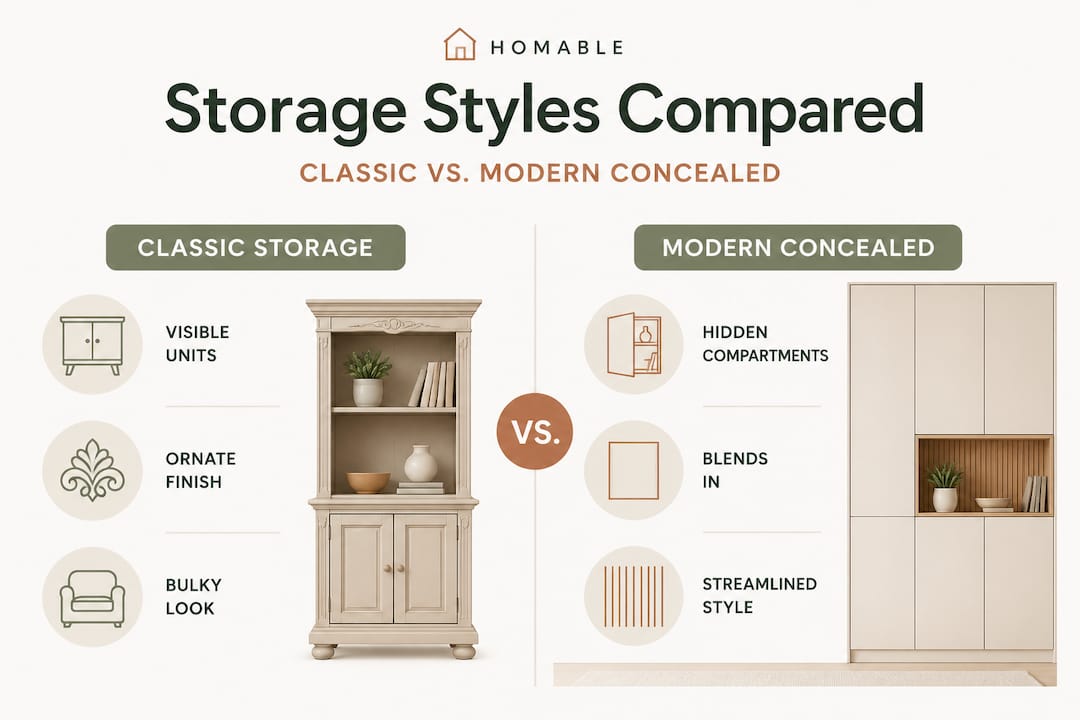
For inspiration on real homes that have pulled this off beautifully, exploring stylish storage examples is a brilliant starting point.
Pro Tip: Before purchasing anything, write down your three non-negotiables for your room’s style — whether that’s a particular colour palette, a material such as rattan or oak, or a specific mood like cosy and warm. Every storage piece you choose should honour at least two of those three criteria.
Maximising every corner: Built-in and smart solutions
Beyond the obvious, some of the most powerful storage upgrades come from rethinking the nooks and crannies often ignored. Most UK homes, particularly older ones, are full of underused spatial opportunities: the void beneath a staircase, the awkward eaves in a converted loft, the recessed alcoves on either side of a chimney breast.
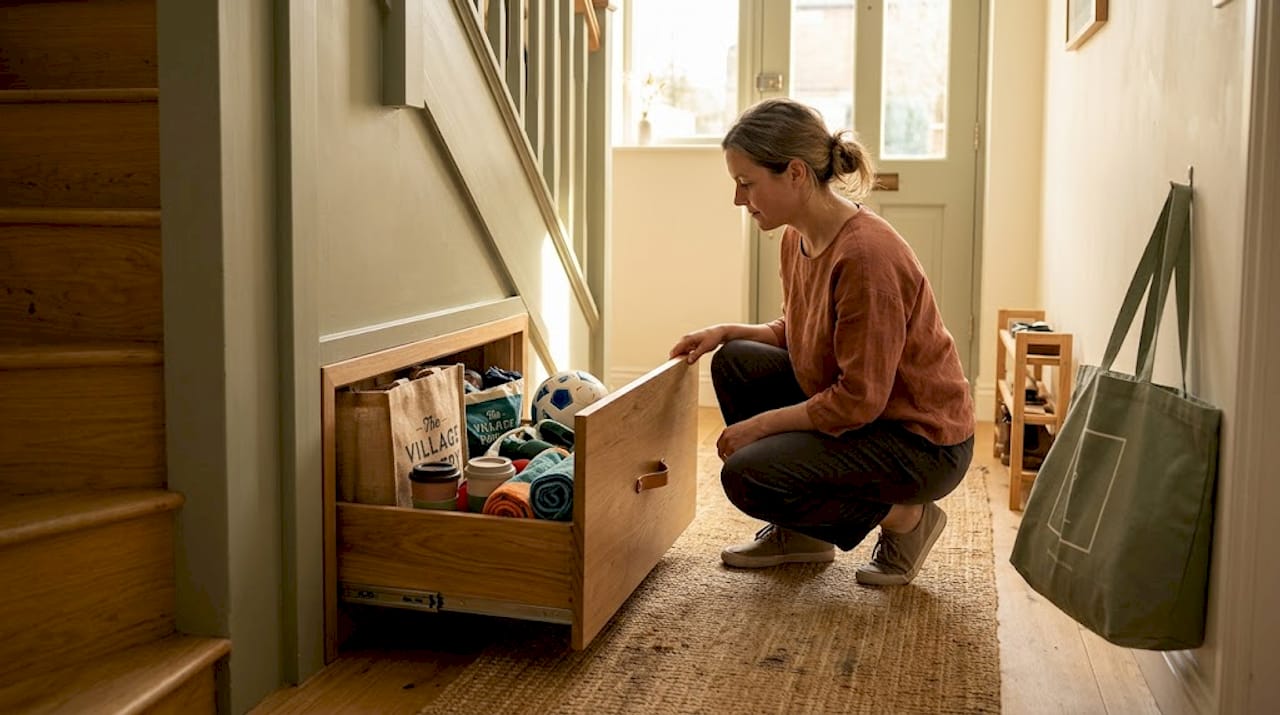
Built-in storage maximises awkward spaces with custom layouts, and the financial argument is compelling. Loft boarding alone can add up to £10,000 to your property’s value, making built-in solutions one of the smarter home investments you can make. Beyond financial returns, the functional gains are immediate and substantial.
Here’s a quick reference for matching awkward spaces with smart storage solutions:
| Space type | Suggested storage solution | Added utility or value |
|---|---|---|
| Under stairs | Pull-out drawers, coat hooks, shoe racks | Clears hallway, creates a purpose-built zone |
| Alcoves | Fitted shelving or cabinetry | Frames the room, adds character and function |
| Loft eaves | Low-profile drawers, shelving | Reclaims otherwise wasted square footage |
| Under bed | Drawers or lift-up ottoman base | Frees wardrobe space significantly |
| Above doorways | Floating shelves | Perfect for books, baskets, and display items |
Exploring creative storage ideas can spark solutions specific to your home’s layout. Once you’ve found the right approach, the implementation process is straightforward if you follow a logical sequence.
Here’s how to assess and commission built-in storage effectively:
- Map your unused spaces. Walk through each room with a notepad and photograph every nook, alcove, or corner that currently holds clutter or nothing at all.
- Measure accurately. Record the height, width, and depth of each space, noting any obstructions such as pipes, sockets, or light switches.
- Define what you need to store. Different items demand different storage depths. Books need roughly 25cm, clothing needs 55cm to 60cm, and bulky items like vacuum cleaners need much more.
- Decide between bespoke and flat-pack. Bespoke joinery offers a perfect fit but costs considerably more. Many flat-pack systems, when trimmed and finished with matching paint or trim, look impressively custom.
- Get at least three quotes. If commissioning a joiner or carpenter, compare quotes carefully and ask to see completed projects from previous clients.
Following a clear step by step storage guide ensures you don’t skip critical planning phases that could lead to costly reworks.
Space-saving techniques: Small actions, big impact
With the big pieces in place, let’s focus on the everyday habits and methods that help storage work harder, even in modest homes. You don’t need a full renovation to make a meaningful difference. Some of the most effective techniques cost very little and can be implemented in a weekend.
One of the most commonly overlooked techniques is vertical storage. Most rooms use only the bottom two metres of wall space, leaving the upper third entirely bare. Fitting shelving all the way to the ceiling, even if the highest shelves hold only seasonal items or decorative pieces, dramatically increases the storage capacity of any room without claiming a single centimetre of floor space.
Here are the most impactful space-saving techniques worth trying now:
- Vertical shelving: Mount shelves high and use a small step stool to access upper levels. This alone can double storage in a living room or bedroom.
- Ottoman and bench storage: Multifunctional furniture like ottomans and beds with built-in drawers serve dual purposes without adding visual bulk.
- File folding clothes: Rather than stacking clothes in piles, fold and stand them vertically in drawers so each item is visible at a glance. This method can free up two-thirds of drawer space immediately.
- Drawer dividers: Dividers prevent the inevitable drift where smaller items migrate and create disorder. Use them in kitchen drawers, bathroom cabinets, and dressing tables.
- Door-mounted organisers: The backs of cupboard doors are prime, underused real estate. Slim racks here can hold spices, cleaning products, shoes, or accessories.
- Labelled baskets and bins: Categorising stored items with clear labels reduces the time spent searching and makes it far easier to put things back correctly.
Pro Tip: Always declutter before you organise. Buying more storage for items you no longer need is like redecorating a room you’re about to gut. Clear out first, then measure what truly needs a home. You’ll likely need far less storage than you think.
Use the space-saving checklist to audit each room systematically, and refer to practical small spaces organising tips for room-specific strategies in compact UK homes.
A new take: Why the real storage revolution starts with mindset
Having seen the range of practical solutions, it’s time to examine what truly transforms a home beyond the shelves and boxes. Here’s an uncomfortable truth that the storage industry rarely says aloud: most people who buy more storage don’t actually solve their problem. They just give their clutter a tidier address.
We’ve watched homeowners invest in beautiful fitted wardrobes, only to fill them to bursting within three months. The product wasn’t the problem. The habit was. Real, lasting organisation is fundamentally a mindset shift, not a shopping trip.
The most effective homes we’ve seen work on a simple principle: every item that enters the home needs a reason to stay. Decluttering first, then organising is the only sequence that produces lasting results. When you organise without first editing, you’re building systems around possessions you may not even value.
What makes the biggest practical difference isn’t the storage unit itself. It’s the small daily habits that prevent clutter from accumulating in the first place. A landing table near the front door, for example, gives post, keys, and bags a consistent home. That single piece of furniture, used intentionally, can prevent the hallway chaos that plagues so many UK homes.
There’s also a psychological dimension worth taking seriously. Rooms that feel genuinely spacious, where you can see the surfaces and move freely, have a measurable effect on mood and cognitive function. Interestingly, homes that use multifunctional pieces strategically tend to feel up to 20% more spacious, not because they have more square footage, but because each piece earns its place visually and functionally.
The real question isn’t “where do I put all this stuff?” It’s “do I actually need all this stuff?” Answering honestly is the start of a genuinely transformed home, one that feels like a retreat rather than a warehouse.
Ready to transform your space?
Feeling inspired to bring some real order and style to your home? At Homable, we’ve curated a collection of storage and decorative pieces designed specifically with modern UK homes in mind, balancing practicality with the kind of aesthetic you’d actually want on display.
Whether you’re looking for a statement piece to anchor a room or a clever solution to tame a chaotic corner, our range makes it easy to shop by style, room, or function. From decorative accents that double as conversation starters to practical organisers that blend seamlessly with your existing decor, every product is chosen because it earns its place in a thoughtfully styled home. Browse our best sellers and new arrivals, and enjoy free shipping on orders over £100.
Frequently asked questions
Do storage solutions really add value to my home?
Yes, built-in storage such as loft boarding can add up to £10,000 to your property’s value, making it one of the more financially rewarding home improvements available to UK homeowners.
What is the best way to start decluttering?
Begin by sorting items into keep, donate, and discard piles before introducing any new storage. Decluttering before organising is the only approach that produces results that actually last beyond a few weeks.
What are some stylish storage ideas for small spaces?
Try concealed shelving, ottomans, or cabinets painted to match your walls. Concealed storage solutions maintain aesthetics without adding visual clutter, which is especially valuable in compact rooms.
How much space can file folding clothes save?
Folding clothes vertically in a file style rather than stacking them can free up two-thirds of the space in a standard drawer, making it one of the easiest and most impactful quick wins you can try today.