Cart
0
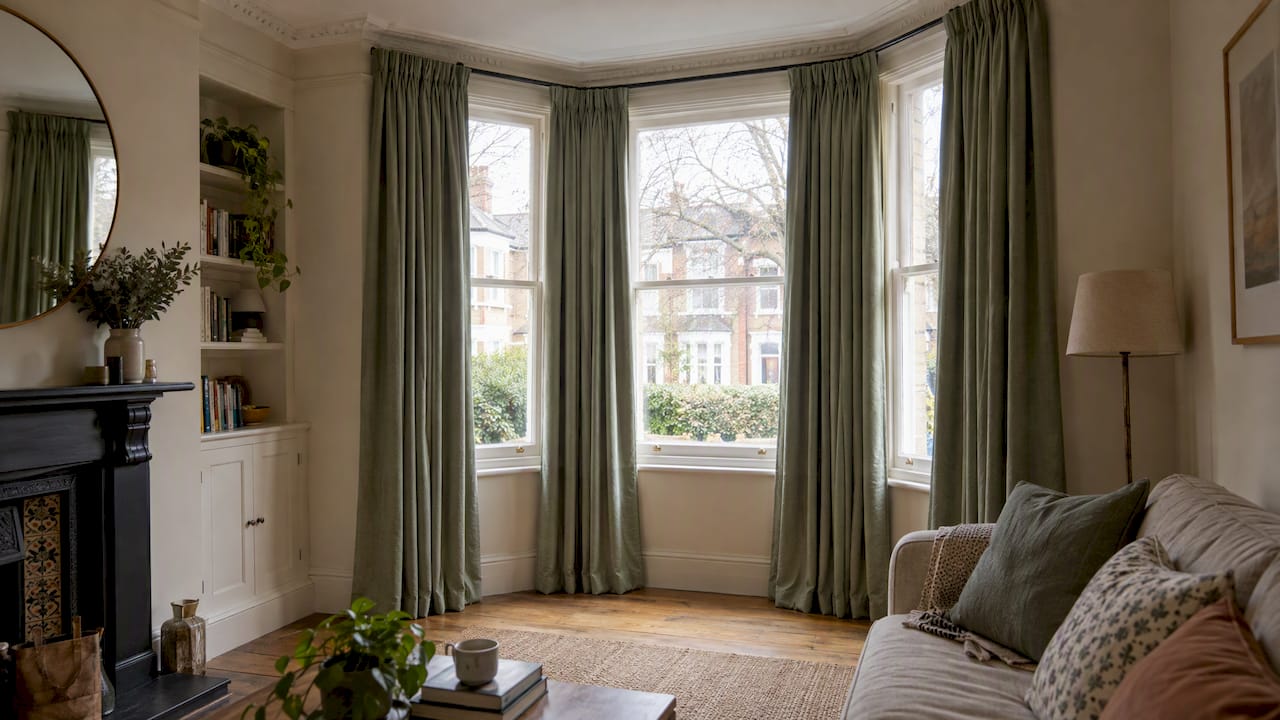
For most bays, stationary side panels that frame the whole window often work best. If every section needs to open, fitting a panel per wall with a shaped track can be considered. For window seats, a Roman shade per section is frequently a practical choice. The right answer depends on what sits below the bay and how much wall space is available for stacking. Read on for styling ideas, then the measuring and hardware steps that decide the final choice.
TL;DR:
- Measure each bay section separately, record corner angles and bracket depth, and mount hardware about 15 to 25 cm above the frame for clearance and stacking.
- Standard gliders cannot cross track corner connectors, so use independent panels; shaped tracks suit curved bays, bendable poles gentle angles, and separate rods sharp turns.
- Daily use favors eyelets, rings, or wave headings on tracks; use roughly one and a half to two times the window width for full folds.
- Bedrooms need blackout lining or layered sheers and blackout curtains, with enough side space for panels to close fully; kitchens suit café curtains or section shades.
Table of Contents
- 1. Styling ideas that work for bay windows
- 2. How to choose the right approach for your bay
- 3. Measuring, hardware and installation essentials
- 4. Fabric weight, headers and styling details
- 5. Room-specific adjustments for living rooms, bedrooms, kitchens and window seats
- 6. How our curtain and blind range fits each bay solution
- 7. Final finishing touches for a bay window scheme
- Shop curtains, blinds and finishing touches with Homable
- FAQ
- Sources
1. Styling ideas that work for bay windows
Bay windows reward a bit of planning because three (or more) angled sections need to read as one. These ideas group by look and function, so you can match one to your room before worrying about fittings.
- Sheer and airy: a single run of voile or linen across the whole bay softens light without blocking the view, and suits living rooms with a lot of natural light.
- Layered with blinds or shades: fit a roller or Roman blind in each section, then add curtains that frame the full bay from outside the recess. Mounting the curtain pole high and wide stops it clashing with the blind headrail, which is the main reason this combination is widely recommended for light control and finish.
- Patterned statement curtains: a bold print on curtains reads as confident rather than busy, because the fabric sits folded for most of the day and is only fully seen when drawn.
- Luxe blackout velvet: heavy velvet on a pinch-pleat heading gives a hotel-style finish and works well in bedrooms or formal living rooms.
- Tailored pinch-pleat framing: stationary panels either side of the bay, mounted outside the recess, give a crisp, structured look without needing to track around corners.
- Café or half-curtains: fabric covering only the lower half of each pane suits kitchens, keeping privacy at worktop height while letting light in above.
- Puddled drama: extra length pooling on the floor suits formal rooms with less foot traffic near the window.
- Apron-length for window seats: curtains that stop just below the sill keep cushions and storage accessible.
- Across-front curtain to hide storage: a single curtain hung on a straight track in front of the whole bay conceals under-seat storage or radiators without fitting into each angle.
- Soft tiebacks and swags: a simple tieback at a third of the way down adds shape to plainer fabrics without extra cost.
Each works best in particular conditions. Sheers and layering suit bays with good wall space either side; café curtains and apron lengths suit kitchens and window seats where full-length fabric would get in the way. Pattern and velvet lean into living rooms and bedrooms where the curtain can be the focal point rather than a practical screen.
2. How to choose the right approach for your bay
Before picking a style, answer a few quick questions. They narrow the three main bay solutions down to one fairly quickly.
- What sits below the window? A radiator, bench or window seat usually rules out full-length puddled curtains.
- Does the curtain need to open and close daily, or can it stay mostly stationary?
- How much flat wall sits either side of the bay for stacking panels when open?
- Are you keeping existing blinds or shutters, or starting from scratch?
Practical guidance on bay windows groups most solutions into three reliable routes, and the right one depends largely on what’s under the window and how much stacking space you have either side of the recess, according to bay window guidance from TheHues.
| Bay condition | Recommended solution |
|---|---|
| Radiator, bench or fitted seat below | Frame with stationary side panels |
| Clear wall either side, curtains need to open | Panel per section on a shaped track |
| Window seat you want to keep usable | Roman shade per section |
| Keeping existing blinds, want a finished look | Layer stationary panels over the blinds |
If there’s a bench or radiator under the bay, framing with stationary panels mounted high and wide is often the simplest way to get a tailored finish without fighting the architecture, a point echoed in the same TheHues guidance.
3. Measuring, hardware and installation essentials
Each section of a bay needs its own measurement, because angles and section widths rarely match even in a symmetrical-looking bay. Measure the width of each pane separately, then measure the return angle where the sections meet, and check the mounting height above the architrave before ordering track or poles.
- Measure each wall section of the bay individually, not the total span in one line.
- Note the angle at each corner, since this decides whether a shaped track or separate rods per section will sit flush.
- Check the depth from window to the point where you plan to mount brackets, so curtains clear the sill and any handles.
- Decide mounting height: higher mounting (around 15 to 25cm above the frame) makes the window look taller and gives more stacking room.
- Confirm how much wall you have either side for stacked panels before buying wide curtains.
A shaped ceiling track follows the curves of a bow or curved bay well, a bendable pole suits gentler angles, and separate rods per section are the simplest fix for sharply angled bays. Standard gliders generally cannot cross the corner connectors on a continuous track, which is why many fitters recommend one independent panel per wall section rather than trying to bridge the corners. For step-by-step numbers, our curtain size guide and curtain length rules walk through the exact measurements to take.
Pro Tip: Measure twice from the floor and once from the ceiling line before ordering, since bay window floors are rarely perfectly level.

4. Fabric weight, headers and styling details
Fabric choice decides whether a bay feels bright and open or warm and enclosed. Sheers, voiles and linen let light through and layer well over blinds, while interlined, velvet or wool curtains add insulation and near-blackout coverage, a distinction fabric guidance from Homes & Gardens sets out clearly.
- Pencil pleat and pinch pleat suit stationary framing panels, giving a tailored, structured look.
- Eyelets, rings and wave or ripple headings run more smoothly along tracks, which matters most when each bay section needs to open daily.
- Fullness of roughly one and a half to two times the window width keeps folds looking full rather than flat once closed.
- Length depends on what’s below: floor-sweeping for open wall, apron-length for seats and radiators.
- Interlining adds both insulation and a heavier drape, which helps pattern and plain velvet alike hang well.
Designers encourage treating curtains as a safe place to use bold pattern, since the fabric is folded away during the day and only fully revealed once drawn, a point Laurence Llewelyn-Bowen makes in Ideal Home. That’s a useful permission slip if a plain bay has always felt safe but a little flat.
5. Room-specific adjustments for living rooms, bedrooms, kitchens and window seats
The same bay solutions shift slightly depending on the room.
- Living room: full-length panels or side framing suit most layouts; in a large bay, interlined or wool-blend fabric adds warmth without losing light during the day.
- Bedroom: blackout lining, or layered sheers with a blackout curtain behind, gives full darkness, and stacking space either side matters more here so the panels can close completely at night.
- Kitchen: café-style half-curtains or a Roman shade per section avoid trailing fabric near hobs and sinks, where floor-length curtains are impractical.
- Window seats: per-section shades or apron-length curtains keep cushions and under-seat storage usable, rather than burying them behind puddled fabric.
Lighting around a bay, such as LED coving or downlights offset to wash down the curtain line, can also change how the fabric reads once drawn, a styling note from Ideal Home’s bedroom bay window guidance.
6. How our curtain and blind range fits each bay solution
We carry product types that map directly onto the three main bay approaches, so you can match a style decision to something you can actually order.
- Bamboo roller blinds suit the layered approach, sitting behind framing panels for light control.
- Bamboo curtains, including the Bamboo Curtain 90x200 cm, work well for café-style or lightweight layered looks where a natural texture suits the room.
- Our curtain trends 2026 guide covers wave and ripple headings for anyone leaning towards the panel-per-section route.
- Our double curtain rod ideas page covers mounting heights for anyone layering curtains over existing blinds.
7. Final finishing touches for a bay window scheme
Scale the pattern to the room rather than the window, since a bay often reads as one long run of fabric once the panels are open.
Pro Tip: Match tieback weight to curtain weight, order swatches before committing, and measure twice.
— Cristiano
Shop curtains, blinds and finishing touches with Homable
Once you know which bay solution suits your window, we make it simple to put it together. Our curated range covers bamboo curtains, bamboo roller blinds and the accessories that finish a scheme, alongside the measuring guides above so you order the right size the first time.

- Browse bamboo curtains for a lightweight, textured layering option.
- Check our curtain size guide before ordering to avoid a reorder.
- Pair your new curtains with wall art; how art shapes the mood of a room is a useful read on getting the balance right.
- Orders over £100 ship free, so it’s worth planning blinds and curtains together.
Head to our shop to see the full range and start putting your bay window scheme together.
FAQ
What kind of curtains look best on a bay window?
Stationary pinch-pleat side panels mounted high and wide generally give the most tailored look for most bays, especially when there’s a radiator, bench or seat below the window. Where you need the curtains to open and close daily, a panel per wall section on a shaped track suits better.
What type of curtain is best for a bay window?
It depends on what’s below the window and how much wall space you have either side for stacking. Framing with side panels works for most rooms, a panel per section suits bays with clear wall space, and a Roman shade per section suits window seats.
How do you dress a bay window with curtains?
Measure each wall section of the bay separately, including the corner angles, before choosing between a shaped track, a bendable pole, or separate rods per section. Mount the hardware high and wide to maximise stacking space, then choose a fabric weight and heading that match how often the curtains need to move.
Should you put curtains on a bay window?
Curtains on a bay window are optional rather than essential, but they soften the architecture and improve insulation when fitted with interlined or heavier fabric. Many homes combine curtains with blinds in each section for better light control and a more finished look.
Sources
- Laurence Llewelyn-Bowen on being bold with your curtains | Ideal Home
- Bay window curtains: three solutions that work | TheHues
- How to hang curtains over blinds or shades | Homes & Gardens