
Cart
0
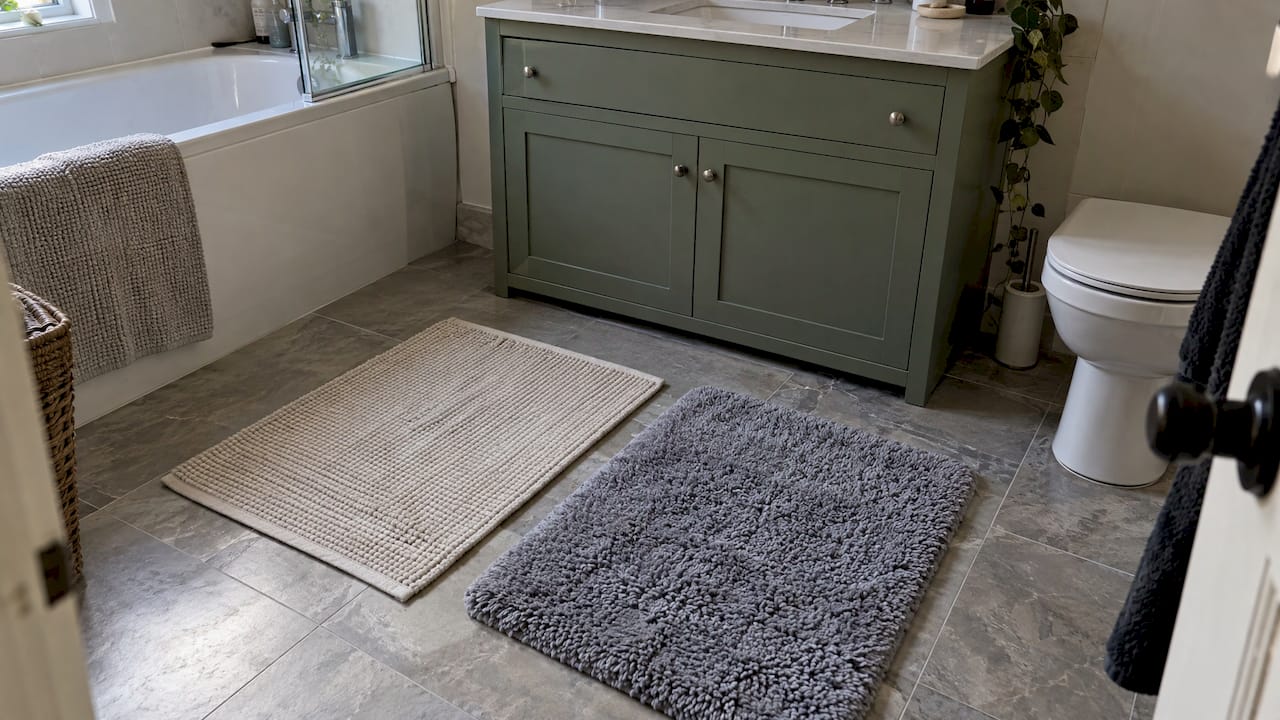
Cotton is the better choice if you want a mat that soaks up puddles and feels like a towel underfoot. Microfibre is the better choice if your bathroom stays damp and you need a mat that dries between showers. Neither wins everywhere, so the right answer depends on how your bathroom is ventilated, how many people use it and how often you are willing to wash the mat.
This guide compares the two on the things that matter day to day: absorbency, drying time, feel, care, durability and environmental impact. It then shows how to pick, and where our own bath mat sets fit in.
TL;DR
- Cotton is a natural fibre that absorbs very well and feels soft, but it holds on to water and can stay damp for longer in a humid room.
- Microfibre is a synthetic fibre that tends to feel plush and dry more quickly, but it sheds tiny fibres in the wash.
- Whichever you choose, wash the mat at least weekly if it is used daily, and every 3 to 4 days in a damp bathroom.
- Weave, pile height, backing and size affect performance as much as the fibre itself.
- For a small, busy bathroom, a set of two mats and a rotation routine beats any single “perfect” material.
Table of Contents
- The short comparison
- What is the difference between cotton and microfibre?
- Absorbency and drying time
- Softness, comfort and durability
- How often to wash a bath mat
- The environmental picture
- What to look for in an absorbent bath mat
- Which should you choose?
- Our view
- Shop bath mats at Homable
- FAQ
- Sources
The short comparison
Here is the whole decision on one page. The details behind each row follow below.
| Factor | Cotton | Microfibre |
|---|---|---|
| Fibre type | Natural | Synthetic (polyester or similar blends) |
| Absorbency | Very high, the fibre itself takes up water | High, water is held between very fine strands |
| Drying speed | Slower, especially in humid rooms | Usually quicker |
| Feel underfoot | Soft, towel-like | Plush, often silky or fluffy |
| Washing | Machine washable, may shrink slightly | Machine washable, best at cooler temperatures |
| Best for | Well-ventilated bathrooms, families who want a natural feel | Small, steamy or windowless bathrooms |
| Main environmental point | Water-intensive to grow, organic cotton reduces some impacts | Sheds microfibres when washed |
What is the difference between cotton and microfibre?
The difference starts with the fibre. Cotton comes from the seed pod of the cotton plant and is a natural, plant-based material. Microfibre is man-made, usually from polyester or a polyester and polyamide blend, spun into strands much finer than a human hair. Because the strands are so fine, a microfibre mat packs a lot of surface area into a thick, soft pile.
That structure explains most of what you notice at home. Cotton fibres take water into the fibre itself. Synthetic fibres mostly do not: they hold water in the gaps between strands instead. Both approaches can leave you with a mat that stops puddles, but they behave differently once the shower is off.

Absorbency and drying time
In a straight absorbency test, natural fibre wins on the fibre alone. A University of Manchester study on fabric moisture management found that a sample containing 95% cotton showed the best water absorption and capillary effect, while a sample made of synthetic fibres showed the least. That is the hydrophilic (water-loving) nature of cotton against the hydrophobic nature of synthetics.
But absorbing water and dealing with it afterwards are two different jobs. Textile testing specialists James Heal explain that cotton does not wick efficiently or dry out easily because the fibre itself is so absorbent. For quick drying, they point to synthetic yarns with a low or zero absorption rate, such as polyester.
What does that mean on a bathroom floor?
- A cotton mat takes the water you drip and keeps it. In a bathroom with an open window or a heated towel rail, it will dry. In a steamy room with no airflow, it can stay damp from one shower to the next.
- A microfibre mat soaks up water into its dense pile, then releases it to the air faster, so it is usually dry sooner.
Construction matters as much as fibre. In The Independent’s 2026 bath mat tests, the best overall pick was a pure cotton design that dried quickly between uses thanks to its textured weave, and the best for quick drying was a thin Egyptian cotton mat, about as thin as a towel, whose woven pile still absorbed well. So a flat-woven, thinner cotton mat can dry far faster than a thick, deep-pile one. The same logic applies to microfibre: a thick, dense pile holds more water and takes longer to release it.
A useful rule: thin and woven dries faster, thick and fluffy absorbs more but dries slower, whichever fibre you pick.
Softness, comfort and durability
Cotton feels like a good towel: soft, slightly cool, familiar. Many people prefer it for bare feet first thing in the morning. It is also easy to live with, being machine washable, though it may shrink a little after washing, so it pays to check the care label and avoid very hot cycles unless the label allows them.
Microfibre feels plusher and often silkier, with a deep, springy pile. It suits people who want that spa-like sink-your-toes feel. The pile can flatten if it is washed too hot or dried on a high heat, so a gentle wash and low-heat drying help it keep its texture.
On durability, the honest answer is that how you treat the mat counts for more than the fibre. Three habits do most of the work:
- Let it dry fully. A mat that is regularly damp is the one that smells and breaks down first.
- Wash it at the temperature on the label. Heat is what flattens pile and shrinks cotton.
- Shake it out and hang it up. Draping the mat over the side of the bath or a towel rail between uses lets air reach both sides.
How often to wash a bath mat
This is the part most people skip, and it matters more than the material. A bath mat sits on the floor of a warm, damp room, which is exactly where mould and mildew like to grow.
According to Woman & Home’s cleaning expert advice, if you use your mat every day you should wash it at least once a week, and every 3 to 4 days if it gets wet frequently or sits in a damp area. That is a sensible baseline for both cotton and microfibre.
Ideal Home reports an expert view that most people wash their bath mats only once or twice a year, which lets bacteria and mould build up in the fibres. The same piece suggests replacing bath mats about once a year as they wear. Treat that as a guide rather than a rule: a mat that is washed regularly, dries well and keeps its backing intact can stay in use for longer.
A simple care routine
- Hang the mat up after every shower rather than leaving it flat on the floor.
- Wash weekly, or every 3 to 4 days in a damp bathroom or a busy household.
- Wash cotton and microfibre according to the care label, and tumble dry on the setting the label gives, or dry flat or on a rail.
- Do not use fabric softener on microfibre. It can coat the fibres and reduce how well they absorb.
- Buy a second mat so one can dry while the other is in use. This is the single easiest way to keep a bathroom fresh.
The environmental picture
Both fibres have a footprint, and they are different ones.
Cotton
Cotton is natural, but it is thirsty to grow. The Guardian’s guide to cotton towels reports that cotton uses 3% of global water, and that dyeing and treating textiles is responsible for 17% of industrial water pollution. The same article reports a Textile Exchange survey of 82,000 hectares in 2014, which found lower global-warming potential, less soil erosion and less water and energy use among organic growers than conventional ones. If cotton is your choice, an organic or responsibly sourced label is worth looking for. Note that the Guardian data dates from 2016.
Microfibre
Synthetic fabrics shed tiny fibres in the washing machine. Research from the Marine Conservation Society’s 2025 microfibres policy paper estimates that between 700,000 and 7 million microfibres are released with every wash of textiles. The All-Party Parliamentary Group on Microplastics report says UK households do as much as 68 million loads of laundry a week.
The good news is that how you wash makes a measurable difference. A PLOS One study of real soiled UK household laundry found that moving from a 40°C, 85-minute cycle to a 15°C, 30-minute cycle cut microfibre release by 30%. So if you own microfibre mats, washing them cool, on a short cycle and with a full drum is a practical way to reduce shedding.

What to look for in an absorbent bath mat
If you are searching for the most absorbent mat, fibre is only one of five things to check.
- Pile and weave. Dense, looped or woven surfaces hold water without becoming heavy. A very thick shag looks luxurious but takes longest to dry.
- Backing. A non-slip backing is a safety feature on a wet floor. Check that it is suitable for the washing temperature on the label, because some backings break down in a hot wash.
- Size. A mat that covers the spot where you step out of the shower or bath absorbs far more than one that only catches a corner. Measure the floor first.
- Washability. Choose a mat you can put in the machine. If it needs hand cleaning, you will wash it less often.
- Your bathroom. A bathroom with a window and a radiator copes happily with cotton. One with no airflow often suits a quicker-drying mat better.
If you also wonder whether you need a mat or a rug at all, our guide on bath mat vs rug walks through the checks before you choose a style.
Which should you choose?
| Your situation | Better fit |
|---|---|
| Bathroom with a window or heated towel rail | Cotton |
| Small, steamy, windowless room | Microfibre or a thin, flat-woven mat |
| You want a natural, towel-like feel | Cotton |
| You want a plush, spa-style pile | Microfibre |
| Busy family bathroom, daily use | Either, as a set of two so one can dry |
| You want to limit shedding in the wash | Cotton, or microfibre washed cool and short |
If you are replacing bathroom pieces and thinking about the whole room, it can also help to browse bathroom furniture ranges to see how a mat, storage and layout work together in the space.
Our view
Most advice treats this as a fibre contest. In our experience, the bigger win is having a mat that suits the room and a routine that keeps it fresh.
We build our bath mat range around the things shoppers tell us they care about: soft underfoot, absorbent, non-slip and machine washable. Our sets come with more than one mat, which makes rotating easy, and that habit does more for hygiene than any single material choice.
If you like a natural look, we also offer woven jute and bamboo bath mats that bring texture and an eco-friendly feel to the bathroom. Choose by the size of your floor, the airflow in the room and how you like it to feel, and you will be happy with the result.
Cristiano
Shop bath mats at Homable
We stock bath mat sets in soft, absorbent, non-slip styles that are described as machine washable, alongside natural options. A soft absorbent bathroom mat set is a good place to start if you want two mats to rotate. If you prefer a natural texture, look at our hand-woven jute bathroom mat set or the bamboo bath mats. Orders over £100 ship free.

You can browse the full range of home accessories on the Homable homepage.
FAQ
Are cotton bath mats good?
Yes. Cotton is soft, absorbent and easy to wash, and a flat-woven cotton mat can dry quickly in a ventilated bathroom. Its weakness is damp rooms, where it can stay wet for longer, so hang it up after use and keep a spare to rotate.
Is microfibre or cotton more absorbent?
Cotton fibres absorb water into the fibre itself, and a University of Manchester study found a high-cotton sample absorbed best. Microfibre holds water between very fine strands and usually releases it faster. For a bathroom that stays humid, quick release can matter more than raw absorbency.
How often should you wash a bath mat?
If you use it every day, wash it at least once a week. In a damp bathroom or one that gets wet often, wash it every 3 to 4 days. Always follow the care label for temperature.
What is the difference between a bath mat and a bath rug?
A bath mat is usually flatter and sized to sit by the bath or shower to absorb drips. A bath rug is typically larger and thicker, and often more decorative. Our bath mat vs rug guide covers how to choose between them.
Why do people use bath mats in showers?
A mat gives you a dry, warmer, grippier place to step out onto, and it stops water spreading across the floor. A non-slip backing adds to that, particularly on tiles.
Sources
- Moisture Management Ability of Different Fabrics, University of Manchester
- Applications Insight: Dry Rate Testing, James Heal
- Best bath mats for 2026, The Independent
- How often should you wash bath mats? Woman & Home
- Experts reveal how often you should wash bath mats, Ideal Home
- The eco guide to cotton towels, The Guardian
- Microfibres Policy Paper, Marine Conservation Society
- All-Party Parliamentary Group on Microplastics report
- Microfiber release from real soiled consumer laundry, PLOS One