Cart
0
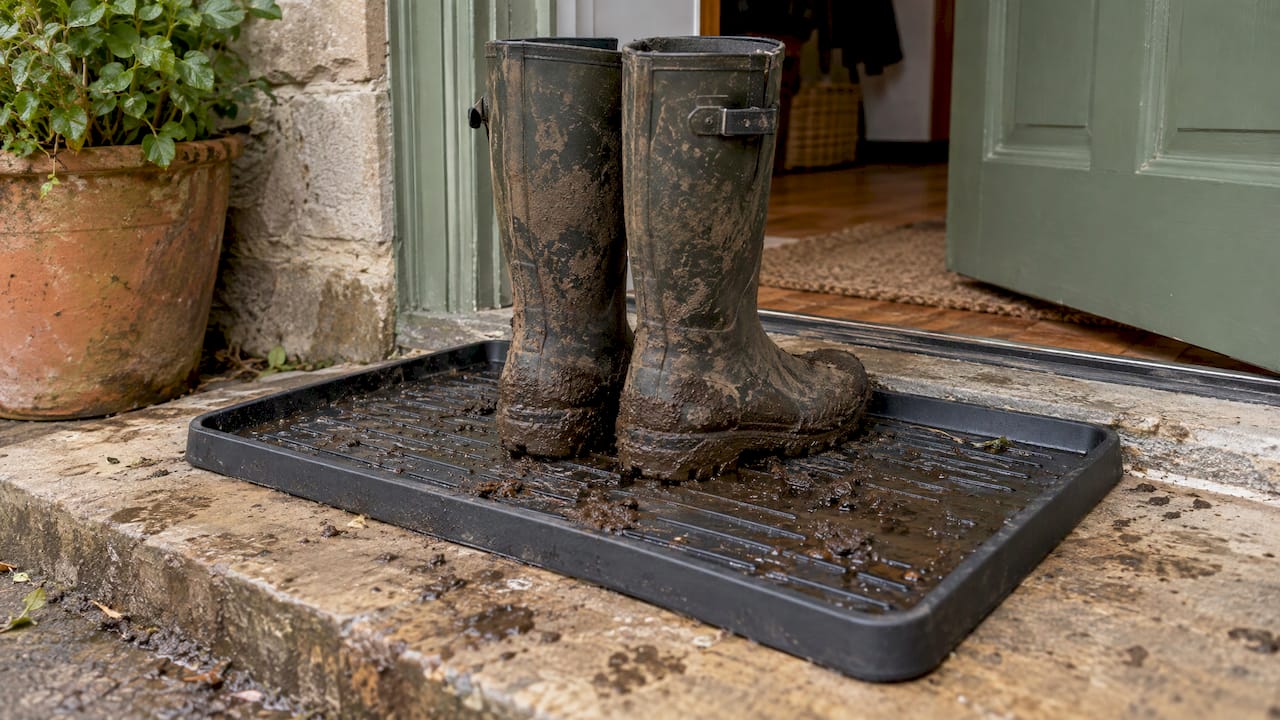
The best muddy boots mat is usually a rubber tray or scraper-style mat with a raised edge and drainage, placed where you take your boots off, with a dense absorbent mat just inside the door for the damp that remains. One mat rarely does both jobs. Pick the mat that matches where your boots meet the floor, how much mud comes in and how easily you will clean it, and you will stop sweeping the hallway every evening.
This guide covers the types of mat, what to look for, where to put it, how to protect your floor and how to keep it working through a British winter.
TL;DR
- Heavy mud needs a rubber tray or scraper-type mat, ideally outside or in a porch. Fine grit and damp need a dense absorbent mat inside.
- Look for a lip or raised edge, a non-slip base, a size that fits every pair of boots your household owns, and a surface you can hose or shake clean.
- Use two mats if you can: one to scrape, one to absorb. It cuts what reaches your floors.
- Lift and clean the mat regularly. A mat that is full of grit pushes dirt back indoors.
- Check the underside and the floor beneath from time to time, so water does not sit trapped in one spot.
Table of Contents
- What a muddy boots mat actually does
- The main types of mat for muddy boots
- What to look for when choosing
- Where to put the mat
- Protecting your floors
- A mat for a busy family home or a small entrance
- Cleaning and looking after your mat
- Our perspective
- Find a mat for your entrance
- FAQ
- Sources
What a muddy boots mat actually does
A muddy boots mat has one job: to take the mud, grit and water off your footwear at the door, so they stay on the mat and not on the floor. There are two ways to do that. A scraper surface knocks the soil off. A tray or absorbent surface catches what drips and holds it.
The distinction matters because the two designs fail in different ways. A thin decorative mat looks fine on day one, then saturates in the first wet week. A deep tray that is too small gets boots standing half on, half off it. Knowing which problem you have makes the choice easy.
The main types of mat for muddy boots
Scraper mats and rubber trays
Scraper mats have a coarse, open surface, such as rubber ridges, bristles, metal or heavy coir, designed to strip heavy soil off the sole and let it fall through. According to Cleaning Guides, they belong outside, where the mud can drop away from the entrance.
A rubber tray is the practical version for families. It has a flat base, a raised rim and often drainage holes or a ridged surface, so slush, meltwater and clumps of soil stay contained. You can lift it, tip it out and rinse it. Our black rubber tray mat for indoor and outdoor use is built along these lines, and suits a porch, utility room or back step.

Absorbent indoor mats
Absorbent mats have a dense textile pile that holds water and fine particles. The same Cleaning Guides piece places them inside, where moisture is the main problem. They are good for the last stage: socks, damp soles and paw prints after the boots have already been scraped.
On their own they struggle with thick, wet clay. The pile fills quickly and, once saturated, it stops absorbing. If you want to see how absorbent options compare for a busy home, we have written about absorbent door mat options for busy homes.
Coir mats
Coir is a classic scraper, and it looks good on a front step. The trouble comes with constant wetness: Cleaning Guides notes that coir rots when it stays wet and sheds fibres. So coir suits a sheltered front door better than a back door where wellies come in soaking from a field. If you own one, our guide to caring for a coir mat explains how to dry it first.
Quick comparison
| Type | Best for | Works less well when | Where it goes |
|---|---|---|---|
| Rubber tray or scraper mat | Heavy mud, wet wellies, dog walks | You want a soft, decorative look | Outside, porch, utility room |
| Dense absorbent mat | Fine grit, damp soles, light rain | Mud is thick and wet | Just inside the door |
| Coir mat | Dry-ish mud on a sheltered step | It sits in constant rain | Sheltered front door |
| Cotton washable mat | Light use, easy washing | Heavy mud, where it saturates quickly | Inside, low-traffic doors |
What to look for when choosing
Material
For outdoors, Cleaning Guides says rubber and rubber-with-bristle designs last longest and cope with rain. For indoors, it recommends a dense polypropylene or nylon pile with a rubber backing, which holds grit below the surface. It also says cotton absorbs well but saturates quickly and needs washing more often. That matches what most households find: cotton is lovely until the first muddy weekend.

Heavy-duty enough for the entrance
A UK matting specification guide from Coba Flooring points out that muddy work boots need a more heavy-duty scraper mat than office or leisure shoes. It adds that if an entrance is not sheltered from wind and rain, you should specify something tougher. An under-specified mat saturates, and dirt then gets carried onto the surrounding floor, which raises the risk of slips and trips.
In plain terms, ask where the mat sits. A covered porch is gentler than an open back step facing the garden.
Size
Most people buy too small. Measure the footprint of the boots you actually own, then add room for a second pair. Think about these points:
- Can an adult in size 10 wellies stand with both feet fully on the mat?
- Can two or three pairs sit side by side to drain?
- Does the mat leave a gap between its edge and the door, so it does not catch on the door when it opens?
If you have limited room, a long, narrow tray along a wall holds more pairs than a square one. In a small entrance, one slimmer mat beside the door plus a short absorbent runner often works better than one big mat that blocks the way.
Grip
A wet mat on a hard floor is a slip risk. Look for a rubber or textured base that grips tile, laminate or wood, and a top surface with ridges so boots do not skate across it. Our non-slip entrance mat is made for indoor and outdoor use, with the non-slip purpose built into the design.
A raised edge or drainage
A lip stops water running off the sides. Drainage holes or ridges let water drop below the boot sole, so boots are not standing in a puddle. If you do not have a raised rim, choose a mat bigger than you think you need, so the water stays in the middle.
Easy to clean
This is the criterion that decides whether the mat is still useful in February. Cleaning Guides makes the point bluntly: a mat that cannot be cleaned easily will not be cleaned. If you have to drag it into the bath, you will leave it for a month. Choose a surface you can lift and shake out or rinse in a minute.
Where to put the mat
The best setup is two stages, one outside and one inside. The first mat scrapes, the second absorbs. We have set this out in our guide to doormat placement, including why two mats help prevent trips and rot.
Some practical rules:
- Put the scraper where the boots stop. If boots come off at the back door, put the tray there, not three metres into the kitchen.
- Give the user time on it. A mat only works if you stand on it long enough to scrape both boots and shake off the worst. Place it where you naturally pause: beside a bench, a boot rack or a coat hook.
- Keep it flat and tight to the threshold. Curling edges catch toes and let mud slip under.
- Leave the door swing clear. Test it opens fully, with the mat in place and wet.
- Place the absorbent mat after the scraper. Dirty boots should meet the rough surface first, and the soft one second.
Protecting your floors
Water and grit escape from mats in predictable ways. A quick check helps:
- Does the mat extend beyond the boots? If water drips off the edge, go up a size or choose a tray with a rim.
- Is the base grippy? A mat that slides spreads mud further.
- What is the floor? On hard floors such as tile or vinyl, a rubber base grips well. On wood or laminate, make sure the mat is dry underneath before you put it down, and lift it regularly so moisture is not held against the floor. If you are unsure whether a rubber base suits a specific floor finish, check the floor maker’s care guidance.
- Is grit trapped under the mat? Fine grit can scratch hard floors if the mat moves over it. Sweep under it when you clean.
This ties in with the Coba point: when a mat saturates, dirt and water move onto surrounding flooring. A mat sized for the job is the best floor protection.
A mat for a busy family home or a small entrance
Families need different things from a single person in a flat. If your hallway sees school bags, dog walks and football boots, this is what helps most:
- A big, easy-to-rinse tray for the muddiest pairs, so the mess stays in one place.
- A rubber surface that dries quickly. Wet boots stacked on a soaked pile do not dry.
- A mat that children can use alone. A flat tray they can step onto without fuss gets used. One that needs lifting does not.
- A shoe rack or kids’ storage basket beside it, so the boots get moved off the mat once drained. Our kids’ storage baskets and wall shelves help here, keeping the hallway tidy once the mud is dealt with.
In a small entrance, a single slim rubber mat at the door can do double duty. Choose a rectangle that fits along one wall, and keep the walking space clear.
A note on bundles. If you want options at different sizes, a pack of rubber mats can cover a back door, a porch and a boot room. See our assorted pack of heavy-duty rubber doormats.
Cleaning and looking after your mat
The mat that works in November needs a little attention to still work in February. Cleaning Guides gives a simple routine:
- Indoor mats: vacuum or shake two or three times a week, more in winter, and wash every four to eight weeks.
- Outdoor mats: lift and brush weekly, and sweep the step underneath, because grit builds up and is tracked back indoors.
- The clearest sign it needs attention: if shaking it produces a cloud, it has been full for a while.
For washing, Cleaning Guides warns that rubber backing can degrade in a hot wash and tumble dryer. The safe default is a cool wash and air drying. Always follow the care label on your particular mat.
For a rubber tray, the routine is shorter: tip out the loose soil, rinse with a hose or in the sink, and stand it up to drain. Do it before the mud sets hard.
Our perspective
We think a muddy boots mat should be the most boring part of your house to maintain. You put it down, it does its work, and you give it a quick rinse.
That is why we look for mats that are practical first and good-looking second: a rubber base that grips, a surface built for water and grit, and sizes that suit real entrances. A tray that fits your back door is more useful than a dozen pretty mats that saturate in a day.
Our approach is two stages. Rubber at the door to scrape and catch, an absorbent mat inside to finish the job. We stock both kinds, so you can build the combination that suits your hallway, and tidy the rest with storage that keeps boots off the floor.
Cristiano
Find a mat for your entrance
If you are ready to sort the mud, start with our black rubber tray mat. It is designed for indoor and outdoor use and for wet footwear.

For everything else in the hallway, from rugs to storage, browse the full range at Homable. Free shipping applies on orders over £100.
FAQ
What is the best mat for muddy boots?
For heavy mud, a rubber tray or scraper mat with a raised edge or drainage is the strongest choice. Put it where you take your boots off. Add a dense absorbent mat just inside the door to catch damp and fine grit.
Should a muddy boots mat go inside or outside?
Scraper-style mats work best outside or in a porch, where soil can fall away. Absorbent textile mats belong inside, where moisture is the main problem. If you only have room for one, a rubber tray designed for indoor and outdoor use is the most flexible.
How often should I clean a boot mat?
For indoor mats, shake or vacuum two or three times a week, more in winter, and wash every four to eight weeks. Outdoor mats need lifting and brushing weekly, with the step swept underneath. If shaking releases a cloud of dust, clean it sooner.
Can I put a boot mat on a wooden or laminate floor?
Yes, choose one with a non-slip base and a rim or enough size to hold water. Make sure the mat and floor are dry when you place it, and lift it regularly to sweep underneath. For particular finishes, follow your floor manufacturer’s care advice.
Can I machine wash a muddy boots mat?
Textile mats can often be washed, but rubber backing can degrade in a hot wash and tumble dryer, so use a cool wash and air dry. Rubber trays are easier: tip, rinse and drain. Always check the care label first.