Cart
0
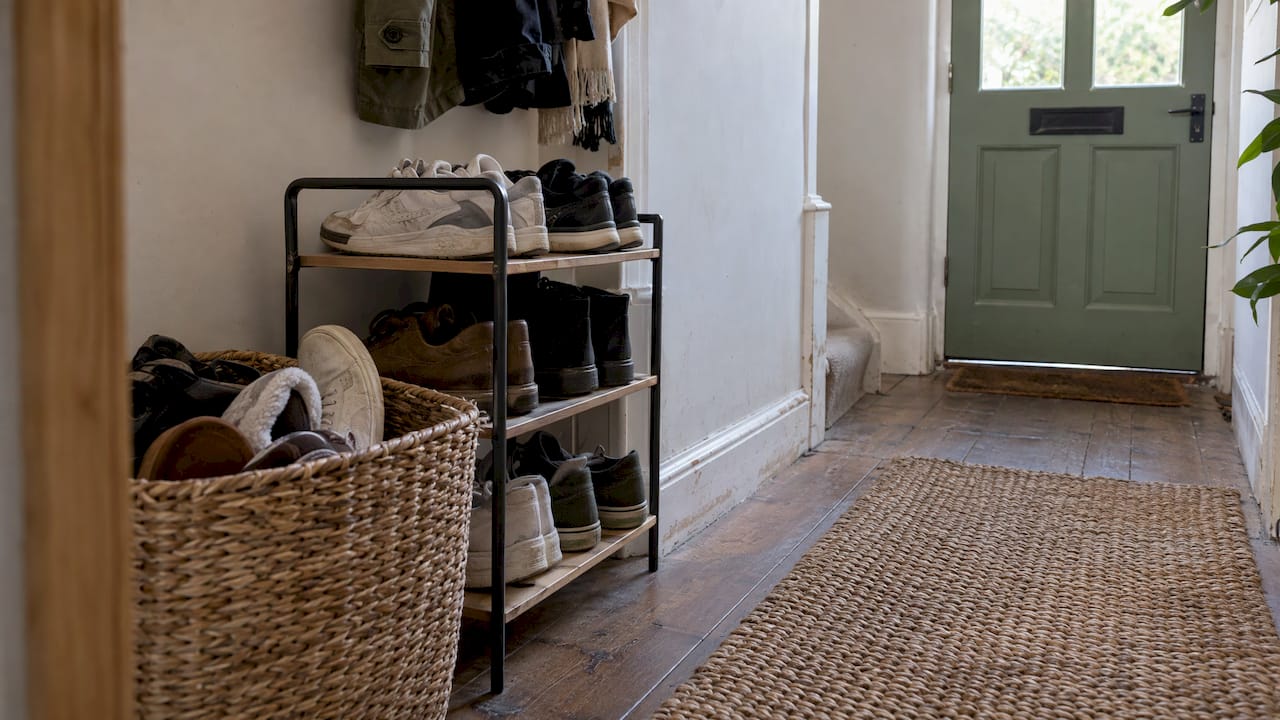
Choose a shoe rack if you want every pair visible, aired and easy to grab. Choose baskets if you want bulky, muddy or mismatched footwear out of sight in one quick toss. Most busy UK hallways work best with a mix: a slim rack for daily pairs and a deep basket for wellies, trainers and the children’s shoes.
This guide compares the two on the things that decide it in a real hall: how many pairs you own, how much floor you have, how wet your shoes get and who needs to use the storage every morning.
TL;DR
- A rack suits people who own several pairs each and like to see what they have. Open shelves also keep air moving around the shoes.
- Baskets suit bulky footwear, children and anyone who wants a tidy look without lining up pairs.
- Leave around 80cm of clear walkway whichever you pick, and keep only everyday shoes by the door.
- In a narrow hall, a slim rack or a bench with shoe storage often beats a floor full of baskets.
- The best answer for many families is both: a rack for the regulars, a basket for the rest.
Table of Contents
- The real difference between a shoe rack and shoe baskets
- Side-by-side comparison
- When a shoe rack is the better choice
- When baskets are the better choice
- Capacity: how many pairs will each really hold?
- Where to put your shoe storage
- The best of both: a combined setup
- How to choose: a quick decision guide
- Perspective
- Make it look as good as it works
- Shop shoe storage and hallway pieces at Homable
- FAQ
- Sources
The real difference between a shoe rack and shoe baskets
A shoe rack is a structured frame with shelves or slats. Each pair has a place, usually side by side, and the rack stacks vertically so it uses height rather than floor. A basket is a container. Shoes go in loose, and the basket decides how much you can fit, not a set number of slots.
That single difference drives everything else:
- Racks organise. They push you to pair shoes up and keep them in rows. You see the whole collection at a glance.
- Baskets contain. They hide the mess and ask nothing of you except a place to drop things.
Neither is better in the abstract. A rack rewards a tidy-minded household. A basket forgives a rushed one.
Side-by-side comparison
| Factor | Shoe rack | Shoe baskets |
|---|---|---|
| How shoes are stored | Paired, in rows, on shelves | Loose, in a container |
| Visibility | Every pair on show | Hidden or partly hidden |
| Airflow | Open shelves let air circulate | Depends on the weave and how full it is |
| Best for | Daily shoes, several pairs per person | Wellies, trainers, kids’ shoes, guests’ shoes |
| Use of space | Vertical, small footprint | Floor or shelf level, wider footprint per pair |
| Look | Clean lines, can double as display | Soft, natural, decorative texture |
| Effort to keep tidy | Higher: pairs must be placed | Lower: drop and go |
| Family friendly | Works if each person has a shelf | Works well, one basket per person |
When a shoe rack is the better choice
You own more than a few pairs
If each adult has five or six pairs in rotation, a rack gives each pair its own spot and stops the pile forming. Stacked shelves make good use of a narrow wall. In a UK terrace or a new-build with a slim entrance, height is the space you have most of.
You care about airflow
Shoes need to breathe. Homebuilding advises against sealed cupboards and suggests slatted designs or small ventilation holes so air keeps moving. An open rack gives you that by design. Damp school shoes and work boots dry more evenly when air can get round them, and the hall smells fresher for it.
You want to see what you own
When every pair is visible, you pick faster and put back more reliably. That matters on a school-run morning. It also means the rack becomes part of the look of your hall, so a solid wood finish is worth considering. Our vidaXL shoe rack with 5 shelves in solid oak measures 100 x 27 x 100 cm, which gives you a tall, shallow footprint that fits against a wall without taking over the hall. For a smaller space or a single household member, the 2-shelf oak rack at 100 x 27 x 40 cm is a lower, more compact option.

When baskets are the better choice
Your shoes are bulky or muddy
Wellies, walking boots and chunky trainers do not stack neatly on shelves. A deep basket does the job better. Homebuilding notes that a generously sized wicker basket can swallow a pair of wellies or a tangle of trainers while still looking intentional. That is the whole appeal: you toss, close the door and the hall looks calm.
You have children
Young children rarely line shoes up in pairs. A basket at their height gives them a target they can manage alone, and it keeps their shoes separate from yours. Homebuilding recommends pull-out wicker baskets or drawers for compact spaces because they hide muddy shoes yet stay easy to reach, and each family member can have their own spot. Our kids storage baskets are made for exactly this kind of daily sorting.
You want softness and texture
A hall full of hard surfaces can feel cold. Natural-look baskets add warmth and pair well with a bamboo or flatweave rug underfoot. If you like the idea, our guide to basket storage ideas has more ways to use them around the home.
Capacity: how many pairs will each really hold?
Racks have a countable capacity. A shelf 100 cm wide takes roughly the number of pairs that fit side by side, and with five shelves you can plan precisely: count your regular pairs, divide by the number of shelves, and check the answer against the width. Because racks stack, capacity grows upward.

Baskets are less predictable. A deep basket can take a large number of children’s shoes thrown in loose, but fewer adult boots. The practical rule is to give each person one basket and accept that it holds only the pairs that person wears this week. Anything beyond that moves upstairs.
For slim hall cabinets the numbers can be higher. Homebuilding’s example flip-front cabinet holds up to 18 pairs across three flip-down compartments. That is a useful benchmark if you are weighing a rack against a closed unit.
Where to put your shoe storage
Place it close to the door, but never in the way. Netmums advises creating a tight, defined shoe zone beside the door and keeping only daily shoes there, perhaps one or two pairs per person. The same source recommends leaving at least about 80cm of clear walkway so the hall still feels open.
That gives you a simple layout test:
- Measure the wall beside your front door, and the depth you can spare.
- Subtract the depth from your hall width and check that at least 80cm remains.
- If it does not, choose a shallower rack or a bench rather than free-standing baskets on the floor.
A shallow rack of 27 cm depth sits flat to the wall. A bench is another smart option: our vidaXL shoe storage bench in oak, at 80 x 24 x 45 cm, also comes in a white finish. It gives you somewhere to sit while you put your shoes on and a place to store them in one piece. For narrow halls, our guide to hallway shoe storage for narrow UK halls goes through the measurements in more detail.
Top-of-unit space is useful too. Netmums suggests the top of a slim shoe cabinet or a short stretch of wall by the door as sensible spots. A rack with a flat top can hold a tray for keys, and a basket on the top shelf takes scarves or gloves.
The best of both: a combined setup
Most households do not have to choose. A combined setup uses each for what it does best:
- Rack for the regulars. The one or two daily pairs per person sit on open shelves where air reaches them.
- Basket for the extras. Wellies, spare trainers, slippers and guests’ shoes go in a deep basket on the floor or the bottom shelf.
- Kids’ basket at child height. Each child gets their own, so the sorting is theirs to manage.
This keeps the main route clear, which is the point of the whole exercise. It also grows with you: add a shelf or another basket when the household changes. For more layout ideas, see our guides to entryway storage for small halls and a step-by-step entryway styling guide.
How to choose: a quick decision guide
Answer these four questions in order.
- How many pairs live by the door? Up to two per person: baskets are enough. More than that: add a rack.
- How wet or muddy do they get? Wellies and boots go in a basket or on the bottom shelf, ideally with a mat beneath.
- Who uses it? If children need to manage alone, give them a basket. If adults want to find a pair quickly, give them a shelf.
- How much floor can you spare? If your hall is narrow, go vertical with a rack or bench and keep the walkway clear.
Perspective
We sell both racks and baskets, so we see how people actually use them. The households that stay tidy for months are rarely the ones with the biggest storage. They are the ones who matched the storage to how they come through the door.
Our view is simple. A solid wood rack gives a hall structure, and it works hard in a narrow space because it uses height. Baskets give it softness and forgive the chaos of a family morning. When the two sit side by side, the hall looks designed rather than just organised.
If you are unsure, start with a rack for the pairs you wear every week and add a basket for everything else. It is easy to build on, and it looks good at every stage.
Cristiano
Make it look as good as it works
Storage that looks right gets used. A few touches help it fit the hall:
- Match the materials. Oak shelves and natural baskets share a warm tone, so the two look planned together.
- Add a mat. A mat or flatweave rug under the shoes catches damp and grit. Our bamboo rugs are a natural-look choice for a hallway floor.
- Keep the top clear. One tray, one plant or one ornament is plenty. Clutter on top undoes the order below.
- Use the wall. If the floor is tight, a wall shelf above the rack takes keys, post and small baskets.
Our entryway styling tips cover more ways to bring the look together.
Shop shoe storage and hallway pieces at Homable
Whether you lean towards open oak shelves, a bench with built-in storage or a set of soft baskets, you can find hallway pieces in one place. Browse the full range at Homable, from racks and baskets to rugs, mats and wall shelves, with free shipping on orders over £100.
If you are furnishing a whole entryway, start with the rack or bench, add a basket or two, and finish with a rug underfoot.
FAQ
Is a shoe rack or a basket better for a small hallway?
A slim rack or a bench is usually the better fit, because it uses height and leaves floor free. Baskets can work too if you have a spare corner or a shelf to put them on. Whichever you choose, keep about 80cm of clear walkway.
Can I use baskets for wet or muddy shoes?
Yes, for wellies and trainers a deep basket works well because it hides the mess and holds bulky shapes. Put a mat or tray underneath to catch drips and let shoes dry a little before they go in. Open-weave baskets let air through, which helps.
Where should I put a shoe rack?
Put it beside the front door, on a wall where it will not block the route in. Keep only the pairs you wear daily there, one or two per person. Store the rest upstairs or in a wardrobe, and our wardrobe storage ideas can help with that.
What is the best shoe storage for a hallway with children?
Give each child their own basket at a height they can reach, and keep adult shoes on a rack nearby. This lets small children put shoes away without help. Pull-out baskets or drawers keep muddy shoes out of sight.
Do shoes need ventilation when stored?
Yes. Shoes keep fresher when air can move around them, so open racks, slatted designs or baskets with an open weave suit them better than sealed cupboards. Homebuilding suggests small holes in a cabinet back if you choose a closed unit.
Sources
- Shoe storage ideas for small spaces | Homebuilding
- This 5-minute hallway trick is quietly ending chaotic school run mornings | Netmums