Cart
0
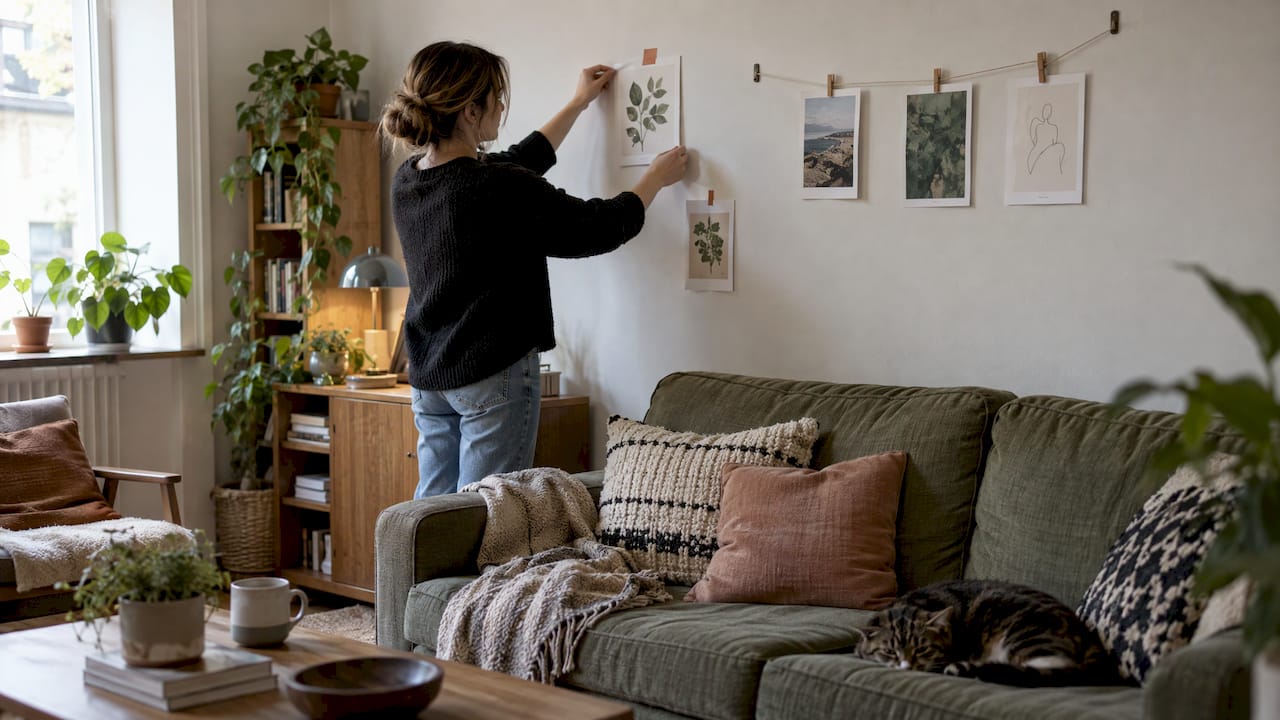
The safest renter-friendly wall decor is anything that either sits on the floor, hangs from something already in the room, or sticks on and peels off cleanly: adhesive strips for lightweight frames, peel-and-stick wallpaper for a feature wall, big pieces leaned against the wall, and soft furnishings that carry colour without touching the plaster. Done properly, it makes a rented room feel like yours and leaves the walls ready for the check-out inventory.
This guide covers what works on which surface, how to put things up and take them down without marks, what to check with your landlord first, and how to protect your deposit.
TL;DR
- Use adhesive strips on clean, smooth painted walls, respect the weight limit on the pack, and remove them by pulling the tab slowly straight down.
- Peel-and-stick wallpaper, decals and leaning art give you a statement wall with no holes, but check your tenancy agreement before changing the look of a wall significantly.
- Rugs, curtains, blinds, baskets and ornaments change a room as much as a framed print does, and they never touch the wall.
- Landlords can deduct from a deposit for damage such as holes, but not for fair wear and tear, so photograph the walls on move-in and move-out.
- When in doubt, ask for permission in writing.
Table of Contents
- Check the tenancy agreement before you start
- Wall decor you can put up without drilling
- Decor that carries the room without touching the walls
- Match the decor to the wall
- Hanging heavy things: when to ask for help
- If you remove wallpaper at move-out
- Protecting your deposit
- Our perspective
- Start with the pieces that move with you
- FAQ
- Sources
Check the tenancy agreement before you start
The most damage-proof idea still depends on what your tenancy agreement allows. Shelter England says tenants should get written permission from the landlord before making improvements, and warns that unauthorised work can lead to demands to put things back, deposit deductions or, in the worst cases, attempts to evict. The same page says ordinary decorating does not usually need permission, subject to what your agreement says.
In practice that gives you two tiers:
- Usually fine without asking: furniture, lamps, plants, rugs, curtains you can hang from the existing rail, art leaned on shelves or floors, and removable adhesive products used as directed.
- Ask first, in writing: painting, wallpapering, panelling, drilling, or filling and sanding holes. Dulux advises getting written landlord approval before significant changes like these, and notes that filling holes is governed by the tenancy agreement.
An email is enough to start. Describe what you plan to do, where, and how you will reverse it, then keep the reply with your tenancy papers. Landlords tend to say yes more readily to “removable wallpaper on one wall, taken down when I leave” than to a vague request to redecorate.
The Shelter pages cited in this guide are written for England. If you rent in Scotland, Wales or Northern Ireland, read your own agreement closely and check the tenancy guidance that applies where you live before relying on the England-specific points.
Wall decor you can put up without drilling
Adhesive strips and hooks
For frames and lightweight prints, adhesive strips are the first thing most renters reach for. Ideal Home lists Command hooks and strips alongside removable wallpaper, wall stickers, washi tape and a picture line as ways to decorate rental walls.
The manufacturer’s own guidance is worth following to the letter. 3M says Command strips are intended for smooth painted walls, tile, glass and wood, and that they should be removed by slowly pulling the tab straight down. The same page tells you to wait seven days after painting, to stay within the weight limit printed on the pack, and to avoid wallpaper and delicate surfaces.
A practical routine:
- Clean the wall where the strip will go and let it dry.
- Weigh your frame and choose strips rated comfortably above it.
- Press firmly and give the adhesive time to bond before you hang anything. Ideal Home’s advice is to allow strips time to adhere.
- Hang the frame, and check it is level before you walk away.
- When you leave, pull each tab slowly straight down, parallel to the wall, not outwards.
If you take a frame down to move it, 3M advises waiting an hour before reattaching it.
Washi tape and picture lines
Washi tape is the lightest option: good for paper prints, postcards and kids’ drawings. A picture line, which is a cord or rail you hang pictures from, spreads the load across one fixing point you may already have, such as an existing picture rail. Both are in Ideal Home’s list of rental tricks, and both suit a gallery-style arrangement you can change every season.
If you use masking-style tape, follow the maker’s instructions on removal. 3M advises pulling tape back on itself slowly at about a 45-degree angle, and not leaving it on longer than the product’s stated maximum.
Peel-and-stick wallpaper and decals
When you want a real feature wall, removable wallpaper is the standard renter answer. House & Garden reports designer Medina Grillo recommending it for rented walls because it can come off at the end of the tenancy. Ideal Home also suggests it, and notes that smaller removable vinyl shapes are easier to apply without creases or bubbles, which makes decals a better first project than a full roll.
Results depend on the product and the wall. In its testing, the Telegraph found one peel-and-stick wallpaper came away without lifting paint or damaging plasterboard, and its application advice was to start with a clean, dry, even wall, align panels gradually and smooth out bubbles as you go.

Two cautions before you commit. First, wallpaper counts as a visible change, so mention it to your landlord. Second, textured or freshly painted walls are harder for adhesives, so test a small hidden patch first and give new paint the seven days 3M recommends for strips.
Lean it, don’t hang it
The lowest-risk wall decor never touches the wall. Ideal Home suggests leaning ladders or mirrors against the wall, and House & Garden reports stylist Clare Gaskin’s idea of painting or wallpapering boards or canvases and leaning them against the wall to bring in colour and pattern without altering the surface.
Try:
- A large mirror on the floor, leaning against the wall opposite a window.
- A canvas you have painted yourself, resting on a sideboard.
- A bookcase that doubles as display, with frames standing among the books. Ideal Home lists upcycling a bookcase as a rental idea too.
- A decorated ladder holding throws, plants or framed prints.
Decor that carries the room without touching the walls
When walls are off limits, the rest of the room has to do the work. The BBC’s advice on sprucing up a rental suggests books, framed photographs, decorative objects and houseplants, plus table or floor lamps and soft furnishings such as curtains and cushions, to make the space feel personal. The same article recommends temporary changes such as stick-on tiles, suction storage, expandable blinds and artwork secured with removable strips, and tells tenants to check the tenancy agreement before any permanent work.
This is where a wall-decor plan often succeeds: the eye reads a room as a whole, so texture and colour at floor and window level can make plain walls look intentional.
- Rugs anchor a seating area and add pattern. A natural flatweave such as a bamboo rug brings warm texture beneath white or magnolia walls.
- Curtains and blinds soften a room and frame the wall. If your landlord is happy for you to swap what hangs from the existing fittings, bamboo curtains and natural-weave blinds add a layered, textured look.
- Ornaments and shelf styling give you the gallery effect on a sideboard or windowsill instead of the wall.
- Baskets and storage keep the visual noise down. Tidy storage is half of what makes a plain wall look deliberate, and a woven basket on the floor adds texture where a shelf would otherwise need fixing.
- Kitchen textiles are an easy colour hit. A set of patterned tea towels on an oven handle or hook does more for a kitchen than you would expect.
If you want a displayed collection of photographs, a multi-photo frame collage is a neat way to group many memories into a single piece, so you manage one object and one fixing method instead of a dozen.
Match the decor to the wall
Different surfaces call for different methods. Use this as a starting point and always read the pack.
| Wall or situation | Better choices | Take care |
|---|---|---|
| Smooth, painted and fully dry | Adhesive strips, washi tape, removable decals | Follow the weight limit, wait a week after painting |
| Tile, glass or sealed wood | Adhesive strips and hooks, which 3M lists as suitable surfaces | Clean and dry first |
| Wallpapered or delicate surface | Leaning art, furniture-based display | 3M advises against strips on wallpaper |
| Textured or uneven plaster | Leaning mirrors, ladders, boards, lamps | Adhesives need an even surface, as Telegraph application advice for wallpaper shows |
| Walls you cannot change at all | Rugs, curtains, plants, ornaments, shelf styling | Check what your agreement says about fittings |
Hanging heavy things: when to ask for help
Mirrors, large frames and anything with real weight are where renters get into trouble. Strips have limits, and a falling mirror damages the wall, the floor and possibly you. For heavy pieces, lean them on the floor against the wall, or ask your landlord whether they would allow a fixed hook or shelf and who would fill the holes at the end. Shelter says that filling and sanding is subject to the tenancy agreement in the same way as other changes, so settle it in writing rather than assuming.

If you remove wallpaper at move-out
If your landlord approved wallpaper, plan its removal. Which? advises covering floors and furniture, protecting sockets and switches, turning off the electricity before wet stripping, wearing eye protection and gloves where chemicals are involved, and avoiding knives that can gouge the wall. Its experts also say that repeated soaking with hot water and washing-up liquid or a stripper solution helps paper release, while steamers can damage plaster.

Peel-and-stick products are far simpler, but the principle is the same: go slowly, work with the product’s instructions and stop if paint starts to lift.
Protecting your deposit
Understanding the rules helps you decide how bold to be. Shelter England says landlords can deduct for tenant-caused damage, including holes in walls, but not for fair wear and tear, and generally cannot charge the full replacement cost if a cheaper repair would do. Citizens Advice makes a similar point: a deduction can cover a mark on the wall where a picture was hung, but not reasonable wear and tear.
On redecoration, Shelter says a landlord cannot keep a deposit simply because it is time to redecorate, though they may deduct if you made significant unauthorised changes or caused damage that requires redecorating.
Three habits protect you:
- Record the start. Photograph every wall with a date when you move in, and flag existing marks to the agent.
- Keep permissions. Store landlord emails agreeing to wallpaper, paint or fixings.
- Record the end. Citizens Advice recommends photographing the property at move-out, getting a signed check-out inventory and asking for the reasons for any deduction in writing. Documenting your rental’s condition before you hand back the keys gives you evidence if a dispute arises.
Our perspective
We think a rented home deserves the same care as one you own, and the walls are only a small part of how a room feels. Most of what makes a space look considered is at eye level and below: the rug that anchors the seating, the curtains that frame a window, the basket that hides the clutter, a few ornaments grouped with intent.
That is why we build our range around those pieces: bamboo rugs, bamboo curtains and roller blinds, kitchen textiles, ornaments and storage baskets. They bring colour, texture and pattern into a room without asking anything of the plaster, and they travel with you to the next place.
Our advice for a first rental project is to pick one focal point, such as a rug and a lamp in the corner you look at most, and build outward. Add wall pieces last, using removable fixings, once you know where the room needs them.
Cristiano
Start with the pieces that move with you
If you would like to dress a rented room without touching the walls, our home decor collection covers rugs, curtains, blinds, ornaments, kitchen textiles and storage, chosen for modern, affordable style. Free shipping applies on orders over £100.

For more ideas as you plan, our guides on renter-friendly balcony decor, small-space decorating and choosing wall art cover the details room by room.
FAQ
Do I need my landlord’s permission to put up pictures?
Ordinary decorating does not usually require permission, according to Shelter England, but that is subject to your tenancy agreement. Read the clause on alterations and decorating. If it mentions nails, fixings or marks, ask by email before you hang anything, even with adhesive strips.
Can adhesive strips damage paint?
They are designed for smooth, painted surfaces, but results depend on how you use them. Clean the wall, stay within the weight limit, wait seven days after fresh paint and pull the tab slowly straight down to remove. Avoid wallpaper and delicate finishes, as 3M advises.
Is peel-and-stick wallpaper safe for a rented flat?
It is one of the most commonly suggested rental options because it can be removed when you leave. Apply it to a clean, dry, even wall, smooth out bubbles as you go and mention it to your landlord first, since it changes the look of the room.
Can a landlord charge me for nail holes?
Shelter England and Citizens Advice both say landlords can deduct for tenant-caused damage such as holes or marks, but not for fair wear and tear. Your tenancy agreement and any permission you obtained matter, so keep written records and dated photographs.
What can I do if I am not allowed to touch the walls at all?
Move the decor to the floor and the furniture. Lean a large mirror or canvas against the wall, add a rug, change the curtains if the fittings are yours to use, and group ornaments on shelves and sideboards. The effect is a finished room without a single fixing.
Sources
- How to decorate rental walls, Ideal Home
- Five ways to spruce up your rental, BBC News
- Decorating a rented home, House & Garden
- How to hang a picture without nails, 3M Command UK
- When to remove masking tape, 3M UK
- The best peel and stick wallpaper, tested, The Telegraph
- How to wallpaper a room, Which?
- Renter-friendly decorating ideas, Dulux
- Making improvements to your rented home, Shelter England
- Deposit deductions for damage and missing items, Shelter England
- Can landlords charge for cleaning and decorating, Shelter England
- Getting your tenancy deposit back, Citizens Advice