Cart
0

Go vertical first, then zone what’s left. Floating shelves above the toilet and an under-sink organiser sized to your P-trap will clear more counter space than any single large unit, and both fit rented flats as easily as owned homes. This guide covers nine quick-win ideas, exact measurements to avoid buying the wrong thing twice, and DIY hacks for hidden storage that Homable’s own styling picks can finish off.
TL;DR:
- Using vertical space with shelves, niches, and over-toilet units helps maximize storage without blocking access or damaging walls.
- Under-sink organizers must be measured carefully to fit around pipes, with adjustable shelves and trays recommended for UK plumbing standards.
- Narrow freestanding cabinets and hooks placed at reachable heights provide practical storage that avoids drilling or permanent fixtures.
- In a small bathroom, combine multiple smaller storage solutions to better match item locations and prevent clutter, rather than relying on one large unit.
- No-drill options like adhesive strips and over-door organizers are effective for renters if properly measured and humidity-rated, with minimal risk of damage.
Table of Contents
- Bathroom storage ideas you can try this weekend
- Maximise vertical space: shelves, niches and over-toilet storage
- Under-sink systems that actually work around pipes
- Slim, freestanding furniture for narrow gaps
- Hooks, rails and towel storage that cut the laundry pile
- Renter-friendly and no-drill storage options
- DIY hacks and hidden storage ideas
- Styling and decluttering systems that keep working
- More storage inspiration from Homable
- What most storage advice gets wrong
- Homable picks to finish your bathroom storage
- Sources
- FAQ
Bathroom storage ideas you can try this weekend
Nine ideas, ranked roughly by effort. Start at the top if you want results before the kettle boils.
- Floating shelf above the toilet — no-drill brackets or a light screw fix; instant display space for towels and canisters.
- Two-tier under-sink organiser — slides around the P-trap; works in rented and owned bathrooms alike.
- Over-door hook rail — zero drilling, holds dressing gowns and damp towels off the floor.
- Adhesive-rated wall shelf — humidity-rated strips hold surprisingly well on tiled walls; DIY, renter-safe.
- Slim tower cabinet — 30 to 40cm wide, slots into gaps beside the loo or sink; requires basic assembly.
- Ladder towel rail — freestanding, no fixing needed, doubles as a decorative piece.
- Recessed medicine cabinet — install job, best left to a tradesperson, but reclaims dead wall depth.
- Skirted pedestal sink curtain — a DIY sew or clip job that hides baskets under an exposed sink.
- Stackable bins for backstock — no installation at all, just a shelf or cupboard to put them on.
Quick wins (shelves, hooks, bins) take under an hour. Longer projects (recessed niches, tower cabinets) are worth planning around a free weekend.
Maximise vertical space: shelves, niches and over-toilet storage
The wall above your toilet and either side of the mirror is the most underused real estate in the room, and designers consistently point to it first. Professional organisers recommend using every available wall surface, from floating shelves to over-toilet units, before considering floor-standing furniture at all.
A few rules keep vertical storage safe and genuinely useful:
- Leave a small clearance above the toilet tank so the seat lifts and cistern lids come off without hitting the shelf.
- Space shelves appropriately to fit standard toiletry bottles and rolled towels without wasted air.
- For recessed niches, budget at least 7 to 8cm of wall depth. Anything shallower usually means opening up plumbing or wiring, which is a job for a tradesperson, not a Saturday afternoon.
Combining a few of these fixes rather than relying on one big cabinet tends to clear counter clutter faster than a single large unit ever manages on its own. Recessed shelving and open niches have also overtaken mirrored medicine cabinets as the design-forward choice in newer bathroom schemes, mostly because they stay visually calm even when full.
Under-sink systems that actually work around pipes
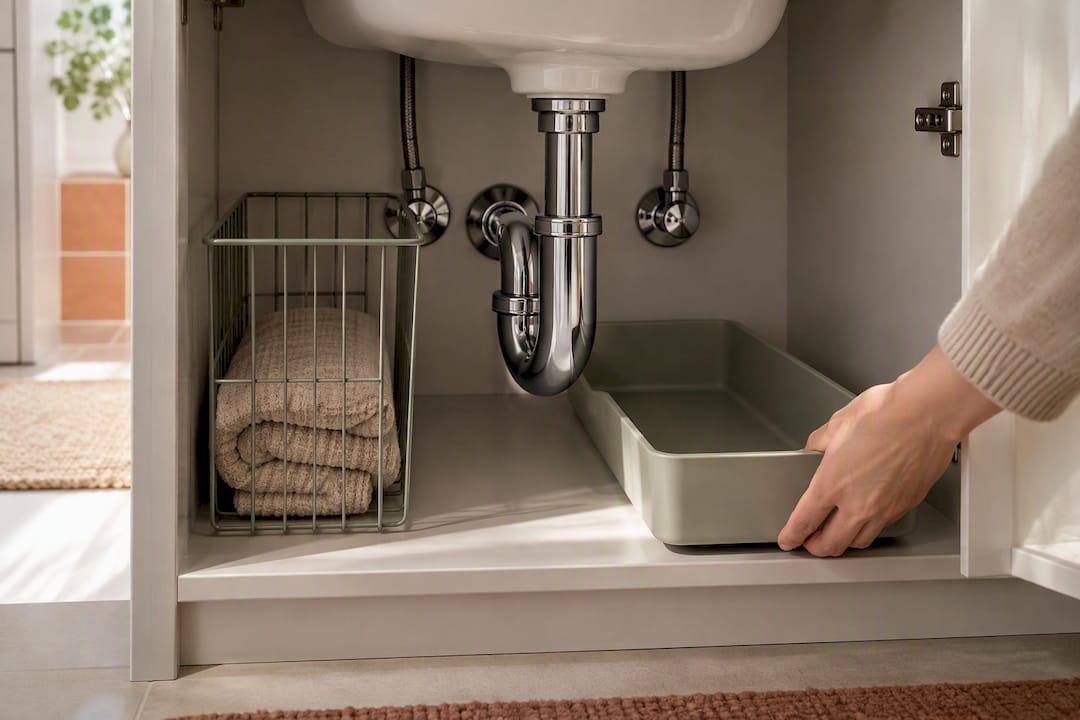
Buy blind here and you’ll be returning an organiser within a week. Measure the gap around your P-trap before ordering anything. UK vanities typically need 8 to 10cm of clearance either side of the pipe for a standard two-tier shelf to sit flat, and that four-measurement habit, checking pipe clearance alongside toilet and door gaps, is what separates a storage system that lasts from one you’re rebuying every season, according to guidance from Clutterless Nest.
What actually fits under most UK sinks:
- Two-tier expandable shelves that adjust to your specific pipe width.
- U-shaped pull-out drawers that slot around the trap rather than boxing it in.
- Stacking bins for backstock (spare bottles, cleaning supplies).
- Slide-out trays for anything you grab daily, like razors or cotton pads.
Practical guides also flag drawer dividers and labelled baskets as a cheap way to stop the under-sink cupboard turning into a junk drawer with a door.
Pro Tip: Choose powder-coated wire or moulded plastic over untreated wood under the sink. Splashback and condensation will warp bare timber within a year.
Slim, freestanding furniture for narrow gaps
A tower cabinet of narrow width slots into the strip beside a toilet or sink that most people write off as dead space, and going tall rather than wide is what makes it worth the floor footprint. Before you buy, check the cabinet won’t block a door swing or sit over a stopcock, isolation valve, or boiler access panel. Landlords and building insurers both take a dim view of blocked service access.
- Closed-door towers suit anything you don’t want on display: cleaning products, spare toiletries, first aid kit.
- Open shelving on the same footprint suits rolled towels and styled canisters you’re happy to show off.
- Leave at least 5cm between the cabinet and any door arc so nothing catches when it swings open.
Hooks, rails and towel storage that cut the laundry pile
Hooks beat bars for one simple reason: towels dry faster when they hang open rather than folded double over a rail. A family bathroom does best with one hook per person, fixed at a height each user can actually reach without stretching.
- Fit hooks at 140 to 160cm for adults, lower for children’s bathrooms.
- Use a ladder towel rail where you want a decorative statement piece as well as storage.
- Stick to powder-coated metal, sealed hardwood, or resin. Untreated wood and bare mild steel both suffer in a steamy room within months.
- Reserve wall bars for bath sheets that need spreading out to dry properly.
Renter-friendly and no-drill storage options
Renters don’t need to skip storage just because the tenancy agreement bans wall fixings. A freestanding over-toilet étagère, an over-door organiser, or humidity-rated adhesive shelving strips all avoid drilling entirely.
Before buying any of them, measure:
- Door-top clearance, so an over-door rail doesn’t jam against the frame.
- Toilet-to-wall gap, to check a freestanding étagère actually fits.
- Under-sink trap height, if you’re adding an organiser rather than a shelf.
Only humidity-rated adhesive strips hold reliably in a bathroom; standard adhesive hooks sag within weeks once steam gets to the glue. If a wall is tiled and slightly uneven, skip adhesive altogether and go freestanding instead.
DIY hacks and hidden storage ideas
None of these need a tradesperson, and most cost under £20 in materials.
- Fit a shallow shelf under a floating vanity to hide spare toilet roll. A simple adhesive or screw-fixed shelf does the job in under an hour.
- Skirt a pedestal or exposed sink with a fabric curtain on a tension wire to hide baskets of cleaning supplies behind it.
- Stack spare rolls on a length of dowel or an old broom handle mounted horizontally. It’s a genuinely cheap multi-roll holder that also looks tidy on a shelf.
- Build or buy a small wooden cubby for the gap beside the cistern; even 15cm of width holds a surprising amount.
Styling and decluttering systems that keep working
Storage only stays useful if you police what goes back on the counter. Keep daily items (toothbrush, cleanser, razor) within arm’s reach and push backstock, spare shampoo, extra toilet roll, cleaning products, up onto higher shelves or into closed cabinets.
- Purge expired products and empty bottles every three months; bathrooms accumulate clutter faster than any other room.
- Zone by frequency: daily items at eye level, weekly items below, backstock up top.
- Label bins if more than one person shares the space. It stops the “whose is this” pile-up.
- Choose canisters and finishes that wipe clean easily. Steam and splashes punish porous materials fast.
Designers favour grouping toiletries into a small number of matching canisters rather than leaving individual bottles scattered. It reads as curated, not cluttered, even in a tiny room.
Pro Tip: Group by colour or container type, not by brand. Three matching glass jars on a shelf look intentional; five different plastic bottles look like an unopened delivery.
More storage inspiration from Homable
For readers who want to go further, Homable’s creative storage designs guide expands on reclaiming wall and floor space beyond the bathroom, while the space-saving solutions checklist covers the same measure-before-you-buy discipline used above. The storage basket and wall shelf ranges mentioned are designed with small-space styling in mind.
What most storage advice gets wrong
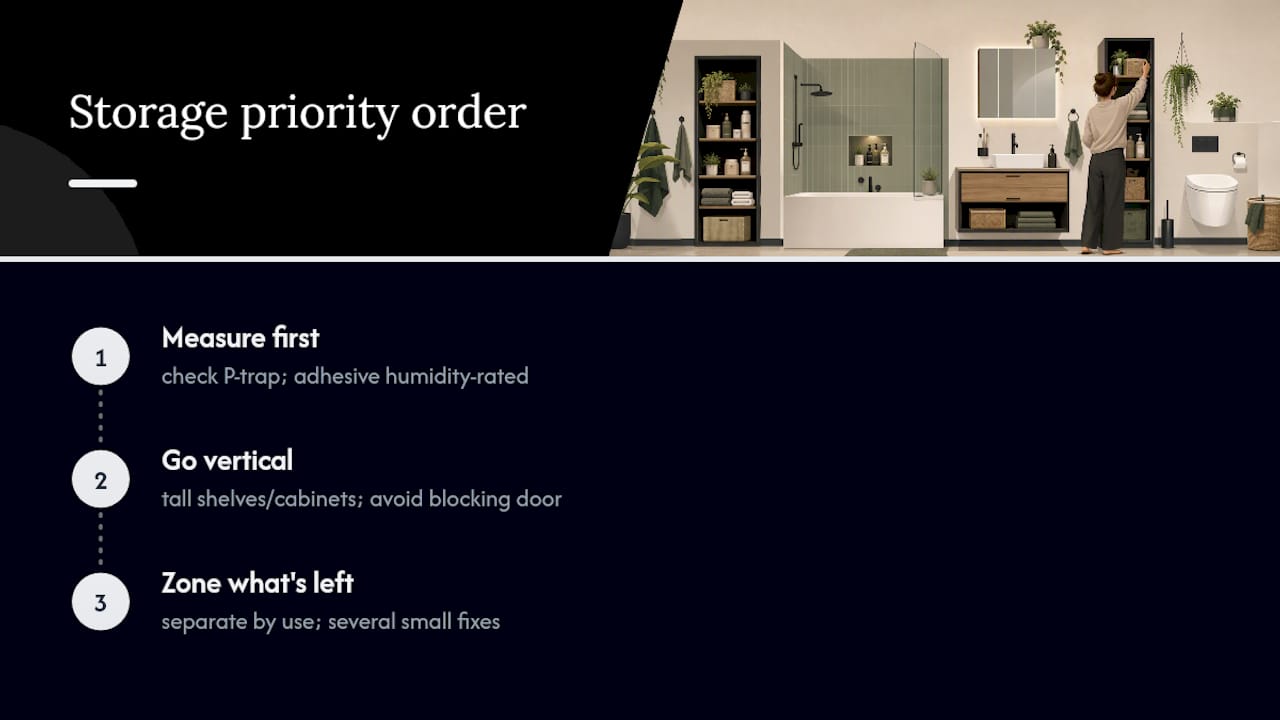
Most bathroom storage content treats every idea as equally worth doing, and that’s the mistake. Not every gap needs filling, and not every shelf needs to be full. The research here points to a clearer priority order: measure first, then go vertical, then zone what’s left. Skip that order and you end up buying an organiser that doesn’t fit the P-trap, or a tower cabinet that blocks the door.
The other overrated piece of advice is “buy one big unit and be done.” Editors who’ve actually tested this consistently find that two or three smaller, well-placed fixes, a shelf here, an under-sink tray there, clear more clutter than a single large cabinet ever does, partly because one big piece concentrates all your storage in one place instead of matching it to where things are actually used.
If you’re renting, don’t wait for permission to drill. No-drill options have genuinely closed the gap on permanent fixtures, provided you check the adhesive is humidity-rated and the wall surface is suitable. That’s the one measurement step people skip, and it’s the one that causes the most returns.
— Cristiano
Homable picks to finish your bathroom storage
Once the shelves and organisers are sorted, the finishing touches are what make a bathroom feel put together rather than merely functional. There are round storage baskets for rolled towels or backstock, bamboo laundry baskets suitable for damp towels, and bathroom textiles designed to hold up to steam without losing their colour.

Browse the full homewares collection for pieces that match the styling ideas above, or go straight to the round storage basket if you need something on the shelf this week. A bamboo laundry basket works well tucked beside a tower cabinet for overflow towels. Check sizes against your own measurements first, then order. Most pieces ship free on orders over £100.
Sources
- Under the sink is a scary place—these bathroom storage tips make it less so | Architectural Digest
- 15 brilliant small bathroom storage ideas for any space | Good Housekeeping
- 12 bathroom storage ideas when you have no vanity space | Oakwood Remodel
- DIY hidden toilet paper shelf under vanity | Hunker
- Bathroom storage ideas for small spaces that actually last | Clutterless Nest
FAQ
What are the trending bathroom storage ideas?
Floating shelves, recessed niches, and over-toilet units are currently favoured over bulky mirrored cabinets, largely because they keep counters clear while looking more design-forward. Ladder towel rails and matching canister sets for open shelving are also popular for their dual role as storage and display.
How do you maximise storage in a small bathroom?
Go vertical first: shelves, over-toilet units, and wall-mounted cabinets use space that’s otherwise wasted. Pairing that with a properly sized under-sink organiser typically clears more clutter than one large cabinet on its own.
What are some good storage ideas for a small bathroom without a vanity?
A recessed cabinet, a couple of floating shelves, and a tall narrow tower cabinet together roughly replicate the storage of a small vanity. Skirting an exposed pedestal sink with a fabric curtain also hides baskets underneath it.
What should you not store in a bathroom?
Avoid keeping medication, electronics, or anything paper-based (books, important documents) in a bathroom cupboard, since humidity and steam degrade them faster than in any other room. Cardboard packaging and untreated wood shelving also warp or grow mould over time, so stick to sealed, wipeable finishes for anything stored long-term.
Do renters have viable no-drill bathroom storage options?
Yes. Freestanding over-toilet étagères, over-door organisers, and humidity-rated adhesive shelving all avoid wall fixings entirely. Check the door-top clearance and toilet-to-wall gap before buying, since these two measurements cause most fitting problems for renters.