Cart
0
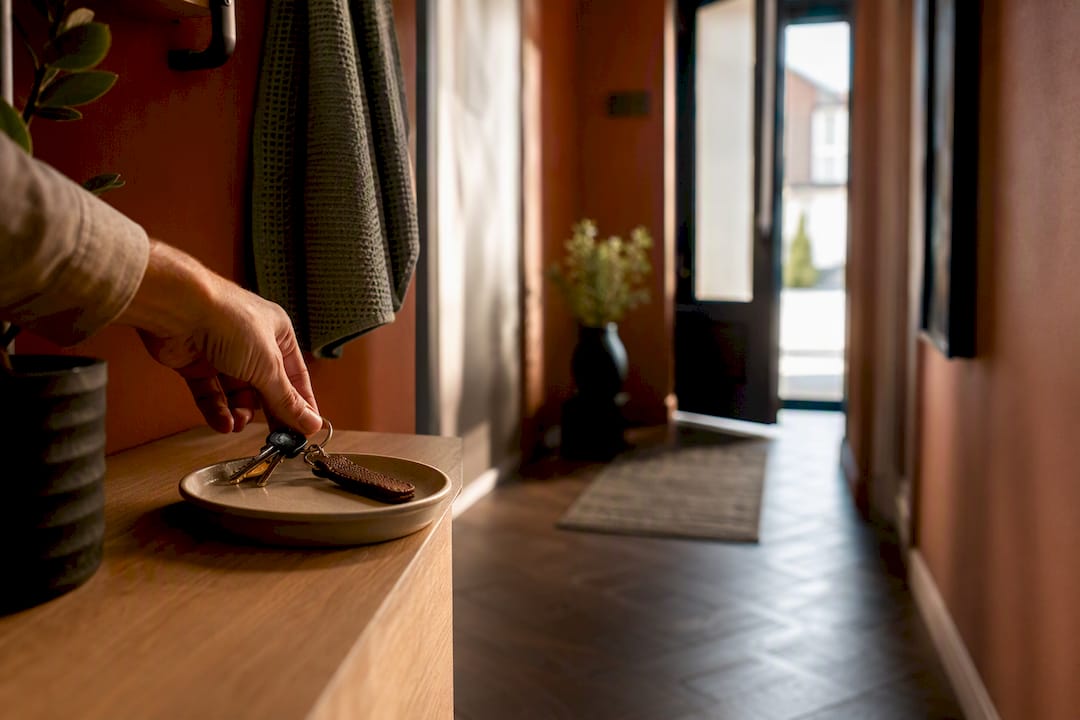
Create one drop zone with a hook, a landing tray, a shoe spot and a labelled basket, and you’ll clear most of the daily clutter before it even builds up. That’s the whole trick. Homable’s styling team and Cristiano, who writes much of the brand’s entryway advice, both point to this same combination over anything more elaborate. What follows is the full set of ideas for building it in a space that suits you, whether that’s a wide hallway or a hall barely wider than the front door.
TL;DR:
- Enclosed shoe cabinets are ideal for households with more than six pairs, while open racks suit small collections for quick access.
- Use vertical storage like hooks, floating shelves, and slim cabinets in narrow halls to maximize space without cluttering the floor.
- Mount a peg rail at two heights to accommodate different ages and use a slim wardrobe for seasonal coats to prevent overloading the entryway.
- Layer lighting with wall sconces or lamps near mirrors and add LED strips inside cabinets to improve visibility and create a welcoming atmosphere.
- Incorporate a charging station and Bluetooth trackers to keep cables and keys organized, and choose one multi-use storage piece like a cubby bench for quick, comprehensive upgrade.
Table of Contents
- Entryway storage ideas: eight quick starters to try today
- Shoe storage: cabinets, racks and trays that actually work
- Coat and bag storage: hooks, rails and compact wardrobes
- Seating with storage: choosing the right bench
- Console tables, trays and small-surface containment
- Baskets, bins and labelled containment for small items
- Vertical and narrow-space solutions: hooks, floating shelves and tall slim units
- Mirrors, lighting and finishing touches that lift storage from functional to stylish
- Homable’s three-step workflow to implement entryway storage quickly
- Styling and materials advice so storage looks tidy, not cluttered
- Tips for maximising storage in small or narrow entryways
- Lighting solutions to enhance storage visibility and aesthetics
- Incorporating technology for smart entryway storage
- Cristiano’s pick: one multi-use item to start with
- Shop Homable: curated storage pieces to get started
- Sources
Entryway storage ideas: eight quick starters to try today
You don’t need a full renovation to fix a chaotic hallway. Pick one of these, install it this weekend, and build from there.
- A single wall hook rail for coats you wear that week (best for narrow halls).
- A slim shoe cabinet against the wall where floor space is tight.
- A boot tray by the door for wet or muddy footwear.
- A storage bench for families needing seating and hidden containment together.
- A console table with a drawer for keys, post and sunglasses.
- Labelled baskets on open shelving for gloves, dog leads and scarves.
- A floating shelf above the door for seasonal items you rarely touch.
- A leaning mirror for renters who can’t drill into walls.
Rented properties suit the last two best. Family homes get the most value from the bench and labelled baskets.
Shoe storage: cabinets, racks and trays that actually work
An enclosed shoe cabinet suits households with more than a couple of pairs on rotation, because it hides visual clutter behind doors while occupying minimal floor width. Open racks work better for smaller collections or for people who genuinely want to see their shoes to grab them fast. Under-bench baskets sit somewhere in between: less structured than a cabinet, tidier than a pile by the door.
For wet weather, a boot tray or a pebble-filled tray captures mud and moisture before it reaches your flooring, a fix several entryway guides recommend as one of the simplest wins available. Slim cabinets, often 20 to 25 centimetres deep, are the standard recommendation for narrow entryways where every centimetre of hall width matters.
- Choose enclosed storage if you own more than six pairs of shoes.
- Choose an open rack if you need speed over neatness.
- Choose a boot tray in any household with children, dogs, or a wet climate.
Pro Tip: Rotate seasonal shoes out of the entryway every three months. If a pair hasn’t been worn in that window, it doesn’t belong by the front door.
Coat and bag storage: hooks, rails and compact wardrobes
Peg rails beat single hooks in most households because they let you stagger heights for adults and children on the same rail. A row of five or six pegs, mounted at two different heights, solves the “whose coat is whose” problem without needing labels.
For longer-term storage, a slim wardrobe or shallow closet keeps out-of-season coats away from the daily rotation. Renters without the option to fit a wardrobe can use a freestanding coat rack instead, which moves with you and needs no wall fixings.
- Mount a peg rail at two heights for mixed-age households.
- Reserve a slim wardrobe for coats you wear less than once a fortnight.
- Use a freestanding rack in rented flats or shared houses.
- Keep daily coats separate from seasonal ones to stop the rail overflowing.
Seating with storage: choosing the right bench
A storage bench earns its floor space only if the storage part is genuinely usable. Lift-up lids hold the most but require you to move cushions or bags to access anything underneath, which slows you down on a rushed morning. Cubbies are faster for grab-and-go items but leave things visible. Drawers sit in between, offering quick access with a tidier look than open cubbies.
For comfort, aim for a bench height and seat depth sufficient for someone to sit and put shoes on without perching awkwardly.
- Choose lift-up lids for seasonal or bulky items.
- Choose cubbies for daily shoes that need to be grabbed fast.
- Choose drawers for a tidier look with quick access.
- Pick wipeable finishes such as painted wood or laminate for households with children or pets.
- Leave a generous amount of clear walking path in front of the bench.
Console tables, trays and small-surface containment
A shallow console table with a single drawer gives you somewhere to drop keys and post without eating into hallway width. If a drawer isn’t practical, a tray on top does the same job for less money and less depth. Layer your storage here: a tray on the surface for daily items, a woven basket underneath for scarves or umbrellas.
Add a mirror above the console for last-minute checks, and position a lamp beside it instead of relying on the hall’s main overhead light, which tends to be too harsh for a small nook. Renters without wall fixings can lean a mirror against the wall instead of hanging one, and use freestanding, no-drill hooks alongside the console.
- Use a drawer or tray for keys, sunglasses and post.
- Add a basket beneath the console for bulkier items.
- Position a lamp beside the console rather than depending on overhead lighting.
Baskets, bins and labelled containment for small items
Labelled baskets cut the daily search time for gloves, dog leads and umbrellas, a point professional organisers make consistently when advising on entryway systems. The label matters more than the basket itself: it tells everyone in the house exactly where something lives, which cuts down on the “where did you put it” arguments.
Choose woven or fabric baskets for a warmer look, or opt for wipeable plastic bins in households with muddy dogs or young children. Assigning one basket per purpose, rather than one big catch-all bin, keeps items from disappearing into a jumble.
- Give dog leads, gloves and keys their own separate basket each.
- Place baskets at a height children can reach themselves.
- Choose wipeable materials wherever mud or rain is a regular factor.
- Label each basket clearly so every household member knows where things belong.
Vertical and narrow-space solutions: hooks, floating shelves and tall slim units
When floor space is genuinely tight, build up instead of out. A vertical stack of a hook rail, a slim floating shelf, and a small basket underneath keeps everything off the floor while using barely 15 centimetres of wall depth.
Space above the door is often wasted. A shallow shelf there suits off-season items you touch twice a year, such as scarves in summer or sun hats in winter. For renters, adhesive hooks and freestanding units avoid drilling into plasterboard altogether, while a slim tall cabinet, sometimes no wider than 30 centimetres, works well for anyone with a hallway too narrow for a bench.
- Stack a hook, shelf and basket vertically to keep the floor clear.
- Use above-door space for items you access rarely.
- Choose adhesive or freestanding options where drilling isn’t possible.
- Pick a tall slim cabinet when hallway width is under one metre.
Mirrors, lighting and finishing touches that lift storage from functional to stylish
A mirror does double duty in a narrow hall: it makes the space feel wider and gives you a last check before heading out, a combination design guides consistently recommend for small entryways. Pair it with layered, warm lighting rather than a single harsh overhead bulb. Coordinate your hook, tray and lamp finishes (all brushed brass, all matte black) so the space reads as considered rather than assembled piecemeal. Pick one decorative object, a vase or a small print, and stop there.
Homable’s three-step workflow to implement entryway storage quickly
Cristiano’s approach at Homable comes down to three moves: Clear, Assign, Contain. Clear the space completely first, even if it takes ten minutes. Assign a home to every category of item, one hook per coat type, one basket per purpose. Then contain what’s left in baskets or bins rather than leaving it loose on a surface.
For sizing, Homable generally suggests baskets no wider than 30 centimetres for a narrow console, and a bench depth of at least 35 centimetres for genuine comfort. Expert organisers back this zoned approach, splitting the space into a drop zone, shoe zone and coat zone rather than one catch-all area.
- Clear the whole space before adding anything back.
- Assign one storage spot per item category.
- Contain loose items in labelled baskets or trays.
- See Homable’s step-by-step styling workflow for a longer walkthrough.
Styling and materials advice so storage looks tidy, not cluttered
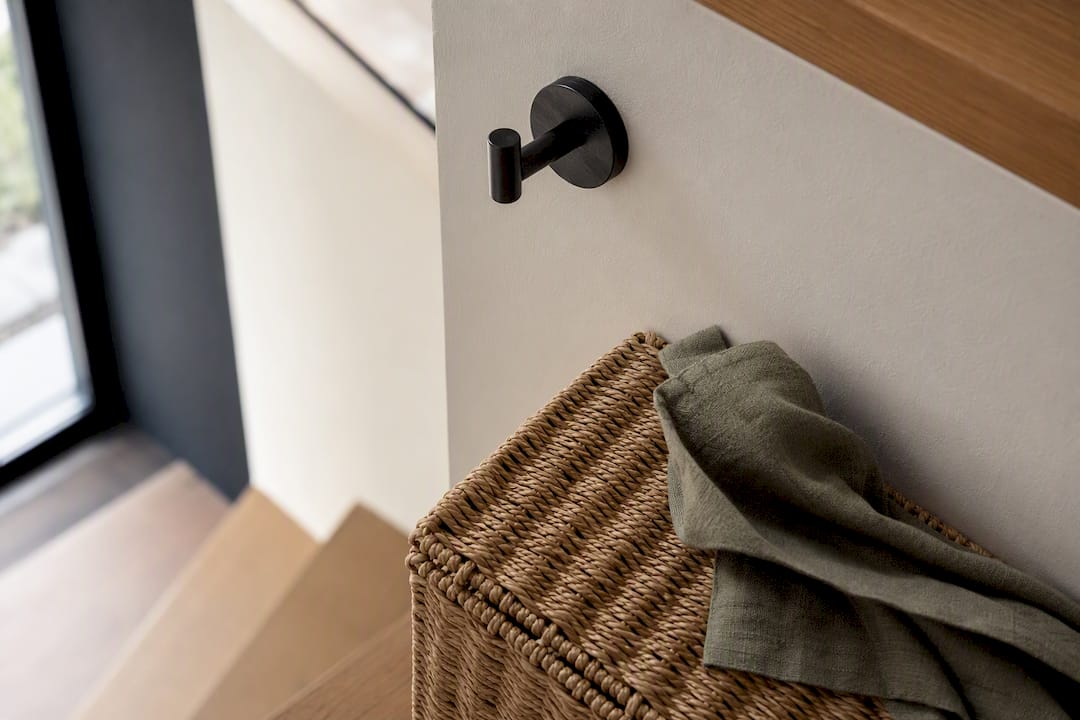
The difference between a tidy entryway and a cluttered one usually isn’t the amount of storage. It’s the materials. Mixing five different textures and finishes in one small space reads as chaotic even when everything technically has a home. Pick two or three materials, wood, woven fibre, and one metal tone, and repeat them across your hooks, baskets and console.
Open storage (visible baskets, exposed hooks) needs more discipline than closed storage, because every item on display becomes part of the room’s visual language. If you’re using open shelving, keep contents grouped by colour or type rather than mixed randomly. Closed storage, cabinets and drawers, forgives more mess because the door hides it, which makes it the better option for households that struggle to maintain a system.
Design experts often encourage homeowners to be bolder with small entryways than they would in a living room, since the visual risk is contained to one small area. A patterned basket or a brass hook rail that might feel too much in a large room can work well in a hallway you pass through rather than sit in.
Texture matters as much as colour. A woven basket against a smooth painted wall creates contrast without adding clutter, while an all-smooth, all-matching set of accessories can feel sterile rather than styled. Aim for one textured element, one metal element, and one soft element (fabric or wood) in every entryway vignette. That’s usually enough variety to feel intentional without tipping into busy.
Tips for maximising storage in small or narrow entryways
Narrow hallways punish bulky furniture fast. The first rule is depth, not width: a console, bench or cabinet deeper than about 35 centimetres will make a tight hall feel like an obstacle course, even if it offers more storage capacity on paper. Prioritise anything shallow enough to leave at least 90 centimetres of clear walking space.
Vertical storage does the heaviest lifting in a small hall. Hooks, floating shelves and tall slim cabinets all use wall space rather than floor space, which is almost always the more constrained resource. If you can only fit one piece of furniture, choose a slim shoe cabinet with a flat top, since it doubles as a landing surface for keys and post without needing a separate console.
Mirrors help more than most homeowners expect. A mirror opposite or beside the front door bounces light back down the hall and creates the illusion of extra width, a trick interior guides return to repeatedly for compact spaces. Pale wall colours and a light rug do similar work.
Finally, resist the urge to store everything at the front door. The deep knowledge shared by organisers suggests keeping only a hook for daily outerwear and a shallow tray for keys in the tightest spaces, moving everything else, spare shoes, umbrellas, seasonal coats, to storage elsewhere in the home and rotating it back in as needed. A narrow hall isn’t meant to hold everything the household owns. It’s meant to hold what you need in the next five minutes.
Lighting solutions to enhance storage visibility and aesthetics
Poor lighting is why tidy entryways still look messy after dark. A single ceiling bulb creates flat, unflattering light and makes it hard to actually see into baskets or find keys on a dim console. Layering light fixes both problems at once.
Start with a wall-mounted sconce or a small lamp near the console, positioned at eye level rather than overhead, so you can see clearly into drawers and baskets without squinting. Warm white bulbs, around 2700 Kelvin, suit entryways better than cool white, which can feel clinical in a space meant to feel welcoming.
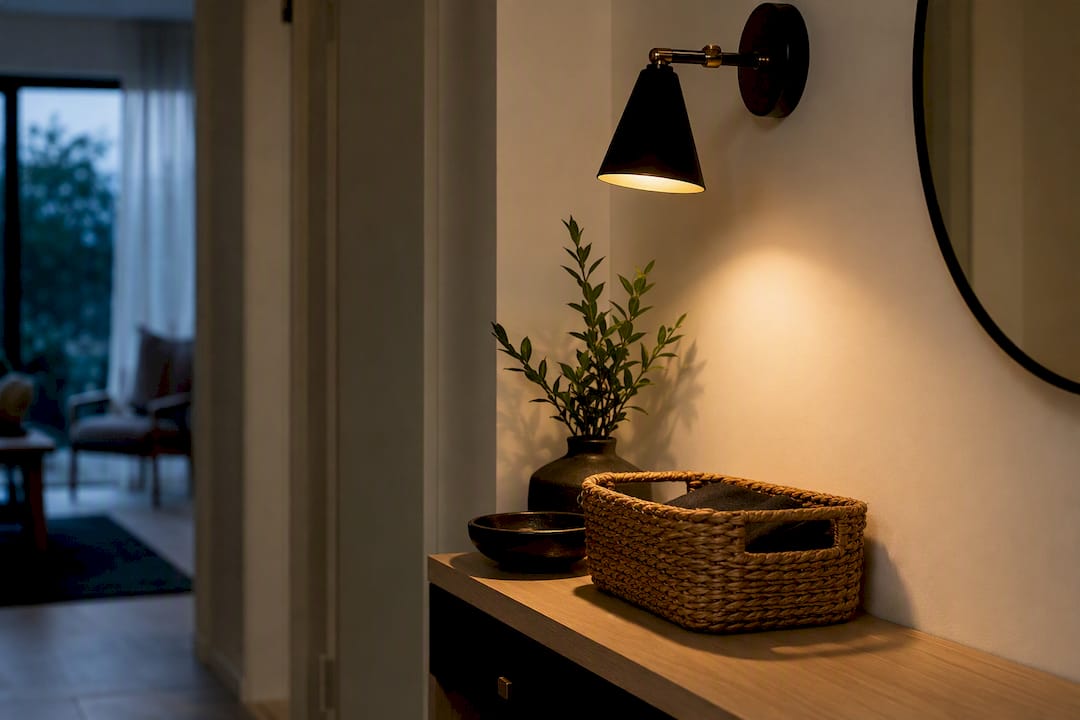
For shoe cabinets and cubbies, a strip of battery-powered LED lighting inside the unit makes a genuine difference to daily usability. It costs little to add and means you’re never digging through a dark cabinet for a matching shoe on a winter morning.
If your entryway has no natural light at all, a mirror positioned to catch light from an adjoining room, or from a lamp, will do more for the sense of brightness than adding another overhead fixture. Combine that with a pale-coloured console or bench, since dark furniture in a dim hall tends to disappear into the shadows and makes the whole space feel smaller than it is.
Incorporating technology for smart entryway storage
A dedicated charging station solves one of the most common entryway problems: phones and cables scattered across the console. A small drawer with a built-in power strip, or a simple charging dock placed inside a console drawer, keeps cables out of sight while still being reachable the moment you walk in.
Key finders, small Bluetooth trackers attached to a keyring or looped through a bag strap, pair well with a dedicated key tray or hook. The habit of always returning keys to the same spot solves most of the problem on its own, but a tracker adds a safety net for the mornings when the habit slips.
Smart lighting is worth considering too. A motion-activated light strip inside a shoe cabinet or under a bench means the space lights up automatically the moment you open it or walk past, which is especially useful in hallways with no natural light and no easy access to a wall switch nearby.
None of this needs to be elaborate. The most effective smart addition to most entryways is simply a single plug socket positioned near the console, since it opens the door to a charging dock, a lamp, or motion lighting without any rewiring.
Cristiano’s pick: one multi-use item to start with
If you’re only changing one thing this weekend, choose a storage bench with cubbies. It gives you seating, hidden containment and a landing surface in a single footprint, and a wipeable finish keeps it practical for families and pets alike.
— Cristiano
Shop Homable: curated storage pieces to get started
Homable’s storage and accessory range is built around the same combination this guide recommends: coordinated finishes, shallow footprints for narrow halls, and materials that hold up to daily use. Once the functional pieces are in place, a single styled object finishes the look without adding clutter. The Decorative Silver Flower Candle Holder works well on a console or bench top, catching the light near an entryway mirror without taking up storage space you need for keys or post.
If you’re starting from scratch, browse Homable’s storage and accessory collections and pick one piece that solves your biggest daily friction point, whether that’s a shoe cabinet, a bench, or a console with a drawer. Add the styling details once the system is working.
Sources
- The secret to an organized entryway, according to professional organizers
- 15 entryway storage ideas to say goodbye to clutter
- Great ideas to declutter your home’s small entryway | Wirecutter
- Entryway decluttering tips
- 10 entryway ideas for a more organized space