Cart
0
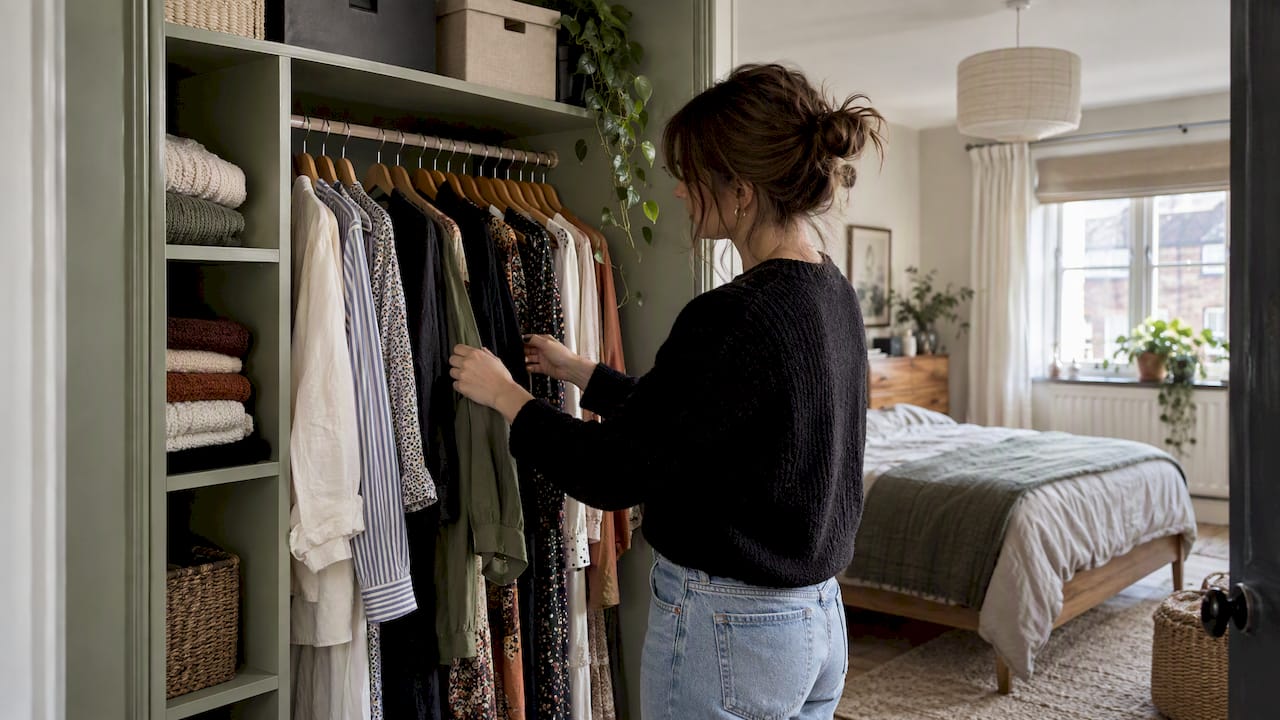
The best wardrobe storage ideas share one order of work: sort what you own, give every category a fixed home, and only then buy baskets, dividers or boxes. Do it the other way round and the containers just hold the clutter in tidier packaging. Below you will find the sorting method, then the storage that works in a small British wardrobe: door organisers, shelf dividers, baskets, under-bed boxes and a laundry basket with a proper liner.
TL;DR
- Declutter one category at a time before you buy any storage, and measure your shelves and rail before you shop.
- Use the dead space: the back of the door, the top shelf, the floor of the wardrobe and the gap under the bed.
- Fold to a standard you will actually keep up, and hang only what creases or needs to hang.
- Baskets work best as labelled homes for small items, not as a dumping ground.
- A laundry basket with a smooth liner protects knitwear and keeps the bedroom looking calm.
Table of Contents
- Start with the clothes, not the containers
- Measure before you buy anything
- Wardrobe storage ideas for a small wardrobe
- Wardrobe storage baskets: where they earn their place
- Beyond the wardrobe: under the bed, on the wall, on a rail
- Seasonal swaps without the mess
- Laundry basket liners, materials and cotton rope baskets
- Our view: storage should make mornings easier
- Ready to pick your baskets?
- FAQ
- Sources
Start with the clothes, not the containers
Professional organisers are remarkably consistent on this. Organiser Ben Soreff, quoted by Homes & Gardens, says storage should come at the end of decluttering: review what you own, then let how often you use something decide where it lives. Julie Morgenstern’s SPACE framework, as reported by Good Housekeeping, puts the same idea in five steps: Sort, Purge, Assign, Containerise, Equalise. Containers are step four. Maintenance is step five.

How to sort when you have too many clothes
Good Housekeeping’s advice is to pull out one category at a time (all the jeans, all the dresses) and split items into keep, sell and donate. Finish one category before moving on, otherwise you end up with a bedroom floor covered in half-decisions.
Two tests help when you are stuck:
- The one-year test. The British Red Cross suggests that if you have not worn something in the last year, you should consider donating it. For uncertain pieces, try them on, or put a temporary safety pin on the hanger and see whether it gets worn.
- The count. Marie Kondo told Ideal Home that recording how many items you own in each category, such as dresses or black shirts, helps prevent rebound clutter and duplicate purchases. A note on your phone is enough.
One warning from Good Housekeeping is worth repeating: putting floor clothes back into an already overcrowded wardrobe recreates the problem. Every garment needs a known place, and it needs to stay visible and reachable.
Decide whether you are a folder or a hanger
Homebuilding advises planning storage around your habits: choose shelves and drawer dividers if you fold, or more rail space if you prefer to hang. Be honest about which you are. A wardrobe built for hanging will not suit someone who throws jumpers onto a shelf.
A sensible split for most people: hang shirts, smart trousers, dresses and anything that creases badly; fold knitwear (hanging stretches the shoulders), T-shirts and casual trousers. Organiser Vicky Silverthorn’s rule, reported by Ideal Home, is to fold to a standard you can keep up. There is no point folding socks beautifully if you will give up in a fortnight.
Measure before you buy anything
Good Housekeeping reports that organisers recommend measuring shelves before buying storage. Take four measurements and keep them in your phone while you shop:
| What to measure | Why it matters |
|---|---|
| Shelf depth and width | Baskets that overhang block the door; ones that are too small waste space |
| Height between shelves | Decides whether you can stack boxes or only slide in one layer |
| Rail height to shelf or floor | Shows whether a second, lower rail or a shoe rack fits underneath |
| Door clearance | A door organiser that is too thick stops the wardrobe closing |
Also note which way the doors open and whether a hinge sits where a basket would go. A basket that looks perfect online and then fails by two centimetres is the commonest wardrobe-storage mistake.
Wardrobe storage ideas for a small wardrobe
If the wardrobe is a standard double or a shallow built-in, the aim is simple: use every surface, not just the rail.
1. Use the back of the door
Ideal Home recommends a door organiser with mesh pockets or fold-out boxes for bulkier items, plus self-adhesive hooks for handbags and scarves. Mesh pockets suit tights, belts and swimwear. Hooks suit the bags you use weekly.
2. Go up
Homebuilding quotes Craig Horeau recommending maximum use of vertical space with shelves, hanging organisers or high shelves for out-of-season clothing. The top shelf is for things you touch twice a year: winter coats in summer, beachwear in winter, spare bedding. Keep a small step stool nearby and label the boxes.
3. Add vertical hanger hooks and bottom cubes
The Standard’s guide to wardrobe organisers suggests vertical hanger hooks to use dead space, and cubes or side shelves to add storage at the bottom of a wardrobe. Hanging several items off one hanger slot is a quick win for a crowded rail, as long as you use it for lighter garments.
4. Use shelf dividers and short piles
Ideal Home recommends short folded piles, shelf separators or fabric storage boxes for bulky knitwear and denim. Short piles are less likely to topple, and fabric boxes contain smaller items. Dividers also stop you pulling out a whole stack to reach the bottom jumper.

5. Match your hangers
Uniform non-slip or velvet hangers make a rail look calmer and stop clothes sliding off, according to the organisers Good Housekeeping spoke to. Specialised hangers for belts, scarves and bags free up shelf space. Swapping mismatched wire and plastic hangers is cheap and gives you a surprising amount of extra room.
6. Order the rail so you can see it
Ideal Home suggests arranging hanging clothes by category and, within each, by sleeve length and colour, with frequently worn pieces easiest to reach. Put in-season favourites at eye level. Vogue offers an alternative, grouping by outfit or occasion, if you dress for distinct settings such as work and weekends.
Wardrobe storage baskets: where they earn their place
Baskets are the most flexible wardrobe storage because they suit shelves, floors and the tops of wardrobes. They are best for the small things that otherwise sprawl: socks, underwear, scarves, gloves, belts, swimwear.
Vogue recommends storing swimwear and winter accessories in bins on shelves and using stackable baskets to take advantage of height. The rules that make baskets work:
- One job per basket. “Scarves and gloves” is a job. “Miscellaneous” is the start of a new pile.
- Label the front. You will not remember what is in the third basket from the left.
- Choose materials that suit the content. Homes & Gardens notes that natural-fibre or wood baskets can replace plastic bins. Soft woven baskets are kinder on knitwear and scarves, while hard-sided ones hold their shape on a high shelf.
- Leave a gap. A basket filled to the brim becomes hard to take down and put back, so it stops being used.
Don’t forget the children’s wardrobe
Kids’ wardrobes are mostly small garments, shoes and a lot of odds and ends, which is exactly where baskets shine. Open baskets at child height let them put things away without help. We stock kids storage baskets for this, including a round storage basket that works on a wardrobe floor or a shelf.
Beyond the wardrobe: under the bed, on the wall, on a rail
When the wardrobe is full even after a clear-out, extend it rather than squeezing more in.
Under-bed storage
Homebuilding says under-bed drawers can extend wardrobe storage for seasonal clothing, shoes and extra bedding without taking additional floor space. Professional organiser Helen Constantine recommends lidded under-bed boxes with wheels for infrequently used items such as ski or beachwear, grouped and labelled so they can be found quickly. Measure the clearance under your bed frame first, as many frames leave less room than you expect.

A freestanding clothes rail
GoodHomes notes that a clothes rail is useful when there is insufficient wardrobe space. Rails with lower shelves can hold shoes or bags, and those with trays or extra shelves suit accessories and hats. A rail suits a spare room or an alcove, though it leaves clothes exposed to dust, so keep it for everyday pieces.
Wall shelves and hooks
If your bedroom has a bare stretch of wall, shelves and hooks can take the daily overflow: the jacket you wore yesterday, tomorrow’s bag, a basket of accessories. Our industrial style wall shelving unit with coat hooks is one option for this. If you want a wider look at how to use that sort of space, our guide to creative storage designs has more ideas.
Seasonal swaps without the mess
Twice a year, moving clothes in and out is the ideal moment to edit. Stylist, quoting Vicky Silverthorn, advises that seasonal clothes should be clean and completely dry before storage, kept in categories and stored in containers without holes. Vacuum bags are most useful for bulky items such as puffer coats and duvets, and she suggests not keeping an item for another season if you no longer enjoy wearing it: sell, donate or repair it first.
A practical routine:
- Wash or dry-clean everything that is going away.
- Pull out anything you did not wear this season. Decide there and then.
- Pack by category, not by room or date.
- Label the box on the side as well as the lid, so you can read it on a shelf.
- Bring the new season’s pieces down and put them at eye level.
If you are also tackling a compact wardrobe and need ways to contain smaller clothing items, this piece on organising a busy household has practical routines that fit alongside the steps above.
Laundry basket liners, materials and cotton rope baskets
The laundry basket is part of the wardrobe system, because dirty clothes that have nowhere to go end up on the chair and then back in the wardrobe. Choosing well matters more than most people expect.
Why a liner matters
Homes & Gardens recommends a stylish rattan basket with a lid and an interior liner to protect clothes from snagging. Professional organiser Shannon Krause prioritises exactly that combination: a lidded rattan basket, with the liner preventing snags. So when you look at a wicker laundry basket liner, check three things:
- Fit. The liner should match the basket’s height and width, with enough fabric to fold over the rim.
- Fabric. Smooth, tightly woven cotton or cotton blends are gentler on knitwear than rough weaves. Avoid anything that sheds fibres onto dark clothes.
- Removability. A liner you can lift out and wash is easier to keep fresh, and it doubles as a carry bag on laundry day.
Choosing a laundry basket material
| Material | Good for | Watch out for |
|---|---|---|
| Wicker or rattan | Looks good in a bedroom, breathes | Can snag knits without a liner |
| Cotton rope | Soft, flexible, light | Needs care with moisture and washing |
| Fabric or canvas | Light, often collapsible | Can lose shape when full |
| Plastic | Wipe-clean, cheap | Less attractive, can crack |
Looking after a cotton rope laundry basket
A cotton rope laundry basket is soft on clothes and holds its shape well. The care approach is simple: do not leave damp washing in it, because wet cotton rope can stay damp and develop odours. For marks, spot clean with a damp cloth and a little mild soap, and let the basket dry fully in the air, away from direct heat. Many makers recommend hand washing over machine washing, so check the care label on your own basket before doing anything more than spot cleaning. If it is a lined basket, wash the liner separately and regularly.
Our view: storage should make mornings easier
We have looked at a lot of storage over the years, and the pattern is the same in nearly every home. People buy containers first and then wonder why the room still feels cluttered. Our view is that wardrobe storage should do one thing: make it easy to find what you want and easy to put it back. That means fewer clothes than the space can hold, not more, a few well-chosen baskets rather than a dozen random boxes, and storage that looks good enough that you want to keep using it.
For our own range, we choose pieces for how they look in a real room as well as how they work. A natural-fibre look, a calm colour and a sensible size matter more than a long feature list. If a basket would not look right on an open shelf, it will probably end up hidden at the back.
— Cristiano
Ready to pick your baskets?
Once you have sorted your clothes and measured your shelves, you will know how many baskets you need and what size. Browse our full range of home storage and decor at Homable, including kids storage baskets and wall shelves. Free shipping applies on orders over £100. If you want to plan the whole house, our storage solutions checklist walks through it room by room.
FAQ
How do I organise a wardrobe when I have too many clothes?
Sort one category at a time into keep, sell and donate, and finish each before starting the next. Use the one-year test as a guide: if you have not worn something in a year, think about letting it go. Then give each category a fixed place so it does not creep back.
What is the best storage for a small wardrobe?
Use space that normally goes to waste: a door organiser with mesh pockets, hooks on the door, high shelves for out-of-season items and cubes or shelves at the bottom. Under-bed boxes then take the seasonal overflow. Measure first so everything fits.
Should I hang or fold clothes?
Hang items that crease or need their shape, such as shirts, smart trousers and dresses. Fold knitwear, T-shirts and casual trousers. Choose the method that you will keep up, as a neat system you abandon is worse than a simpler one you maintain.
Do I need a liner in a wicker laundry basket?
It is a good idea. Woven wicker or rattan can snag delicate fabrics, and an interior liner prevents that. Pick one that fits the basket, is smooth to the touch and lifts out for washing.
Sources
- How to declutter your wardrobe, Good Housekeeping
- Decluttering your wardrobe made easy, British Red Cross
- How to organise your wardrobe, Ideal Home
- If it’s time to declutter your wardrobe, Good Housekeeping
- Marie Kondo’s wardrobe tidying tip, Ideal Home
- How to break the floordrobe habit, Good Housekeeping
- The SPACE decluttering method, Good Housekeeping
- How to organise a small wardrobe, Ideal Home
- 12 bedroom storage ideas, Homebuilding
- How to organize a closet, Vogue
- Biophilic decluttering, Homes & Gardens
- Laundry basket storage ideas, Homes & Gardens
- Best closet and wardrobe organisers, The Standard
- Stylish clothes rails, GoodHomes
- How to declutter a bedroom in one day, Ideal Home
- Switching your wardrobe from summer to autumn, Stylist