Cart
0
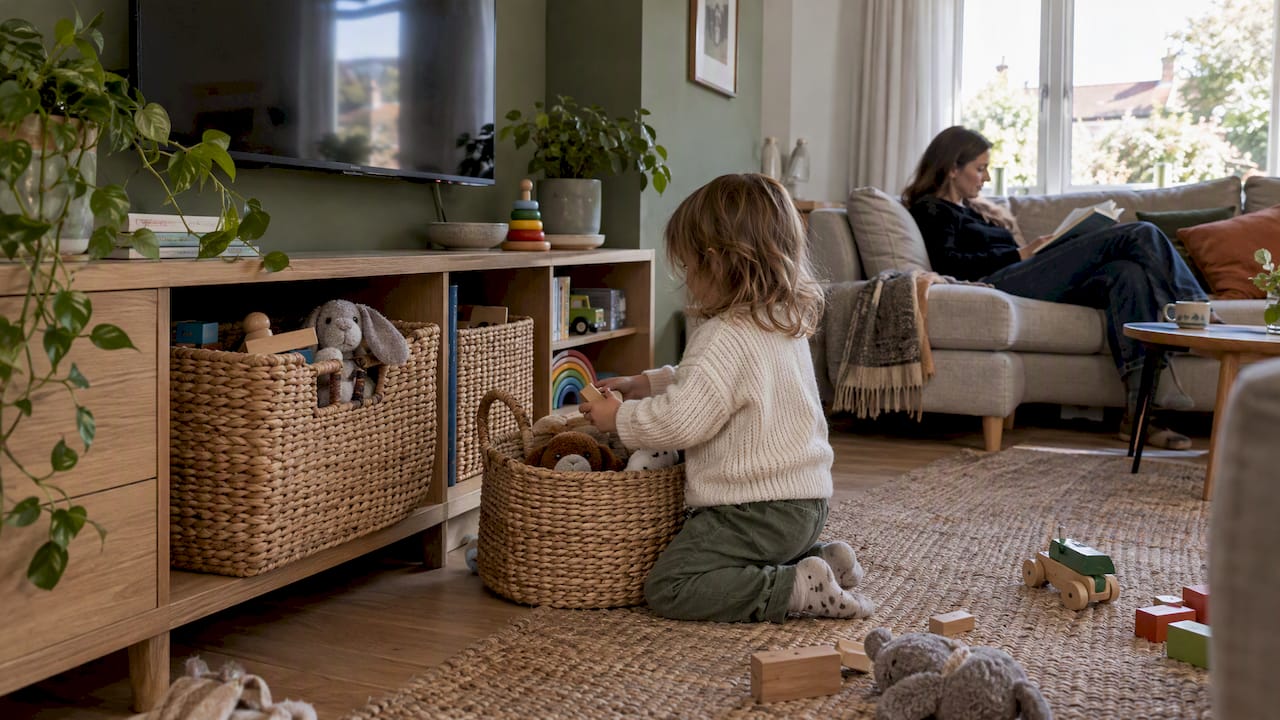
The best toy storage for a living room is storage that looks like part of the room and that a child can use alone. In practice that means woven or fabric baskets for quick tidying, low shelves or cubes at child height for the everyday toys, and one closed piece, such as a sideboard or ottoman, for everything else. Sort out how many toys you keep out first, then buy storage to fit that number, not the other way round.
Below you will find how to choose between baskets, cubes, chests and shelves, how to make it work in a small room, and how to stop a storage unit becoming a safety risk.
TL;DR
- Cut back before you buy: keep a small set of toys out and rotate the rest, so you need less storage.
- Baskets are best for fast “toss-in” tidying; cube units and low shelves suit toys children choose for themselves.
- Closed storage (sideboard, ottoman, cupboard doors) hides the plastic and keeps the room calm in the evening.
- Anchor any tall or drawered furniture to the wall, whatever room it is in.
- In a small room, go vertical with wall shelves and use one multi-purpose piece instead of several boxes.
Table of Contents
- Start with fewer toys, not more storage
- Match the storage to how your child plays
- Toy chest or baskets?
- Living room toy storage ideas for different homes
- Keep it safe: anchor furniture
- Our view on living room toy storage
- Where to start at Homable
- A simple weekly routine
- Choosing what to buy: a quick checklist
- FAQ
- Sources
Start with fewer toys, not more storage
Most living room toy problems are volume problems. A bigger box simply holds a bigger pile. Professional organisers quoted by Good Housekeeping make the same point: more storage is not always the answer, and the first step is deciding what stays.
Two simple ideas help.
The 80/20 rule. The principle, explained by Homebuilding, is that we use about 20% of our belongings 80% of the time. Children are no different: a handful of favourites get nearly all the play. The same article suggests a “box test”: pack items away for a month and see whether they are missed. Anything nobody asks for is a candidate to pass on.
Toy rotation. GiftExperts reports research suggesting children with fewer toys to hand play for longer and more creatively, and recommends around 6 to 10 toys accessible at a time, with the rest stored away and swapped in monthly. The side benefit is that the swap feels like new toys without spending anything.
If the idea of a big cull makes you anxious, the Minimal Parent suggests a “maybe” box: toys you are unsure about go in it, out of sight, and you revisit it later. It also reminds parents that there is no right number of toys for any age and that the goal is not a picture-perfect living room.
A practical sorting pass takes about an hour:
- Gather every toy from the living room into one place.
- Remove anything broken, with missing pieces, or outgrown.
- Choose the current favourites and the things played with daily. These stay out.
- Put the rest into a “rotation” box or two and store them in a cupboard, loft or wardrobe.
- Put doubtful items in the “maybe” box and set a date to look again.
Now you know how much storage you actually need, which is usually less than you feared.
Match the storage to how your child plays
Practitioners quoted by Southern Current argue that living room storage should follow a child’s natural behaviour rather than force a rigid system. Open shelving at child height, on the bottom two shelves, lets children reach things independently, while baskets suit quick toss-in clean-ups. That gives a useful rule: different toys need different containers.
| Storage type | Best for | Watch out for |
|---|---|---|
| Woven or fabric baskets | Soft toys, dressing-up, cars, anything that can be tossed in | Small pieces sink to the bottom and become a jumble |
| Cube units with fabric or plastic bins | Sorted sets: blocks, figures, craft, puzzles | Tall units need anchoring; children pull bins out at speed |
| Low open shelves | Books and a few favourite toys on display | Looks untidy if overfilled; keep it to the rotation set |
| Ottoman or storage bench | Bulky overflow, hides everything in seconds | Lid weight and hinges; check it cannot trap fingers |
| Sideboard or cupboard with doors | Hiding everything after bedtime | Not child-accessible, so keep a basket out for daily toys |
| Wall shelves | Display, books, small ornaments out of reach | Must be fixed properly to the wall type |
Most families end up with a combination: a basket or two within reach, a cube unit for the sorted toys, and one closed piece to take the rest.
Toy chest or baskets?
This is the question behind many searches, and the honest answer is that baskets win for daily life and a chest wins for bulk.
Baskets are light, easy for small hands to carry, and they let a child bring a whole category of toy to the play area and carry it back again. They also look good: textured baskets soften a room in a way that a brightly coloured plastic bin never will. Wirecutter makes the point that toy storage works best when treated as part of the room’s décor, using woven baskets or sideboards with doors to hide bright plastic.
A toy chest is a single deep box. It swallows large items quickly, but everything lands in one heap, and the toy a child wants is always at the bottom. A deep chest is also harder for a young child to use unaided.
Our suggestion: use baskets for the everyday set and, if you have the space, one lidded piece (a chest, ottoman or bench) for big, rarely used items like a play kitchen’s accessories or large building sets.

Stop the “dump” with small containers inside big ones
Professional organisers warn about the child who tips out a whole bin to find one piece. A proven fix, according to Southern Current, is to decant small toys and sets into smaller, labelled boxes or zipped pouches inside the larger container. For pre-readers, a photo or picture label works as well as words. Then each basket holds a handful of pouches, and tidying takes minutes.

Living room toy storage ideas for different homes
A small living room
When floor space is short, go up and double up.
- Use wall height. Wall shelves above a sofa or in an alcove take books and displayed items out of the way. Keep heavier or breakable things high and out of reach, and fix them securely.
- Choose furniture that does two jobs. An ottoman can be a footstool, extra seating and toy store in one.
- Keep the out-and-about set small. A single large basket of the current rotation, tucked beside the sofa or under a console table, is enough for most small rooms.
- Use the dead spaces. Behind a door, under a window seat, beside a TV unit: slim baskets or a low cube unit fit where nothing else does.
We cover more small-space thinking in our guide to living room clutter solutions.
Hidden toy storage
Hidden storage suits adults who want a calm room in the evening. Options include:
- A sideboard or low cabinet with doors, where baskets of toys sit behind closed fronts.
- Open shelves with decorative baskets, which look styled but hold a lot.
- Lidded benches or ottomans that double as seating.
- Fabric-lined baskets under a console or behind the sofa, pulled out at playtime.
The trade-off is that hidden means harder for children to reach. Keep one accessible basket of the current favourites and let the closed storage take the rest.
An open-plan or family room
If the living room doubles as the main play area, define a zone. A rug under the play area, with a unit on one side and a basket nearby, tells everyone where toys live. When everything has a spot, the “reset” at the end of the day is quick. Our family-friendly decor tips go further on making a shared room work for both children and adults.
Keep it safe: anchor furniture
This is the part many people skip. Storage units, chests of drawers and bookcases can topple when a child climbs on open drawers or shelves. According to Lancashire County Council’s guidance on unsecured furniture, even furniture as short as 27 or 28 inches can be involved in incidents, and the advice is to buy low furniture with a sturdy, broad base, to look for pieces that come with anchoring equipment, and to test stability in the shop.
The same guidance notes that the UK has no mandatory national standard for tip-over protection on domestic furniture, so the responsibility sits with you. In practice:
- Anchor tall or drawered furniture to the wall, in the living room as well as the nursery.
- Do not assume the supplied wall fixings suit your wall. Stud, brick and plasterboard need different fittings, so check before you drill.
- Put heavy items low and light items high.
- Never put a television on a unit that a child can climb.
If you are unsure what fixing suits your wall, ask a qualified handyperson or electrician rather than guess. Safety teams also recommend thinking about the early evening, which is when the guidance says these incidents often happen, when everyone is busy and children are active.
Our view on living room toy storage
We sell home décor and household accessories, so we see how families actually style a room around children. Here is what we think matters.
Storage should look like it belongs. A living room is shared. We would rather see a family choose baskets and units in natural textures and colours that match the room than hide a bright plastic tub behind the sofa. When storage looks good, people keep using it.
Buy for the toys you keep, not the toys you own. We would always sort first. A rotation set and a few well-chosen containers do more than a wall of boxes.
Make tidying a two-minute job. If a child cannot put things away alone, the system will fail by week three. Wide baskets, low shelves and obvious homes are the point.
Do not trade safety for looks. A pretty tall unit that is not fixed to the wall is a worse choice than a plain low one.
Our basket storage ideas show how baskets can work across the home, and our decorative storage guide covers pieces that earn their place in a styled room.
— Cristiano
Where to start at Homable
If you want to put this into practice, our kids storage baskets are a good first step for everyday toys. The round storage basket comes in several variants, and the kids’ cube storage cabinet with 12 cubes is available in blue, pink and green for sorted sets. We also stock wall shelves for books and display. Orders over £100 ship free, so a basket set and a shelf or two can be bought together. Browse everything on homable.co.uk.
A simple weekly routine
Storage only works with a habit behind it. A routine that takes ten minutes:
- Daily reset. Before bedtime, everything goes back to its basket. Make it a game, with a song or a timer.
- Weekly check. Pull out anything broken or that has not been touched.
- Monthly swap. Change the rotation set, as GiftExperts suggests, so the toys feel fresh.
- Seasonal edit. As children grow, retire what they have outgrown. The Minimal Parent calls these “toy seasons”: keep what supports the current stage, not everything in case.
This also makes birthdays and Christmas easier. You know what is in play, what is in storage and what can go before new things arrive.
Choosing what to buy: a quick checklist
- Height. Can your child reach the everyday toys without help?
- Weight. Can they lift a full basket? If not, use smaller ones.
- Stability. Is the unit low and broad, and can it be anchored?
- Look. Does it suit your living room in daylight and in the evening?
- Capacity. Does it hold the rotation set, not the whole collection?
- Edges and lids. Are corners rounded and lids safe for little hands?
- Cleaning. Can you wipe it or wash it?
For more on planning storage across the home, see our storage solutions checklist.
FAQ
What is the best way to store kids’ toys in the living room?
Keep a small set of current favourites in baskets or on low shelves your child can reach, and put the rest in closed storage such as a sideboard or ottoman. Rotate the toys monthly. This keeps the room tidy and the toys interesting.
How do I store toys in a small living room?
Use vertical space with wall shelves, choose furniture that doubles as storage, such as an ottoman, and limit the toys out to one or two baskets. Slim units fit beside sofas and under windows. Anchor anything tall.
Is a toy chest better than baskets?
For daily use, baskets are easier for children to carry and sort, and they look better in a living room. A chest suits bulky, rarely used items. Many families use both: baskets for favourites and a lidded piece for overflow.
What is the 20 toy rule?
It is a popular idea that a child plays best with a limited number of toys out at once, with the rest stored. Research cited by GiftExperts suggests 6 to 10 accessible toys, and there is no official number. Choose a figure that fits your space and your child, and rotate the rest.
Sources
- Why Fewer Toys Lead to Better Play, GiftExperts
- How the 80/20 rule can help declutter your home, Homebuilding
- Accidents in the home: injuries from unsecured furniture, Lancashire County Council
- Professional Organizers’ Decluttering Rules, Good Housekeeping
- How to Declutter Toys: Guide and Simple Systems for Busy Parents, The Minimal Parent
- Toy Storage Guide, Southern Current
- 9 Toy Storage Ideas Your Kids Will Actually Use, Wirecutter