
Cart
0
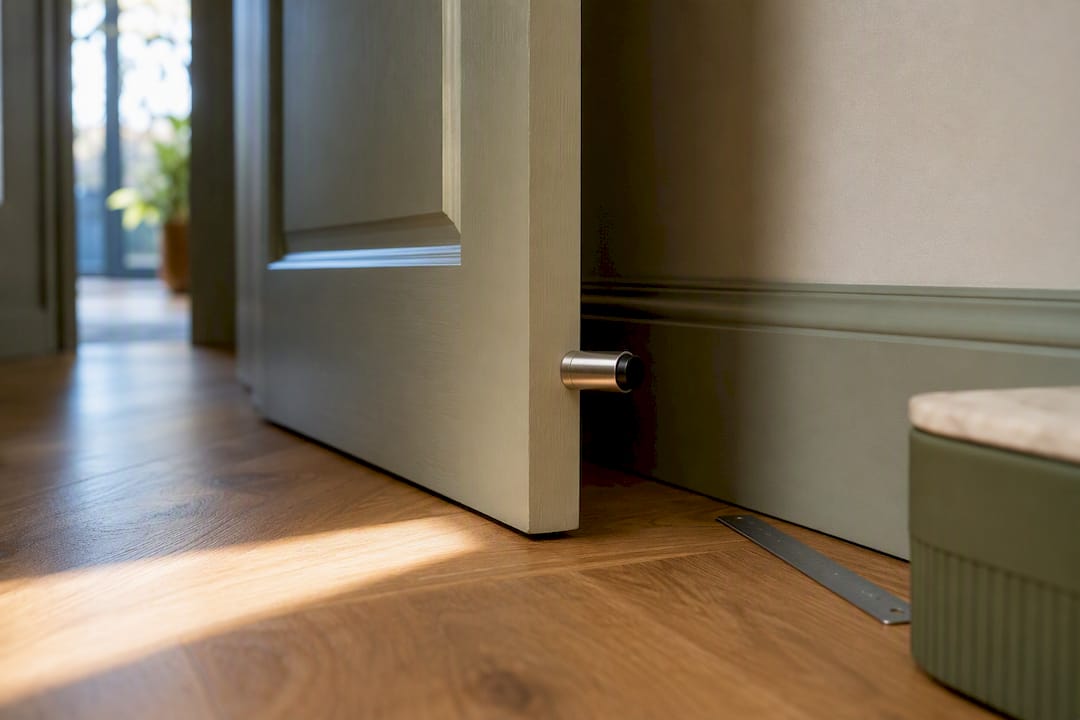
Fit the stop about two-thirds of the way along the door from the hinge, at handle height if it’s wall or baseboard mounted, or directly under the handle if it sits on the floor. Leave clearance of about 25 to 40 millimetres between the door and the wall or skirting. This position spreads the force of an opening door, protects your plaster and skirting, and Ram-design and animal-shaped stops fit this rule as easily as a plain rubber wedge.
TL;DR:
- Proper placement of wall or baseboard stops should be at handle height with a 25-40 mm gap to prevent contact, especially when mounted on studs or solid backing.
- Floor-mounted stops should be positioned a few inches from the door edge under the swing path, with the screw left slightly loose initially to allow natural alignment.
- The two-thirds rule for stop placement is based on the center of percussion, absorbing impact efficiently and avoiding damage to hinges or walls.
- Correct fixings depend on the underlying substrate, requiring heavy-duty anchors for masonry, cavity anchors for plasterboard, and appropriate screws for timber or tiled surfaces.
- Avoid common failure points by matching the fixing to the substrate, testing the position beforehand, and removing obstructions like pipes or cables before drilling.
Table of Contents
- Doorstop placement by type: wall, baseboard, floor, hinge and magnetic
- How do I properly install a door stop step by step?
- Why does the two-thirds rule actually work?
- Fixings and substrate checklist for every floor and wall type
- Common doorstop problems and how to fix them
- What UK homes get wrong about doorstops
- Which Homable doorstop suits your door and floor
- Where can I buy stylish, ready-to-fit doorstops?
- Sources
- FAQ
Doorstop placement by type: wall, baseboard, floor, hinge and magnetic
Not every door and floor combination suits the same fixing, so the right doorstop location depends on what’s underneath and behind it.
- Wall or baseboard stops should sit at the same height as the door handle, screwed into a stud or solid backing wherever possible, with that 25–40 mm gap preserved so the handle never quite reaches the wall.
- Floor-mounted stops work best positioned under the swing path of the handle, set a few inches in from the door’s leading edge to give the mechanism proper leverage. Avoid screwing these into floating laminate, since drilling into a floating floor can void a warranty and cause creaking later.
- Hinge-pin stops fit into the top hinge on most doors. You remove the pin, slot the stop in, replace the pin, then wind the threaded pad until the door stops where you want.
- Magnetic catches suit anyone who doesn’t want to drill at all, but they hold less firmly than a fixed stop, so they’re better for lightweight doors than heavy fire doors or ones that get slammed regularly.
- Hollow-core doors flex more than solid ones, so shift the stop slightly inward from the two-thirds mark or add a small reinforcing pad where the stop makes contact, an approach worth understanding alongside general guidance on door construction and types.
How do I properly install a door stop step by step?
Good doorstop installation is mostly about testing before you commit to a drill hole. Rushing this is how people end up with two extra holes in the skirting.
- Open the door fully and mark the exact point where the handle or door edge would strike the wall or floor.
- Measure back to leave that 25–40 mm clearance gap between door and wall.
- Hold a temporary block or the stop itself in place and swing the door several times to check the position feels right.
- Identify your substrate (masonry, plasterboard, timber, tile) and select the matching plug and screw.
- Apply a strip of masking tape over the drilling point, then drill a pilot hole to stop the bit skating across the surface.
- Fix the stop, but for floor-mounted types, leave the screw slightly loose at first.
- For hinge-pin stops, remove the top pin, fit the stop, replace the pin, then adjust the threaded pad.
- Swing the door repeatedly to test, then tighten fully once you’re happy with the fit.
Pro Tip: Leaving a floor stop’s screw loose for the first few swings lets it square itself naturally to the door face. Tighten too early and you’ll fight a rattle for months.
Wall-mounted stops in plasterboard need heavy-duty cavity anchors rather than standard wall plugs, because a plasterboard skin alone won’t take repeated impact from a swinging door.
Why does the two-thirds rule actually work?
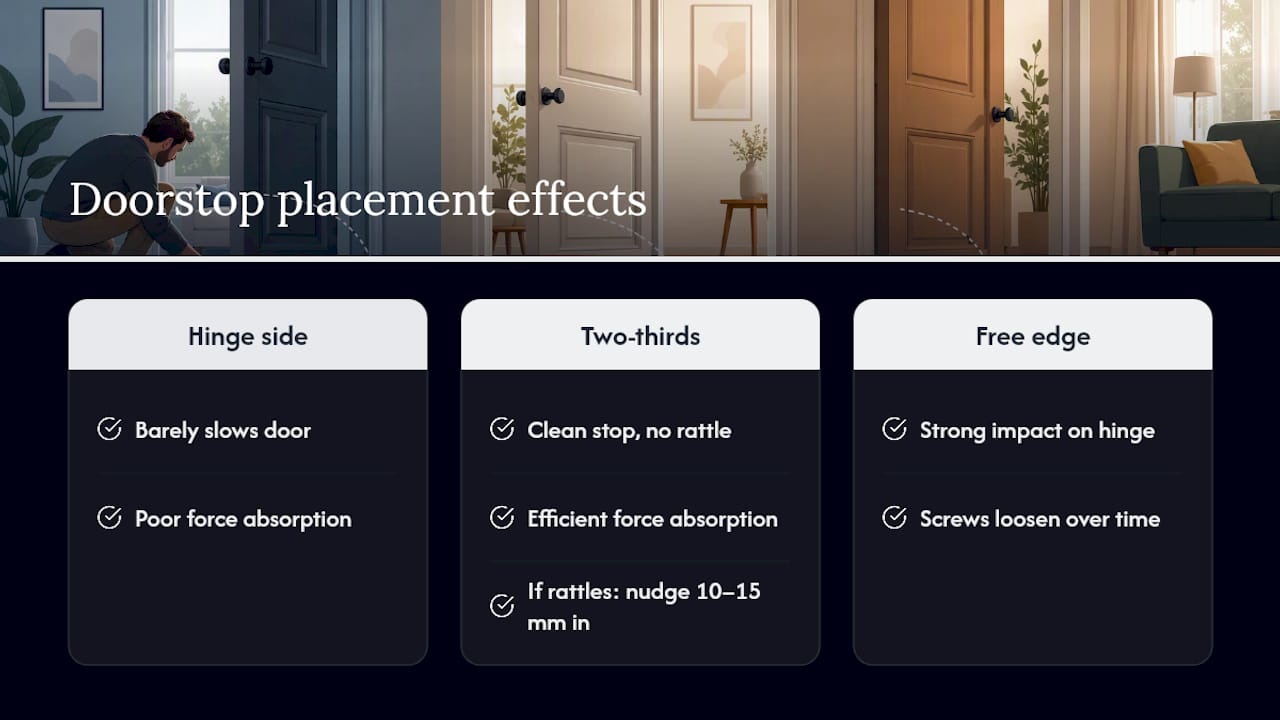
Doorstop placement two-thirds of the way from the hinge isn’t an arbitrary tradition. It’s the practical version of the centre of percussion, the point on a swinging object where impact force is most efficiently absorbed without punishing the hinge or handle. Place the stop too close to the hinge and it barely slows the door; too close to the free edge and every knock jars the hinge screws loose over time.
A quick way to see this in your own hallway: hold a length of 2x1 timber against the door at roughly the two-thirds mark and swing it. If the door stops cleanly with no rattle or bang, you’re close. If it feels loose or the door still slams into the stop, nudge the position 10 to 15 mm inward and test again. Hollow-core doors often need that extra inward adjustment because the panel flexes slightly on impact.
Fixings and substrate checklist for every floor and wall type
The wrong screw is the single biggest reason doorstops fail within a few months. Match the fixing to what’s actually behind the surface, not just what’s in the drawer.
- Masonry walls: a masonry bit, standard 6–7 mm plugs, and screws at least 40 mm long.
- Plasterboard or cavity walls: metal cavity anchors rated for 20–50 kg, never a plastic wall plug alone.
- Dot-and-dab or lath walls: longer fixings that bridge through to the masonry behind, or a specialist cavity anchor designed for that gap.
- Timber subfloors: standard wood screws with a pilot hole to prevent splitting the boards.
- Laminate or floating floors: avoid screwing into the floating surface altogether; a wall or baseboard stop is the safer route.
- Tiled floors: drill with a tile bit first, then switch to a masonry bit, going slowly to avoid cracking the glaze.
Pro Tip: Before drilling anywhere near skirting joints, check for pipes and cables, and keep fixings at least 20 mm clear of a skirting joint to stop it splitting.
For dot-and-dab or tiled work in particular, it’s worth confirming your substrate and drilling method before you commit to a single hole.
Common doorstop problems and how to fix them
Most doorstop failures trace back to one of a handful of avoidable mistakes.
- Stop keeps pulling out of the wall: the anchor doesn’t match the substrate; move to a stud or fit a proper cavity anchor rated for the load.
- Rattling or misaligned floor stop: you tightened it before it could square itself; loosen, reposition, and retighten gradually.
- Trip hazard in a busy hallway: swap a projecting floor stop for a low-profile baseboard or wall-mounted version.
- Repeated failures on a fire door, or you suspect hidden wiring or pipework: stop drilling and bring in a qualified tradesperson rather than guessing.
What UK homes get wrong about doorstops
Most doorstop failures in British homes aren’t about the product, they’re about placement. It is common across period conversions and new-builds alike that someone buys a nice-looking stop, screws it in wherever looks tidy, and wonders six months later why the wall has a scuff mark and the stop rattles. Measuring first, even roughly with a block of wood, would have saved the plaster.
The physics doesn’t care how attractive a doorstop is. A beautifully finished stop screwed into the wrong point on the wall will still let a handle clip the plaster. Product ranges, from cast metal designs to weighted fabric options, are built to work with correct placement rather than despite poor placement…
— Cristiano
Which Homable doorstop suits your door and floor
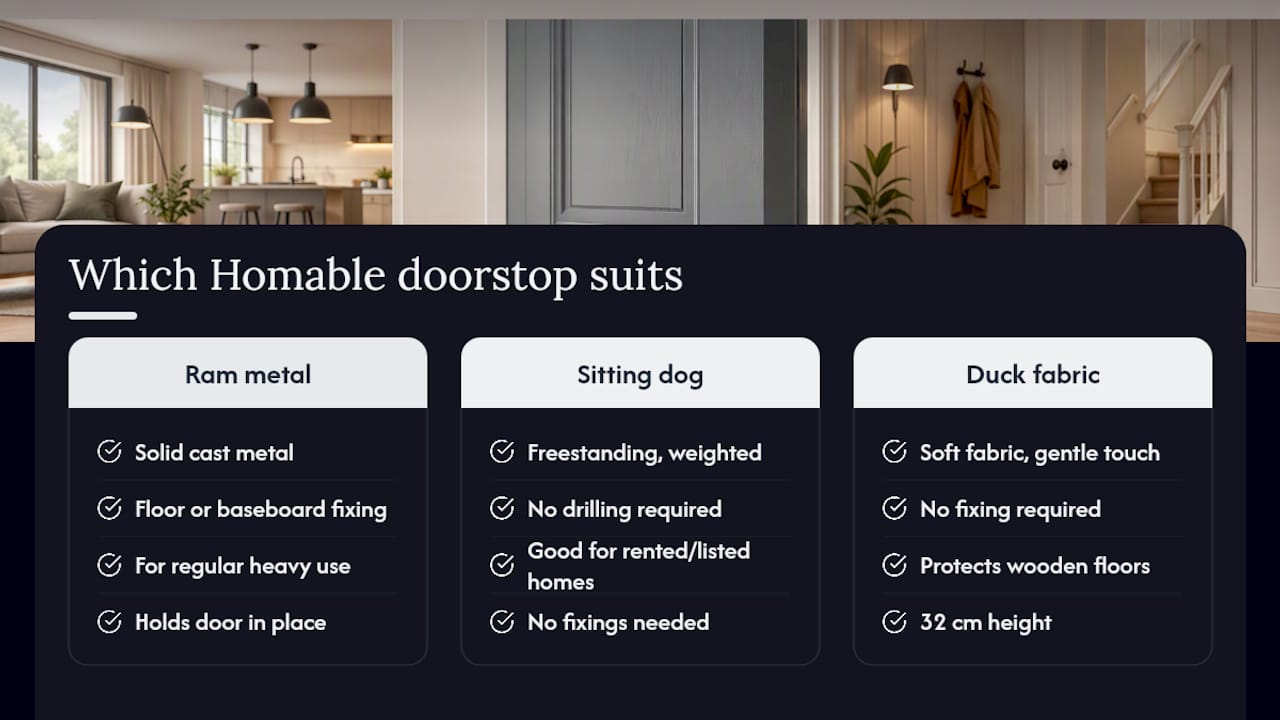
Once you know your measurements, the decision becomes mostly about finish and mounting type rather than guesswork. Homable’s ram design door stop in silver is a solid cast metal option that suits floor or baseboard fixing where you want real weight holding the door in place. The sitting dog doorstop works well as a freestanding, weighted option for rooms where drilling isn’t practical or wanted, useful for rented homes or listed buildings with restrictions on wall fixings. For a softer touch near a draughty entrance or a room where you want something that won’t scratch a wooden floor, the duck fabric door stop in 32cm sits comfortably against the door edge without needing any fixing at all.
Before ordering, check the product dimensions against your measured position, particularly the clearance gap you marked out during testing. Metal stops generally suit fixed floor or baseboard positions where a door sees regular heavy use; soft fabric stops suit lighter, decorative use or draught control rather than repeated hard impacts.
Where can I buy stylish, ready-to-fit doorstops?
If you’d rather not spend a Saturday cross-referencing wall plugs and skirting heights, Homable’s decorative doorstops are designed to work the moment they’re fitted, without sacrificing how your hallway looks. Unlike a generic rubber wedge, pieces like the ram-design stop or the sitting dog doorstop double as a small ornament when the door’s open, so there’s no compromise between practical and presentable.

Orders over £100 often qualify for free shipping, and online purchases are secured, so choosing a doorstop can be as straightforward as browsing the range and picking a finish that suits your hallway or living room. If you’re furnishing a wider space at the same time, the decorative silver flower candle holder is worth a look alongside your doorstop order to finish the room. Measure your gap, check the product page dimensions, and add your chosen stop to the basket. It’s a five-minute decision that saves months of wall scuffs.
Sources
- Best location to install floor door stop
- How to fit door stops in a UK home without damage
- Guide on How to Install a Door Stopper
FAQ
What is the recommended angle for a doorstop?
There’s no fixed angle to set, but the stop should contact the door face-on, roughly two-thirds of the way from the hinge, so the impact lands square rather than at a glancing angle that causes rattling.
How do I properly install door stops?
Mark the impact point with the door fully open, leave a 25–40 mm clearance gap, drill a pilot hole suited to your wall or floor material, then fix the stop and test the swing before final tightening.
What is the recommended height for a doorstop?
Wall and baseboard stops should sit at the same height as the door handle, since that’s roughly where the handle would otherwise strike the wall.
Should a door stop be on the door or wall?
Modern UK homes generally favour wall, baseboard, or floor-mounted stops over the older practice of fitting the stop to the door itself, mainly because hollow-core doors and floating floors don’t hold fixings as well as solid skirting or masonry.
Can I use a magnetic doorstop instead of drilling?
Yes, magnetic catches avoid drilling entirely, but they hold less firmly than a fixed stop, so they suit lighter doors better than heavy or frequently slammed ones.