Cart
0

TL;DR:
- A structured gift selection process involving recipient context, category, and scoring leads to more meaningful home gifts.
- Fixing your budget beforehand and using one clue about the recipient simplifies decision-making and prevents clutter.
Step by step home gift selection is a structured method for choosing meaningful, well-received home gifts by working through recipient context, budget, and simple decision rules before you ever browse a single product page. Most people skip this process entirely and end up with a generic candle or a vase that clashes with the recipient’s décor. The result is a gift that gets quietly moved to a cupboard. This guide gives you a reusable framework, grounded in behavioural research, that works for housewarming gifts, birthdays, and any occasion where a home accessory or décor item is the right choice.
What do you need before starting your home gift selection?
The single most common mistake in the gift selection process is browsing before thinking. Spend sixty seconds building what gift researchers call a “gift snapshot” before you open any website or shop.
Your snapshot covers four things:
- Recipient: Who are you buying for? New homeowner, established household, minimalist, maximalist?
- Occasion: Housewarming, birthday, Christmas, or a thank-you? The occasion shapes the expected price range and formality.
- Vibe: What is the recipient’s home style? Neutral and calm, bold and colourful, or somewhere between?
- Budget: Fix this before you browse. Budget set before shopping acts as a clean filter that prevents awkward half-commitments and keeps your research focused.
Budget tiers follow a clear pattern based on relationship closeness. Casual friends sit in the £20–35 range, good friends in the £40–65 range, and close family in the £60–120 range. Gift satisfaction peaks at appropriate price points. Overspending often creates obligation pressure rather than genuine appreciation, so staying within the right tier is genuinely better for the recipient.
Pro Tip: Keep a running note on your phone for each person you regularly buy gifts for. Record anything they mention wanting, disliking, or admiring in their home. This takes ten seconds in the moment and saves hours of guessing later.
Once your snapshot is ready, you have a clear brief. You are no longer browsing aimlessly. You are shopping with a filter already in place.
How do you identify the right home gift category?
Choosing the category before the item is the step most gift-buyers skip, and it is the one that matters most. A well-chosen category narrows hundreds of options down to a manageable shortlist in seconds.
Start by thinking in rooms:
- Living room: Cushions, throws, ornaments, candle holders, picture frames, and decorative trays.
- Kitchen: Quality serving boards, stylish storage jars, tea towels with character, and practical utensil holders.
- Bedroom: Linen-look cushion covers, bedside organisers, and calming diffusers.
- Entryway: Hooks, small storage baskets, and decorative mirrors.
- Home office: Desk organisers, small plants, and framed prints.
The “one-clue rule” cuts this list further. Identify one thing you know for certain about the recipient’s home or habits. If they always mention their morning coffee ritual, the kitchen category becomes obvious. If they recently moved and mentioned a bare hallway, the entryway category wins. Using one known interest to anchor your category choice is a proven method for avoiding decision paralysis.
The next filter is the useful-versus-delightful question. Decide which one you are buying. A useful gift solves a real problem, such as a storage basket for a cluttered hallway. A delightful gift brings joy without a practical function, such as a sculptural ornament for a shelf. Deciding between useful or delightful simplifies selection and gives the gift a clear purpose. Trying to do both at once often produces something that does neither well.

Pro Tip: Avoid gifts that are highly style-specific, such as a bold patterned rug or a statement wall clock in an unusual colour. Unless you know the recipient’s home well, neutral tones and classic shapes are far safer and far more likely to be used.
For recipients in smaller homes, space-saving gift ideas are worth considering. A gift that solves a space problem lands far better than one that adds to the clutter.
What is the step-by-step process for choosing the perfect home gift?
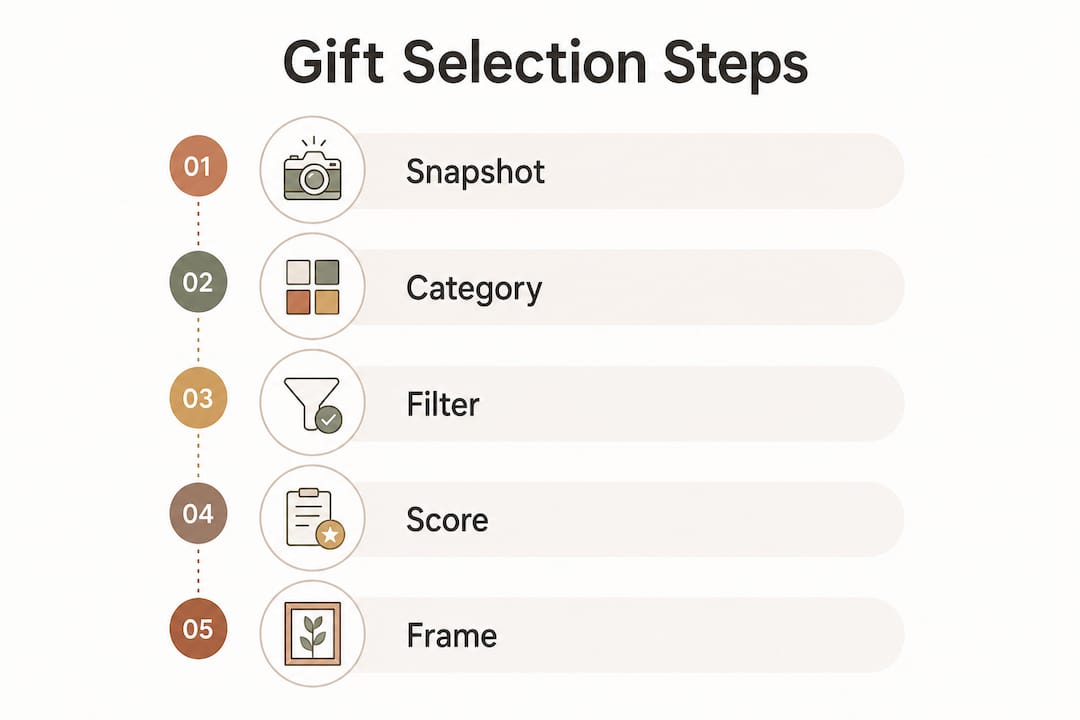
With your snapshot and category in place, the actual decision process becomes short and repeatable. Follow these five steps:
- Build your snapshot. Recipient, occasion, vibe, and budget. Done in sixty seconds.
- Choose your category. Pick the room and the useful-or-delightful filter before browsing.
- Apply the one-clue rule. Use one known fact about the recipient to guide your search within the category.
- Score your top three options. Do not compare more than three items. Limiting comparison to three options prevents decision fatigue and leads to faster, more confident purchases.
- Choose and frame the gift. Pick the highest-scoring option and frame it with context.
The scoring step deserves more detail. Expert gift-buyers rate each shortlisted item across five criteria:
| Scoring criterion | What to ask |
|---|---|
| Usefulness | Will this make a real difference to their daily routine? |
| Style compatibility | Does this match what I know of their home’s look and feel? |
| Space fit | Is this the right size for a typical room or surface? |
| Shipping confidence | Will this arrive safely and look good out of the box? |
| Presentation | Does this feel like a gift, or does it need extra wrapping effort? |
Score each option out of five per criterion. The item with the highest total wins. This takes under three minutes and removes the emotional second-guessing that makes gift shopping exhausting.
The final step, framing, is where most people leave significant value on the table. Framing a gift with routine context increases perceived value by 47%. Instead of handing over a set of linen cushion covers, say: “I thought these would look great on your sofa for your Sunday morning reading.” That one sentence connects the gift to the recipient’s life and makes it feel personal rather than purchased.
For a more detailed look at how to structure your decision-making, the decorating workflow for gift buyers at Homable walks through a similar framework with home décor examples.
What mistakes should you avoid when choosing home gifts?
The most common pitfall is buying a gift that looks impressive in the shop but creates clutter at home. Practical gifts preferred over generic decorative items, particularly for new homeowners who are still settling in and have limited storage. A standard pillar candle, a generic photo frame, or a novelty kitchen gadget all fall into this trap.
Avoid these specific errors:
- Buying purely for aesthetics. A beautiful object that has no function and no connection to the recipient’s taste will be moved within a month.
- Ignoring scale. A large decorative item is a risk unless you know the recipient’s home well. Smaller, versatile pieces travel better across different spaces.
- Overspending to compensate for uncertainty. Spending more does not fix a poorly chosen gift. Recipients value gifts that acknowledge their daily routines 3.2 times more than generic items, regardless of price.
- Leaving personalisation as an afterthought. Personalisation works best when it is built into the gift choice, not added as a gift tag. A personalised home gift that reflects the recipient’s actual style is far more memorable than a standard item with their name printed on it.
Pro Tip: If you are genuinely unsure about style, choose a gift that upgrades something the recipient already uses. A better version of a kitchen storage jar, a higher-quality throw, or a more attractive tray for their coffee table all improve daily life without the risk of clashing with their existing décor.
Functional gifts that ease a recipient’s transition into a new home create lasting appreciation. The bar for a housewarming gift is not beauty. It is usefulness at the right moment.
Key takeaways
The most effective home gift selection process combines a sixty-second recipient snapshot, a category-first approach, and a three-option scoring rule to produce confident, well-received choices every time.
| Point | Details |
|---|---|
| Build your snapshot first | Fix recipient, occasion, vibe, and budget before browsing any products. |
| Choose category before item | Narrow by room and useful-or-delightful filter to cut hundreds of options instantly. |
| Use the one-clue rule | One known fact about the recipient anchors your search and prevents generic choices. |
| Score only three options | Comparing more than three items causes fatigue; score and commit to the highest-rated choice. |
| Frame the gift with context | Connecting the gift to the recipient’s routine increases perceived value significantly. |
Why I think most people make gift selection harder than it needs to be
I have watched friends spend three weeks agonising over a housewarming gift, only to panic-buy something forgettable on the day. The problem is never a shortage of options. It is the absence of a process.
The moment you fix your budget and pick a category, the decision becomes manageable. What used to feel like choosing from thousands of products becomes choosing from a dozen. That shift is not trivial. It is the difference between a confident gift and a last-minute guess.
The note-keeping habit is the one I recommend most. Maintaining a note system for recipient preferences and mentions is the most effective way to prepare for any gifting occasion. I keep a simple note for each person I regularly buy for. When they mention that their kitchen feels disorganised, or that they love a particular colour, I write it down. Six months later, that note is worth more than any gift guide.
The other thing I have noticed is that people confuse spending more with caring more. The research does not support that. A well-chosen £30 gift that connects to someone’s actual life will be remembered long after a £80 generic item has been quietly donated. Trust the process, keep it simple, and enjoy it.
— Cristiano
Thoughtful home gifts, made easy with Homable
Choosing the right home gift becomes much easier when you have a curated range to browse with confidence. Homable brings together stylish, practical home accessories across every category covered in this guide, from living room ornaments and kitchen storage to bedroom textiles and entryway solutions.
Whether you are shopping for a new homeowner or looking for a gift that genuinely fits someone’s daily routine, Homable’s home gift collection offers quality pieces at accessible price points, with free shipping on orders over £100. For gift ideas that combine function with style, the gifting home storage guide is a strong starting point. You can also find a wide range of must-have décor items to inspire your final choice.
FAQ
What is step by step home gift selection?
Step by step home gift selection is a structured process for choosing home gifts by working through recipient context, budget, category, and a scored shortlist before purchasing. It reduces guesswork and produces more thoughtful, well-received results.
How much should I spend on a home gift?
Budget tiers depend on your relationship with the recipient. Casual friends sit around £20–35, good friends around £40–65, and close family around £60–120. Overspending above these ranges rarely improves satisfaction.
What are the best home gifts for new homeowners?
Practical gifts that solve real settling-in problems are the most appreciated. Storage solutions, quality kitchen accessories, and versatile textiles outperform purely decorative items for new homeowners.
How do I personalise a home gift without knowing their exact style?
Choose neutral tones and classic shapes, then frame the gift with a personal note that connects it to the recipient’s routine. Personalisation through context is more effective than personalisation through customisation alone.
How do I avoid buying a home gift that causes clutter?
Apply the useful-or-delightful filter before browsing, and avoid large or highly style-specific items unless you know the recipient’s home well. Smaller, versatile pieces with a clear function are the safest choice.