
Cart
0

Functional design principles define how software modules should be structured: each module carries exactly one responsibility, produces no unexpected side effects, and connects to other modules through explicit, minimal interfaces. The result is code that is easier to test, reason about, and change. Single-responsibility modules are simpler to design, implement, and maintain, and they are far more reusable precisely because they avoid hidden side effects. Robert C. Martin, widely known as “Uncle Bob,” built his book Functional Design: Principles, Patterns, and Practices around the argument that SOLID principles and functional ideas are not rivals but natural allies. The core principles at a glance:
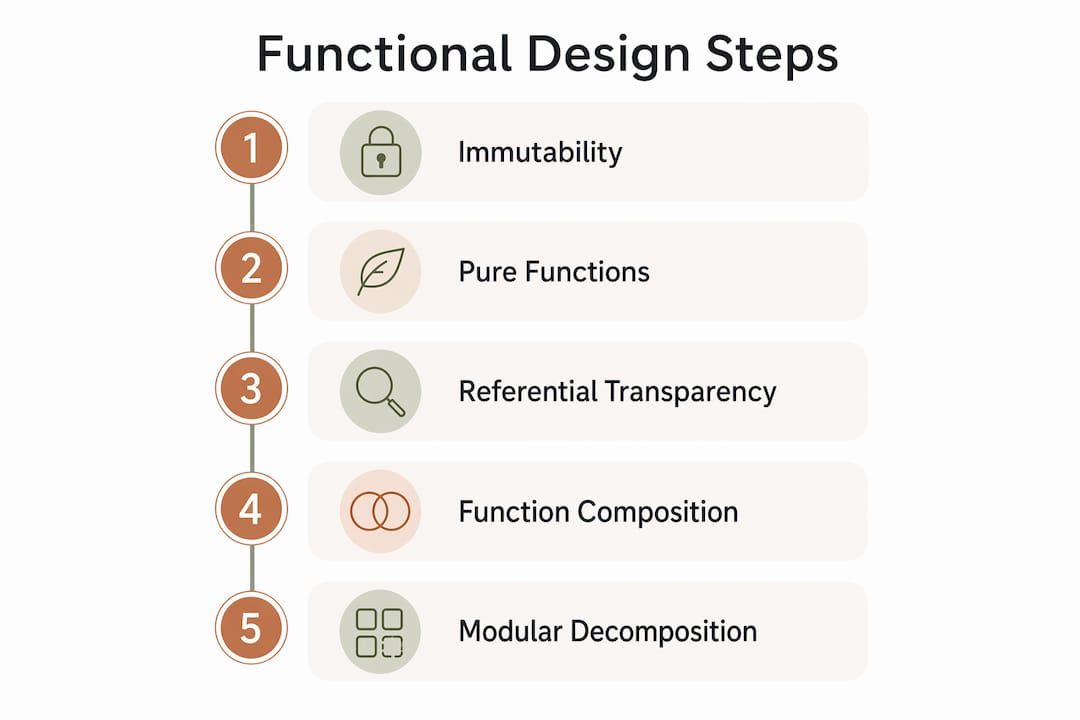
- Immutability: values cannot be changed in place, which prevents an entire class of bugs
- Pure functions: deterministic outputs, no side effects, easy to test in isolation
- Referential transparency: any expression can be replaced by its output without changing behaviour
- Functions as first-class values: functions can be passed, stored, and returned like any other value
- Composition: complex behaviour is built by connecting simple functions
- Low coupling: modules depend on as little as possible from the outside world
- Single responsibility: one module, one job
Why immutability and pure functions matter for code quality
Pure functions produce deterministic outputs with no side effects, and immutability prevents values from being changed in place. Together, they are the foundation on which every other functional principle rests.
A pure function depends entirely on its arguments. Give it the same input twice and you get the same output twice, every time. That predictability makes testing trivial: no mocks, no setup, no teardown. You pass arguments and assert on the return value. Contrast that with a method that reads from a shared mutable object, where a test failure might have nothing to do with the function itself and everything to do with some earlier mutation elsewhere in the suite.
Immutability enforces this discipline at the data level. When a value cannot be changed in place, you cannot accidentally corrupt shared state across threads. Concurrent code that would otherwise require careful locking becomes safe by construction. In languages like F# and Clojure, immutable data structures are the default, not an opt-in.
- Pure functions are completely isolated and cannot impact other parts of the system
- Immutable data makes all state changes explicit and unambiguous
- Referential transparency, a direct consequence of purity, allows safe memoisation of expensive calls
- Testing pure functions requires no complicated hidden state objects
Pro Tip: If a function is hard to test in isolation, the most likely cause is a hidden side effect or a dependency on mutable state. Refactor by extracting the pure computation into its own function and pushing I/O to the boundary.
How referential transparency and function composition shape your architecture
Referential transparency means an expression can be replaced by its output without altering the program’s behaviour. That single property unlocks a surprising amount: safe refactoring, confident inlining, and the ability to reason about a function without reading its implementation.
Function composition is where referential transparency pays off architecturally. When you connect the output of one pure function to the input of another, the composed result is itself a pure function. You can keep composing, building arbitrarily complex pipelines from small, well-understood pieces. Scott Wlaschin describes this as the primary way to build systems in functional architecture: treat functions as standalone values, then compose them into larger workflows.
Higher-order functions and currying extend this further. A higher-order function takes another function as a parameter or returns one, which means you can parameterise behaviour rather than data. Currying partially applies arguments, producing a new function that waits for the rest. Both techniques let you write general-purpose building blocks and specialise them at the call site, rather than writing bespoke logic for every variation.
- Referential transparency enables safe memoisation and confident refactoring
- Composition replaces complex control flow with a chain of simple transformations
- Higher-order functions parameterise behaviour, reducing duplication
- Currying produces specialised functions from general ones without new definitions
- Declarative pipelines built from composed functions read closer to the problem domain than imperative loops
Modular decomposition: single responsibility and low coupling in practice
Functional design ensures each module has exactly one responsibility and minimal impact on others. Low coupling follows almost automatically when you enforce that constraint rigorously.

The single responsibility principle (SRP) sounds obvious until you try to apply it. The practical test is linguistic: read the description of your module aloud. If it contains the words “and” or “or,” it almost certainly has more than one responsibility, and splitting it will reduce both coupling and side effects. A module that “validates input and writes to the database” is two modules waiting to be separated.
Splitting responsibilities also makes dependencies explicit. When a module does one thing, its inputs and outputs are narrow and clear. Hidden coupling, where a function silently reads global state or triggers a side effect in a distant module, becomes visible the moment you try to test the function in isolation. That friction is the design telling you something.
- Apply the conjunction heuristic: “and” or “or” in a module description signals multiple responsibilities
- Narrow interfaces reduce the surface area for unintended coupling
- Explicit dependencies make modules easier to reuse across different contexts
- Modular decomposition improves testability because each unit can be verified independently
- Just as modular wall panels in physical design allow independent reconfiguration, software modules with single responsibilities can be swapped or extended without touching the rest of the system
How functional and object-oriented paradigms complement each other
The contrast between functional programming (FP) and object-oriented programming (OOP) is often overstated. OOP organises behaviour around data, bundling state and methods into objects. FP organises behaviour around functions, keeping data and transformations separate. Both approaches share the same underlying goals: low coupling, high cohesion, and code that is easy to change.
O’Reilly’s analysis of the SOLID principles shows that each one has a functional equivalent. The single-responsibility principle maps directly to pure functions with narrow inputs and outputs. The open/closed principle, which says classes should be open for extension but closed for modification, is achieved in FP through higher-order functions and immutability: you extend behaviour by composing new functions rather than modifying existing ones. The dependency-inversion principle, passing abstractions rather than concrete implementations, is exactly what higher-order functions do when they accept behaviour as a parameter.
Robert C. Martin’s Functional Design makes this bridge explicit. His book examines SOLID and Gang-of-Four patterns from a functional perspective, showing that the patterns remain valuable and that the underlying design intuitions are universal. Functional ideas like immutability and higher-order functions can be adopted progressively within an existing OOP codebase without a full rewrite.
- OOP encapsulates state; FP makes state transformations explicit and traceable
- Higher-order functions in FP serve a similar role to polymorphism in OOP
- Immutability in a Java or C# codebase yields many of the same safety benefits as in a pure functional language
- Avoiding inheritance hierarchies, a functional tendency, aligns with the OOP community’s own “compose, don’t inherit” principle
- The future of most production codebases is hybrid: functional core, imperative shell
Applying these principles effectively in real-world software systems
Applying functional programming principles to production systems naturally produces high cohesion, low coupling, isolated I/O, pure business logic, and immutable data models. The challenge is not understanding the principles but knowing where to draw the lines.
The most practical architectural pattern is the functional core, imperative shell. Keep all business logic in pure, deterministic functions. Push I/O, database calls, and external service interactions to the outermost layer of the system. Real-world systems must accommodate impurity at boundaries such as I/O and resource distribution, but the core logic can and should remain pure. This separation means the vast majority of your code is trivially testable without any infrastructure.
For larger systems, bounded contexts from domain-driven design map cleanly onto functional architecture. Each bounded context becomes an autonomous, composable workflow with its own data model and its own pure transformation functions. Autonomy matters: if one context is unavailable, others continue operating independently. That decoupling is not just a technical nicety; it is what allows separate teams to own and evolve their contexts without coordinating every change.
- Structure systems as a functional core surrounded by an impure shell handling I/O
- Use bounded contexts to define autonomous workflows with explicit API boundaries
- Organise data as one-way flows through pure transformations to maximise cohesion and testability
- Avoid shared mutable state between contexts; pass data explicitly at boundaries
- During code review, flag any function whose description contains a conjunction as a candidate for decomposition
Pro Tip: When reviewing a pull request, ask whether each function’s name describes exactly one thing. If you need “and” to explain what it does, split it before it merges. This single habit catches most SRP violations before they compound.
What is lazy evaluation and why does it matter?
Lazy evaluation defers the computation of a value until it is actually needed. Robert C. Martin dedicates a chapter to laziness in Functional Design, describing how lazy accumulation allows programs to work with conceptually infinite sequences without computing them up front.
The practical benefit is efficiency. A lazy sequence of integers does not allocate memory for every element; it generates each value on demand. This means you can write a pipeline that filters and transforms a potentially unbounded stream, and only the elements actually consumed are ever computed. Haskell is the canonical example of a lazily evaluated language, but the concept appears in many others: Python’s generators, Clojure’s lazy sequences, and Java’s Stream API all implement lazy evaluation in different forms.
Lazy evaluation also interacts well with composition. Because each step in a pipeline only runs when the next step pulls a value, you can compose arbitrarily long chains without paying the cost of intermediate collections. The trade-off is that reasoning about when side effects occur becomes harder, which is one reason lazy evaluation pairs best with pure functions.
Recursion and tail-call optimisation
Recursion is the functional replacement for mutable loop variables. Rather than incrementing a counter in place, a recursive function passes the updated value as an argument to the next call. The logic is the same; the mutation is gone.
The classic problem with recursion is stack overflow. Each call frame sits on the call stack until the function returns, so a deeply recursive function can exhaust available stack space. Tail-call optimisation (TCO) solves this. When a recursive call is the very last operation in a function, a TCO-capable runtime replaces the current stack frame rather than adding a new one. The result is that a tail-recursive function runs in constant stack space, effectively as efficient as a loop. Martin covers this directly in Functional Design, contrasting iteration and recursion and showing how tail calls make recursion practical for production code.
Not every language guarantees TCO. Clojure provides the recur special form to make tail calls explicit and safe. Scala supports tail-call optimisation for self-recursive functions annotated with @tailrec. JavaScript’s specification includes TCO, though browser support has been inconsistent. Knowing your runtime’s behaviour here is not optional when writing recursive code at scale.
State management in functional design
State is unavoidable. Users log in, orders are placed, counters increment. The question is not whether your system has state but how you manage it.
The functional answer is to make state changes explicit and traceable. Rather than mutating an object in place, you produce a new value representing the updated state. The old value remains intact. This is the immutable data model described earlier, applied at the application level. The Elm architecture, popular in frontend development, formalises this pattern: an immutable model holds all application state, an update function produces a new model in response to events, and a view function renders the current model. No mutation, no hidden state, no surprises.
For cases where mutation is genuinely unavoidable, Martin’s book covers Software Transactional Memory (STM) as a mechanism for safe concurrent mutation. STM treats state changes as transactions: if two concurrent operations conflict, one retries automatically. Clojure’s STM support is one of the more mature implementations available on the JVM. The key discipline, regardless of mechanism, is to confine mutable state to the smallest possible boundary and keep everything outside that boundary pure.
Key takeaways
Functional design principles produce maintainable, testable software by enforcing single responsibilities, immutability, and explicit composition across every layer of a system.
| Point | Details |
|---|---|
| Single responsibility drives quality | Modules with one job are simpler to test, maintain, and reuse across contexts. |
| Immutability prevents hidden bugs | Values that cannot be changed in place eliminate an entire class of concurrency and mutation errors. |
| Composition scales complexity | Building complex behaviour from small pure functions keeps each piece independently verifiable. |
| Functional core, imperative shell | Push I/O and side effects to system boundaries; keep all business logic in pure, deterministic functions. |
| SOLID and FP share the same goals | Higher-order functions and immutability satisfy the same design intentions as the SOLID principles in OOP. |