Cart
0
TL;DR:
- Functional aesthetics integrate beauty and practicality by ensuring every design element serves a purposeful role in creating comfortable, efficient spaces. Balancing style with measurable performance factors like lighting, storage, and circulation fosters homes that are both visually appealing and highly functional. Prioritizing restraint, material honesty, and adaptability helps develop timeless, user-friendly interiors that truly enhance daily living.
Most homeowners treat style and practicality as a trade-off, as if choosing a beautiful sofa means sacrificing comfort, or installing proper storage means giving up on elegance. That tension is almost entirely false. Defining functional aesthetics means understanding that a space looks genuinely good because it works well, not in spite of it. This guide unpacks what functional aesthetics really means, how to measure it, and how UK homeowners can apply it in practical, specific ways that make daily life both easier and more beautiful.
Table of Contents
- Understanding functional aesthetics in interior design
- The philosophy behind functional aesthetics: balancing beauty and practicality
- Measurable ways to combine style and function in your UK home
- Common misconceptions and pitfalls when defining functional aesthetics
- Practical steps for applying functional aesthetics in UK living spaces
- Rethinking functional aesthetics: why less is more and honesty matters
- Bringing functional aesthetics to life with Homable
- Frequently asked questions
Key Takeaways
| Point | Details |
|---|---|
| Function defines beauty | An interior looks truly beautiful when its design genuinely serves its intended purpose and daily use. |
| Balance sensory pleasure and use | Successful functional aesthetics balance visual enjoyment with practical considerations like layout and durability. |
| Use measurable metrics | Assess functionality with clear criteria like lighting levels, storage capacity, and workflow for better design decisions. |
| Avoid common pitfalls | Don’t sacrifice everyday usability for trendy looks; plan carefully to prevent frustration and wasted space. |
| Embrace honesty and editing | Choose honest materials and limit decorative excess for cohesive, functional, and timeless home aesthetics. |
Understanding functional aesthetics in interior design
The phrase gets thrown around freely in interior design circles, but what does it actually mean? At its core, functional aesthetics is the idea that form and beauty should emerge from purpose, not be applied on top of it. A functionalist design approach treats every design decision as serving a specific purpose, captured neatly in the phrase “form follows function.” That principle did not begin with home décor. It shaped architecture, industrial design, and fine art. But it translates directly into how your living room, kitchen, or hallway should be planned.
Consider a theatre with beautiful plasterwork and ornate seats but poor sightlines from half the auditorium. It fails aesthetically, regardless of its decoration, because it does not do what a theatre is supposed to do. The same applies to your home. A kitchen with gorgeous marble worktops but no practical workspace for food preparation is not truly beautiful; it is merely decorated. One core principle in interior design holds that whether a space “works” for its intended purpose is itself a central aesthetic consideration.
Understanding what functional design means matters before you spend a penny on décor. A room that functions well creates a sense of ease and rightness that no amount of styling can manufacture from scratch. That feeling of ease? That is what people are actually responding to when they call a room beautiful.
“A functionalist approach treats design as serving a specific purpose, often summarised as ‘form follows function’.” — Jerwood Visual Arts, Art Theory Glossary
The philosophy behind functional aesthetics: balancing beauty and practicality
Philosophy sounds abstract, but in home design it has a very practical payoff. Aesthetics involves a kind of sensory pleasure that is balanced with the everyday demands of real life. The word “disinterested” is used in aesthetics theory to describe pure sensory enjoyment, the pleasure of looking at something without needing it to do anything. But in a home, that disinterested pleasure must coexist with function, otherwise the space becomes a gallery you live inside rather than a home you actually inhabit.
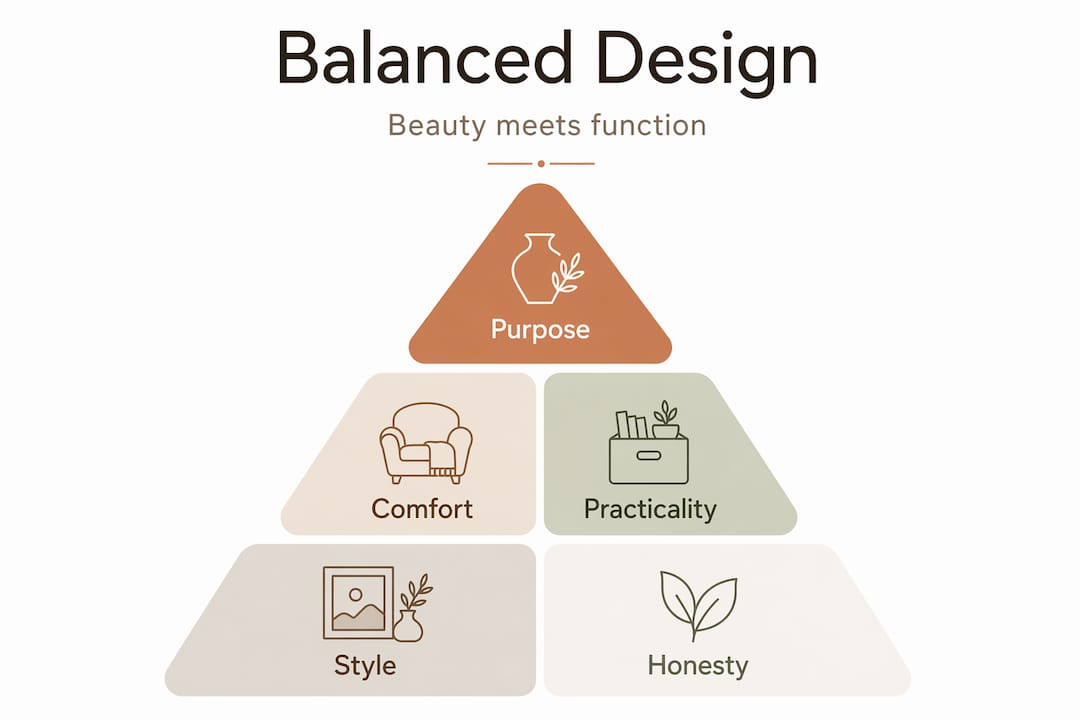
This is where “appropriateness” becomes the most important and underused concept in residential design. A room is appropriate when it genuinely suits the people using it and the activities happening in it. Appropriateness links beauty to real experience rather than photogenic appearance alone. Your living room should feel right for how your family watches television, entertains guests, or reads on a Sunday morning, not how a styled shoot makes it look.
Here are the core philosophical principles that guide this balance:
- Purpose first: Every element in a room should have a reason to be there beyond looking good.
- Sensory coherence: Materials, textures, and colours should work together to create a unified feel, not compete for attention.
- Appropriateness: Design choices should suit the actual people and habits in the space.
- Restraint: A room with too many visual “statements” is exhausting to live in, even if each piece is individually lovely.
- Longevity: Truly beautiful spaces feel right in five years, not just on the day they are styled.
Good room layout optimisation always starts with these philosophical commitments before selecting a single piece of furniture or a paint colour.
Measurable ways to combine style and function in your UK home
Theory only takes you so far. Balancing style and function becomes much more achievable when you treat functionality as measurable performance and style as visual composition. Measurement removes the guesswork and gives you clear targets to design towards.
Step-by-step approach to combining style and function:
- Audit your pain points first. Walk through your home and note where things frustrate you daily: clutter, poor lighting, awkward circulation routes, not enough surface space. These are your functional failures.
- Set lighting targets. Aim for 200 to 300 lux on kitchen worktops, 100 to 150 lux in living areas, and a warm colour temperature of 2700 to 3000K throughout. Install dimmer switches so one room can serve multiple moods.
- Plan storage before furniture. Calculate how much storage you actually need, then add 20% for future accumulation. Hidden storage dressed in beautiful finishes is the backbone of functional aesthetics.
- Establish clear circulation paths. Leave at least 90cm for primary walkways. Cramped rooms look messy even when they are tidy.
- Choose materials for the British climate and your household. Wool rugs, treated hardwoods, and easy-clean upholstery fabrics perform better and age more gracefully than purely decorative alternatives.
| Design element | Functional target | Style consideration |
|---|---|---|
| Kitchen lighting | 200 to 300 lux on worktops | Warm tone, concealed fittings |
| Living room lighting | 100 to 150 lux ambient | Layered with accent lamps |
| Hallway storage | 1 hook and shelf per household member | Cohesive with entry aesthetic |
| Seating circulation | 90cm minimum clearance | Furniture scale suits room |
| Rug placement | Defines activity zone clearly | Colour anchors palette |
Pro Tip: When choosing between open and closed storage, ask yourself whether the contents are things you want to display or things you simply need to access. Closed storage with beautiful handles is almost always the better answer for functional aesthetics.
For small homes, carefully thinking through your small space workflow before buying furniture prevents costly mistakes. And if you are rethinking storage entirely, modern storage solutions that blend form and function are worth exploring early in the process.
Common misconceptions and pitfalls when defining functional aesthetics
Even well-intentioned homeowners fall into predictable traps. Understanding them is half the battle.
“Prioritising aesthetics alone can create beautiful but impractical spaces; focusing solely on function can make spaces clinical and unwelcoming.” — Mileham Construction
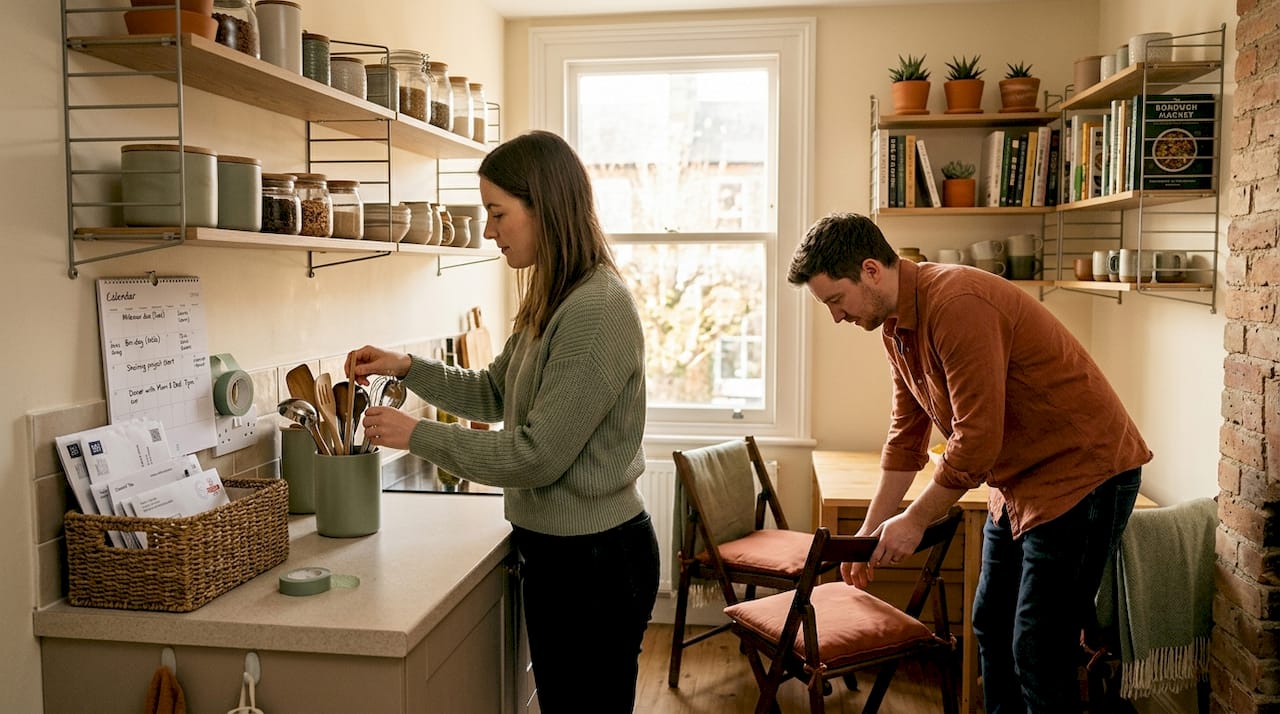
The risk of imbalance is real in both directions. A living room styled to look magazine-ready, with open shelving displaying artfully arranged objects but nowhere to put the remote control, a blanket, or a child’s homework, will frustrate you within a week. Equally, a purely functional space with no visual warmth or personality feels institutional rather than like a home.
Common mistakes to avoid:
- Open shelving as the only storage. It photographs beautifully but demands constant curation and makes clutter visible the moment real life happens.
- Ignoring traffic flow during planning. Rooms that look brilliant in floor plan views can feel cramped and awkward once furnished.
- Chasing trends that don’t suit your lifestyle. Ultra-minimalist interiors work for households with very specific habits. For most UK families, they create daily stress.
- Underestimating lighting needs. A single ceiling pendant is almost never enough. Functional aesthetics requires layered light.
- Prioritising visual drama over tactile comfort. A rug that looks stunning but feels coarse underfoot, or a sofa chosen purely for its silhouette, will quietly erode your enjoyment of the space.
Pro Tip: Before committing to any furniture arrangement, live with your room empty for a few days. Notice where natural movement flows, where light falls, and where clutter accumulates. Let the room tell you what it needs.
Exploring functional home décor insights can help you identify the right balance between visual appeal and everyday practicality before making purchasing decisions.
Practical steps for applying functional aesthetics in UK living spaces
Knowing what to avoid is one thing. Knowing exactly what to do is more useful.
Making every square metre work hard while keeping spaces inviting requires smart layout decisions, layered lighting, and carefully chosen materials. Here is how to approach it room by room:
- Start with a needs audit, not a mood board. Write down how you actually use each room before looking at inspiration images. Your habits should shape your choices, not the reverse.
- Prioritise high-traffic zones. Kitchens and hallways take the most punishment. Invest in durability here first: scrubbable wall finishes, hardwearing flooring, and robust storage.
- Use zoning instead of walls. Rugs, pendant lighting, and furniture arrangement can define distinct areas within an open-plan space without the cost or permanence of partition walls.
- Layer your lighting deliberately. Every room benefits from three layers: ambient (general illumination), task (focused light for specific activities), and accent (to highlight architectural features or artwork).
- Choose multipurpose furniture. An ottoman with internal storage, a dining table that extends for guests, a bed frame with under-bed drawers. These choices are not compromises; they are the definition of functional aesthetics in practice.
- Review before you buy. Ask of every item: does this earn its space? Is it durable? Does it serve a clear purpose while enhancing the room visually?
| Storage type | Accessibility | Visual impact | Best suited for |
|---|---|---|---|
| Built-in cabinetry | High | Clean and seamless | Kitchen, bedroom, living room |
| Open shelving | Very high | Bold, requires curation | Books, display items |
| Ottoman with storage | Medium | Doubles as seating | Living rooms, bedrooms |
| Under-bed drawers | Low | Hidden, no impact | Seasonal items, linens |
| Freestanding units | High | Flexible, moveable | Rental homes, evolving spaces |
Learning how to prioritise design and function together means making decisions that serve you for years, not just for the next Instagram post.
Rethinking functional aesthetics: why less is more and honesty matters
Here is the uncomfortable truth most interior design content avoids: the majority of homes that look cluttered or “not quite right” are not suffering from a lack of style. They are suffering from an excess of it. Too many cushions, too many accent pieces, too many competing patterns layered over spaces that were never properly organised in the first place.
True functional beauty emerges from constraints and purpose, not decoration. When every element in a room has a clear role, the room stops feeling busy and starts feeling considered. That distinction is what separates spaces that photograph well from spaces that feel genuinely good to live in every day.
Honesty in materials is a related and equally undervalued principle. Materials and structures that are honest about what they are and what they do create rooms that feel coherent rather than artificially styled. A solid oak shelf that does not pretend to be anything other than an oak shelf is more beautiful than a veneer-wrapped board dressed up to look like something else. That honesty registers, even if people cannot always articulate why.
The instinct to add more when a room does not feel right is nearly always wrong. Editing out one or two elements, a lamp that is the wrong scale, a rug that is too busy, a side table that serves no real purpose, often resolves more than adding any new piece could. Restraint is not minimalism for its own sake. It is the discipline to let what works speak for itself.
Consider minimalist design principles not as an aesthetic trend but as a practical framework for achieving rooms that feel calm and purposeful rather than styled and strained.
Bringing functional aesthetics to life with Homable
Understanding functional aesthetics is only useful if you can act on it. Homable’s curated collection of home décor is built around exactly this idea: products that earn their place visually and practically, chosen for UK homes and real daily life.
From storage solutions that genuinely reduce clutter to rugs that define a space and curtains that manage light beautifully, everything at Homable is selected with both durability and design in mind. If you are ready to create rooms that work as well as they look, explore the full collection and find pieces that serve a clear purpose while making your home a genuinely better place to be. Free shipping is available on orders over £100.
Frequently asked questions
What exactly does ‘functional aesthetics’ mean in home design?
Functional aesthetics means designing spaces where beauty arises because each element genuinely serves a useful purpose, blending style and practicality so the two reinforce rather than compete with each other. Functionalist theory has long held that art and design serve purposes beyond mere appearance.
How do I measure if my home design balances function and style?
Check measurable factors like storage capacity, kitchen workflow, lighting levels, and material durability, then assess whether the visual composition of those elements creates a coherent, pleasing result. Treating functionality as performance and style as visual composition helps you assess both objectively.
Can focusing too much on aesthetics harm home usability?
Yes. Prioritising aesthetics alone can lead to impractical spaces that look appealing but generate daily frustrations due to poor storage, inadequate lighting, or awkward layout.
What are common mistakes in trying to create a functionally aesthetic home?
The most common errors include choosing open shelving that cannot contain real-life clutter, neglecting layered lighting, and following visual trends that do not suit the household’s actual habits. Minimalist shelving looks stunning in photographs but frequently fails in everyday use.
How can I future-proof my home’s functional aesthetics?
Choose durable materials, adaptable furniture, and layouts that can evolve with your household’s changing needs. Designing with adaptability in mind ensures your home remains both beautiful and practical as your lifestyle changes over time.