Cart
0
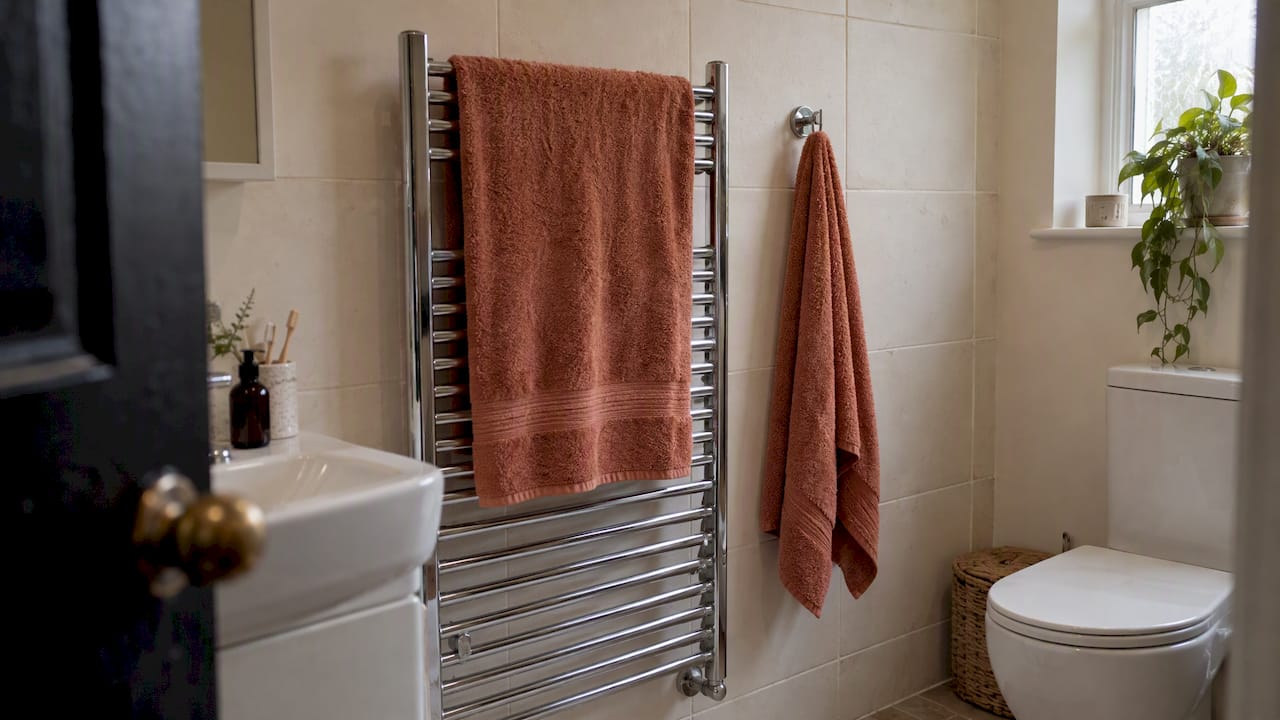
For most bathrooms, a towel rail wins on drying because it lets towels hang flat with air moving across the whole surface. Hooks suit renters, tight spaces and anyone who wants a five-minute fix rather than a project. Heated rails add real benefits but need correct electrical or plumbing installation, so check the fixing type and power source before you buy.
TL;DR:
- Mount towels on an open wall away from shower spray, leave an air gap, and avoid closed door hooks that limit evaporation.
- Electric and dual fuel rails need a qualified installer who understands bathroom zoning and circuit protection because they sit close to water.
- In humid bathrooms, wash towels every three to four uses; separate hanging points prevent overlapping fabric from trapping moisture between layers.
- Hooks fixed with screws hold heavier robes better than adhesive models, while rail buyers should check the power source and wall material before ordering.
- Follow the manufacturer’s loading limit on heated rails, since extra towels or clothing can block heat transfer and affect the unit’s warranty.
Table of Contents
- Rails versus hooks: drying, space, installation and cost
- Where to place hooks and rails so towels actually dry
- Keeping towels and fittings clean, not just dry
- What to check before you buy either option
- The real question isn’t rail or hook, it’s airflow
- Shop practical bathroom storage that fits your space
- FAQ
- Sources
Rails versus hooks: drying, space, installation and cost
The difference between a rail and a hook is mostly geometry. A rail gives a towel a flat, open surface to hang across, so air reaches most of the fabric at once. A hook gathers the towel into a bunch, and unless you spread it out by hand, the folded layers stay damp far longer. Cleaning professionals say rails have the drying advantage for exactly this reason, though hooks can perform reasonably well if they’re mounted on an open wall with good airflow rather than crammed behind a door.
Space works the other way. Rails need horizontal wall clearance and enough drop length for the towel, which rules them out in a lot of small cloakrooms. Hooks take up a few centimetres of wall and work in awkward corners or on the back of a door, though that convenience comes at the cost of airflow.
Installation splits the two options cleanly:
- Hooks are usually a drill-and-screw job, or adhesive-mounted with no tools at all, so most people can fit them in minutes.
- Heated rails involve electrical wiring or a connection to the central heating system, which means following manufacturer guidance and using a qualified installer rather than fitting one yourself.
- Non-heated rails sit somewhere in between: straightforward to mount, but still needing secure wall fixings for the weight of wet towels.
Cost and permanence follow the same pattern. Hooks are cheap and renter-friendly since they come out of the wall without much trace. Rails, especially heated ones, cost more upfront and are harder to remove, which makes them a better fit for homeowners planning to stay put.
Aesthetics matter too. A rail with towels folded neatly over it reads as tidy and hotel-like, while hooks tend to show towels bunched or dangling, which some people like for a relaxed, lived-in look and others find untidy.
Pro Tip: If you only have hooks, fit one towel per hook rather than doubling up. It keeps the folds open and roughly halves drying time compared with two towels sharing a single point.
Where to place hooks and rails so towels actually dry
Where you put a rail or hook changes its performance more than the choice between them. A few placement rules make a real difference:
- Fix hooks or rails on an open wall away from the shower, since cleaning professionals note that direct spray and enclosed, steamy corners slow drying and encourage dampness to linger.
- Leave a gap behind the towel rather than pressing it flush against the wall, since even a small air gap speeds evaporation.
- For heated rails, stick to the manufacturer’s loading guidance rather than draping extra towels, dressing gowns or clothes over the bars, since overloading blocks heat transfer and can affect the warranty on the unit.
- Have electric or dual-fuel rails fitted by a qualified electrician or plumbing engineer who understands bathroom zoning rules, since these appliances sit close to water and need the correct circuit protection.
- In shared bathrooms, give each person a separate hook or a distinct section of rail rather than letting towels overlap, since overlapping fabric traps moisture between layers.
Door-mounted hooks deserve a specific mention. They’re genuinely useful in small bathrooms because they use space nobody else wants, but a closed door means still air and little evaporation, so a towel hung there for days can start to smell. If a door hook is your only option, open the door whenever you can and swap the towel more often than you would with a rail. If a central-heating-fed rail stops warming up, a plumbing specialist’s troubleshooting guide covers the basic checks before you call anyone out.
Keeping towels and fittings clean, not just dry
Drying speed and hygiene are closely linked. A towel that stays damp for hours gives bacteria and mildew far more time to establish themselves than one that dries within an hour or two.
Design and hygiene reporting notes that towel rails can show visible grime when they aren’t cleaned regularly, which matters because a dirty rail transfers residue straight onto a clean towel every time you hang one.
A short routine keeps both towels and fittings in good condition:
- Wipe rails down weekly with a soft cloth and a mild cleaner suited to the finish, since harsh abrasives can dull chrome or painted surfaces.
- Check hooks for soap scum or limescale build-up, particularly suction or adhesive types that sit closer to the sink or shower.
- Wash towels every three to four uses in a humid bathroom, since fabric left too long between washes starts to hold odour regardless of how it was hung, according to cleaning professionals.
- Choose cotton or linen towels over synthetic blends where possible, since natural fibres tend to dry faster and resist musty smells better in damp rooms.
For heated rails, follow the manufacturer’s care instructions on storage and surface cleaning. Guidance in the electric towel rail manual warns that moisture or dirt left on plated finishes can tarnish them over time and may affect the product guarantee, so a dry wipe after use is worth the ten seconds it takes.
What to check before you buy either option
Cristiano writes on home storage and bathroom organisation for the Homable blog, focusing on practical fittings that work in real, often small, UK bathrooms.
Wall hooks remain one of the simplest upgrades for a bathroom that lacks space for a full rail, and a multi-hook design gives you somewhere for robes and spare towels as well as everyday hand towels. Our kitchen wall hooks with a rolling pin design show the kind of multi-point fixing that works equally well in a bathroom, giving several separate hanging points instead of one crowded hook.
Before buying, check:
- Fixing type: screw-fixed hooks hold more weight than adhesive ones, which matters for heavier towelling robes.
- Power type: electric, hardwired or dual-fuel rails each have different installation needs, so confirm which your bathroom can support before ordering.
- Wall material: tiled or plasterboard walls may need different fixings than solid brick.
- Shipping and checkout: we offer free shipping on orders over £100 and secure checkout, which is worth factoring in if you’re buying hooks alongside new towels or other accessories.
For more layout ideas in compact spaces, our guide to renter-friendly bathroom storage covers options beyond rails and hooks.
The real question isn’t rail or hook, it’s airflow
Most advice on this topic treats rails and hooks as a style decision, when the evidence points somewhere more specific: airflow and placement decide whether towels dry properly, and the fitting is secondary. A single hook on an open wall with space around it can outperform a badly placed rail crammed into a steamy corner behind a door.

The conventional advice oversells the heated rail as a universal upgrade. It’s a genuine improvement for drying speed and for warming a towel before use, but it’s also the option with the most ways to go wrong: wrong installer, wrong loading, wrong zone. A simple hook, chosen and placed with a bit of thought, often serves a small bathroom or a rental better than a rail that was never going to be fitted correctly in the first place.
If you take one thing from this, prioritise placement over product. Decide where the air actually moves in your bathroom first, then pick the fitting that suits that spot.
— Cristiano
Shop practical bathroom storage that fits your space
Whether you’ve settled on hooks, a compact rail, or a mix of both, we stock wall hooks and small storage pieces designed to work in bathrooms of any size, including rented ones where fixtures need to stay simple and removable.

Browse our bathroom collection for hooks and storage that suit the space you’ve got, and pair new fittings with fresh towels from our tea towels range. Orders over £100 ship free, and checkout is secure, so you can sort your bathroom storage in one visit to Homable.
FAQ
Do towels dry better on hooks or rails?
Rails generally dry towels faster because they let the fabric hang flat with air reaching most of the surface, according to cleaning professionals. Hooks can dry towels reasonably well too, provided they’re on an open wall with airflow rather than tucked behind a door.
What is the best hook over radiator towel rail?
There isn’t a single fitting that works as both a wall hook and a radiator-mounted rail, since they solve different problems: a hook is a fixed wall point, while an over-radiator rail borrows existing heat to warm and dry a towel. If you want warmth without a dedicated heated rail, an over-radiator rail is worth considering alongside wall hooks for other towels.
What is the best towel hook for the bathroom?
The best hook for a bathroom is one with a screw fixing into a stud or solid wall, since this holds more weight than adhesive options, especially for heavier robes or bath sheets. Multi-point hook designs, like a bar with several individual hooks, also help towels dry better than a single crowded hook.
Are towel racks or towel hooks better?
Racks and rails suit most households best because they let towels hang flat and dry more evenly, while hooks suit renters, small bathrooms and anyone who wants a quick, low-cost fix. The right choice depends on your wall space, whether you own or rent, and how many people share the bathroom.
Sources
- Is it better to hang towels on bars or hooks? We asked cleaning pros
- WALL MOUNTED - ELECTRIC HEATED - TOWEL RAILS (Drummonds manual)
- Towel bars vs. towel hooks: which one holds more mould?