Cart
0
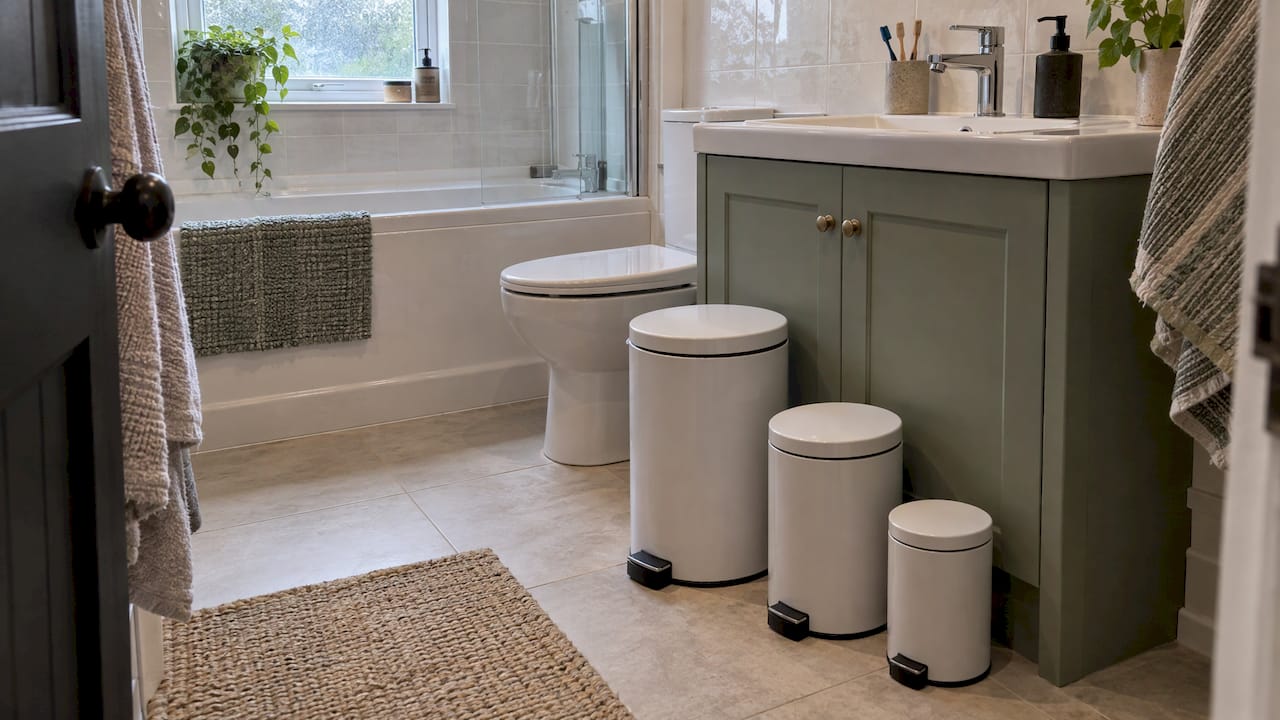
For most UK bathrooms, a bin of 3 to 5 litres is the right size: big enough to go several days without emptying, small enough to sit beside the loo or tuck under a basin. Go up to 8 or 10 litres only if several people share one bathroom or you want to empty it once a week. Below, we show what those litres look like in real life, how to measure your space and how to match capacity to your household, so you buy once and get it right. If you are styling the room as you go, our bathroom collection is a good place to see what sits well alongside a bin.
TL;DR
- 3 litres suits a cloakroom, a guest loo or one person living alone.
- 5 litres is the all-rounder for a family bathroom shared by two to three people.
- 8 to 10 litres suits busy households, but only if you have floor space for it.
- Measure height, width and depth, plus the clearance for a lid or pedal, before you buy.
- Litres are not the same as size: a slim 5-litre bin and a round 5-litre bin take up very different amounts of floor.
Table of Contents
- What size is a bathroom bin?
- How much does 3 litres actually hold?
- How much does 5 litres hold?
- Measure before you choose: the dimensions that matter
- Match the size to your household
- Think about waste type, not just volume
- How often will you empty it?
- Bathroom bins versus household and wheelie bins
- Shape and style: size is not only capacity
- Do you need a bin liner?
- Our view
- Finish the room with our bathroom range
- FAQ
- Sources
What size is a bathroom bin?
Bin capacity is measured in litres, the volume the bin can hold when filled to the brim. Bathroom bins sit at the small end of the scale, because what goes in them is light and takes up little room: cotton wool pads, cotton buds, tissues, dental floss, razor heads, empty toiletry packaging and sanitary products.
The sizes you will meet most often are:
| Capacity | Typical use | Good for |
|---|---|---|
| 1 to 2 litres | Countertop or vanity bin | Cotton pads and small bits, a tiny cloakroom |
| 3 litres | Slim pedal or swing-lid bin | One person, guest loo, narrow gaps beside the toilet |
| 5 litres | Standard pedal or open bin | Couples, small families, most family bathrooms |
| 7 to 10 litres | Larger pedal or basket-style bin | Three or more users, en suites with floor space, weekly emptying |
| 12 litres and up | Bedroom or kitchen-style bin | Rarely needed in a bathroom |
These are our working ranges rather than a standard: manufacturers do not follow a single rule, and the same litre figure can come in very different shapes.
How much does 3 litres actually hold?
Three litres is about the volume of a large milk carton and a bit more. In a bathroom, that is a few days of cotton pads, tissues and packaging for one person. A 3-litre bin is typically narrow and tall, which is why it works in cloakrooms and in the gap between the toilet and the wall.
The trade-off is frequency. A small bin means you empty it more often, and a bin that is always full is a bin that overflows. If you use it daily for make-up removal and the odd razor or sanitary product, you will be emptying it every couple of days.

How much does 5 litres hold?
Five litres is roughly a standard kettle’s worth, or about a litre more than a large carton of juice. It is the size most households end up happy with: a couple or a small family can usually go several days without emptying it, and it is still compact. Most 5-litre bins fit comfortably beside a toilet or under a standard basin, though the footprint varies by shape, which brings us to the part most buyers skip.
Measure before you choose: the dimensions that matter
Capacity tells you how much a bin holds. It does not tell you whether it fits. Check these before you buy:
- Height. If the bin goes under a basin or a shelf, measure the clear height to the underside, then allow for any lid that swings up.
- Width and depth of the footprint. Measure the floor gap beside the toilet, between the toilet and the bath, or beside the vanity. A round bin wastes corners; a rectangular or D-shaped bin tucks flat against a wall.
- Lid clearance. A pedal bin needs room in front for your foot. A swing lid needs a little space around it. Lift-up lids need headroom above.
- Door and pipework swing. Check the bin will not block the door, the toilet cistern or any exposed pipes.
- Pedal and foot space. In a small room, you want to open the bin without stepping sideways.
A useful habit: mark out the footprint on the floor with a strip of masking tape and live with it for a day. If you keep catching it with your foot, go slimmer or choose a different spot.
If the floor is too crowded, wall shelving or a tidy storage solution can free up the space. Our guide to renter friendly bathroom storage ideas shows how small UK bathrooms can give up floor area without drilling or permanent changes.
Match the size to your household
The right size depends less on the bathroom than on who uses it and how often the bin is emptied.
One person or a guest loo
A 3-litre bin is enough. Guest toilets and cloakrooms generate very little waste, and a slim bin keeps the room feeling uncluttered. If the room is tiny, a countertop bin of 1 to 2 litres can be enough for cotton pads and small items, but a floor bin is better for sanitary products.
A couple or two people
Five litres is the sensible default. It gives you a few days between empties and sits neatly in most bathrooms.
A family with children
If three or four people share one bathroom, consider 5 to 8 litres. Children add nappies and wipes in the early years, and tissues, plasters and packaging as they grow. A bin with a lid helps with smell and with small hands, and a wider opening helps with quick tidying.
En suite or master bathroom
En suites tend to be used by one or two people, so 3 to 5 litres usually works. If you want it to blend with the bedroom, choose a style in a matching finish, such as a natural or wood-look material.
Shared houses and rented rooms
If several adults share one bathroom, go up to 8 or 10 litres, and agree who empties it. A bigger bin only helps if there is room for it and if somebody actually takes it out.

Think about waste type, not just volume
Not all bathroom waste is equal. Cotton wool and tissue are light and bulky. Razor heads and packaging are small but sharp or awkward. Sanitary products and wipes are the items you least want sitting in an open bin.
There is also a plumbing reason a bathroom bin matters. UK water companies run a long-standing “bin it, don’t flush it” message: only pee, poo and toilet paper belong in the toilet. Items such as sanitary towels, tampons, cotton wool and cotton buds should never be flushed, because they do not break down and can block pipes. If you have been flushing things for want of a convenient bin, a properly sized one with a lid beside the toilet solves that.
So choose with waste in mind:
- Lots of cotton pads and tissues: pick the larger capacity for the same footprint, 5 litres rather than 3.
- Sanitary products or nappies: choose a bin with a lid, and a size you will empty often enough that it never gets full.
- Small amounts only: a 3-litre bin is fine and keeps the room tidy.
How often will you empty it?
This is the easiest way to decide. Estimate how often you are happy to take the bin out, then pick the size that will not be full by then.
- Emptying every day or two: 3 litres is fine.
- Emptying twice a week: 5 litres.
- Emptying once a week: 8 to 10 litres for a family, or 5 litres for one or two people.
If you empty the bin on bin day alongside the kitchen rubbish, a larger bathroom bin that matches your weekly routine can be more practical than a tiny one that needs constant attention.
Bathroom bins versus household and wheelie bins
Searchers often confuse the small bin in the bathroom with the big bins outside. The gap is enormous. The British Standards code of practice for waste in buildings, BS 5906, gives an illustrative figure of 240 litres of waste per week for a three-bedroom home, which is the whole dwelling, not the bathroom. A standard 240-litre household wheelie bin is far bigger than anything you would keep indoors: one planning design guide lists it at roughly 106.7 cm high, 58 cm wide and 74 cm deep. The same guide gives a 140-litre container for flats and commercial use at about 106.7 cm high by 48.3 cm wide by 55.9 cm deep.
The point: a 240-litre bin holds around fifty times what a 5-litre bathroom bin does. Bathroom sizes are a different scale altogether, which is why 3 to 10 litres is the only range you need to think about indoors.
Shape and style: size is not only capacity
Once you know the litres, the shape decides whether the bin works day to day.
- Round: simple and easy to line, but wastes corner space.
- Rectangular or slim: sits flat against a wall and suits narrow gaps.
- D-shaped: a good compromise for corners beside the toilet.
- Pedal: hands-free, hygienic, needs foot space.
- Open basket: quick and easy, good for tissues and cotton pads, less discreet for sanitary items.
Material matters for looks and for damp. Bathrooms are humid, so bins that tolerate moisture and wipe clean easily are worth choosing. Natural finishes such as bamboo bring warmth to a bathroom, and plenty of people pair them with towels, baskets and shelves for a coordinated look.
Do you need a bin liner?
A small liner makes emptying cleaner and keeps the bin fresher. Check the liner size against the bin’s litre capacity and shape before buying a big pack: a 5-litre bin takes a small liner, and an oversized bag bunches awkwardly under the lid. Fold the top of the liner over the rim to keep it in place.
Our view
We think the most common mistake is buying the bin first and the room second. People pick on looks, get it home and find it blocks the door or is too small to last a week. The fix is boring but works: measure the gap, decide how often you want to empty it, then choose the capacity.
We also think the bathroom should feel like one room, not a collection of unrelated things. That is how we put together our bathroom range: natural textures, practical storage and accessories that suit modern homes, so a bin, a laundry basket and a shelf can look like they belong together.
If you are choosing between two sizes and your space allows it, go for the larger one in a slim shape. A bin that is never full to the brim is one you rarely think about.
Cristiano
Finish the room with our bathroom range
A well-sized bin is one piece of a tidy bathroom. At Homable we sell home decor and household accessories, with a bathroom collection that covers the items that keep the room organised. If you want something that stores rather than just catches, our bamboo laundry bins come in rectangular, oval and round shapes, so you can match the shape to your floor space. You can browse everything in the bathroom collection, and orders over £100 ship free.
For a wider look at the rest of the range, from rugs to wall shelves, start at the Homable homepage.
FAQ
What size bin is best for a bathroom?
For most homes, 3 to 5 litres is best. Choose 3 litres for a cloakroom or one person, and 5 litres for a shared family bathroom. Move up to 8 or 10 litres only if several people share the room and you want to empty it weekly.
How big should a bathroom bin be in a small bathroom?
In a small bathroom, footprint matters more than litres. A slim 3-litre bin, or a rectangular 5-litre one that sits flat against the wall, will fit where a round bin will not. Measure the floor gap and the door swing first.
What is the difference between a 3-litre and 5-litre bathroom bin?
The 5-litre bin holds about two-thirds more, so it needs emptying less often. A 3-litre bin is slimmer and suits tight spaces and light use. If you are unsure and have room, take the 5-litre.
How many litres is a standard wheelie bin?
Household wheelie bins are commonly 240 litres, which is roughly fifty times a 5-litre bathroom bin. They are outdoor collection containers and have nothing to do with bathroom sizing.
Should a bathroom bin have a lid?
A lid helps with smell, hygiene and keeping small items out of sight, especially if you put sanitary products or nappies in the bin. A pedal lid keeps your hands clean, as long as you have the floor space to use it.
Sources
- Bin It Don’t Flush It: what not to flush
- BS 5906:2005 Waste management in buildings, code of practice
- RECAP Waste Management Design Guide, supplementary planning document