Cart
0
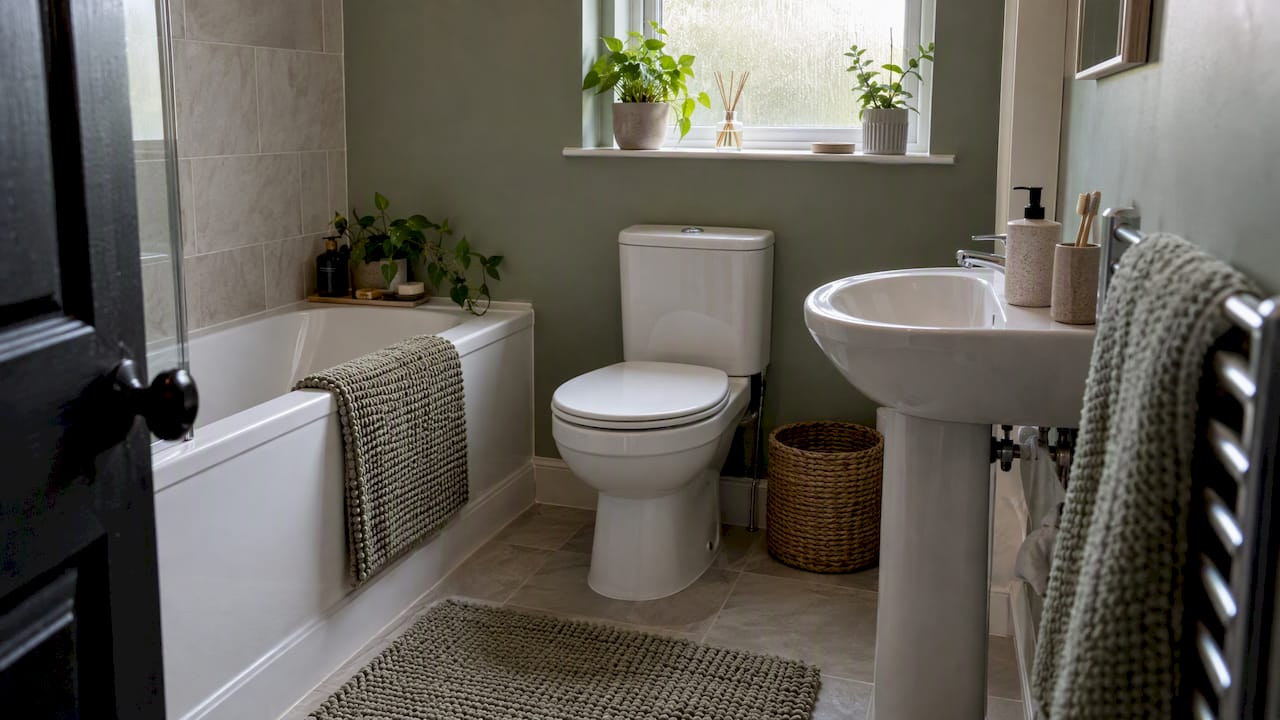
A bathroom needs far fewer accessories than most lists suggest. Start with the items you touch every day: soap, a toothbrush holder, a toilet roll holder and brush, towels, a bath mat, a bin and somewhere to put your products. Add a shower curtain or screen if you need one. Everything else is comfort or decoration. This checklist is split that way, so you can buy the basics first and style the room afterwards.
TL;DR
- Buy the daily-use items first: soap, toothbrush holder, toilet roll holder, toilet brush, towels, bath mat, bin and storage.
- Plan on two towel sets per person, each with a bath towel, hand towel and washcloth.
- Choose one finish and one or two materials, then repeat them across the room so the set looks matched.
- In a small bathroom, go vertical: wall shelves, hooks and a slim basket do more than a bulky cabinet.
- Treat candles, plants, trays and jars as extras that you add last.
Table of Contents
- The essentials: what every bathroom needs
- Storage: where everything lives
- How to match your bathroom accessories
- Bathroom accessories for a new home
- Small bathrooms and family bathrooms
- Extras that add comfort and character
- Keeping it clean and dry
- The printable checklist
- Perspective
- Shop the bathroom edit
- FAQ
- Sources
The essentials: what every bathroom needs
These are the items that make a bathroom work from the first day. Tick them off before you think about colour.
| Item | Why you need it | What to look for |
|---|---|---|
| Soap dispenser or soap dish | Somewhere to keep hand soap off the basin edge | Wipe-clean material, a pump that is easy to refill |
| Toothbrush holder or tumbler | Keeps brushes upright and apart | Drainage or a base that is easy to empty and rinse |
| Toilet roll holder | Roll within reach, not on the cistern | Fixed to the wall or freestanding, depending on space |
| Toilet brush and holder | Hygiene | A holder that lets the brush dry, see below |
| Bath mat | Dry, safe footing | Absorbent, quick drying, non-slip backing |
| Towels | Every day | Two sets per person |
| Shower curtain with hooks, or a screen | Keeps water in the shower area | Washable, with a mould-resistant liner |
| Bin | Lidded if possible | Small enough for the floor space |
| Storage | Products, spare rolls, cleaning kit | Shelves, basket or cabinet |
| Hooks or a towel rail | Towels dry fully between uses | Enough hooks for each person |
The wording of that list is close to what the bathroom basics for a first home from Mira Showers recommend. It also includes a shower caddy, a plunger, cleaning products, a laundry basket and a wastebasket. A home essentials checklist adds a mirror, if the room does not already have one.
Towels: how many to buy
Two sets per person is a sound rule: one in use and one in the wash. A set is a bath towel, a hand towel and a washcloth. For a couple, that is four bath towels, four hand towels and four washcloths. For a family of four, it is eight of each, though you may well find you use fewer washcloths than hand towels.

The quantity matters because towels need to dry fully between uses. Damp towels left on a hook are one of the main causes of a stale smell, and Good Housekeeping’s advice on bathroom freshness is to dry them fully, wash shower curtains and bath mats regularly, and empty bins and replace liners.
The bath mat: get this one right
A bath mat is the item people most often buy on looks alone. Good Housekeeping’s bath mat testing points to the criteria that matter: absorbency, quick drying, a non-slip backing and grip, comfort, size and ease of cleaning. Size is the one that is easy to overlook. A mat should cover the spot where you actually step out, not just sit tidily by the bath.
Two mats are better than one if you have a bath and a separate shower, or a basin where people stand a lot.
Shower curtain or screen
If you do not have a glass screen, a shower curtain with hooks and a mould-resistant liner is the standard answer. Wash it regularly, as above. If you have a wet room, a shower squeegee is worth adding: one writer who lived with a wet room recommended a good one for clearing water quickly.
The toilet brush and holder
This is the least glamorous item on the list and the one where design matters most. A brush that stays wet in a closed holder is not hygienic. Choose a holder that lets the head drain and dry, and a brush head that is easy to rinse. We cover the routine in more detail in our guide to the toilet brush routine and why silicone wins.
Storage: where everything lives
Storage is where a bathroom checklist usually goes wrong. People buy a cabinet because they feel they should, then find the products still end up on the edge of the bath.
A better way to plan is by routine. Bathroom expert Warren Kinloch suggests organising storage around the shower routine: pre-shower, main shower and post-shower. In practice, that means:
- Pre-shower: towels, hair ties, a robe hook near the door.
- Main shower: a caddy or shelf inside the shower for shampoo, conditioner and body wash.
- Post-shower: body lotion, toothbrush, razors and a hairbrush at the basin.
Shelving, according to the same piece, is a great way to maximise bathroom storage. Wall shelves keep the floor clear, which makes cleaning quicker. Our wall shelves come in stainless steel in several sizes, and a basket underneath takes the spare loo rolls and towels. For more on the basket side, see our basket storage ideas.
If you rent, our guide to renter-friendly bathroom storage ideas shows what you can add without drilling into tiles.
How to match your bathroom accessories
Matching bathroom accessories is mostly about restraint. You do not need every item from one range. You need a few repeated decisions.
Pick one finish
The most noticeable link in a bathroom is metal: taps, shower fittings, towel rail, holders and hooks. If the taps are chrome, keep the holders and hooks chrome. If you have brushed brass or matt black fittings, repeat that. Ceramic, glass and resin accessories sit more quietly, so they can be mixed more freely.
Pick one or two materials
Wood, ceramic and linen work well together. John Law of Woodhouse & Law suggests keeping the palette tonal when you mix textures, which adds richness without visual clutter. In a bathroom, that could be a white ceramic soap dispenser, a wooden or bamboo tray and a natural cotton hand towel, all in warm neutrals.
Pick a colour story
The easiest scheme is two neutrals and one accent. Towels and the bath mat carry most of the colour, because they are the biggest soft items and the easiest to replace. If you are painting or tiling too, our bathroom colour schemes with earthy accents is a good place to start. Our guide on why matching room accessories works goes through the reasoning in more depth.
What to check when buying a ready-made set
A coordinated set is a good shortcut, as long as it covers what you use. Check these points:
- What is in it. A typical set covers a soap dispenser, toothbrush holder, tumbler and soap dish. Check whether a toilet brush and bin are included, because they are often not.
- The material. Ceramic is easy to wipe and feels solid. Glass is light but shows water marks. Resin and plastic are lighter and cheaper but can look flat.
- The finish against your fittings. Compare against your taps, not the picture on the screen.
- Cleaning. Pumps that can be unscrewed, and holders without deep grooves, stay cleaner.
- Gaps. A set rarely includes towels, a bath mat or storage, so use this checklist for those.
Bathroom accessories for a new home
When you move in, buy in two rounds.
Before the first night: towels, toilet roll and holder, toilet brush, bath mat, shower curtain and hooks if needed, hand soap and a bin. You can then wash, brush your teeth and use the room.
In the first month: storage, hooks, a laundry basket, a mirror if needed and cleaning supplies. By then you will know where you stand, where you reach and what clutter builds up.
The same sequence works for any room: function first, then storage, then style. If you are working through the whole house, our 7-step home decorating checklist covers the order. The room-by-room logic carries over to other spaces, even an outbuilding, as the garden room interior design guide shows.
Small bathrooms and family bathrooms
Small spaces
In a small bathroom, floor space is the scarce resource. Use these tactics:
- Go up the wall with shelves, which also keep products away from splashes.
- Use hooks rather than a freestanding towel stand.
- Choose a slim basket instead of a bulky cabinet.
- Pick a wall-hung or floating vanity if you are replacing one: floating vanity units can make a small bathroom look bigger because light flows underneath.
- Keep to one colour family so the room reads as calm rather than crowded.
Family bathrooms
With children, storage has to be reachable and tidy-up has to be easy. Give each child a hook and a towel in their own colour, keep bath toys in a basket that drains, and keep anything breakable out of reach. Our kids storage baskets suit that job, and a shower caddy or two shelves in the shower stop bottles ending up on the floor. Check that bath mats have a non-slip backing, which matters more with children.

Extras that add comfort and character
None of these is essential. They are what turns a clean bathroom into one you like using.
- Candles or a diffuser: a small one on a shelf is enough.
- A plant: pick one that copes with humidity.
- A tray: it groups small items so they look deliberate.
- Glass jars or baskets: for cotton pads, cotton buds and spare soap.
- A stool or small bench: somewhere to put a towel or sit to dry off.
- Art: a small print above the toilet fills a blank wall.
For character, mix old and new. Interior designer Rowan Giles says that pairing new storage with old pieces, such as antique apothecary jars or charity shop baskets, looks more interesting and collected than buying everything in one go. For more ways to dress a room with accessories, see tips for stylish home accessories and our step by step home accessory styling.
Keeping it clean and dry
The best accessory set fails if it stays damp. Four habits make most of the difference:
- Hang towels so they dry fully before the next use.
- Wash the bath mat and shower curtain regularly.
- Empty the bin and replace the liner.
- Clean around the toilet with floor cleaner and a long-handled brush, as Good Housekeeping suggests.
Ventilation matters too. For wet rooms, designer Lisa Kyme says ventilation has to work harder than in a conventional bathroom, and recommends sensors that run it automatically to clear moisture quickly. Even in an ordinary bathroom, a working extractor fan and an open window after a shower protect everything you have just bought.
The printable checklist
Daily use
- [ ] Soap dispenser or dish
- [ ] Toothbrush holder
- [ ] Toilet roll holder
- [ ] Toilet brush and holder
- [ ] Bath mat (non-slip)
- [ ] Two towel sets per person
- [ ] Shower curtain, hooks and liner, or a screen
- [ ] Bin with liners
Storage
- [ ] Wall shelves or cabinet
- [ ] Basket for spares
- [ ] Hooks for each person
- [ ] Shower caddy
- [ ] Laundry basket
Extras
- [ ] Mirror, if the room has none
- [ ] Tray, jars, candle
- [ ] Plant
- [ ] Stool
Perspective
We see the same mistake again and again: people buy a set because it looks good together, then find the room still does not work. Our view is that a bathroom is built in layers. First comes the daily kit, then storage, then the pieces that give the room its character.
That is why we like to see the bathroom as a small system. Wall shelves take products off the bath edge. A basket hides the spare rolls. A holder that lets the toilet brush dry keeps the room fresh. Once those are in, a tonal mix of wood, ceramic and cotton brings it together without needing a full matching range.
At Homable we curate for exactly that approach: affordable pieces with a modern design that you can mix and repeat across the room, so it looks considered rather than bought in one go.
Cristiano
Shop the bathroom edit
If you would rather pick everything in one place, our bathroom collection brings together accessories for the room, and the rest of the shop covers shelves, storage baskets and towels. Orders over £100 ship free.
You can browse the full range, from wall shelves and kids storage baskets to ornaments and rugs, and build the room in the order above.
FAQ
What accessories do I need in a bathroom?
At a minimum: a soap dispenser or dish, toothbrush holder, toilet roll holder, toilet brush, bath mat, towels, a bin and some storage. Add a shower curtain with a mould-resistant liner if you have no screen. Everything else is optional.
How many towels should I buy?
Two sets per person is a good starting point, each with a bath towel, hand towel and washcloth. That way one set is always dry while the other is in the wash. Add a few extra hand towels if you have guests often.
How do I match bathroom accessories without buying one set?
Keep to one metal finish and one or two materials, and repeat a small palette of colours. Wood, ceramic and linen mix well when the tones are close. Use towels and the bath mat for the accent colour.
What should I buy first for a new home?
Buy towels, toilet roll and holder, toilet brush, bath mat, hand soap and a bin before you move in. Storage, hooks and decorative items can wait a few weeks until you know how you use the room.
Sources
- First Home Bathroom Essentials, Mira Showers
- Home Essentials Checklist: What You Need for a New Home
- 10 ways to make your bathroom smell nice, Good Housekeeping UK
- The best bath mats to buy in 2026 UK, Good Housekeeping UK
- I tried living with a wet room, Ideal Home
- The ultimate everything shower bathroom design recipe, Ideal Home
- 7 Clever Yet Simple Ways to Make Basic Storage Look More Expensive, House Beautiful UK
- 6 Biggest Bathroom Trends of 2025, House Beautiful UK