Cart
0
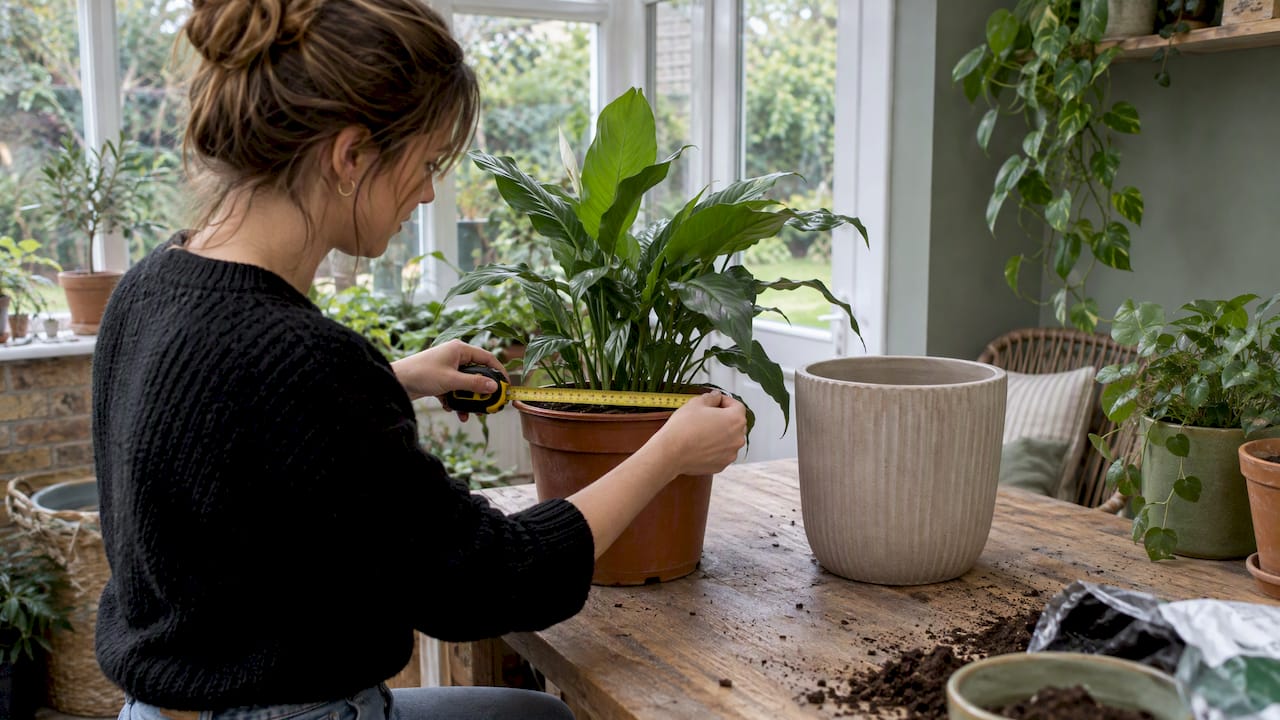
Choose a planter only slightly bigger than the plant’s current pot or rootball. For a repot, the RHS says no more than one third larger, which for most houseplants means 2.5 to 5cm extra width. Go bigger and the soil stays wet. Go smaller and the roots run out of room. The rest of this guide shows you how to measure, how to match a decorative planter to the pot inside it, and how to pick a size that looks right where it will stand.
TL;DR
- Measure the pot’s top width and depth, or the rootball, not the plant’s height.
- Go up by 2.5 to 5cm in width for small and medium pots, and keep the depth similar.
- An oversized pot holds unused wet soil, which raises the risk of root rot.
- Use a pot with drainage holes, or double-pot: a draining inner pot inside a decorative outer one.
- For floors and entrances, think about stability and proportion as well as the plant.
Table of Contents
- Start by measuring what you already have
- How much bigger should the new planter be?
- Depth, shape and root habit
- Drainage and the overpotting problem
- Choosing a planter size for the space
- Perspective: why we start with the room, then the pot
- Find a planter that fits
- FAQ
- Sources
Start by measuring what you already have
Most sizing mistakes begin with a guess. Take two minutes with a tape measure and you avoid the classic outcome: a planter that swallows the plant, or an inner pot that will not fit inside the outer one.
Measure the pot, not the plant
Measure across the top of the pot, rim to rim, for the diameter. Then measure from the rim to the base for the depth. Those two figures are what every planter listing is describing, so they are the numbers to compare. A plant’s overall height tells you how top-heavy it is, but not how much root space it needs.
If you are repotting, slide the plant out gently and look at the rootball. The RHS suggests using the rootball as a guide for a single specimen and choosing a pot only slightly larger. If roots are circling the outside of the soil or poking from the drainage holes, it is ready to move up. If there is still plenty of loose compost around the roots, leave it alone.
Measure the inside of a decorative planter
This is where people go wrong. A decorative planter’s listed size is usually its outer dimension, so the usable space inside is smaller because of the wall thickness, and many designs taper towards the base. Check these three things:
- Inside width at the rim. The inner pot’s rim must pass through this.
- Inside depth. Subtract the height of any feet or a drip tray you plan to use.
- Width at the narrowest point. If the planter tapers, this is the figure that decides whether the inner pot sits down far enough.
A simple trick: measure your plastic grow pot, then look for a decorative planter with an inside width a centimetre or two larger. That leaves a small gap so the pot slides in and out for watering. Where a listing gives only outer dimensions, allow a little extra for the walls rather than assuming the two match.
How much bigger should the new planter be?
The short answer from the RHS: a new container no more than one third larger than the current one. For containers under 25cm in diameter and depth, that works out at roughly 2.5 to 5cm more in width and depth. The RHS gives the same figure in its advice on choosing a pot 2.5 to 5cm wider than the previous one and not much deeper.

US extension services say much the same in inches. Illinois Extension recommends 1 to 2 inches larger in diameter when repotting a houseplant. NC State Extension is more specific: for pots up to 8 inches wide, go 1 to 2 inches wider than the current root ball, and for pots 10 inches or wider, 2 to 3 inches wider. In centimetres, that is roughly 2.5 to 5cm for smaller pots and 5 to 7.5cm for larger ones.
A quick sizing table
| Current pot width | Sensible next size up | Notes |
|---|---|---|
| Up to 20cm (about 8 in) | 2.5 to 5cm wider | Keep depth close to the old pot |
| 25cm (about 10 in) or more | 5 to 7.5cm wider | Large pots can take a slightly bigger step |
| Any size, plant very root-bound | Next size up only | Do not jump two sizes to save repotting later |
The figures follow the RHS and NC State guidance above. Treat them as a starting point and adjust for the plant: a fast grower with a dense root system may fill its pot sooner than a slow, compact one.
Why not just buy something big and be done with it?
It is a tempting shortcut, and it is the one the guidance warns against. Illinois Extension explains the trade-off clearly: larger containers buffer drying and need watering less often, but a pot far too large for the plant leaves a lot of unused soil that stays wet and can harm the roots. A small plant in a huge pot is not given room to grow into. It is given a reservoir it cannot drink from.
The opposite problem is just as real. NC State notes that restricted roots reduce root and shoot growth and can also cut flowering and fruiting. So the aim is a snug but not cramped fit, and a pot that matches the plant’s root system.
Depth, shape and root habit
Width gets most of the attention, but depth matters as much, particularly for outdoor planters. The RHS points out that large containers dry more slowly while shallow ones dry quickly. That makes depth a watering decision as well as a root one.
A few practical rules follow from that:
- Shallow-rooted plants such as many herbs, succulents and bedding plants are happy in a wider, shallower planter. A bowl-shaped or low rectangular trough suits them.
- Deep-rooted plants such as small trees, tall grasses and vegetables like carrots need real depth. A planter that looks generous from above can still be too shallow underneath.
- Plants that dry out fast, such as those on a sunny south-facing patio, do better in a larger volume of soil, because a bigger pot dries out more slowly.
- Plants that hate wet feet, such as cacti and many Mediterranean herbs, do better in a modest pot with fast drainage than in a generous one.
When you are choosing between two planters of the same width, ask which is deeper and what the plant’s roots actually do. For a tall, narrow planter holding a tall plant, the RHS also flags that tall narrow containers may need stabilising, which brings us to the space where the planter will sit.
Drainage and the overpotting problem
Drainage is the other half of sizing. A pot that is slightly too big is manageable if water can escape. A pot that is slightly too big and has no holes is how plants rot. Colorado State’s PlantTalk recommends containers with drainage holes, and notes that decorative containers without holes can serve as outer pots.
If a planter you love has no holes, you have two choices. You can plant straight into it only with a careful, light hand with water, or you can double-pot. We cover the reasoning in more depth in our guide to whether plant pots need drainage, including what to do if yours has none.

Double-potting: the neat solution
Double-potting is the easiest way to combine a practical growing pot with a decorative planter, and it takes the pressure off getting the size exactly right.
- Keep the plant in its plastic or terracotta grow pot, which has drainage holes.
- Choose a decorative planter with an inside width a centimetre or two larger than the grow pot’s rim, and enough inside depth for the pot to sit just below the planter’s lip.
- If the grow pot sits too low, put a layer of something stable underneath, such as an upturned saucer, to raise it.
- Water at the sink, let it drain fully, then put the pot back in the planter. Never leave the pot standing in water at the bottom.
This also makes repotting simple. When the plant outgrows its grow pot, you move up one size, and as long as the decorative planter has a little spare width, the same outer pot keeps working. That is why we suggest buying the decorative planter for the next size up, not the current one, when you are shopping for a plant you expect to grow.
Choosing a planter size for the space
So far this has been about the plant. The second question is how the planter looks and behaves where it stands, and here the rules come from proportion and safety.
Proportion
A useful starting point is to let the surface decide. Small planters suit shelves, windowsills and side tables. Medium ones can anchor a kitchen counter, a dining table or a console. Large planters, the ones that stand on the floor, are the pieces that anchor a room and work best in entrances, in corners and beside furniture. As a visual guide, a floor planter that looks tiny next to a sofa or a door frame will read as an afterthought, while one that is generous in width and height looks deliberate.
For tall, structural pieces, look at the overall height. Our artificial bamboo planter at 120cm fills the height of a hallway corner, while the 65cm foliage plant pot suits a spot beside a sideboard or a chair. These are artificial, so there is no watering to plan around, but the same proportion logic applies to real plants.
Stability
A planter that tips is a hazard, particularly with children or pets around, or in a windy garden. Illinois Extension says container shape and volume affect stability: square pots and straight-sided cylinders are more stable than traditional inverted-cone shapes, and a broad base helps reduce tipping. If you are choosing a tall plant, favour a wide base and a heavier material, and put the weight low by filling the lower part with soil.
The same principle applies outdoors on a larger scale. When you are working out how big a planter should be relative to what it sits beside, guidance on foundation planting proportions shows how landscapers think about mixing heights and sizes so the arrangement looks balanced from the front door.
Large outdoor planters
For patios and gardens, bigger is usually easier. A large trough holds more soil, dries out slowly and gives roots space. Planters such as the vidaXL galvanised steel garden planter at 100.5 x 40.5 x 90 cm or the reclaimed wood planter at 60 x 20 x 68 cm show the range: one is a statement piece for a border edge or a wall, the other a slim planter for a narrow ledge or a doorway. Check the internal depth against your plant’s roots before you buy, as outside dimensions and usable soil depth are not the same thing. If you want ideas for putting these together, our outdoor planter styling ideas match planting formulas to pots.
Perspective: why we start with the room, then the pot
We sell home decor, so we look at planters from the room outwards. A planter is part of how a space feels, and an oddly sized one is one of the quickest ways to make an otherwise tidy room look unfinished. Our view is simple: pick the plant’s real needs first, then choose the most attractive planter that meets them.
In practice that means we would always rather see a customer buy a decorative outer planter and keep the plant in a draining inner pot than push a plant into a beautiful pot with no drainage and hope. It keeps the plant healthy, makes moving and repotting easy, and means the planter can be swapped when your style changes. Colorado State’s PlantTalk describes the planter as both a growing environment and a design element, and we think that is the right way to hold both ideas at once.
The second thing we would say is to buy for the space you have. Measure the corner, the shelf or the step. Measure the doorway if the planter has to get through it. A well-proportioned planter in the right place does more for a room than a more expensive one in the wrong spot.
— Cristiano
Find a planter that fits
If you have your measurements, you are ready to shop. Our planter collection includes outdoor troughs, tall statement planters and artificial bamboo plants in planters for corners that never see much light. Browse by height and width, check the dimensions in each listing against your inner pot and your space, and add what you need to your basket. Free shipping applies on orders over £100. You can also see the rest of the range, from ornaments to rugs, on the Homable homepage.
FAQ
How do I know what size planter to use?
Start with the current pot or the rootball. Choose a planter only slightly larger: about 2.5 to 5cm wider for most houseplants and small containers. Check that the depth is similar and that there are drainage holes, or plan to double-pot with a draining inner pot.
How much bigger should a planter be than the plant?
It is better to compare with the pot or rootball than the plant above it. The RHS recommends a container no more than one third larger than the current one when repotting. Anything much larger holds more wet soil than the roots can use.
What size pot should I choose for a houseplant?
Move up one size, not two. Illinois Extension suggests 1 to 2 inches (about 2.5 to 5cm) larger in diameter for a houseplant. If the plant sits in a decorative outer planter, measure the inside width of that planter, not its listed outer size.
Do I need to match all my planters to one size?
No. A mix of heights and widths often looks better than a row of identical pots. Keep a common material, colour or shape to tie them together, and vary the sizes so there is a large piece to anchor the group and smaller ones around it.
Sources
- RHS: Growing plants in containers
- RHS: How to repot a plant
- RHS: Overpotting
- Illinois Extension: Houseplants, Get Started
- Illinois Extension: Container Size
- NC State Extension: Plants Grown in Containers
- PlantTalk Colorado: Houseplants, Containers
- GC Signature Outdoors: Foundation plantings