Cart
0
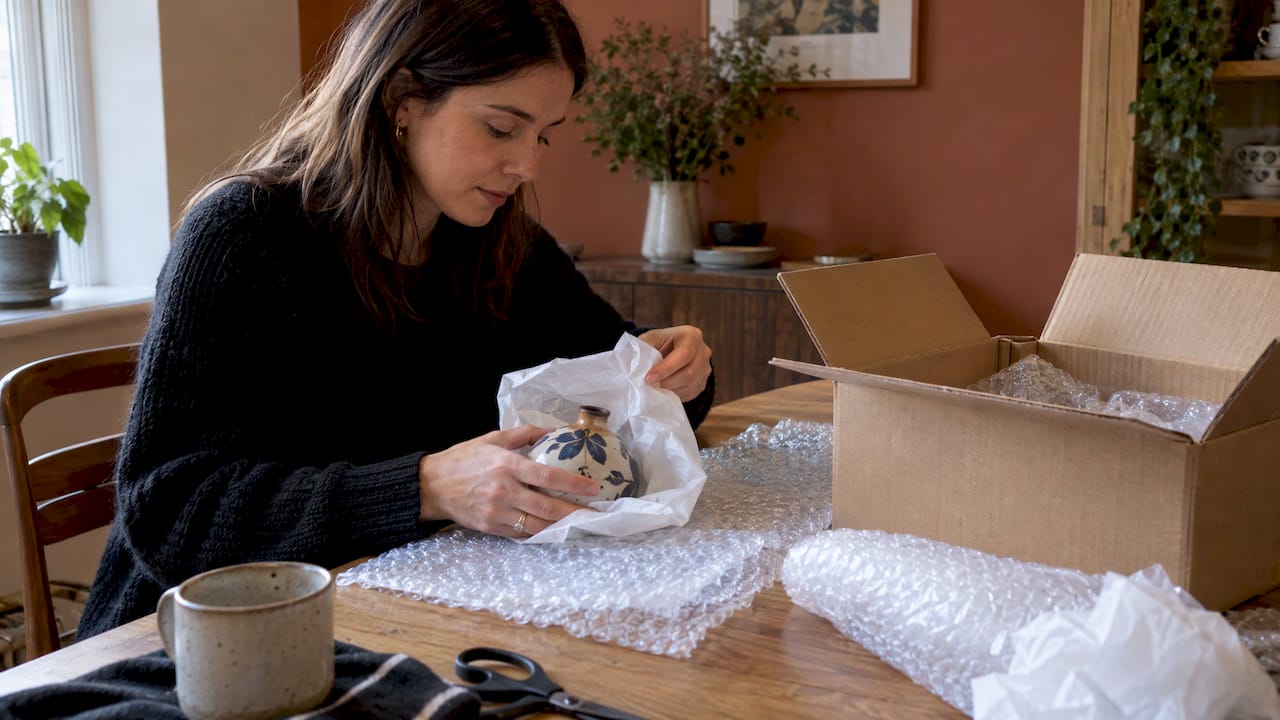
Wrap fragile decor in layers, not in more paper: a soft inner wrap, a cushioning layer, a box that gives at least 5cm of padding on every side, and a final shake to check nothing moves. Gift paper and ribbon go on the outside, last, so the present looks good and the piece inside arrives whole. If you are choosing the gift as well as wrapping it, our ornaments and home accessories are the kind of pieces this guide was written for.
TL;DR
- Protect first, decorate second: tissue or honeycomb paper next to the piece, bubble wrap over it, a snug box around it, gift paper outside.
- Leave at least 5cm of cushioning around the item, according to Royal Mail’s guidance, and keep it clear of the box sides.
- Never wrap two fragile pieces together. Wrap each one on its own and separate them with dividers.
- Skip balled-up newspaper and air pillows as the main protection.
- Seal the box, shake it gently, and listen: any movement or rattle means more filler.
Table of Contents
- Why fragile gifts break (and why wrapping paper is not the answer)
- What you need
- How to wrap a fragile gift, step by step
- Wrapping awkward shapes
- Wrapping several fragile pieces together
- Making protective wrapping look like a present
- The shake test: checking a wrapped gift before you hand it over
- Carrying it versus posting it
- Common mistakes
- Our view: choose the gift and wrap it with the journey in mind
- Choose the gift, then wrap it
- FAQ
- Sources
Why fragile gifts break (and why wrapping paper is not the answer)
Gift paper is decoration. It does nothing to stop a knock, a drop or a squeeze in a carrier bag. What breaks a ceramic ornament, a glass vase or a decorative dish is movement: the piece shifts in the box, hits a side or hits another item. Royal Mail’s advice treats movement in transit as the core risk, which is why the whole method is built around holding the item still.
That changes how you plan. Before buying paper, ask three questions:
- How is the gift travelling: handed over in person, carried on a train, or posted?
- What shape is it? A rounded ornament, a tall vase with a narrow neck and a flat tray need different handling.
- Is it one piece or several?
A gift you will hand over across the table needs less than a parcel going through the post. The method below works for both, and you can scale it up or down.
What you need
You do not need a craft shop. A short list covers almost every fragile decor gift.
The inner layer
This sits directly against the piece. Tissue paper does the job of keeping scratches, scuffs and dust off. RAJA UK, a packaging supplier, says tissue at 16 to 19gsm guards crockery, glassware and ornaments against scratches and scuffs, but it is not a cushioning layer on its own. Use it as the first wrap, not the only one. Acid-free tissue is the better pick for delicate or painted finishes.
Honeycomb paper is the tidier alternative. It is a paper that stretches open into a cushioning mesh. ProcuraPack explains that for vases and ornaments you wrap fully in stretched honeycomb paper, add extra padding at the base, and double-wrap the most fragile pieces. It also looks neat enough to leave visible, which makes it protection and presentation in one.
The cushioning layer
Bubble wrap is the standard. Royal Mail recommends cardboard dividers, bubble wrap and polystyrene fillers, and it says to leave at least 5cm of cushioning around each fragile item. The same page advises against balled-up newspaper, which is flimsy and poor at absorbing shocks, and against air pillows, which can pop and leave the item exposed.
The box
Choose a sturdy cardboard box with room for the cushioning on every side, not one that fits the bare piece snugly. A box that is too big is fine as long as you fill the gaps. A box that is too small forces you to squash the padding, which defeats the point.
The outside
Gift paper, double-sided tape, ribbon, a tag. Keep these for the very end.
How to wrap a fragile gift, step by step
This combines Royal Mail’s packing method with the extra care that gifts need.
1. Prepare the piece
Remove anything loose: lids, stoppers, stands, hanging cords. Wrap them separately and tape the small parcel to the inside of the box, or pack it into the box on its own. Loose parts rattle, and thin handles and rims are the first things to chip.
2. Wrap the inner layer
Wrap the piece in two or three sheets of tissue, or stretch a sheet of honeycomb paper open and wrap it round fully. Pay extra attention to rims, bases, handles and spouts. ProcuraPack suggests wrapping tightly around rims and bases and double-wrapping the most delicate items.
3. Add the first bubble layer
Use small-bubble wrap under and over all parts of the item and secure it with tape. Tape the wrap to itself, never to the piece, because tape residue can lift paint or a glaze on some finishes.
4. Add the second bubble layer
A second layer of larger-bubble wrap goes over the first. QC Couriers explains that small bubbles absorb localised surface impacts and large bubbles absorb bigger forces, while also adding bulk so the item sits snugly in the box. For glass, DHL eCommerce UK notes that two protective layers are worth considering.
5. Build the box
Put a cushioning layer on the bottom of the box. Stand the wrapped piece in the middle, never touching the sides, then fill every gap around and on top with filler: more bubble wrap, crumpled honeycomb paper, polystyrene pieces or a corrugated liner. Royal Mail’s guidance is that the item must not touch the box sides, and that cushioning should surround it on all sides.
6. Seal and check
Close the box and seal every edge with strong tape. Then run the movement check described below.
7. Dress the outside
Only now do you pick up the gift paper. A plain brown or coloured box wrapped in paper looks the same as any other present, and the recipient never sees the engineering inside.
Wrapping awkward shapes
Round ornaments, tall vases and pieces with handles do not fold neatly into paper. Three tricks help.
Moulding wraps. Cartwright & Butler recommends flexible cellophane or tissue for awkward shapes, because they mould around the item without looking messy. Ribbon then becomes the eye-catching feature. This works best when the piece is already protected in a box or bag, so the cellophane is purely the finish.
Extra padding at the base. The base takes the weight when a vase is set down or tipped. Honeycomb paper at the bottom and a second wrap over the base give it the most protection where it matters.
Gift bags with an inner box. For very irregular shapes, such as a sculptural ornament, skip the gift paper and put the cushioned box inside a good gift bag with tissue on top. It looks generous and saves you wrestling with corners.

One more point on neatness. House & Garden’s wrapping professionals say the biggest mistake is using too much paper, which ruins neat corners. Their fix is to wrap the box before cutting to measure, leaving an inch or two of overlap. With a bulky padded box this matters even more, because it is easy to cut far too much.
Wrapping several fragile pieces together
A pair of vases, a set of ornaments or a bowl and candle holder invite you to bundle them into one parcel. Resist it.
DHL eCommerce UK’s top tip is that it is fine to box two or more fragile items together but never to wrap them together, because even well-wrapped pieces can damage each other on contact. Royal Mail adds that fragile items shouldn’t touch one another or the container side, and that robust cardboard dividers should separate them.
In practice:
- Wrap each piece individually, with its own inner and bubble layers.
- Place them in a box with cardboard dividers between them, or in separate compartments.
- Keep each piece as close to the centre of its space as you can.
- Use polystyrene pieces in corners and a corrugated liner if the box feels flimsy.
- Heaviest piece at the bottom, lightest on top.
For a gift set, a divided box looks intentional too. When the recipient opens it, each piece is in its own nest rather than tangled in padding.
Making protective wrapping look like a present
The good news is that the materials that protect also look lovely when you use them on purpose.
- Tissue and honeycomb as a feature. Speciality Food Magazine notes that tissue paper is perfect for wrapping fragile items like glass bottles or mugs, and that a ribbon, tag or sticker lifts the outside. A loose tissue wrap spilling out of an open gift box looks luxurious and also holds the contents in place.
- Double-sided tape. House & Garden’s professionals recommend double-sided tape, kept on a dispenser because it tears easily, over sticky tape or stickers on the outside, which make a wrapped gift look disjointed.
- Colour and a small extra. In British Vogue, Scribble & Daub’s Caroline Kent says her favourite recipe is brightly coloured tissue with clashing ribbons, with a small decoration tucked into the layers or tied into the bow as an extra gift.
- Less paper, more finish. If you want a considered gift box without piling on layers, putting together a gift box with a few well-chosen pieces keeps wrapping tidy and avoids excess paper.
For styling ideas that go further, our guide to gift box styling for home decor gifts shows how to arrange the contents once the protection is in place.
The shake test: checking a wrapped gift before you hand it over
Before you add the gift paper, or before the parcel leaves your hands, check it.
- Hold the sealed box and tilt it slowly from side to side. Feel for any shift of weight inside.
- Give it a gentle shake. You should hear and feel nothing. A dull thud or a rattle means the piece, or a loose part, is moving.
- Press the sides. If a side gives way easily with no resistance, there is too little filler or a weak box. Add a corrugated liner or more padding.
- Check the corners. Voids at the corners are where pieces slide. Fill them.
- Mark the box. A fragile sticker will not help automated sorting machines, DHL eCommerce UK points out, but it flags the parcel to the delivery driver for extra care, so it is worth adding on anything you post.
If you hear movement, open it up, add filler and test again. It takes two minutes and is far cheaper than a broken present.
Carrying it versus posting it
Carrying by hand. Use the same inner layers, but you can use a sturdy gift bag with a box inside rather than a fully sealed parcel. Keep the bag upright on a seat or on your lap. Never put it in the boot where it can slide.

Posting. Treat the box as if it will be dropped. That means the full 5cm of cushioning, a sealed box with strong tape along every edge, and gift paper only if you wrap the outside of the packing box. For a surprise, put the gift-wrapped present inside a second, plain shipping box with cushioning between the two.
Common mistakes
- Scrunched newspaper as padding. Royal Mail says newspaper is flimsy and ineffective at absorbing shocks.
- Wrapping the item only in gift paper. It looks neat, but it has no cushioning.
- A box that is a tight fit. There is no room for protection on every side.
- Bundling pieces together. They knock against each other.
- Heavy tape on delicate finishes. Tape to the wrap, not the piece.
- Skipping the shake test. It is the one step that tells you whether the rest worked.
Our view: choose the gift and wrap it with the journey in mind
Most breakage is decided before the paper comes out. When we think about gifting home decor, we think about the piece, the room it is going into and the journey it makes to get there.
A tea towel, a woven bamboo rug, a set of kids’ storage baskets or a wall shelf can be wrapped in minutes. A ceramic ornament or a vase needs the layered treatment above. Knowing which kind of gift you are buying helps you plan the wrapping, the box and the time you need.
We like gifts that are designed to be used and displayed: ornaments, kitchen accessories, storage pieces, textiles. If you wrap each one with its own protection and finish it with a ribbon and a tag, it feels considered from the outside in.
If you are unsure what to give, our guides to gifting home storage and the decorating workflow for gift buyers are a good place to start.
Cristiano
Choose the gift, then wrap it
We stock ornaments, tea towels, kitchen mats, kids’ storage baskets, wall shelves and bamboo rugs, curtains and roller blinds, so you can choose a gift for most rooms in one order. Delivery is free on orders over £100, which helps if you are buying for several people at once. Browse the full range on Homable, and use the steps above to wrap whatever you pick.

If you want to see how a piece will sit in a home before you give it, our ornament styling tips show how to display it. And if the recipient is likely to keep their decorations safe afterwards, our guide to seasonal ornament storage explains how to pack them away.
FAQ
Can I use tissue paper alone to wrap a fragile gift?
Tissue is a good inner wrap that protects against scratches and scuffs, but it is not a cushioning layer on its own, as RAJA UK says. Use it next to the piece, then add bubble wrap or honeycomb paper and a box with at least 5cm of padding on every side.
What is the best way to wrap a fragile ornament?
Wrap it in tissue or stretched honeycomb paper, adding extra padding at the base and double-wrapping if it is very delicate. Add a bubble layer, then place it in a box with filler all round so it cannot touch the sides. Finish the outside with paper and a ribbon.
Should I wrap two fragile gifts together?
No. Wrap each one on its own, then put them in one box with cardboard dividers between them. Both Royal Mail and DHL eCommerce UK advise that wrapped pieces can still knock against each other if they are bundled.
How do I know my wrapped gift is safe to carry or post?
Seal it and tilt and gently shake it. You should feel and hear nothing move. If anything shifts, open the box and add filler to the gaps. Corners and the space above the piece are the usual weak spots.
Is newspaper fine as filler?
It is better to avoid it. Royal Mail says balled-up newspaper is flimsy and ineffective at absorbing shocks. Use bubble wrap, honeycomb paper, polystyrene pieces or a corrugated liner instead.
Sources
- How to package and send fragile items, Royal Mail
- How to send fragile items, DHL eCommerce UK
- Tissue paper packaging, RAJA UK
- How to use honeycomb paper for gifts, glassware and homeware, ProcuraPack
- Pack fragile items for shipping: zero breakage guide, QC Couriers
- How to wrap a present: tips from the professionals, House & Garden
- Expert tips for making Christmas hampers, Speciality Food Magazine
- The chicest way to wrap Christmas presents, British Vogue