Cart
0
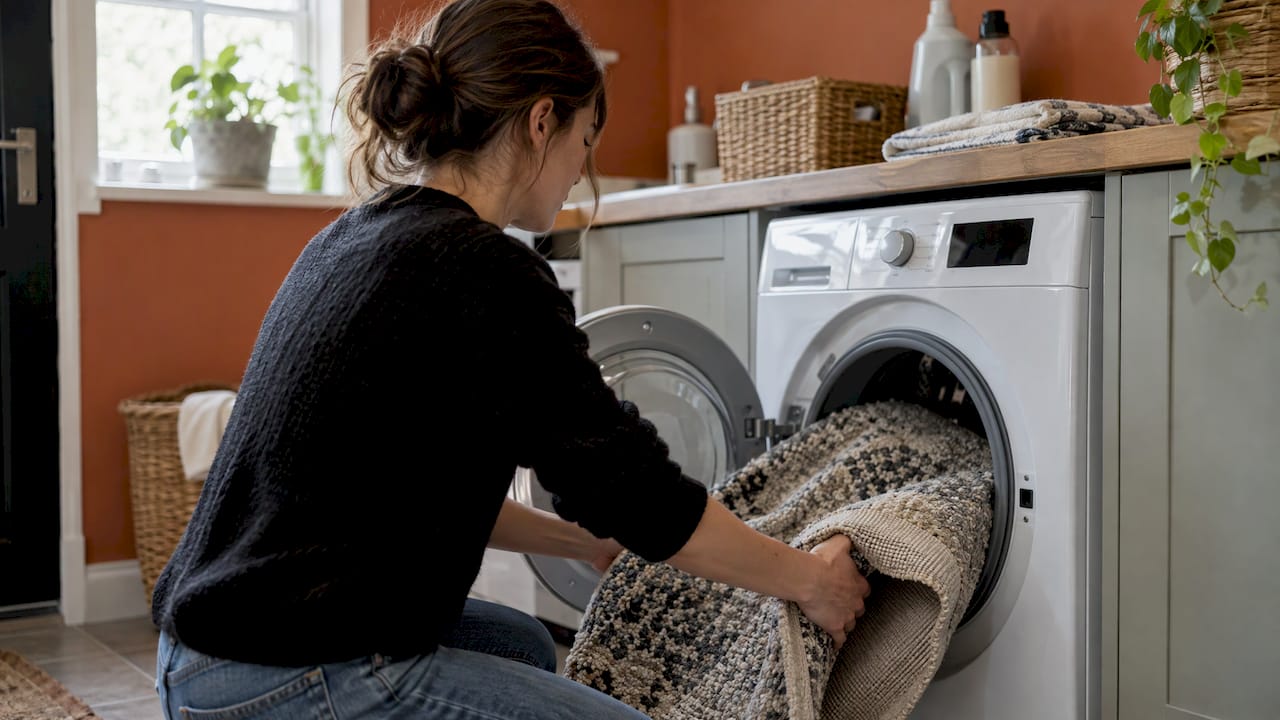
A washable rug is cared for in four moves: shake or vacuum it, treat the stains, wash it cold on a gentle cycle with a few towels to balance the load, then dry it completely, flat or hanging, with no heat. Get those four right and a washable rug will go on looking as good as the day it arrived. Get one wrong, usually the drying, and the backing and the edges take the damage. Below is the full routine, what to do when a rug is too big for your machine, and how to keep it flat on the floor afterwards.
TL;DR
- Read the care label first. Cotton, polyester, nylon, olefin and microfibre rugs are generally machine-safe, while wool, silk, jute and sisal are not, according to The Spruce.
- Vacuum both sides, pre-treat stains, then wash cold on a Delicate or Gentle cycle with a few old towels in the drum.
- No bleach, no fabric softener, no hot water and no tumble dryer on a rubber or non-slip backing.
- Dry the rug completely before it goes back on the floor, ideally flat on a rack by an open window.
- Rugs that are too big for your drum can go to a laundrette with large machines, or be hand-washed in a tub.
Table of Contents
- Check the label before you wash anything
- What you need
- How to wash a washable rug in the machine
- Drying: where most washable rugs go wrong
- Rugs that are too big for your machine
- Between washes: the habits that make a rug last
- Keeping the rug flat and in place
- Common mistakes to avoid
- Our view: easy-care is a design choice
- Choosing a rug that is easy to look after
- FAQ
- Sources
Check the label before you wash anything
Every step that follows depends on one thing: whether the rug is actually made to be washed. The safest check is the care tag sewn into the underside or the maker’s product page. The tag will usually give a maximum temperature, say whether a tumble dryer is allowed, and show whether the rug is machine-washable or only suitable for spot cleaning.
If the tag is missing, the fibre is the next clue. The Spruce’s guide lists cotton, polyester, nylon, olefin (also sold as polypropylene) and microfibre as fibres that can go in a washing machine. Wool, silk, jute, sisal and antique hand-knotted rugs should stay out of it. Natural fibres like jute swell and shed when soaked, which is why they need dry care instead. We cover that in our guide to weekly dry care for jute rugs.

The backing matters as much as the pile. Many washable rugs have a rubber or synthetic non-slip layer. The same Spruce guide warns that chlorine bleach and a dryer can both make a rubber backing deteriorate. Treat the backing as the fragile part of the rug, and most of the advice below follows from that.
What you need
Nothing specialist. Gather these before you start:
- A vacuum cleaner, or a stiff brush and somewhere outdoors to shake the rug
- A soft-bristled brush for stains
- A mild liquid laundry detergent, or a gentle stain remover
- Two to four old towels (colour-fast ones) to balance the drum
- A drying rack, a clean flat floor, or a sturdy clothes airer
Skip bleach and fabric softener. Whirlpool’s rug guide advises against both, as well as heavy-duty cycles, because they can cause shrinkage or damage.
How to wash a washable rug in the machine
1. Shake out and vacuum both sides
Take the rug outside and shake it, then vacuum the top and the underside. This is not just tidiness. The Spruce notes that leftover sand and grit can clog the washer’s drain lines, and gritty debris is also what grinds into a rug’s weave during the wash.
2. Pre-treat stains
Work a little stain remover or laundry detergent into the mark with a soft-bristled brush and leave it for 10 to 15 minutes, the timing The Spruce gives. Before you use any new stain remover, test it on a hidden corner. Whirlpool recommends this patch test to check the colours do not run.
Blot fresh spills instead of rubbing them. Rubbing pushes the stain deeper into the pile and can fuzz the surface.
3. Load the machine with towels
A single rug is a heavy, awkward lump that can send an unbalanced drum thumping across the kitchen floor. Add a few old towels so the weight spreads around. The Spruce suggests a front-loader, or a top-loader without a central agitator, because an agitator can twist and drag at the rug.
Check the size. A small kitchen runner or bath-sized mat fits easily. A big living room rug will not, and forcing it in stops water and detergent reaching the fibres and strains the motor.
4. Choose a cold, gentle cycle
Set the machine to a Delicate or Gentle cycle with cold water. This is the combination both Whirlpool and Maytag give for machine-washable rugs. Hot water can run dyes and damage a non-skid backing, so even if your label permits a warmer wash, cold is the safe default and the one that protects colour.
Use a small amount of mild liquid detergent. Too much leaves residue in the pile that attracts dirt and leaves the rug feeling stiff. If your machine has an extra rinse option, use it.
Wash the rug on its own, or with the towels only. Dark rugs and pale rugs should never share a load.
5. Dry it fully
Maytag’s guidance is to hang the rug or lay it flat in a well-ventilated space. It also allows a tumble dryer on a No Heat setting, but only if the care tag says so. If the rug has a rubber backing, skip the dryer altogether, as above.
While it is damp, smooth the rug flat with your hands and square up the corners. This helps the edges dry straight instead of curling.
Drying: where most washable rugs go wrong
A rug that feels dry on top can still be damp in the backing. Putting it back on the floor too soon traps moisture, which is bad for a non-slip layer and can leave a musty smell. Testers at The Independent make the same point in their round-up of washable rugs tested at home, published on 22 October 2026: most rugs have a synthetic non-slip backing that falls apart under high temperatures, so air-drying over a rack until completely dry is the safest route.

Small homes make flat drying hard. The same reviewer’s solution was a flat rack beside an open window, so air could circulate from every side, and she watched the corners for warping or curling, which looks untidy and can be a trip hazard.
Practical ways to dry a rug in a UK home, where the weather is rarely cooperative:
- A clothes airer or rack in the room with the best ventilation. Drape the rug evenly and turn it over halfway.
- A bathroom with an extractor fan or an open window. Fine for runners and small mats.
- A garden washing line on a dry, breezy day. Fold it over the line, not pegged by one edge, so the weight is spread. Keep it out of strong direct sun, which can fade colour.
- A flat patch of floor with a fan running. Lay a clean sheet beneath it and flip the rug after a few hours.
If you can still feel any coolness or dampness in the backing, give it more time.
Rugs that are too big for your machine
Plenty of rugs are washable in principle but too big for a domestic drum. The Independent’s testers give a rough guide: a medium rug needs up to a 7kg drum, and a 160 x 230cm rug up to 9kg. Anything larger than that may need a laundrette with larger-capacity machines, and should be folded into a laundry bag first.
Laundrette prices vary by town. As one example, a Porthcawl laundrette lists 27kg washers at £16 a full wash, with dryers at £1 for six minutes. Dryers there offer high, medium or low temperatures. Check your own care label before choosing one: if the rug has a rubber backing, wash it at the laundrette but take it home to dry it flat.
If a laundrette is not practical, hand-washing works. Whirlpool’s method is to fill a tub with cool water and mild detergent, immerse the rug, scrub it gently, rinse thoroughly, then air-dry. In a flat, a bath is the obvious tub. Press out the water by folding, not wringing, because twisting distorts the shape.
Between washes: the habits that make a rug last
Most washable rugs need washing less often than people think, provided you look after them in between.
- Vacuum weekly. Use suction only, or turn the beater bar off, so loops and edges do not snag.
- Blot spills straight away. Use a clean cloth and a little mild detergent in water. Work from the outside of the stain inwards.
- Rotate the rug. Turn it through 180 degrees every few months so wear from footfall is shared.
- Shake it outside. In a kitchen or hallway, grit from shoes does most of the damage to both pile and backing.
- Wash by use, not by calendar. A kitchen runner that catches crumbs and splashes may need washing every month or two. A bedroom rug may only need washing a couple of times a year.
Where the rug sits changes the routine
High-traffic spots such as the hallway and the area in front of the cooker or sink collect the most grit and grease, so they are the first to need a wash. A child’s playroom or nursery rug is another place where regular washing pays off. If you are picking one for little ones, our 30-second nursery rug safety tests are worth running through. For rugs that live outside, the rules differ again: see our guide to cleaning and protecting an outdoor rug.
Keeping the rug flat and in place
Curling corners are the most common complaint after a wash. They happen when a rug dries unevenly, or when the backing has been stressed by heat. Smoothing it flat while damp, and drying it with the underside exposed to the air, prevents most of it.
If a corner has already lifted, our guide on how to stop a rug curling walks through the fixes that work and how to prevent it coming back. For a rug on a hard floor in a busy area, a non-slip backing is worth having from the start, since a rug that slides is a rug that wrinkles and trips.
Common mistakes to avoid
- Using hot water. It can run dyes and harm non-skid backings.
- Using fabric softener. It coats fibres and can affect the backing.
- Overloading the drum. The rug needs room to move.
- Using carpet cleaner or carpet shampoo on a washable rug. These can be too harsh for the fibres. Mild detergent is the safer choice.
- Skipping the label. Different rugs, even from the same room, can have different instructions.
- Rehanging it still damp. Moisture trapped in the backing is the usual cause of smells and rubber breakdown.
Our view: easy-care is a design choice
A rug is the hardest-working thing in a room, and the one most people avoid buying in the colour they actually love because they fear the first spill. We think that is the wrong way round.
At Homable we build our range around pieces that suit real homes: kitchen runners and mats that are made to be washed, with non-slip backs for busy floors. Choosing something you can freshen up, instead of replacing, means you can pick the pattern you like and stop worrying.
Our advice is simple. Read the label, wash cold and gentle, dry it completely and keep the rug flat. Do that and a washable rug does exactly what it promises.
Cristiano
Choosing a rug that is easy to look after
If your current rug is past saving, or you are choosing for a new kitchen, hallway or utility room, start with the places that get messy first. Our washable kitchen runners come in a range of patterns and finishes, including a spoons and spices design, a coffee brown runner, a velvet non-slip runner and a mosaic kitchen floor mat. Always follow the care label that comes with the product you buy.
Browse the full range of rugs, mats and home accessories at Homable. Orders over £100 ship free.

FAQ
Can I put a washable rug in the washing machine?
Yes, if the care label says it is machine-washable and it fits comfortably in the drum. Use a cold Delicate or Gentle cycle, mild detergent and a few towels to balance the load, and avoid bleach and fabric softener.
What is the best way to dry a washable rug?
Air-dry it flat or over a rack in a well-ventilated room until it is completely dry, including the backing. Avoid a tumble dryer on rugs with a rubber or non-slip backing, because heat can make the backing deteriorate. Only use a No Heat setting if the care tag allows it.
Can I wash a washable rug at a laundrette?
Yes, and it is the practical route for rugs too big for a home machine. A medium rug needs up to a 7kg drum and a 160 x 230cm rug up to 9kg, according to The Independent’s testers. Wash it cold, and take it home to air-dry if it has a synthetic backing.
How often should I wash a washable rug?
It depends on where it sits. A kitchen or hallway rug that collects crumbs, splashes and grit may need a wash every month or two, while a bedroom or living room rug needs far less. Vacuum weekly and blot spills straight away to stretch the time between washes.
What if my rug is not machine-washable?
Spot-clean it with mild detergent in water, blotting instead of rubbing. For a heavier clean, hand-wash it in a tub of cool water with mild detergent, rinse well and air-dry it flat.
Sources
- Can You Wash a Rug in the Washing Machine? The Spruce
- How to Wash and Clean Rugs, Whirlpool
- How to Wash Rugs in a Washing Machine, Maytag
- Best washable rugs for 2026, reviewed at home, The Independent
- Laundrette prices and machine sizes, Porthcawl