Cart
0
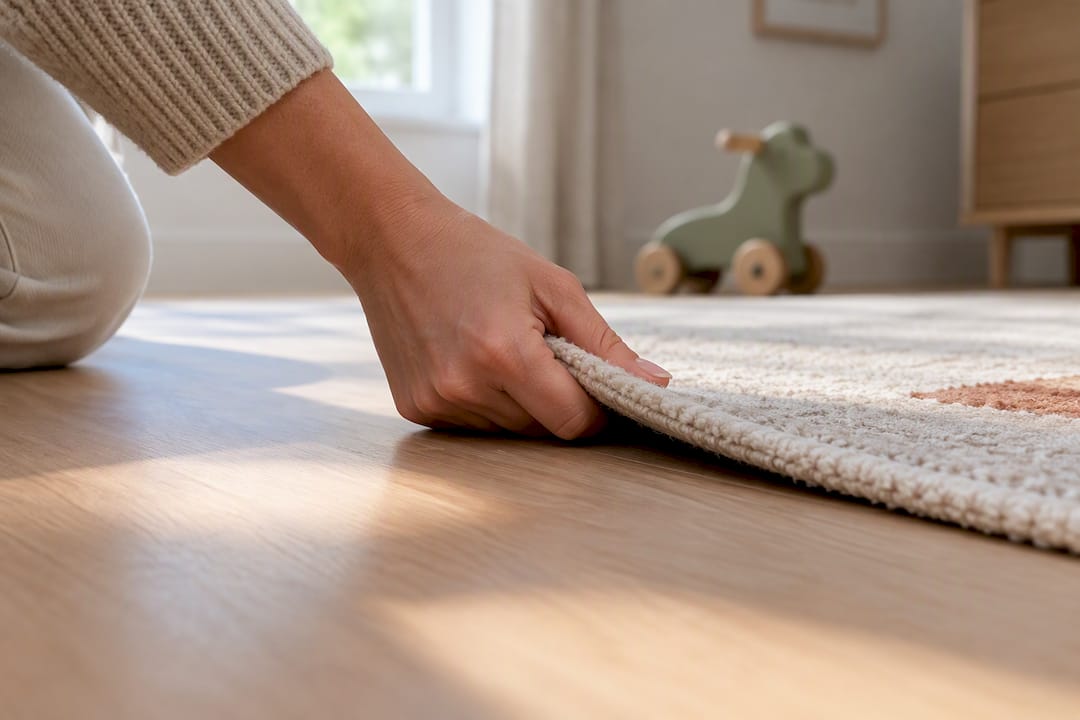
The safest nursery rug is low-pile, machine-washable, and carries verifiable chemical-safety information for the finished product, not just the yarn. It needs a backing that genuinely grips your floor or a rug pad that does the job instead. Skip anything with tassels, a crumbly-looking backing, or vague marketing claims with no certificate number behind them.
TL;DR:
- Verify that the nursery rug has a verifiable OEKO-TEX STANDARD 100 certificate for the finished product, especially at product class I for infants.
- Choose low-pile rugs with non-slip backings made from rubber, latex, or felt with grip layers, and test the grip with the pull test before placing it in the nursery.
- Avoid rugs with tassels, crumbly backing, or vague marketing claims, and ensure the backing material and care instructions are clearly listed on the product page.
- Use a proper rug pad suited to your flooring type, and re-test the grip periodically to account for backing wear or degradation.
- When washing, check that the backings are compatible with machine cleaning and ensure the rug can fully air-dry to prevent mold and odour issues.
Table of Contents
- What makes nursery rug safety about materials, not just marketing
- Non-slip backings, rug pads, and how to install them properly
- Washing a nursery rug without wrecking the safety features
- Pile height, cushioning, and where to actually put the rug
- Five things to check before you buy a nursery rug
- Quick tests you can run at home before trusting a rug
- Why I trust checklists over marketing copy
- Where to find safe, washable rugs for your nursery
- Sources
- FAQ
What makes nursery rug safety about materials, not just marketing
Chemical safety on a nursery rug comes down to two separate questions: what the fibres are made from, and what’s been tested on the finished item. Those are not the same thing, and mixing them up is where a lot of well-meaning parents go wrong.
OEKO-TEX STANDARD 100 tests the finished textile product and its accessory materials, including non-textile components like backing and trim, for harmful substances. That’s the certificate that tells you the rug you’re actually going to put a baby on has been checked, not just the raw cotton or bamboo fibre before it became a rug. GOTS, by contrast, certifies organic fibre origin and processing standards. A rug can be organic without being independently tested for chemical residues on the finished product, and a rug can pass finished-product testing without being organic at all. Neither claim substitutes for the other.
Crucially, OEKO-TEX STANDARD 100 includes a stricter tier called product class I, reserved for items intended for babies and infants up to three years old. If a nursery rug is only certified to a lower product class, it hasn’t been held to the standard that actually matters in your situation, so confirm the specific product class before assuming “OEKO-TEX certified” means what you think it means.
Pro Tip: Search the certificate number on the OEKO-TEX or GOTS database yourself rather than trusting a badge on the packaging. A real certificate is verifiable in under a minute; a fake or expired one isn’t.
What to check on any product page:
- A specific certificate number you can look up, not just a logo
- Confirmation the certificate covers the finished rug, not only the yarn
- A clear material breakdown, including the backing
- Full care and cleaning instructions
Red flags worth walking away from: no care label, decorative tassels or crowns your baby could chew or catch a finger in, and a backing that photos or reviews describe as flaking or crumbly. That crumbling is often the backing degrading, which is also a slip-safety failure waiting to happen.
Non-slip backings, rug pads, and how to install them properly
A rug that shifts under a crawling baby is a trip hazard regardless of how soft or pretty it is. Backing material determines most of this. Rubber and latex backings grip hard floors like wood, laminate, and tile well when new, but they can degrade over a few years and leave residue. Felt backings with a grip layer tend to be gentler on floor finishes and work reasonably well on hard surfaces, though they’re usually less effective than rubber on very smooth tile.
None of these backings work reliably on top of existing carpet. That’s where a rug pad earns its place.
- Match the pad to the subfloor. Thin grip pads suit hard floors; thicker felt-and-rubber combination pads are what you need on carpet-on-carpet setups.
- Run the 30-second pull test. Push the rug firmly with your foot in several directions. It should not slide, bunch, or lift at the corners.
- Check the edges lie flat. Curled corners or a rug that domes in the middle is a trip risk even if the centre grips fine.
- Reject shedding backings. If you see rubber crumbs or dust after moving the rug, the backing is already failing.
If you’ve got a nursery rug sitting on wall-to-wall carpet, securing it properly is a slightly different job to hard-floor installation, and it’s worth doing before the rug ever meets a crawling baby rather than after a near-miss.
Washing a nursery rug without wrecking the safety features
“Machine-washable” on a label is not a blanket promise. Check the size limit against your own machine’s drum capacity first. A rug that’s technically washable at 1.2 metres square can still be too bulky for a standard domestic washer to clean or rinse properly, and manufacturers often specify a lower wash temperature, typically 30°C, to protect both fibres and backing.
The backing is the part most likely to fail here. Some rubber and latex backings cannot go through a washing machine at all, even if the fibre on top is machine-washable, because the agitation and heat break down the adhesive. Always check whether the backing is explicitly included in the washable claim, or only the pile.

Drying matters just as much as washing. A rug that can’t fully air-dry within your household setup risks trapping moisture in the backing, which invites mould and odour that no amount of surface cleaning fixes. Manufacturers should give realistic drying guidance, and if a rug’s instructions call for tumble-drying but the backing isn’t tumble-dry safe, that’s a contradiction worth querying before you buy.
For everyday mess, spot-clean first: blot liquids immediately, use a mild detergent solution on the stain, and rinse without soaking the backing. Reserve a full wash for when odour, general grime, or an accumulation of small stains means spot-cleaning can’t keep up.
Know when to stop trying to save a rug. Persistent odour after washing, visible mould spots, or a backing that’s gone stiff, sticky, or crumbly all mean it’s time to replace it rather than keep cleaning around the problem. A degraded backing isn’t just unpleasant, it’s also a non-slip failure in progress.
Pile height, cushioning, and where to actually put the rug
Low-pile is the safer default for a nursery. It doesn’t catch tiny toes mid-crawl, it doesn’t hide small dropped objects, and it dries faster after a wash, which matters more than it sounds. Thicker, padded playmats have their place for tummy time and floor play, but they need their own non-slip base and shouldn’t double as a general nursery rug that sees foot traffic from adults carrying a baby.
Placement affects both safety and how long the rug lasts.
- Position rugs beside the cot or under a nursing chair, where footfall is predictable rather than constant.
- Define play zones with the rug rather than letting it stretch into a doorway or hallway pinch point.
- Avoid areas where a door swings, since a rug edge there becomes a catch point every single time.
- Leave enough clearance for chair legs to move without dragging the rug edge, and for the door to open fully.
- If the nursery has underfloor heating, check the rug and any pad are both rated for it. Some rubber backings soften or degrade under sustained heat.
Sizing the rug to the furniture layout, rather than to the room as a whole, avoids most of these problems before they start.
Five things to check before you buy a nursery rug
Run through this at the shelf or on the product page before adding a nursery rug to your basket:
- Intended use is stated clearly. The listing should say whether it’s a rug, a play mat, or both, and any age or use warnings should be visible, not buried in a manual.
- Edges are finished and nothing detaches. No fringing, no glued-on decorations, no tassels a curious hand can pull loose.
- Non-slip performance is confirmed for your floor. Either the backing is rated for your surface, or the listing recommends a rug pad, and you’ve budgeted for one.
- Chemical safety is verifiable. A real certificate number for the finished product, checkable on the relevant database, not just a claim of “non-toxic” with nothing behind it.
- Care instructions match what you can actually do at home. If it needs a size or temperature your washing machine can’t handle, that’s a problem you’re buying now and discovering later.
Quick tests you can run at home before trusting a rug
A rug looking safe in photos and being safe on your floor are two different things, so test it yourself once it’s home. The 30-second pull test catches most non-slip failures immediately: push firmly in several directions and watch for sliding or bunched corners.
For hygiene, a 10-minute spot-clean routine, blot, mild detergent, rinse, air-dry, handles most nursery accidents without a full wash cycle. If a rug fails the pull test on carpet, securing it within 48 hours with the right pad is far better than leaving a known trip hazard in a room where a baby is learning to stand. For hard floors, a 15-minute non-slip fix using grip strips or a thin pad usually solves the problem outright.

Pro Tip: Re-run the pull test every few months, not just once at purchase. Backings wear unevenly, and a rug that gripped perfectly in month one can loosen by month six.
Why I trust checklists over marketing copy
Product pages sell reassurance. A checklist sells nothing, which is exactly why it’s more reliable. Homable’s own approach to curating rugs and home textiles leans on the same logic: verifiable certificates, honest care labels, and backings that actually hold up on real floors, over any badge designed purely to catch the eye. Safety and good design aren’t in tension here. A rug that passes the pull test and washes cleanly can still look exactly right in the room.
— Cristiano
Where to find safe, washable rugs for your nursery
Some online retailers offer curated collections with clearer product descriptions and care instructions. Every rug and mat category on the site is chosen with the same checklist in mind: clear materials, honest washing guidance, and backings suited to real UK floors.
For a nursery specifically, the bamboo rug range offers a naturally low-pile, easy-wipe option that suits crawling babies and quick clean-ups alike, and it pairs well with a grip pad on hard floors. If you’re outfitting the wider room, Homable’s full collection covers rugs, storage baskets, and soft furnishings that follow the same safety-first sourcing. Match whatever you choose to the drying capacity you actually have at home, not the capacity the label assumes, and you’ll avoid most of the problems this guide has covered. Browse the current range and check the care label on each listing before you check out.
Sources
Check certificates directly rather than trusting badges: OEKO-TEX STANDARD 100 covers finished-textile testing, Gov explain the current scope for baby products, and the Toys (Safety) Regulations 2011 guidance clarifies when play-mat claims trigger toy-safety rules.
- OEKO-TEX STANDARD 100 (2025 standard document)
FAQ
What are some safe rugs for nurseries?
Look for low-pile, machine-washable rugs with a verifiable OEKO-TEX STANDARD 100 certificate covering the finished product, ideally at product class I for babies. Natural fibre options like bamboo rugs tend to be easy to wipe clean and naturally low-pile, which suits crawling babies well.
Should you put a rug in a nursery?
Yes, a well-chosen rug adds cushioning for tummy time and warmth underfoot, provided it’s low-pile, secured against slipping, and placed away from door swings and high-traffic paths. The risk isn’t rugs generally, it’s rugs with poor backings, loose decorations, or no verifiable chemical-safety information.
Is it safe for babies to be around a bad smell from new carpeting or rugs?
A strong, lingering smell from a new rug often signals off-gassing from adhesives, backing chemicals, or dyes, and it’s sensible to air the rug thoroughly outside the nursery before use. If the odour persists after several days of airing, that’s a sign to check the certification behind the product or consider returning it.
Is Ruggable safe for a nursery?
Any washable rug brand’s suitability for a nursery depends on whether it carries a verifiable finished-product chemical-safety certificate and a backing rated non-slip for your specific floor, so check those details on the manufacturer’s own product page rather than assuming a popular name covers it. The same checklist, certificate number, finished edges, confirmed non-slip performance, and realistic care instructions, applies regardless of brand.