Cart
0
TL;DR:
- Curated collections are intentionally assembled groups of home decor items selected for style, quality, and coherence. They reduce decision fatigue, enhance visual harmony, and promote sustainable, long-lasting choices. Creating a collection involves defining a theme, setting constraints, selecting complementary pieces, and editing ruthlessly for coherence.
Curated collections are refined, intentional groupings of items selected to represent specific design principles or goals, rather than random or exhaustive assortments. In home decor, this means a set of ornaments, storage pieces, or accessories chosen because they share a colour palette, material, or functional purpose. The result is a living space that feels considered rather than cobbled together. Whether you are styling a sitting room or organising a hallway, understanding what curated collections are gives you a practical framework for making better choices, faster.
What are curated collections and how do they differ from random assortments?
The word “curated” comes from the Latin curare, meaning to care for or attend to. Collection curation, as it is practised in home decor and retail, is the deliberate process of selecting, vetting, and grouping items so they work together in style, function, and visual weight. A curated collection is not simply a product category or a shelf of similar items. It is a bounded set with a clear theme and a consistent standard of quality.

The contrast with a random assortment is significant. An open marketplace or a general homeware aisle presents every available option without filtering for compatibility. A curated collection, by contrast, acts as a gatekeeper for quality and brand consistency, approving only items that meet defined criteria before they reach you. This is the same principle used by curated digital platforms, where sellers and products are vetted before listing, rather than allowing anyone to contribute regardless of quality.
Scope control is central to what makes a collection genuinely curated. Smaller, focused, and themed groupings reduce cognitive load and improve coherence. When you walk into a room styled around a neutral linen palette with matte ceramic accents, every item reinforces the others. That coherence does not happen by accident. It is the product of deliberate selection.
Pro Tip: To identify a genuinely curated collection, look for three things: a stated theme or design principle, a limited number of items (not hundreds), and visible compatibility between pieces in terms of colour, material, or scale.
| Feature | Curated collection | Random assortment |
|---|---|---|
| Selection process | Intentional, theme-driven vetting | No filtering or compatibility check |
| Quality control | Defined eligibility rules and review | Open to any quality level |
| Number of items | Bounded and focused | Unlimited or exhaustive |
| Visual coherence | High, items complement each other | Low, items may clash |
| Decision effort for buyer | Reduced, choices are pre-filtered | High, buyer must filter independently |
What are the key benefits of curated collections for home decor?
The most immediate benefit of a curated collection is the reduction of decision fatigue. Expert vetting saves shoppers time by filtering quality, style, and relevance before you ever see the options. For homeowners, this means you spend less time second-guessing whether a rug will work with a sofa, and more time enjoying the result.
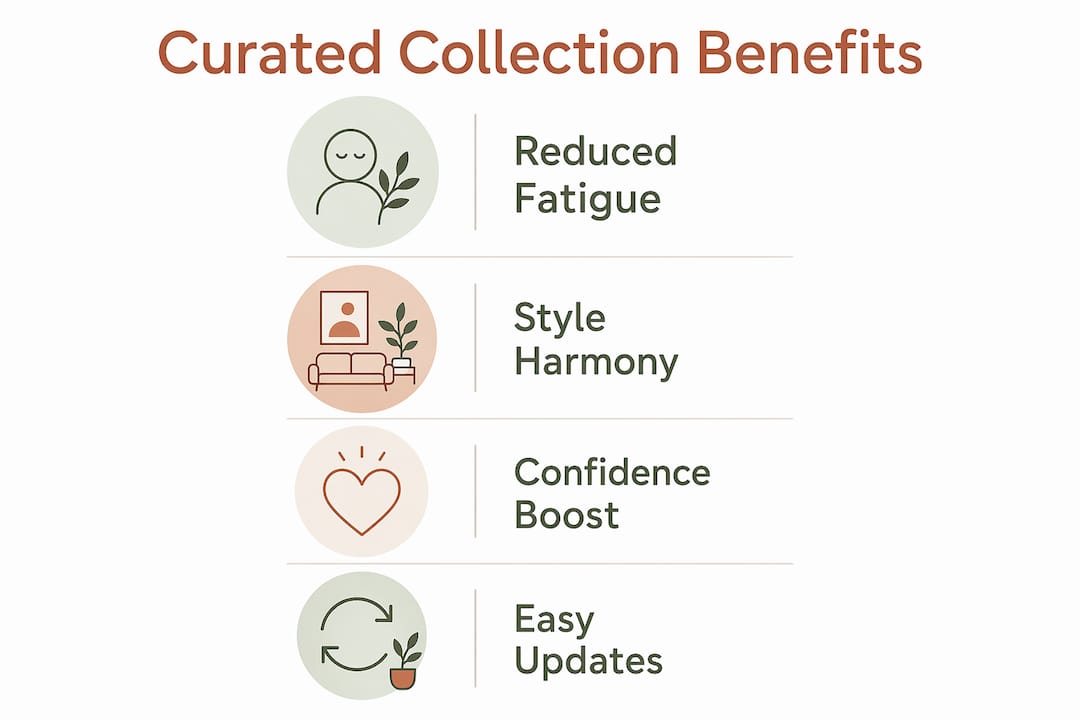
Beyond convenience, curated collections create stylistic harmony. When items share a design language, a room feels intentional rather than accidental. Interior designers have long understood that a cohesive space is not about matching everything identically. It is about selecting pieces that share enough visual DNA to feel related. A curated set of storage baskets in the same weave and tone, for example, transforms a utility shelf into a design feature.
There is also a sustainability argument. Curated fashion prioritises quality and longevity, reducing overbuying and waste. The same logic applies to home decor. Buying fewer, better-chosen pieces that work together means less clutter, fewer replacements, and a home that ages gracefully rather than looking dated within a season.
Here is a summary of the core benefits:
- Reduced decision fatigue: Pre-filtered choices mean you spend less time comparing incompatible options.
- Visual cohesion: Items selected for compatibility create rooms that feel designed, not assembled.
- Less clutter: Bounded collections discourage impulse buying and excess accumulation.
- Better value: Quality-vetted pieces last longer and require fewer replacements.
- Functional organisation: Purpose-driven groupings, such as a bathroom storage set, solve practical problems elegantly.
- Confidence in choices: Knowing items have been selected to work together removes the anxiety of mixing and matching incorrectly.
The confidence factor is worth expanding on. Many homeowners feel uncertain about their own taste, particularly when buying online without seeing items in person. A curated collection removes that uncertainty by doing the compatibility work in advance. You are not just buying a candle holder. You are buying into a considered aesthetic that has already been tested for coherence.
How to create your own curated collections at home
Creating a curated collection for your own home follows the same principles used by professional stylists and expert-built collections designed to answer specific user needs efficiently. The process is repeatable and does not require a design degree.
1. Define your theme or purpose. Before selecting a single item, decide what the collection is for. Is it decorative, functional, or both? A bedroom shelf collection might be purely aesthetic, built around a warm terracotta and brass palette. A kitchen counter collection might prioritise function, grouping items used daily in a consistent material like matte black or brushed steel.
2. Set your constraints. Decide on a colour range, a material palette, and a scale range. For example: neutral tones, natural materials (linen, wood, ceramic), and a mix of small and medium-sized pieces. Constraints are not limitations. They are the rules that make a collection feel intentional rather than random.
3. Select items that complement each other. Each piece should earn its place by relating to at least two others in the set. A ceramic vase, a woven tray, and a linen cushion all share a natural material story. A glass vase, a chrome lamp, and a velvet throw do not. Avoid mixing incompatible style languages, such as industrial and cottage, unless you are deliberately creating an eclectic theme with its own internal logic.
4. Vet quality carefully. Vetting and moderation keep collections consistent over time. Apply the same standard to your own selections. If a piece is cheaper but noticeably lower in finish quality, it will undermine the entire set. One poorly chosen item draws the eye for the wrong reasons.
5. Edit ruthlessly. A curated collection is defined as much by what it excludes as what it includes. Once you have assembled your candidates, remove anything that does not clearly belong. The goal is coherence, not completeness.
6. Arrange with intention. Groupings of odd numbers (three or five pieces) tend to feel more natural than even numbers. Vary heights and textures within the group. Place the largest item at the back or side, and use a tray or base to anchor the collection visually.
Pro Tip: Refresh your collections seasonally rather than replacing them entirely. Swap one or two pieces for seasonal colours or textures, such as adding amber glass in autumn or white ceramic in winter, while keeping the core theme intact. This keeps your home feeling current without requiring a full redesign.
For room-specific inspiration, Homable’s curated room decor picks offer practical examples of how themed selections work across different spaces.
How curated collections shape modern shopping and home styling
The curation process has moved well beyond physical retail. Digital platforms now use a blend of AI and human expertise to handpick items matching personal preferences, creating selections that feel tailored rather than algorithmic. For home decor consumers, this means that the best online shopping experiences present you with a shortlist of compatible, quality-vetted items rather than thousands of unfiltered results.
Curated commerce operates through managed pipelines. Platforms define eligibility rules, review submissions, and moderate listings over time to maintain consistency. This is fundamentally different from a search result page, where the only filter is relevance to a keyword. The difference in experience is significant. Browsing a curated collection feels like visiting a well-edited boutique. Browsing an open marketplace feels like searching a warehouse.
The resale and authenticated goods market illustrates this well. Curated resale platforms offer discounts of 30% to 70% versus retail, with expert vetting ensuring authenticity and quality. This model has migrated into home decor, where platforms now offer authenticated vintage and artisan pieces selected for design quality rather than simply price. For consumers, this creates access to unique items that would be impossible to find through standard search.
| Curation method | How it works | Consumer benefit |
|---|---|---|
| Human expert curation | Stylists or buyers select and vet items manually | High trust, strong aesthetic coherence |
| AI-assisted curation | Algorithms match items to user preferences and behaviour | Personalised, time-efficient discovery |
| Managed marketplace curation | Platform sets eligibility rules and reviews all listings | Consistent quality, reduced risk |
| Themed editorial collections | Items grouped around a seasonal or design theme | Inspiration-led, easy to replicate at home |
For a deeper look at how curated home design simplifies decision-making, Homable’s editorial covers the principles behind expert product grouping in detail. If you are planning a bedroom refresh, the top 2025 bedroom design trends offer useful context on the styles currently shaping curated home collections.
Key takeaways
Curated collections work because they replace volume with intention, giving every item in a set a clear reason to belong.
| Point | Details |
|---|---|
| Definition matters | A curated collection is a bounded, themed grouping vetted for quality and compatibility, not just a product category. |
| Coherence is the goal | Items should share colour, material, or functional purpose so the collection reads as a single, considered whole. |
| Benefits are practical | Curated collections reduce decision fatigue, limit clutter, and improve confidence in home styling choices. |
| Creation follows a process | Define a theme, set constraints, select compatible pieces, edit ruthlessly, and arrange with intention. |
| Modern curation blends expertise | The best collections combine human judgement and smart technology to deliver personalised, quality-filtered results. |
Why curation changed how I think about home styling
People often assume that a curated collection means expensive. In my experience, that is the most persistent misconception in home decor. The defining quality of a curated set is not price. It is the relationship between the items. I have seen beautifully curated shelves assembled entirely from affordable pieces, and I have seen expensive rooms that felt incoherent because no one had considered how the items related to each other.
The shift that curation produces is not aesthetic. It is psychological. When a room is styled around a coherent collection, people feel calmer in it. There is less visual noise competing for attention. Clients who have made this shift consistently describe their homes as feeling “more like them,” even when the individual pieces are not dramatically different from what they had before. The difference is the editing.
What most people overlook is that curation is an ongoing practice, not a one-time purchase. The best-styled homes I have encountered are maintained through regular editing. Pieces that no longer fit the collection are removed. New additions are held to the same standard as the originals. This discipline is what separates a curated home from a decorated one.
My honest advice: start with one surface. A sideboard, a bathroom shelf, a kitchen windowsill. Apply the six-step process above to that single space. The clarity you gain from that exercise will change how you approach every other room.
— Cristiano
Discover Homable’s curated home collections
Homable brings the principles of collection curation directly to your home, with themed, quality-vetted selections across decor, storage, and accessories.
Each collection is assembled with style and function in mind, so you spend less time searching and more time enjoying your space. The Decorative Silver Flower Candle Holder is a strong example of how a single well-chosen piece can anchor a wider collection, pairing naturally with neutral ceramics, metallic accents, and natural textures. Browse Homable’s full range to find themed groupings that take the guesswork out of home styling, with free shipping on orders over £100.
FAQ
What are curated collections in home decor?
Curated collections in home decor are intentional groupings of items selected for design compatibility, quality, and thematic coherence, rather than assembled randomly. Each piece is chosen because it works with the others in terms of colour, material, or function.
How do curated collections differ from regular product ranges?
A regular product range includes all available options in a category, while a curated collection is a filtered, bounded set vetted for quality and compatibility. The curation process acts as a gatekeeper, removing items that do not meet the collection’s design standard.
What are the main benefits of curated collections for homeowners?
The primary benefits are reduced decision fatigue, improved visual cohesion, and greater confidence in styling choices. Pre-filtered, quality-vetted selections save time and remove the uncertainty of mixing incompatible pieces.
How do I start creating my own curated collection at home?
Begin by defining a clear theme and a material or colour constraint, then select items that relate to at least two others in the set. Edit out anything that does not clearly belong, and arrange the final group with varied heights and an odd number of pieces for a natural, considered look.
Are curated collections more sustainable than buying individual items?
Curated collections encourage buying fewer, better-chosen pieces, which reduces overbuying and waste. Quality and longevity over volume is a core principle of good curation, making it a more considered approach to consumption than impulse or trend-driven purchasing.