Cart
0
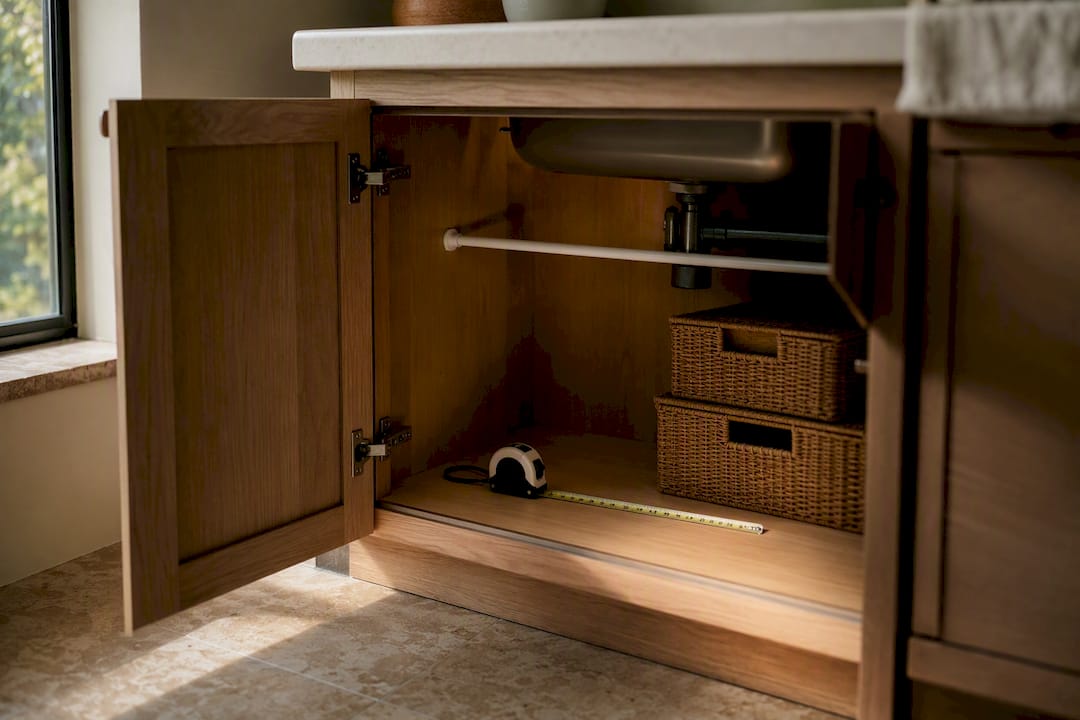
Match the fix to the constraint. Cupboards built around a central pipe column need an adjustable freestanding rack or an expandable slatted shelf you can trim to fit. Deep kitchen base units do better with pull-out bins or drawers, which drag the dead zone at the back within reach. Shallow bathroom vanities and rental flats respond best to a tension rod and a door caddy, since neither needs a screw. Whatever you choose, a waterproof silicone liner or drip tray goes underneath first, protecting the cabinet floor from the leak that eventually happens to everyone; for more ideas on door-mounted organisers and hanging solutions see Home Organization Systems | One Day Doors & Closets.
The rule that saves you money: measure before you buy anything. Under sink storage only works when the organiser actually fits around your pipes, not the cabinet’s advertised width.
- Pipes in the way? Adjustable rack or trimmable slatted shelf.
- Deep kitchen unit? Pull-out bins on either side of the plumbing.
- Rental bathroom vanity? Tension rod plus door caddy, zero drilling.
- Any cabinet, always: a liner or drip tray on the base first.
Pro Tip: Take a tape measure, a torch, and five minutes before you order anything. Returning an organiser that doesn’t clear your P-trap costs more time than measuring ever will.
TL;DR:
- Measure the internal width, depth, basin height, and space around pipes to ensure organiser compatibility before purchasing.
- Use adjustable racks, tension rods, or expandable slatted shelves to solve pipe and space constraints without drilling.
- Always place a waterproof liner or drip tray beneath organisers to protect the cabinet floor from leaks and condensation.
- Perform a monthly inspection by emptying, checking for leaks, cleaning the liner, and reorganising to prevent clutter and damage.
- Select durable, moisture-resistant materials like coated wire, stainless steel, or plastic to ensure longevity in damp cabinet environments.
Table of Contents
- Measure your cabinet before choosing an under sink storage solution
- No-drill fixes that work around your pipes
- Which organiser type suits your cabinet?
- Choosing materials that survive a wet cabinet
- The monthly reset that keeps it working
- Why trust Homable’s under sink storage guidance
- Fitting mounted organisers without damaging the cabinet
- What under sink storage actually costs
- Adapting organisers to an awkward or irregular cabinet
- Key Takeaways
- What the conventional advice on under sink storage gets wrong
- Fit out your cabinet with Homable’s storage range
- Sources
Measure your cabinet before choosing an under sink storage solution
Four numbers decide what will actually fit, and skipping this step is the single biggest reason organisers end up back in their boxes. Professional organisers consistently flag the same mistake: people buy first and measure second, then discover the unit straddles the pipe or blocks the stopcock.
Work through these before you shop:
- Internal width – measure the cabinet opening at its narrowest point, not the door frame.
- Usable depth – front-to-back clearance, checked at both floor level and basin height, since many units taper.
- Height to the underside of the basin – this caps anything you stack or slide in vertically.
- Clearance either side of the plumbing – measure the left and right zones separately, because buyers who measure only total cabinet width are the ones whose organisers arrive and don’t fit around the pipe.
While you’re in there, check the stopcock is reachable and look for damp patches, swelling, or a faint musty smell that suggests a slow leak. Sketch the cabinet as three zones (left, right, front) on paper. That sketch becomes your shopping list.
Pro Tip: Photograph the empty cabinet with the tape measure still in shot. It’s the fastest way to remember exact numbers when you’re standing in a shop three days later.
No-drill fixes that work around your pipes
Renters and anyone who’d rather not touch a drill have more options than they think. A tension rod, wedged wall-to-wall a few inches below the basin, gives you somewhere to hang spray bottles by their trigger necks, instantly clearing the base. The one snag: rods can slide on smooth melamine. A strip of Command tape or a blob of Blu Tack at each end stops that.
Expandable slatted racks solve the pipe problem differently. Most let you pull out individual slats that would otherwise collide with the P-trap, then rest the shelf on the remaining frame so it wraps around the pipe without any cutting.
- Portable caddies with handles work well for cleaning essentials you use daily, and stop you overstocking the cabinet since you naturally limit what fits in the tote.
- Adhesive hooks are fine for light items like cloths, but check the stated weight limit before hanging anything heavier.
- Slim door caddies suit shallow vanities, though a full bottle of shampoo on a door hinge is asking for trouble over time.
Pro Tip: Fit adhesive hooks to the cabinet’s side wall, not the door. Doors flex every time they close, and that flex is what eventually pulls adhesive strips off.
Which organiser type suits your cabinet?
Not every under sink storage product solves the same problem, and buying the wrong shape for your cabinet is how good intentions end up as clutter again by March. Match the organiser to the constraint, not the other way round.
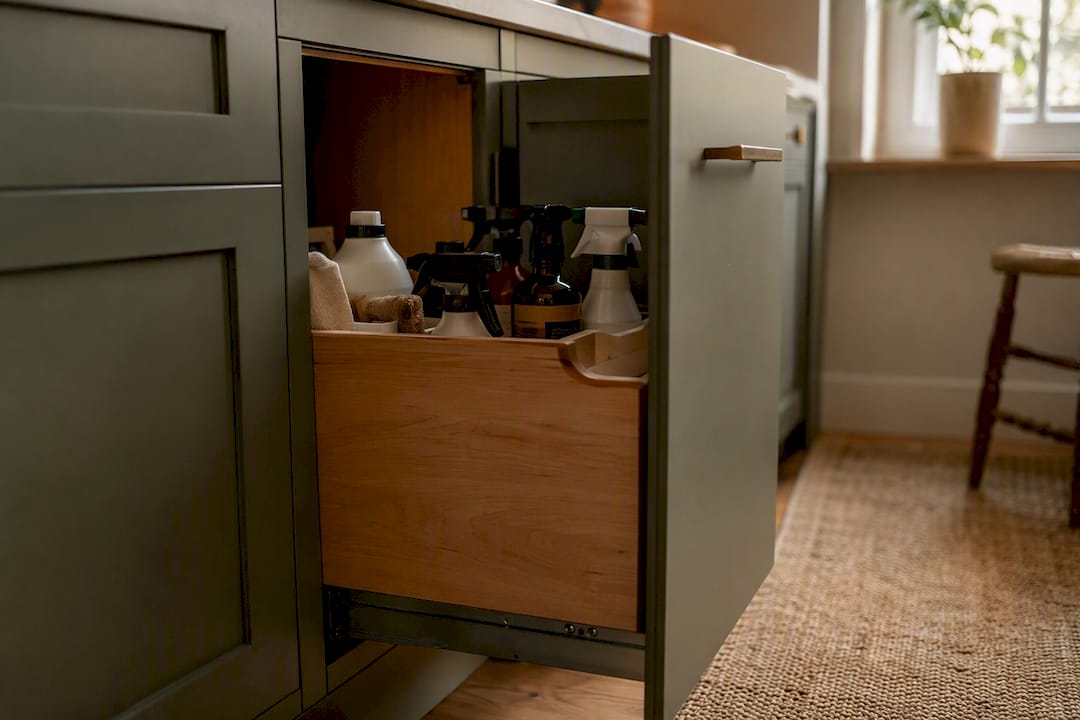
Pull-out drawers and bins are the strongest option for deep kitchen cabinets, where the back third of the cupboard is normally a black hole of forgotten bleach bottles. Testing by The Spruce found drawer-style units meaningfully improve accessibility over fixed shelving, though metal-framed versions hold up to weight better than plastic while plastic wipes clean more easily. Look for smooth, low-profile handles that won’t snag on the cabinet frame, and check the stated weight rating before loading it with detergent bottles.
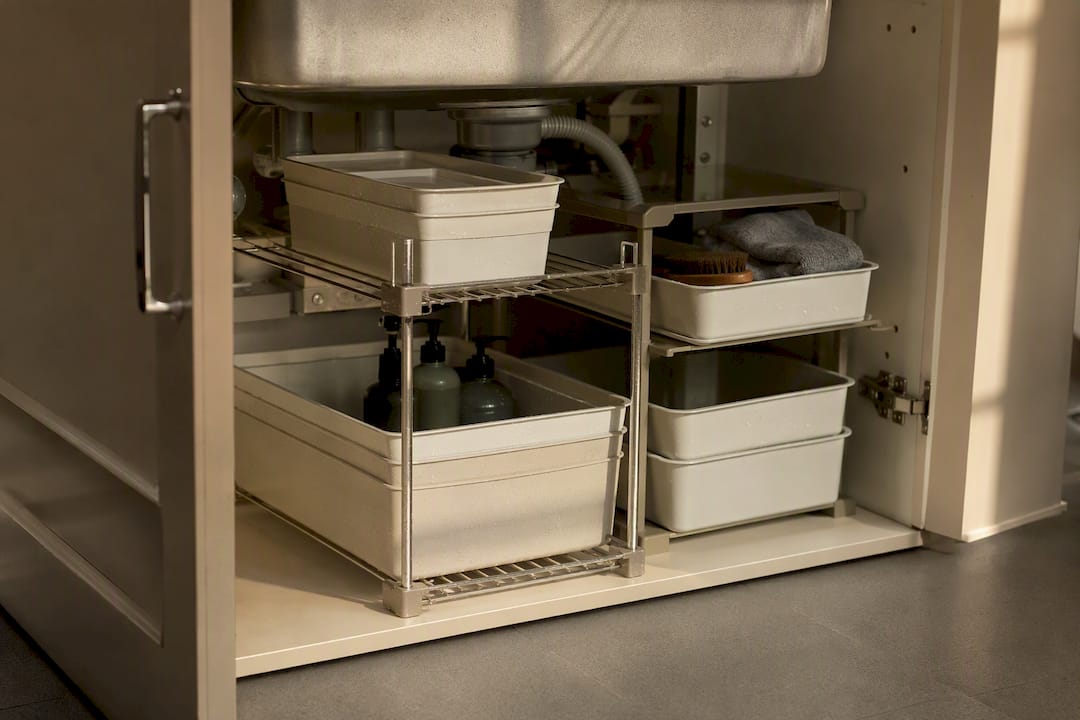
For cabinets with decent basin clearance, tiered sliding shelves and stackable risers reclaim vertical space that would otherwise sit empty above your first row of bottles. Clear stackable drawers do the same job in miniature, and they’re particularly good in bathroom vanities where you’re storing dozens of small items, cotton pads, spare toothbrushes, hair ties, that vanish in a single deep box.
A lazy Susan or turntable earns its place in wide cabinets holding bottles of different heights. Spin instead of dig. It’s a small thing, but it removes the “everything at the front” pile-up that happens within weeks of any other system.
For genuinely shallow bathroom vanities, door caddies and slim trays are usually the only thing that fits. Keep the heavy items off the door itself. A 12-item round-up from Good Housekeeping singles out door organisers as one of the most consistently useful additions for exactly this cabinet type, provided you’re realistic about what a hinge can carry.
- Deep kitchen cabinet → pull-out drawers or bins either side of the pipe.
- Good basin clearance → tiered shelves or stackable risers.
- Small bathroom items → clear stackable drawers.
- Wide cabinet, many bottle heights → lazy Susan.
- Shallow vanity → door caddy or slim tray, light items only.
Choosing materials that survive a wet cabinet
Under sink cabinets are, by definition, a damp environment, and that changes what’s worth buying. Coated wire, stainless metal, and moulded plastic all shrug off condensation and the odd splash. Untreated wood or bamboo does not, and will warp, swell, or grow mould within a season unless it’s properly sealed.
The liner underneath matters as much as the organiser sitting on it. A silicone mat or a rigid plastic drip tray with a raised lip gives you somewhere for a slow leak to pool instead of soaking straight into chipboard. Think of it as a shallow tray rather than a bucket. It’s there to catch drips and condensation, not survive a burst pipe.
One habit worth changing: dishwasher tablets sold in cardboard boxes go soft fast if they’re sitting directly on a damp cabinet floor. Decant them into a sealed, labelled container instead, and the box goes in the recycling on day one.
- Coated wire or stainless metal for anything load-bearing.
- Plastic for anything that needs regular wiping down.
- A liner or drip tray under everything, no exceptions.
- Dishwasher tablets and other tablets: sealed container, never the original cardboard.
Pro Tip: Sniff before you buy. A faint chemical smell from a cheap plastic organiser usually means it’ll off-gas in an enclosed cabinet for weeks.
The monthly reset that keeps it working
Under sink storage fails for one reason more than any other: nobody maintains it. A two-minute check once a month is genuinely enough to stop the slide back into chaos, and it’s also your earliest warning system for leaks.
- Empty the cabinet completely onto a towel.
- Inspect the base and pipework for drips, staining, or swelling.
- Wipe the liner or drip tray, even if it looks dry.
- Put items back into their original zones rather than wherever they land.
- Check labels on any decanted containers are still legible.
- Apply a one-in, one-out rule for anything new that comes into the cabinet.
If you spot a slow drip or chipboard that’s started to swell, deal with it immediately rather than waiting for the next reset. Keep one spare of anything essential (bin bags, cloths) on-site, and store bulk-buy backups somewhere dry outside the cabinet altogether.
Pro Tip: Set a recurring phone reminder for the same day you take the bins out. Piggybacking the habit onto an existing routine is the only reason it actually sticks.
Why trust Homable’s under sink storage guidance
Cristiano writes Homable’s storage guides, including the storage solutions checklist and a collection of creative storage designs, both built around the same measurement-first approach used throughout this guide.
Storage only works long-term when the container fits the space, not when the space is forced to fit the container. That’s the principle behind every recommendation Homable makes on organising a home.
Homable’s editorial content sits alongside its product range, which means the guidance here reflects genuine cabinet constraints, not a sales pitch dressed up as advice. For readers who want to go further:
- The complete storage solutions checklist for measuring and planning any room.
- Creative storage designs for inspiration beyond the sink cabinet.
- Step-by-step storage solutions for readers ready to install.
Fitting mounted organisers without damaging the cabinet
Some under sink solutions need light installation even when they’re not permanent fixtures, and it’s worth knowing what you’re getting into before you start. A basic tool kit covers most jobs: a tape measure, a screwdriver (both flathead and Phillips), a spirit level for anything shelf-based, and a pencil for marking screw points.
For genuinely mounted pieces, door-hung wire racks and over-the-door organisers usually clip onto the door’s top edge rather than needing screws through the panel itself, which is worth checking before you assume drilling is unavoidable. If a unit does call for screws, mark the position with the door closed and the cabinet loaded normally, since weight shifts a door’s hang slightly and you don’t want a rack fouling the frame when it’s full.
Adjustable slatted shelves and expandable racks typically need no tools at all. You extend them to width and set them on the cabinet base or an existing shelf lip. The only real skill involved is working out which slats to remove so the frame clears the P-trap and any waste pipe, resting the remaining slats across the gap rather than forcing them against the pipe.
If you’re wall-mounting anything inside the cabinet itself (a hook strip, a small shelf bracket), a stud or solid timber batten holds far better than chipboard alone, which tends to crumble around a screw over time in a damp environment. Where the cabinet wall is thin, an adhesive-mounted alternative is usually the safer long-term choice over screwing directly into it.
What under sink storage actually costs
Budgets for this project run wider than most people expect, and the price rarely tracks neatly with how much storage you get. A single tension rod sits at the cheap end, often under £10, and solves the “spray bottles everywhere” problem on its own. Door caddies and slim over-door organisers sit in a similar bracket, making them the obvious starting point for renters testing the waters before spending more.
Expandable slatted shelves and freestanding adjustable racks cost more, reflecting the engineering needed to trim around a pipe without losing structural strength. Pull-out drawer systems sit at the higher end of the range, since you’re paying for runners, a frame, and often a higher weight rating, but they’re also the fix most likely to end the “digging to the back of the cabinet” problem for good.
Liners and drip trays are worth budgeting for separately, even though they feel like an afterthought next to the organiser itself. Spending a little here protects a cabinet that would otherwise cost far more to replace if chipboard swells from an unnoticed leak.
A sensible approach for most cabinets: start with a liner and one no-drill fix, live with it for a month, then add a second organiser once you know exactly which zone still frustrates you. Buying everything at once, before you’ve used the space, is how organisers end up unused in a cupboard of their own.
Adapting organisers to an awkward or irregular cabinet
Very few under sink cabinets are a clean rectangle. Angled corner units, cabinets with a shallow shelf halfway down, or ones with pipework running diagonally all need a bit of improvisation rather than a boxed solution bought as-is.
For cabinets split by a central pipe column, two narrower pull-out bins positioned either side of the pipe work better than one wide drawer, which also keeps the stopcock reachable rather than buried behind a single unit. Expandable slatted shelves handle irregular width naturally, since you’re already trimming slats to fit; the same trimming logic works for uneven depth if you’re willing to cut a shelf’s supporting rail rather than the surface itself.
Corner cabinets, common under bathroom basins, often waste the triangular space at the back. A lazy Susan sized to the front opening rather than the full cabinet width usually fits better than a rectangular organiser forced into a curved space.
Where a cabinet has a permanent internal shelf that can’t be removed, treat it as two separate zones rather than one tall one. Slim stackable drawers or trays on the shelf itself, taller items below it. Measuring both zones separately, rather than the cabinet’s total height, is what stops you buying something that’s technically the right height but physically can’t get past the shelf on the way in.
Homable’s step-by-step storage guidance covers more examples of adapting fixed pieces to awkward layouts, useful if your cabinet doesn’t match any of the standard shapes above.
Key Takeaways
Under sink storage works reliably only when you measure the cabinet’s usable zones first and match organiser type to the specific constraint (pipes, depth, or hinge weight) rather than buying on looks alone.
| Point | Details |
|---|---|
| Measure four things first | Internal width, usable depth, basin clearance height, and space either side of the plumbing. |
| Choose by constraint, not style | Deep cabinets suit pull-outs; shallow vanities suit door caddies; pipe-heavy cupboards suit adjustable racks. |
| Protect the base always | Fit a silicone liner or rigid drip tray with a raised lip before adding any organiser. |
| Reset monthly | Empty, inspect for leaks, wipe the liner, restore zones, and apply a one-in, one-out rule. |
| Homable for style and durability | Homable’s storage guides and product range pair measurement-first advice with organisers built for damp cabinets. |
What the conventional advice on under sink storage gets wrong
Most guides treat under sink storage as a shopping problem: buy the right basket, job done. The research doesn’t support that. The recurring failure point isn’t the wrong product, it’s skipping the tape measure and treating every cabinet as though it’s the same rectangle with the same pipe position.
The second thing conventional advice underplays is maintenance. A beautifully organised cabinet with no monthly check is just a slower route back to clutter, and it hides leaks until they’ve already damaged the cabinet floor. I’d rank a two-minute monthly reset above almost any single organiser purchase.
Where I’d push back hardest is the instinct to buy the biggest, most feature-packed unit available. A cheaper, adjustable, slightly boring rack that actually clears your P-trap beats an expensive fixed drawer that doesn’t fit. Measure first, buy modular, protect the base, then worry about how it looks. Style matters, but it’s the last decision, not the first.
— Cristiano
Fit out your cabinet with Homable’s storage range
Homable is the practical next step once you know your measurements: a curated range of storage and home accessories chosen for durability and design, not just price, so you’re not gambling on an unbranded organiser that warps within a year. Where the fixes covered above are about technique, Homable’s range covers the products themselves, from decorative pieces that finish a room to functional accessories built to handle everyday use.

If you’re furnishing the rest of the room while you’re at it, browse pieces like the decorative silver flower candle holder for a finishing touch once the cabinet itself is sorted. Start by measuring your cabinet using the steps above, then head to Homable to see the current storage and home accessory range and find pieces that match both your cabinet and your décor.
Sources
- Use a tension rod to increase storage space under the sink — CNET
- Tackling under-sink organisation — Neat Method
- Best under-sink organisers — The Spruce
- Under sink storage ideas without drilling — The Neat Den
- Under-sink storage ideas — Good Housekeeping