Cart
0
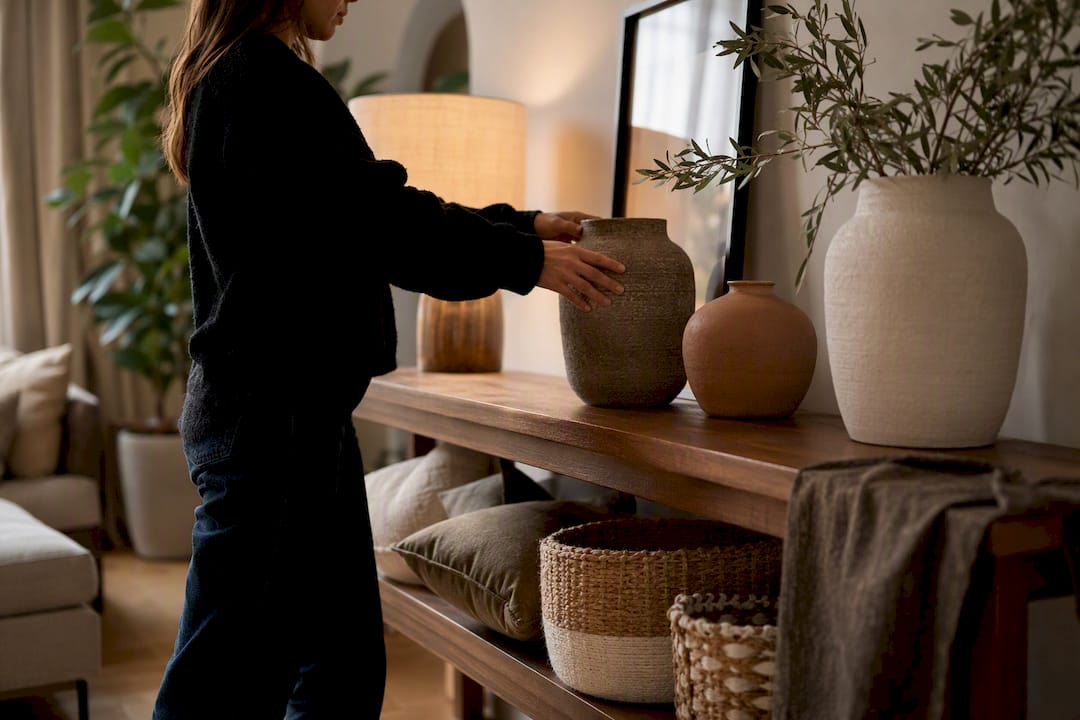
The best design solves the user’s need first, then uses appearance to make that solution easier to recognise, trust and enjoy. Functional design is about whether something works: can people complete the task, use the space, or operate the object without friction? Aesthetic design is about how something feels to look at and touch. Neither wins outright. Function should be the foundation, but the aesthetic-usability effect shows that attractive design makes people more forgiving of small usability flaws and more likely to trust a product in the first place.
- Set the functional requirements first: safety, accessibility, durability, core task flow.
- Layer aesthetic choices inside those constraints, not instead of them.
- Test both dimensions separately before calling a design finished.
Pro Tip: If you’re stuck choosing between two options for a room, product or interface, ask which one still works when the lighting’s bad, the user’s tired, or the object’s been used daily for two years. That’s your functional baseline.
Key Takeaways
Functional design succeeds or fails on whether a task gets done safely and efficiently, while aesthetic design determines how quickly people trust and enjoy that solution.
| Point | Details |
|---|---|
| Function first, always | Meet safety, durability and core-task requirements before choosing colours or finishes. |
| Aesthetics build trust fast | Attractive design increases perceived usability and first impressions within moments of exposure. |
| Match priority to involvement | High-stakes or high-involvement items need function to lead; low-risk, symbolic items can let looks lead. |
| Use constraints as a creative tool | Fix functional boundaries first, then explore aesthetic options freely inside them. |
| Test both dimensions separately | Ask “does it work” and “how does it feel” as two distinct questions, not one. |
Table of Contents
- What is functional design?
- What is aesthetic design?
- Functional design vs aesthetic design: a side-by-side comparison
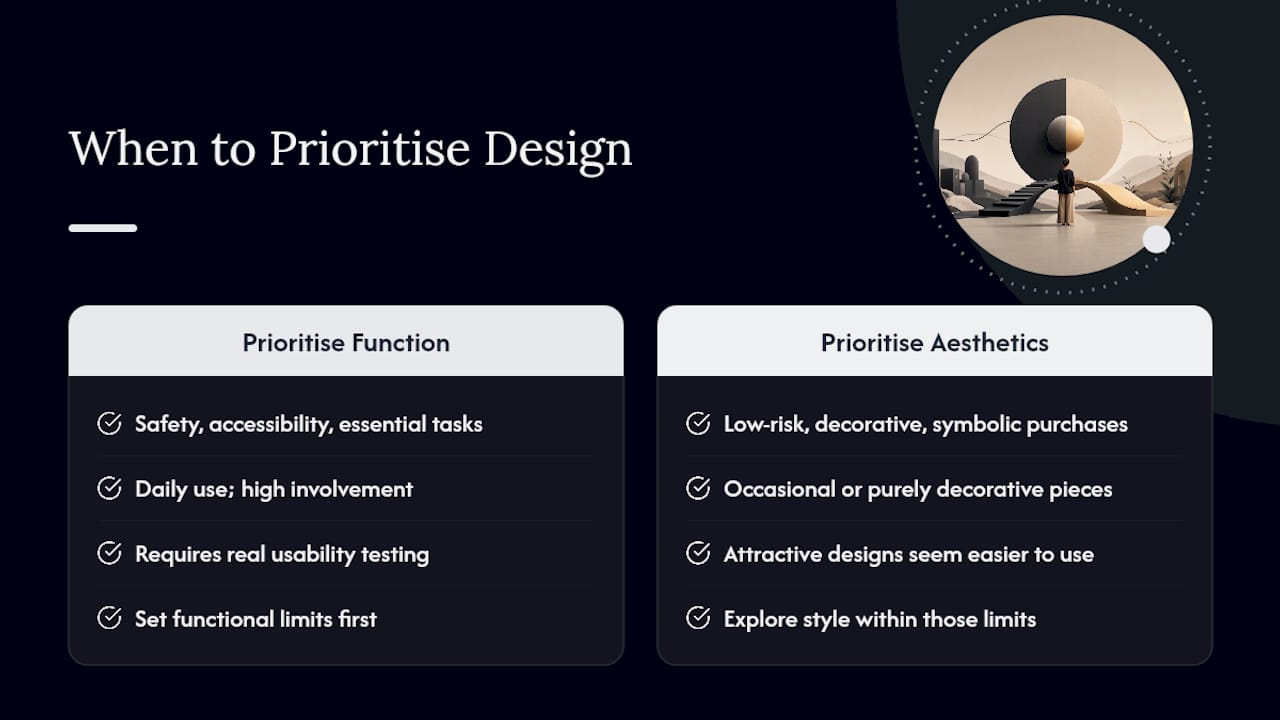
- When should function lead and when should aesthetics lead?
- How do you actually balance function and aesthetics?
- What do functional and aesthetic design look like in practice?
- How do you apply this balance to home decor?
- Frequently asked questions
- Sources
What is functional design?
Functional design is the discipline of making something do its job well: complete tasks efficiently, hold up to repeated use, and remain accessible to the people who need it. It’s judged by performance, not appearance. A kitchen drawer that jams, a website button nobody can find, or a chair that hurts your back after twenty minutes has failed on functional grounds, regardless of how it looks in a photograph.
Design thinking treats this as the “feasibility” and “viability” lens. According to IDEO’s design thinking process, a solution only earns its place once it’s been checked for practicality alongside desirability, not before. You can spot functional design principles at work through a handful of concrete signals:
- Clear affordances: a handle that looks and behaves like a handle.
- Measurable outcomes: task completion time, error rate, conversion rate.
- Accessibility: usable by people with different abilities, ages and contexts.
- Durability and safety: the object performs the same on day 900 as day one.
Good functional design rarely announces itself. You only notice it when it’s absent, in the jammed drawer or the confusing checkout form.
What is aesthetic design?
Aesthetic design governs how something looks, feels and reads emotionally: colour, proportion, material, typography, and the overall visual harmony of a piece. It’s the layer that creates a first impression before anyone has tested whether the thing actually works. Toptal’s analysis of aesthetics versus functionality frames this as the sensory and emotional dimension, distinct from but not opposed to usability.
Watch for these signals when assessing aesthetic quality:
- Colour and material finish that suit the context (warm terracotta in a living room, brushed steel in a kitchen).
- Typography and proportion that create visual rhythm rather than clutter.
- A clear visual hierarchy that guides the eye to what matters most.
- Symbolic cues, like a brass finish signalling quality, or rounded edges signalling softness.
First impressions form almost instantly. Research on credibility judgements shows visual design shapes trust within the first fifty milliseconds of exposure, long before anyone has tried using the thing.
Functional design vs aesthetic design: a side-by-side comparison
Every design decision sits somewhere on a spectrum between “does it work” and “does it feel right.” The table below breaks that spectrum into the dimensions that actually drive decisions on a brief.
| Dimension | Functional design | Aesthetic design |
|---|---|---|
| Primary goal | Task completion, reliability, safety | Sensory appeal, emotional resonance |
| Success metrics | Task time, error rate, durability, conversions | Engagement, perceived quality, first impressions |
| When to prioritise | Safety-critical items, essential workflows, high-involvement purchases | Low-risk purchases, branding moments, decorative goods |
| Typical trade-offs | Can look plain or clinical if pursued alone | Can hide usability flaws until they surface later |
| Example fields | Medical devices, load-bearing furniture, checkout flows | Ornaments, packaging, gift items, feature-launch pages |
Academic work analysing consumer responses across 547 product cases found that functional, aesthetic and symbolic design each move behaviour differently, and the balance shifts with how involved the buyer is in the purchase. A £15 candle holder and a £1,500 sofa don’t get judged the same way.
A few practical implications follow directly from this:
- For high-involvement purchases (sofas, kitchens), test function rigorously before finalising the look.
- For low-involvement, symbolic purchases (ornaments, cards), aesthetics can lead the brief.
- Never treat conversion rate as proof of usability. It can also just be proof of a good photograph.
When should function lead and when should aesthetics lead?
Function has to lead when the stakes of failure are high. That covers anything involving safety, regulatory compliance, accessibility for disabled or elderly users, or a task someone has to complete under pressure, such as a checkout page or a fire escape route. In these contexts, prioritising the functional foundation first prevents the frustration that comes from a beautiful thing that doesn’t actually work.
Aesthetics can lead when the stakes of getting it “wrong” are low, or when the product’s whole purpose is symbolic: a decorative ornament, a gift, a feature wall, an aspirational purchase where the buyer already knows it will work and is choosing on feel alone.
Use this checklist before starting a brief or a home renovation:
- Does failure here risk injury, exclusion, or a broken essential task? Function leads.
- Is this a decorative, gift, or low-frequency-use item? Aesthetics can lead.
- Will the item be used daily for years, or admired occasionally? Daily use tips towards function.
- Is trust or first impression the main job of this object (a hallway console, a homepage hero)? Aesthetics earns more weight here.
Statistic Callout: Consumer-behaviour analysis across functional, aesthetic and symbolic design categories confirms that effectiveness depends heavily on product involvement, so the “right” balance genuinely changes case by case rather than following one universal rule.
How do you actually balance function and aesthetics?
Constraint-based design is the most reliable method here: set the functional boundaries first, then explore aesthetic options freely inside that container. Research into constraint-based design processes shows this prevents the feature creep and aesthetic clutter that happens when style decisions get made before the brief is settled.
- Define the user need. What has to happen, and for whom? Be specific: “a parent needs to reach cereal without waking a toddler,” not “make the kitchen nicer.”
- Set functional constraints. Dimensions, safety standards, durability requirements, accessibility needs. Write these down before sketching anything.
- Generate aesthetic options inside those constraints. Colour, material, form, finish, all explored freely, but never allowed to override step 2.
- Prototype. A cardboard mock-up, a wireframe, a taped-out floor plan. Cheap and fast beats polished and wrong.
- Test for both usability and emotional response. Ask “can you use this” and “how does this make you feel” as two separate questions.
- Iterate. Fix functional failures immediately. Refine aesthetic choices based on genuine reaction, not assumption.
A few heuristics catch conflicts early: tap targets need to stay above minimum thumb-friendly sizes, text needs sufficient contrast against its background, and visual hierarchy should point to the most important action first, not the prettiest one. Practitioner reports on concurrent design consistently find that projects handling visual and functional decisions together, rather than handing off from one team to another, produce better conversion and retention.
Take a kitchen storage brief as a mini case: the functional constraint is “hold five days of dry goods, be reachable by a 5’2” user, survive daily wiping." Only once that’s settled does the aesthetic exploration begin, choosing between oak fronts, matte lacquer or open shelving.
What do functional and aesthetic design look like in practice?
- UX example: A booking app redesign moved its confirm button from a subtle grey ghost button to a solid, high-contrast block. The functional constraint was tap accuracy on small screens; the aesthetic decision was colour and weight. Completion rates rose because the button was finally visible, not because it looked nicer in isolation, as covered in guidance on how design affects usability.
- Product example: A kettle brand kept its spout angle fixed by pouring-accuracy testing, then varied only the handle material and colour range across its line.
- Architectural example: A balcony redesign needed a barrier strong enough to meet safety load requirements; the aesthetic answer was a glass balustrade rather than solid railings, preserving the view while meeting the brief, an approach detailed in glass balcony design for everyday outdoor living.
- Home decor example: A hallway needed a doorstop that wouldn’t scuff skirting boards; the functional brief was weight and grip, the aesthetic decision was a finish that matched brushed brass fittings elsewhere in the home, echoing the reasoning in why interior doors are the next big home trend.
How do you apply this balance to home decor?
Start with the daily task, not the mood board. Homable’s own guidance on functional home decor puts the same constraint-first logic to work in ordinary rooms.
- List the daily tasks the item supports (holding keys, blocking a draught, storing shoes).
- Set durability and cleaning constraints before choosing colour or material.
- Prioritise ergonomics, especially for anything touched or lifted daily.
- Choose finishes that hide scuffs and fingerprints rather than show every mark.
- Use colour and texture to signal function, a matte grip surface reads as “practical,” a glossy finish reads as “display only.”
Statistic Callout: The aesthetic-usability effect means a well-finished piece will feel easier to live with even before you’ve tested it, but that perception fades fast if the item doesn’t hold up to daily use.
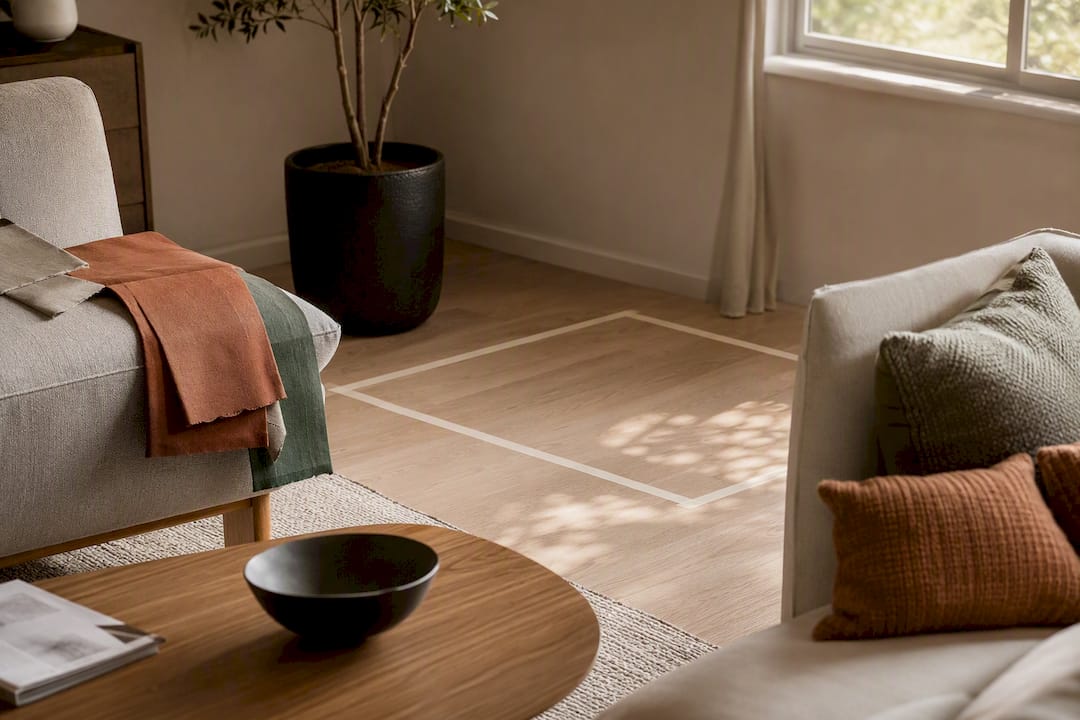
Measure success by comfort and reduced friction, not just how a piece photographs. Before buying, tape out the footprint on your floor or hold a swatch against your existing palette for a few days.
A note on balancing design in real projects
Constraint-first thinking wins in practice more often than mood-board-first thinking, because it forces the hard questions early rather than after the paint’s dried. Homable’s guide to prioritising design and function at home reflects the same order of operations argued for here.
Homable’s collections are built on that same logic: pieces designed to earn their place functionally first, then finished to a standard that makes them worth displaying. The Decorative Silver Flower Candle Holder is a fair example, sized and weighted to sit stably on a shelf or table, finished to catch the light without demanding constant polishing. If you’re weighing up a piece for your own home, start with the task it needs to do, then let the finish follow.
Frequently asked questions
Is functional design more important than aesthetic design? Function matters more when safety, accessibility or essential tasks are at stake. Aesthetics can lead for low-risk, decorative or symbolic purchases where the buyer already trusts the product works.
What is the aesthetic-usability effect? It’s the tendency for people to perceive attractive designs as easier to use, even before testing them. It builds initial trust but never substitutes for real usability testing.
Can a product be both highly functional and beautiful? Yes. Constraint-based design, setting functional limits first and exploring style within them, is how most successful products and interiors achieve both, rather than treating it as a trade-off.
How do I know which to prioritise for my home project? Ask how often the item will be used and what happens if it fails. Daily-use, high-involvement pieces need function first; occasional or purely decorative pieces can be chosen on looks alone.