Cart
0
TL;DR:
- Disorganization costs more than money; it depletes your time, stress levels, and mental clarity each day. Investing in storage without first decluttering often results in concealed chaos and ongoing frustration, not long-term organization. Proper storage solutions, paired with deliberate editing, can enhance space use, protect belongings, and support your daily routines, ultimately improving wellbeing.
Most people underestimate just how much disorganisation costs them. Not in money, but in time, stress, and mental clarity. If you’ve ever wondered why invest in storage solutions when you can simply “tidy up later,” the answer lies in what clutter quietly steals from you every single day. This article cuts through the noise, explains what storage can genuinely do for your home, and gives you an honest look at where most people go wrong before they spend a single penny on storage.
Table of Contents
- Key takeaways
- Why invest in storage solutions: the hidden cost of clutter
- Storage versus organisation: why they are not the same thing
- The real advantages of quality storage solutions
- How to choose storage solutions wisely
- My honest take on investing in storage
- Upgrade your home with Homable’s storage range
- FAQ
Key takeaways
| Point | Details |
|---|---|
| Clutter costs real time | The average person loses over 50 hours a year searching for misplaced items at home. |
| Storage alone isn’t enough | Without decluttering first, storage only conceals clutter and delays better decision-making. |
| Organisation precedes storage | Deciding what to keep before buying storage prevents wasted money and ongoing frustration. |
| Quality storage improves wellbeing | Well-chosen storage reduces visual chaos, lowers stress, and supports clearer daily routines. |
| Smart selection matters | Choosing the right size, access, and type of storage maximises your return on investment. |
Why invest in storage solutions: the hidden cost of clutter
Before you can appreciate the storage solution advantages that genuinely improve daily life, you need to understand what disorganisation is actually doing to your home environment. And the numbers are sobering.
Over 50 hours lost every year searching for misplaced items at home. That works out to roughly 8.5 minutes each day spent looking for things you already own. Nearly half of adults have been late to work, school, or appointments because of disorganisation. That is not a minor inconvenience. That is a structural problem inside your living space, and it touches your work, your relationships, and your mood before the day has properly started.
The wellbeing impact goes deeper than lost time. Research shows that cluttered homes raise cortisol levels by between 18% and 25%, with women in cluttered environments showing flatter cortisol curves that indicate chronic, ongoing stress rather than temporary spikes. Clutter is not just untidy. It is a persistent low-level stressor that keeps your nervous system on alert, even when you are trying to relax.
“Reducing visual stimuli helps regulate stress responses and supports mental clarity.” — NAPO, 2026
The key takeaway here is that organised environments reduce competing mental inputs, which means your brain is not constantly processing visual noise whenever you walk through your own home. Organisation matters well beyond aesthetics. It has a measurable effect on cognitive function, mood, and the quality of time you spend at home.
Storage versus organisation: why they are not the same thing
Here is where most people waste their money. They buy storage. Lots of it. And then, a few months later, they are still frustrated because nothing feels calmer or easier to find. The reason is almost always the same: they bought containment instead of creating a system.
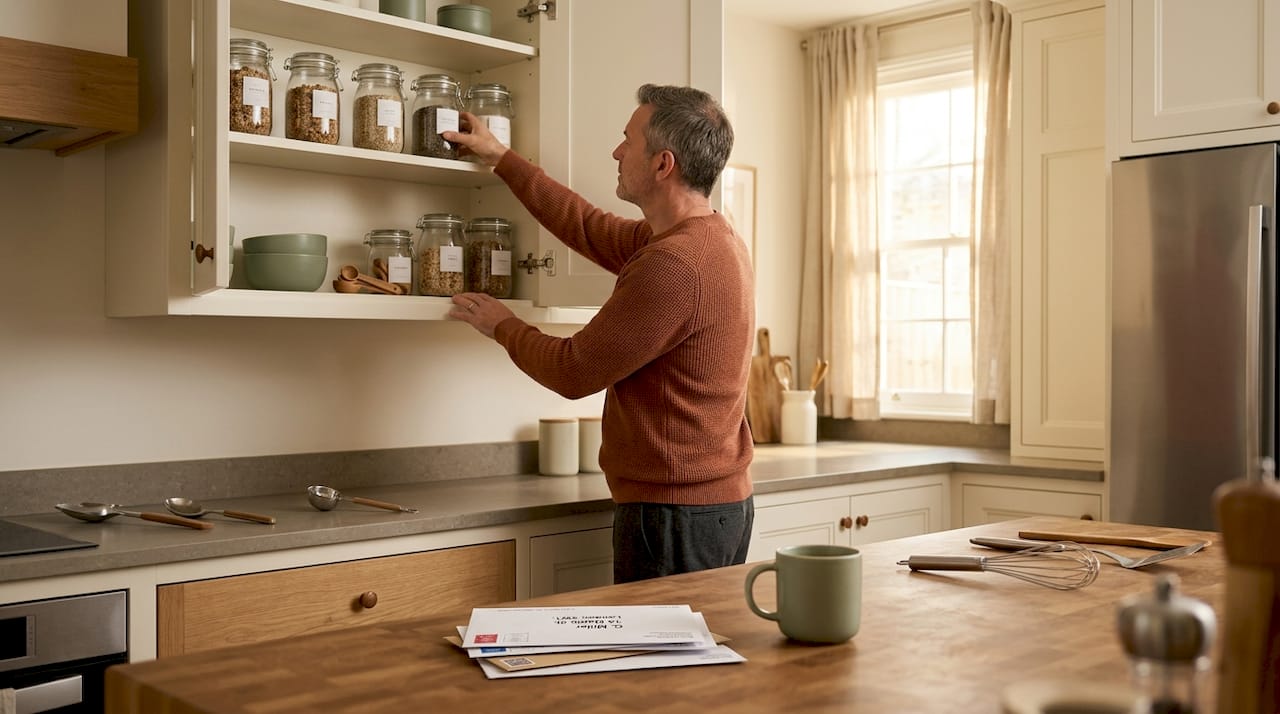
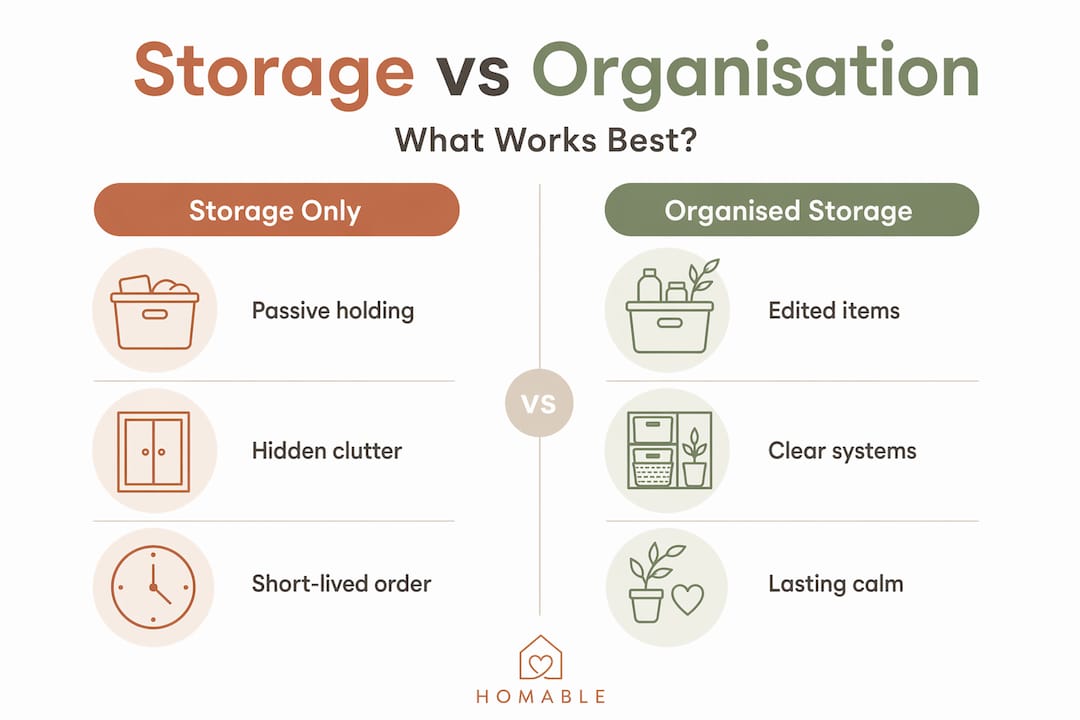
Storage is passive holding. Organisation involves decisions about what belongs where, why it stays, and how the system will be maintained. Without those decisions, storage simply moves clutter from surfaces into boxes, drawers, and baskets. The visual chaos disappears temporarily, but the mental load stays exactly where it was.
| Approach | What it does | Long-term result |
|---|---|---|
| Storage only | Contains items without editing | Hidden clutter, harder to maintain |
| Organisation only | Decides what stays and where | Clear system, but may lack capacity |
| Organisation then storage | Edits first, then contains purposefully | Lasting clarity and easy daily use |
The table above captures why the order matters. Extra storage often leads to increased hidden clutter when it is not preceded by decluttering, making long-term organisation harder rather than easier. This is not a flaw in the storage product itself. It is a flaw in the sequence of decisions.
Pro Tip: Before purchasing any storage solution, spend one hour editing the space it will serve. Remove anything you have not used in six months. What remains will tell you exactly how much storage you actually need, and what type.
The practical implication is clear. If you are considering investing in storage options for a spare room, a kitchen, or a hallway, the first step is not shopping. It is sorting. Decide what earns a place in your home, then design storage around what stays.
The real advantages of quality storage solutions
Once you have done the editing work, investing in the right storage pays off in ways that compound over time. This is where the genuine storage solution advantages become tangible.
Here are the core benefits that well-chosen storage delivers:
-
Better use of your space. Quality storage designed for your specific space means you stop losing square footage to awkward piles or underused corners. Organisation solutions matched to your use patterns create ease of access and reduce the time you spend retrieving everyday items.
-
Protection of your belongings. Proper storage preserves what you own. For items sensitive to temperature and humidity, such as wooden furniture or electronics, climate-controlled storage prevents damage from environmental fluctuations over time. This is particularly relevant for seasonal items you rotate in and out of use.
-
Reduced daily friction. When everything has a designated place and that place is logical, your mornings change. You stop hunting. You stop second-guessing. The time you lose daily searching drops significantly because the system does the thinking for you.
-
Visible mental clarity. Tidy, intentional storage reduces the visual noise that keeps your nervous system in low-grade alert. This is not abstract. It is the physical difference between walking into a room and feeling calm versus walking in and immediately feeling overwhelmed.
-
Support for daily routines. Good storage solutions support the rhythms of your specific household. Whether that is a dedicated space for school bags near the door, a linen organisation system in the bathroom, or a kitchen drawer system that reflects how you actually cook, storage that fits your life requires less effort to maintain.
Pro Tip: When choosing storage for frequently used items, prioritise open shelving or clear containers. Opaque, lidded boxes are best reserved for items you access seasonally, not daily. Visibility reduces friction.
If you are exploring how storage can also lift the look of your home, read how stylish storage transforms spaces without sacrificing function. The best storage solutions do both.
How to choose storage solutions wisely
Knowing why choose storage systems is only half the picture. The other half is choosing and implementing them correctly so you actually get the storage solutions ROI you are hoping for.
Here are the most common mistakes to avoid and the practical steps that work:
-
Do not oversize your storage. A unit or piece of furniture that is too large for your space creates dead zones you will never use effectively. Planning unit size and layout carefully avoids the “black hole” problem where things go in and never come out.
-
Leave access space. Whether you are organising a wardrobe, a cupboard under the stairs, or a separate storage unit, the ability to move within and around your storage matters. Packing floor to ceiling without leaving retrieval space makes the whole system harder to use and less likely to stay maintained.
-
Match access frequency to placement. Items you use daily should be at eye level and within arm’s reach. Seasonal or rarely needed items can go higher, lower, or further back. This single principle alone reduces the daily time cost of a disorganised home.
-
Think about access hours for external storage. If you are renting additional storage space, consider that 24/7 access often raises costs and security risks without delivering proportional benefit. Extended daytime access, typically from 7am to 8pm, suits the majority of home storage needs and keeps costs lower.
-
Build in a maintenance habit. The best-organised space will drift back to chaos without a monthly reset. Set a recurring time to check that items are where they belong and remove anything that has crept back in without a purpose.
| Storage decision | Smart choice | What to avoid |
|---|---|---|
| Unit size | Slightly larger to allow aisles | Packing to capacity with no access |
| Access type | Extended daytime hours | Paying for overnight access you will not use |
| Item placement | Frequency-based arrangement | Random stacking by whatever fits |
| Climate control | Use for wood, electronics, fabric | Skipping it for long-term sensitive storage |
For a broader look at maximising your living space, Homable’s space-saving solutions checklist covers room-by-room approaches that pair well with storage investment decisions. You can also find useful room-by-room guidance in this home design checklist that covers practical steps across every space.
My honest take on investing in storage
I have watched people spend hundreds on storage solutions and feel worse about their homes six months later. Not because the products were poor, but because they bought storage when what they actually needed first was a clear-out. The containers became a way of avoiding the harder question: do I actually need this item?
In my experience, the homes that benefit most from investing in storage options are the ones where the residents have already made hard choices about what to keep. Storage becomes genuinely transformative once those decisions are in place. Before them, it is just a more expensive form of postponement.
What I have also noticed is that storage investment works best when it matches how you actually live, not how you aspire to live. Buying a beautiful set of matching baskets for a hallway only works if your household is the kind that naturally puts things back. If it is not, open hooks and a bench with a simple system will outperform them every time. Honest self-assessment before you spend is worth more than any product recommendation.
The storage solutions ROI you are really investing in is not shelf space. It is the mental clarity, time savings, and daily ease that come from a home that works with you rather than against you. That return is absolutely worth pursuing, as long as you sequence the work correctly.
— Cristiano
Upgrade your home with Homable’s storage range
At Homable, we believe that a well-organised home should also be a beautiful one. Our curated storage collection pairs practical function with designs that genuinely complement your living spaces, whether you are sorting out a busy hallway, a cluttered bathroom, or an overloaded kitchen. From soft, absorbent bathroom mat sets that bring order and comfort to your morning routine, to stylish accessories that hold their own as part of your décor, everything at Homable is chosen with both form and function in mind. Browse our full range and discover how the right pieces can make your home feel calmer, clearer, and more you. Explore our home styling insights for inspiration on where to begin.
FAQ
How much time does clutter actually waste each year?
Research shows the average person loses over 50 hours annually searching for misplaced items at home, roughly 8.5 minutes every day.
Does buying more storage solve a clutter problem?
Not on its own. Without decluttering first, storage conceals clutter rather than resolving it, making the underlying problem harder to address over time.
Can disorganisation affect my mental health?
Yes. Cluttered environments have been shown to raise cortisol levels by up to 25%, contributing to chronic stress, particularly in women.
What is the best storage to invest in first?
Start with the space that causes the most daily friction, such as an entryway or kitchen. Choose storage that matches how you actually use the space, and edit what goes into it before you buy.
Do I need 24/7 access to a storage unit?
For most households, extended daytime access from 7am to 8pm is sufficient. Round-the-clock access typically adds cost and security risk without meaningful benefit.