Cart
0
TL;DR:
- Lighting significantly influences a home’s mood, color perception, and texture visibility beyond basic illumination. Combining ambient, task, and accent lighting at different heights creates depth, contrast, and a welcoming atmosphere in every room. Essential practices include layering sources, choosing warm or cool tones appropriately, and utilizing dimmers for flexible, effective home lighting.
Lighting is one of the most underestimated tools in home design. Most homeowners treat it as an afterthought, something you sort out once the furniture is in place and the walls are painted. But the role of lighting in home design goes far deeper than simply illuminating a room. It shapes how a space feels, how colours read on walls, how textures catch your eye, and even how long you want to stay in a room. Get it right and your home feels polished and alive. Get it wrong and even the most expensive décor falls flat.
Table of Contents
- Key takeaways
- The role of lighting in home design: types and functions
- Colour temperature, diffusion, and brightness
- Lighting strategies for every room in your home
- Common lighting mistakes and how to fix them
- How lighting works with colour, texture, and décor
- My take on what lighting actually changes in a home
- Take your home lighting further with Homable
- FAQ
Key takeaways
| Point | Details |
|---|---|
| Layer your light sources | Use ambient, task, and accent lighting together to create depth and avoid flat, shadowless rooms. |
| Colour temperature changes mood | Warm tones suit relaxation spaces; cooler tones work better in kitchens and home offices. |
| Dimmers are worth every penny | Adding dimmers to overhead lights gives you flexible control over atmosphere for any time of day. |
| Swap clear shades for frosted ones | Opaque or frosted shades diffuse light softly, making rooms feel more flattering and comfortable. |
| Natural light supports well-being | Aligning artificial lighting with daylight cycles helps regulate energy and restfulness throughout the day. |
The role of lighting in home design: types and functions
Before you start shopping for fixtures, you need to understand the three core categories of lighting and why each one matters. They are not interchangeable, and a room that relies on just one of them will always feel off.
Ambient lighting is your foundation. It provides the general illumination that lets you move safely around a space. Think ceiling pendants, flush-mount lights, and recessed downlights. Most rooms have this covered. The mistake is stopping here.
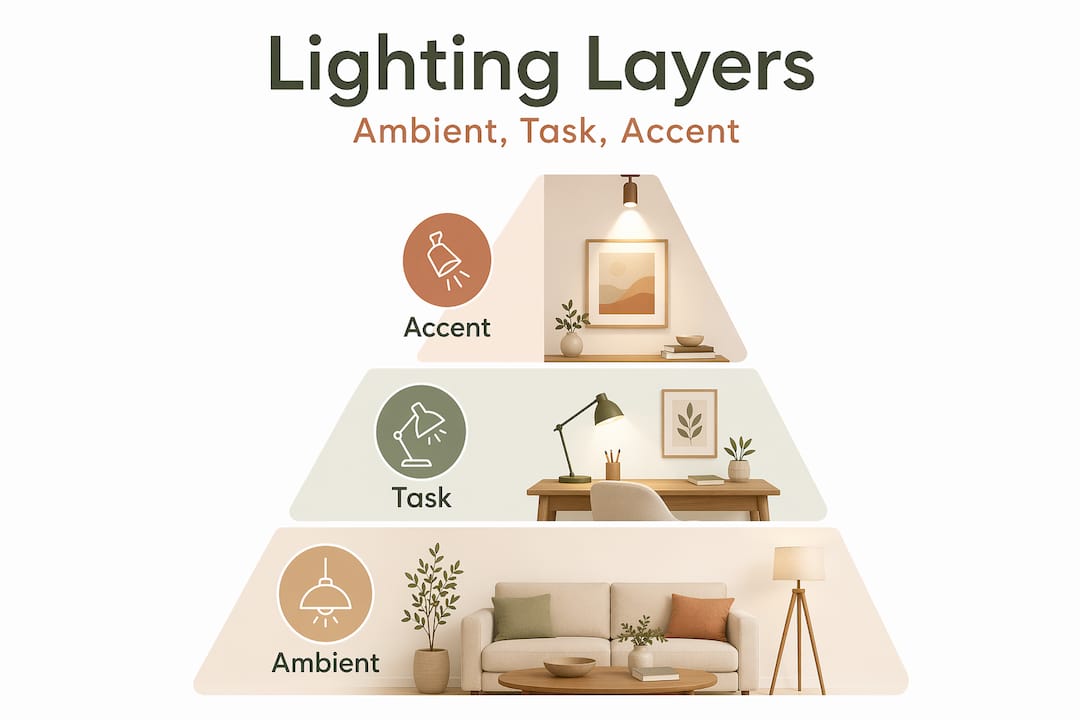
Task lighting is focused and functional. It goes where you need it most: above a kitchen worktop, beside a reading chair, over a bathroom mirror. Without it, you are squinting at your recipe or struggling to shave in shadows.
Accent lighting is where personality enters the picture. Picture lights above artwork, LED strips behind shelving, or a directed spotlight on a textured wall all count. Accent lighting draws the eye and creates visual hierarchy in a room.
| Lighting type | Primary purpose | Common placements |
|---|---|---|
| Ambient | General illumination | Ceiling pendants, recessed downlights |
| Task | Focused, functional light | Desk lamps, under-cabinet strips, mirror lights |
| Accent | Visual interest and drama | Picture lights, shelf lighting, wall washers |
Layering at least two to three sources at different heights creates depth and eliminates dark corners that a single overhead light simply cannot reach. Overhead, mid-level (sconces and table lamps), and low-level (floor lamps and picture lights) together produce balanced illumination that feels genuinely considered.
Pro Tip: When planning a room, sketch the three layers before choosing any fixture. If a layer is missing, fill the gap before you worry about the style of the fittings.
Understanding how these layers work together is the foundation of great interior styling practice, and it makes every other design decision easier.
Colour temperature, diffusion, and brightness
The quality of light matters just as much as its quantity. Two lamps with the same wattage can feel completely different depending on their colour temperature and how their light is diffused.
Colour temperature is measured in Kelvins. Without getting technical, the practical range for home use runs from warm white (around 2,700K) to cool white (around 5,000K). Warm light tones create a cosy, inviting atmosphere and are preferred in living rooms and bedrooms, where you want to relax. Cool whites feel energising and clinical, which can work in a home office or utility room but will make a bedroom feel cold and unwelcoming.
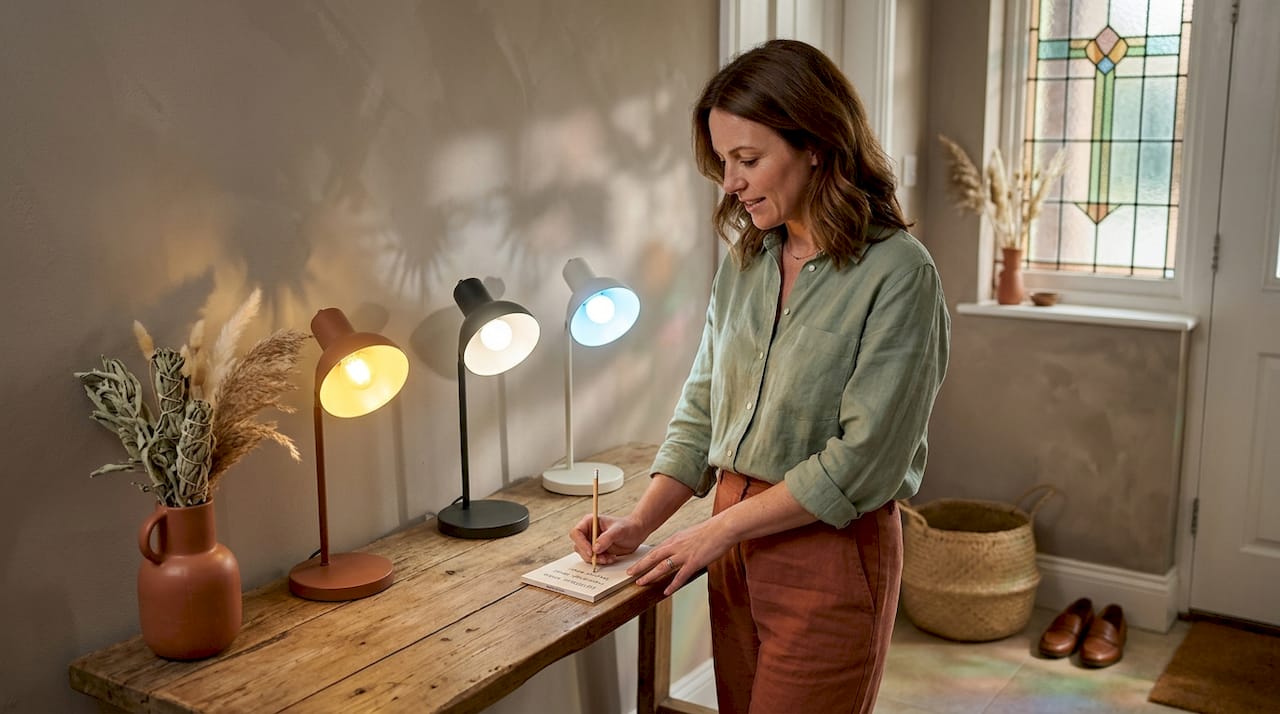
Diffusion is the other half of the equation. Bare bulbs and clear glass shades push harsh, unfiltered light directly at you. Replacing clear shades with opaque ones softens light and creates a more flattering atmosphere, particularly in kitchens and bathrooms where people spend time looking at themselves and their food.
Here is what to keep in mind when choosing bulbs and fittings:
- Choose 2,700K to 3,000K bulbs for living rooms, bedrooms, and dining spaces
- Use 3,500K to 4,000K in kitchens and home offices where clarity matters
- Pick frosted or fabric shades over clear glass wherever ambiance is a priority
- Add a dimmer wherever possible, as dimmers provide flexibility and mood control that a fixed-output bulb simply cannot match
Pro Tip: Buying a single bulb in different colour temperatures before committing to a full room is a simple test that saves money and frustration. Hold each one in the space at different times of day before deciding.
Brightness does not equal beauty. Our eyes are drawn to contrast rather than uniform brightness, so a room with pockets of warm light against softer shadow will always feel more visually interesting than one lit to the ceiling at full blast.
Lighting strategies for every room in your home
Knowing the theory is one thing. Applying it room by room is where most homeowners get stuck. Here is a practical framework for each key space.
-
Living room. Layer all three types of lighting. A pendant or recessed ambient light sits overhead, table lamps or floor lamps at seated eye level provide warmth, and accent lights on shelving or artwork add depth. Combining these lighting types supports transitions from energetic daytime use to calm evening relaxation.
-
Kitchen. Start with bright ambient light for safety, then add under-cabinet task lighting for worktops. A pendant above the island or dining table creates an intimate zone within a larger, functional space. Avoid warm-only lighting here: a little cool-white task light prevents accidents and makes food preparation easier.
-
Bedroom. Avoid harsh overhead lighting entirely if you can. A dimmed ambient source paired with soft bedside lamps works far better for winding down. Good lighting supports circadian rhythms by mimicking the shift from cool daylight to warm evening tones, which genuinely affects how well you sleep.
-
Bathroom. Lighting beside or around the mirror (rather than above it) is far more flattering for daily grooming. Add a warm, dimmable overhead for bath-time relaxation and you have covered both function and mood.
-
Hallways and landings. These transition spaces are often overlooked. A wall sconce or low-level lamp creates warmth and guides movement without flooding the space. Smart controls and dimmers allow you to manage brightness by time of day, which is especially useful in hallways that double as night-time routes.
Pro Tip: Treat your hallway as the first impression of your home. A single well-placed lamp at the end of a hallway draws the eye inward and makes the space feel longer and more considered.
Common lighting mistakes and how to fix them
Most lighting problems in homes come down to the same handful of errors. Recognising them is the first step.
- Relying on one overhead light. This is the most widespread error in home lighting. A single central fixture creates flat, even light with no depth and harsh shadows at the edges of the room. Most homeowners rely on a single source, but designers use multiple sources at varying heights specifically to avoid this.
- Using clear glass shades. Clear shades look sleek in product photos, but in real life they distribute unfiltered light that feels glaring and unflattering. Swapping them for frosted covers is one of the quickest and cheapest upgrades a designer would recommend.
- Ignoring contrast and shadow. Rooms that are uniformly bright feel clinical rather than comfortable. Designers understand that light and shadow interplay creates aesthetic richness. Leave some areas softer; let the brighter zones do the work.
- Forgetting natural light. Where you position furniture, the colour of your window treatments, and even the sheen of your flooring all affect how natural light behaves. Natural light aligned with your routine supports energy levels and rest in ways artificial light alone cannot.
Pro Tip: Before spending money on new fixtures, try rearranging existing lamps into different positions and heights. Sometimes the light you already own is simply in the wrong place.
How lighting works with colour, texture, and décor
Lighting does not operate in isolation. It is the thing that makes everything else in a room look its best, or worst.
Consider colour. A paint colour chosen under fluorescent showroom lighting will look completely different under warm incandescent light at home. Lighting shapes colour perception so significantly that designers always test paint samples under the actual lighting conditions of a room before committing.
Texture is equally affected. A rough stone wall, a woven rug, or a velvet cushion all look flat under direct overhead light. Angle a light source across a textured surface and shadows catch in the weave and grain, suddenly making the material feel three-dimensional and tactile. This is why layering textures in design and layering light sources go hand in hand.
Furniture placement also matters more than most people realise. A sofa pushed against a wall will look stranded under bright overhead light, but place a floor lamp behind or beside it and you create a reading nook with real warmth and purpose. Lighting as an architectural tool guides attention, separates zones, and gives rooms a sense of intention.
- Use directional accent lighting to highlight art, plants, or a feature wall
- Choose warm-toned lighting to make earthy, natural textiles feel richer
- Consider how curtains and blinds filter natural light through the day and choose window treatments accordingly
My take on what lighting actually changes in a home
I’ve worked with enough homeowners to know that lighting is almost always the missing ingredient. They repaint, they buy new furniture, they swap rugs and cushions, and the room still feels somehow wrong. Then they add a floor lamp in the corner and suddenly the whole space comes together. It happens more often than I can count.
What I’ve found is that people underestimate the emotional effect of light. A room lit with two or three warm, layered sources at different heights feels genuinely different from a room lit by one bright ceiling fixture. Not just better looking. Actually calmer, more welcoming, more like somewhere you want to be. That shift is hard to photograph and hard to explain in a shop, but the moment you experience it yourself, you cannot unsee it.
My honest advice? Buy a dimmer switch before you buy any new furniture. The return on that single change is higher than almost anything else you could do to a room. And if you are not sure where to start with layering, add one floor lamp to your living room tonight and see what it does by tomorrow evening. The result will convince you more than any article could.
— Cristiano
Take your home lighting further with Homable
If this has sparked ideas for your own home, Homable is a good place to keep exploring.

At Homable, you will find a curated selection of home accessories, décor, and styling resources designed to help you put these ideas into practice. Whether you are rethinking your living room, updating a bedroom, or looking for guidance on layering depth and style throughout your home, Homable brings together quality products and design thinking in one place. Free shipping is available on orders over £100, and the collections are updated regularly with pieces that work across a range of interior styles. Start with what interests you most and build from there.
FAQ
What is the role of lighting in home design?
Lighting shapes how a room feels, how colours appear, and how textures read. It goes beyond basic illumination to influence mood, functionality, and the overall sense of a space.
How does lighting affect home ambiance?
Warm-toned lighting at lower intensities creates a cosy, relaxing atmosphere, while cooler, brighter light feels more energising. Layering multiple light sources at different heights adds depth and warmth that a single overhead fixture cannot achieve.
What are the benefits of layering lighting in a room?
Layering ambient, task, and accent lighting eliminates dark corners, creates visual interest through contrast, and allows you to adapt the mood of a room for different activities and times of day.
How can I improve my home lighting without a large budget?
Swap clear glass shades for frosted or opaque alternatives, add a dimmer switch to an existing overhead light, and reposition any lamps you already own to vary heights and angles. These three changes cost very little but make a significant difference.
Why does colour temperature matter in home lighting?
Colour temperature determines whether light feels warm and relaxing or cool and clinical. Choosing the right Kelvin rating for each room, warm white for bedrooms and living rooms, cooler tones for kitchens and workspaces, keeps the atmosphere aligned with how you use the space.