Cart
0
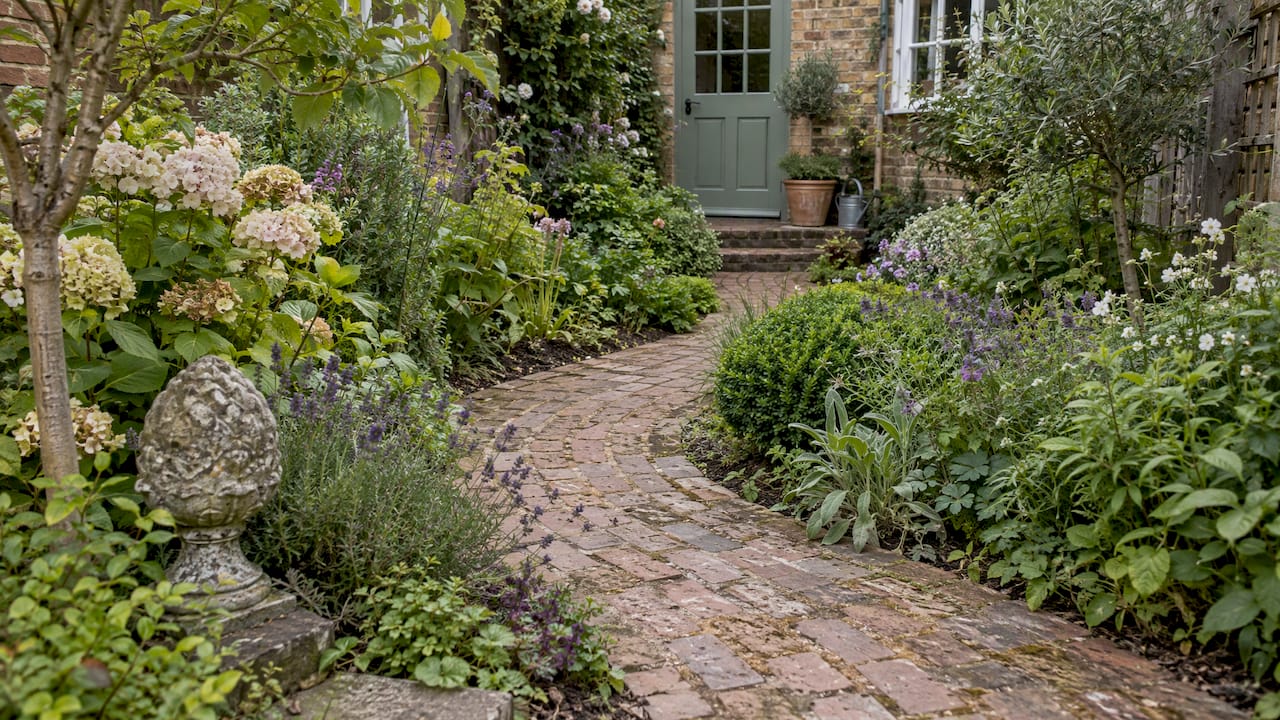
The best garden pathway decor works in layers: a clear edge, planting that softens it, light to guide you at dusk, and a few ornaments placed to draw the eye along the route. Start with the edge and the planting, add lighting, then finish with ornaments and a focal point at the far end. Ornaments come last because they only look right once the path has a shape. Our Garden/Patio collection is where we gather the decorative pieces for that final layer.
TL;DR
- Decide the path’s character first (cottage, contemporary, calm and Japanese-inspired) and let it dictate materials, planting and ornaments.
- Edge and plant the sides before you add anything decorative: lavender, rosemary, lamb’s ear and hardy geraniums are classic path-edge choices.
- Light the path with discreet, low-glare fittings and test the layout with lanterns first.
- Place ornaments in rhythm, not in a crowd: one focal piece at the end, smaller repeats along the way.
- Keep the whole scheme to two or three materials and colours so it looks designed, not accumulated.
Table of Contents
- Start with the character of the path
- Pathway decor ideas by garden style
- Edging and planting: the frame that makes ornaments work
- Lighting a garden path
- Garden border ornaments that earn their place
- The budget route: a decorative path without the big spend
- A simple order to follow
- Perspective
- Finishing your path with Homable
- FAQ
- Sources
Start with the character of the path
A path is not just a surface. It tells people how to move through the garden and what to look at on the way. Before you buy anything, decide what kind of journey you want: a gentle meander past flowers, a straight, tidy route to the back door, or a slow, quiet walk.
That decision filters everything else. A winding line with old brick and roses reads as cottage. A sinuous gravel path edged with a slim steel strip reads as contemporary and Mediterranean-inspired: Gardens Illustrated’s 2026 profile of a Surrey garden describes exactly this combination as a solution that suits a UK garden. A path of stepping stones through planting reads as calm and considered.
If you are unsure, look at the house. A brick Victorian terrace suits reclaimed brick tones and a softer, planted edge. A rendered new build usually looks best with cleaner lines and a more limited palette. Our guide to choosing a decor theme for UK homes uses the same logic indoors, and it carries outside well.
Pathway decor ideas by garden style
Cottage garden paths
Cottage style is the most forgiving and the most popular in British gardens. Homebuilding’s 2026 guide to cottage garden paths suggests stone-wall edging, foxgloves, arches, rose arbours, reclaimed bricks, natural-stone mosaics, offset paving and log stepping stones, plus a focal point at the end of the path.
You do not need all of that. Pick three:
- Reclaimed or old-look brick for the surface, laid in a relaxed pattern.
- An arch or arbour partway along, so the path passes through something.
- Tall, soft planting such as foxgloves that leans slightly over the edges.
If an arch appeals, DIY rustic arch plans show how a simple timber frame is built and anchored so it stays upright in wind. That matters on an exposed path far more than it does on paper.
Contemporary and Mediterranean-inspired paths
Here the beauty is in the line. A gently curving gravel path with a crisp metal edge, planted loosely on both sides, needs very little decoration. Choose one or two sculptural ornaments in a muted, natural tone and repeat the planting rather than adding more objects. Restraint is the whole look.
Calm, Japanese-inspired paths
The RHS explains in its guide to creating a Japanese-style garden that paths, bridges and stepping stones are used to control movement and views, and that natural wood or stone stepping stones are positioned to slow the journey. The same guide notes that stone lanterns illuminate paths and are commonly used in British gardens as ornamental sculptures and focal points.

The lesson for any garden is to slow people down. Stepping stones set slightly apart, or a bend that hides what comes next, makes even a short path feel longer and more interesting.
Edging and planting: the frame that makes ornaments work
A path with no edge looks unfinished, and loose surfaces such as gravel spread without something firm holding them in. A neat edge in brick, steel, stone or timber also gives your eye a line to follow, which makes everything placed beside it look deliberate.
Border planting then softens that line. Country Living’s 2026 plant advice, quoting Bex Hamilton, recommends lavender and rosemary for scent, hostas at tree bases, and lamb’s ear and hardy geraniums along path edges. Lavender and rosemary release their fragrance when brushed in passing, which is a lovely reason to plant them where people actually walk.
Designing the border itself
If you are building a border alongside the path from scratch, natural materials give a quick, rustic edge. Gardens Illustrated’s report on RHS Chelsea trends in 2024 records chestnut posts, hazel rods and willow dividers as boundary and edging materials used by show-garden designers. Woven willow or hazel is also easy to cut to length for a small garden.

Keep the planting in drifts of three to five of the same plant rather than one of everything. Repetition is what makes a border read as designed, and it leaves clear spaces where an ornament can sit without being swallowed.
Lighting a garden path
Light changes a path after dark, and it extends the hours you use the garden. The trick is to illuminate the ground and the planting, not to line the route with bright fittings. Homebuilding’s 2025 lighting guide points to discreet downlights, adjustable spike lights and concealed lighting as ways to light a path without letting the fittings dominate planting or views.
On height, the lighting expert Alina Enache, quoted in the same guide, recommends 450 to 650mm fittings for smaller paths and 850 to 1100mm fittings for larger ones. A narrow side-passage needs the lower end; a long garden walk can take the taller fittings.

Test before you commit
The same guide suggests using temporary candles, lanterns and portable lamps to test an arrangement before installing permanent lighting. This is a useful habit. Set lanterns along the path one evening, look from the house window and from the far end, and move them until the spacing feels natural. Mains-powered outdoor installation should be done by a qualified electrician; battery and solar options need no wiring.

Garden border ornaments that earn their place
Ornaments are where a path gets its personality, and also where gardens most often go wrong. A dozen small objects scattered along a border looks like clutter. Three well-chosen pieces in rhythm look intentional.
A few principles work in almost any garden:
- One focal point at the end. A statue, a large pot, a bench or a decorative piece the path leads to gives the walk a purpose. Homebuilding’s cottage-path guidance also recommends ending the route with a focal point.
- Repeat to create rhythm. Country Living’s report on the 2023 Chelsea garden for Horatio’s Garden describes tactile stone cairns as rhythmic, symbolic wayfinding ornaments along a path. You can borrow the idea with any repeated object: stacked stones, matching small planters, similar-sized figures.
- Match scale to the planting. A tiny ornament vanishes behind a hardy geranium. Place small pieces at the front of the border and let taller ones stand where planting is sparse.
- Pair ornaments with plants that frame them. Lamb’s ear or a low lavender hedge around the base of a piece anchors it in the border.
For accents with a calmer feel, Country Living’s UK guide to feng shui in the garden lists birdbaths, water features, stone lanterns, wind chimes, ceramics and metal ornaments. That is a useful menu for choosing between materials: stone and ceramic for weight and permanence, metal for a sharper line, chimes for sound.
If you want more on choosing and placing pieces, we have written a fuller guide to garden ornament ideas that actually earn their space.
Containers as path decor
Planters are the easiest path decoration, because they combine ornament and planting. A pair either side of a gate or step, or a row along a patio edge, gives structure at once. Matching the planting to the pot matters, and our outdoor planter styling ideas explain how. Drainage matters too, so check whether plant pots need drainage before you plant up a pot that has no holes.
The budget route: a decorative path without the big spend
The cheapest way to a path that looks decorative is to spend little on the surface and invest your effort in the details. Homebuilding’s cottage-path ideas include several that are easy to do yourself: a natural-stone mosaic, offset paving, reclaimed bricks and log stepping stones.
A few practical points keep a low-cost path looking good for years:
- Build a firm base. A path laid on soft soil sinks and tilts. Compact the ground and any base layer well before you lay the finish.
- Allow a slight slope for water. A very gentle fall across the width stops puddles forming. Check by eye after rain.
- Contain loose material. Gravel and bark need a firm edge or they drift onto the lawn and borders.
Then put the decoration where it costs least and shows most: planting along the edges, a couple of well-placed ornaments and a few lanterns. Our article on budget patio finishes for small UK spaces applies the same principle to a patio.
A simple order to follow
When readers ask how to put it all together, we suggest this sequence:
- Walk the route and mark the line. Use a hosepipe or string to try curves and widths. Two people should be able to walk side by side on the main path.
- Fix the surface and edge. Do the structural work first, before planting or placing anything.
- Plant the border. Choose scented, soft plants for the sides and repeat them.
- Add lighting. Test with lanterns, then fix what you like.
- Choose the focal point. Decide what the path leads to.
- Add ornaments last. Place them in rhythm and stand back. Remove one piece for every two you add if it feels busy.
- Revisit through the seasons. A path that looks good in July may look bare in January, so add structure such as evergreen planting, a lantern or a sculptural piece that carries through winter.
Our seven key steps for styling an outdoor space go further on the same idea across a whole garden or patio.
Perspective
Most people start a path with ornaments, then wonder why it looks cluttered. We would start with the frame: the edge, the planting and the end point. Once those are in, decor has somewhere to belong.
At Homable we think the finishing layer should be considered rather than crowded. A few pieces chosen for design, quality and affordability, placed with space around them, do far more than a dozen bought on impulse. That is how we curate our garden and patio range: pieces that suit modern UK homes and look as good in winter as in summer.
Choose a style, keep to two or three materials, and let each object do a job: a focal point, a rhythm, a pair at the gate. That is the whole method.
Cristiano
Finishing your path with Homable
When the path is framed and planted, the decorative pieces are what make it yours. Our Garden/Patio collection brings together garden and patio decor chosen for modern UK homes, with design, quality and affordability in mind. You can browse the whole range on the Homable homepage, and orders over £100 ship free.

If you are also dressing the entrance to your home, our guide to interchangeable front door decor carries the look from the end of the path to the door itself.
FAQ
What is the cheapest way to make a garden path look decorative?
Keep the surface simple and put your effort into the details. Reclaimed brick, offset paving, log stepping stones or a stone mosaic are all easy DIY options, according to Homebuilding. Build a firm base, contain any loose material with an edge, then add scented planting and a couple of ornaments.
What can I put along the edge of a garden path?
Plants are the first choice: lavender, rosemary, lamb’s ear and hardy geraniums are all recommended for path edges. For structure, use brick, steel, stone or natural materials such as hazel and willow. Add ornaments in small repeats, so the edge feels rhythmic rather than crowded.
How do I light a garden path without it looking harsh?
Use discreet downlights, adjustable spike lights or concealed lighting, and keep the fittings low and low-glare. Smaller paths suit shorter fittings of about 450 to 650mm; larger ones can take 850 to 1100mm. Try candles or lanterns first to settle the spacing.
How many ornaments should a path have?
Fewer than you think. One focal point at the end, plus two or three smaller repeated pieces along the way, is usually enough. If the border looks busy, take one away and look again.
Sources
- 12 cottage garden path ideas to add instant charm, Homebuilding
- Garden path lighting ideas, Homebuilding
- How to create a Japanese-style garden, RHS
- Award-winning designer Pollyanna Wilkinson reveals her garden, Gardens Illustrated
- What trends to expect at RHS Chelsea Flower Show in 2024, Gardens Illustrated
- The Nervous System Garden: plants that help us feel calmer, Country Living
- Chelsea 2023: Horatio’s Garden, Country Living
- How to feng shui your garden, Country Living
- DIY rustic arch plans