Cart
0
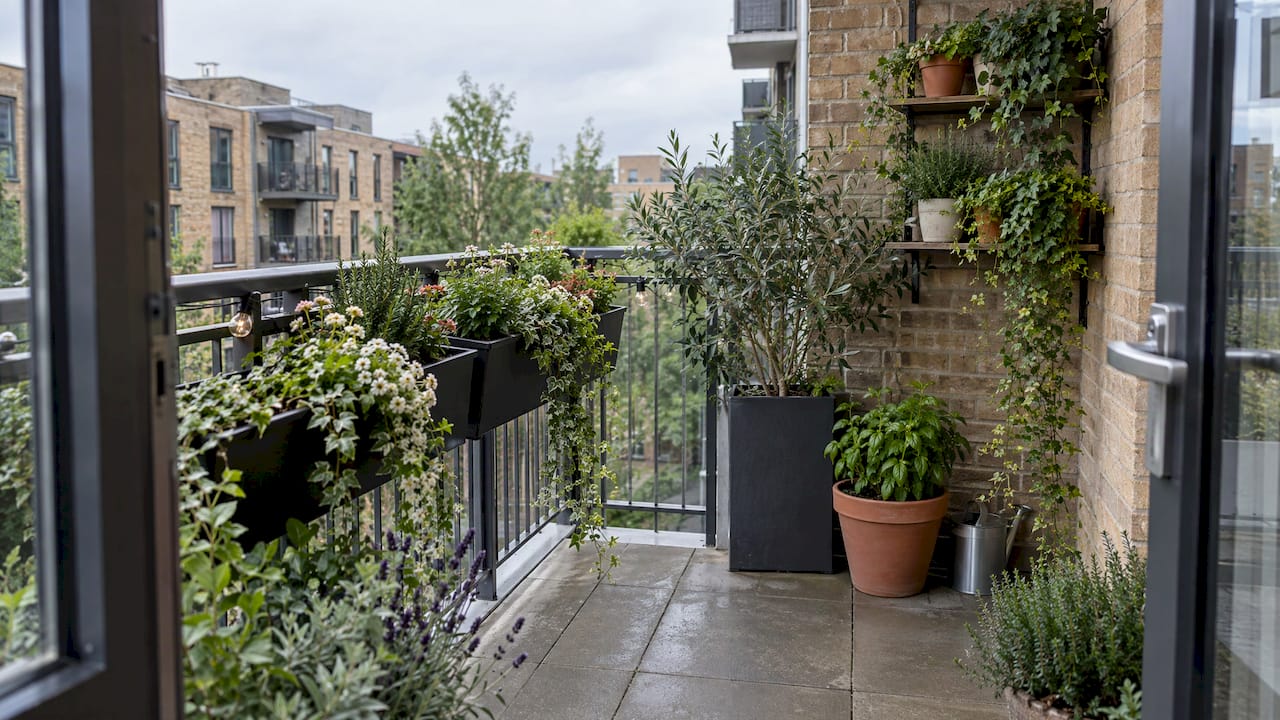
The best balcony planter arrangement is built in layers: one large anchor pot, smaller pots grouped around it in odd numbers, something trailing over the edge, and something climbing the wall or rail. Keep the palette small, put the heaviest containers against the building wall, and choose planters that suit your balcony’s wind and sun. At Homable we style outdoor corners with planters, shelves and decorative accessories, so this guide is written from the styling side: how to make a small space look deliberate, not crowded.
TL;DR
- Think in layers: floor for the anchor pot, rail for light planters, wall for shelves and climbers. Leave a clear path through the middle.
- Use the thriller-filler-spiller formula in each pot or group: one tall plant, one bushy plant, one trailing plant.
- Group pots in odd numbers (three or five), vary height and width, and keep to two or three colours.
- Put heavy pots against the building wall, not along the railing, and check your balcony’s weight limit before filling anything with wet compost.
- Wind and sun dry pots out fast. Pick tough foliage and plan for watering once a day in summer on exposed balconies.
Table of Contents
- Start with the layers, not the plants
- The thriller-filler-spiller formula
- Choosing planters for floor, rail and wall
- Colour, foliage and seasons
- Wind, sun and shade: matching plants to your balcony
- Zones: give each corner one job
- Weight, drainage and watering: the safe set-up
- A tight budget: how to look put-together for less
- Promo: build your balcony set-up from one place
- Perspective: our view on balcony styling
- FAQ
- Sources
Start with the layers, not the plants
Most balconies look messy for one reason: everything sits on the floor. The RHS advises thinking in all directions, up, along, around and through, so walls carry climbers, railings have plants woven through them, and structures give height and screening. Plants stop being something you step around and become part of the view.
In practice that gives you three layers to fill:
| Layer | What goes there | Why it works |
|---|---|---|
| Floor | One large anchor pot, plus a trough or two smaller pots | Gives the display a centre and keeps the heaviest weight low |
| Rail | Narrow railing planters for herbs, trailing plants or seasonal colour | Uses edge space without eating into the floor |
| Wall | Shelves, pocket planters, trellis with climbers | Adds height and frees the floor for a chair |
Draw this on paper first. Measure the depth of your balcony, mark where the door swings, and keep a clear walking line. A balcony that is 1.2 m deep cannot take a 60 cm pot and a chair, and no arrangement fixes that.
The thriller-filler-spiller formula
If you remember one design rule, make it this one. Each container, or each group of containers, gets three kinds of plant:
- Thriller: a tall, striking plant that acts as the centrepiece. Think ornamental grasses, a small Japanese maple or a clipped evergreen.
- Filler: compact, bushy plants that add volume and colour around the base.
- Spiller: trailing plants that cascade over the rim and soften the edge of the pot.
Gardens Illustrated describes the same approach for pot-only gardens: one focal plant, supporting companions and trailers over the edge. It also suggests working in odd-numbered groups, varying height and width, and using one large anchor pot with smaller ones around it.
On a small balcony, treat the formula as a grouping rule rather than something to squeeze into one pot. A tall planter holds the thriller, a wide low pot holds fillers, and a railing box or wall shelf carries the spillers. The effect is the same and each plant gets enough root room.
A worked example for a 2 m by 1 m balcony
- Anchor: one large pot in the corner against the wall, holding an evergreen such as fatsia or a clipped box.
- Companions: two smaller pots beside it at different heights, one with salvias or hydrangea, one with herbs.
- Spillers: a railing planter along the front with trailing ivy or strawberries.
- Wall: one pair of shelves above the seating spot for small pots, plus a trellis behind the anchor pot for star jasmine or clematis.
- Path: a clear 50 to 60 cm line from the door to the chair.
That is five elements in odd-numbered groups, three heights and one clear route, which is what makes a small space look planned.
Choosing planters for floor, rail and wall
Floor planters
The floor is for your anchor. Square or rectangular planters follow the contours of the space, so they save room or create a sense of enclosure around seating, while a few round pots add interest, as garden designer Henry of Berkeley Inspiration suggests for small outdoor spaces. A tall rectangular planter is also a way to build height and a visual screen without taking up much floor.
If you want that look, our galvanised steel garden planter in anthracite, 100.5 x 40.5 x 90 cm gives you a tall, narrow shape that works as a screen along one side, and there is a plain galvanised version in the same size if you prefer a lighter metal tone. Measure your balcony depth against the 40.5 cm width before you order.
Railing planters
Railing planters earn their place by using the edge. Whatever you choose, it must be fixed firmly to the rail, and it needs a tray or liner so water does not drip onto the neighbours below. Our wicker balcony planter set with PE lining, 80 cm comes as a pair, which suits the odd-and-even logic of a balcony: one pair on the rail, one anchor on the floor. The wicker look warms up cold metal or concrete railings.
Wall shelves and vertical planting
Walls give you the cheapest square metres on a balcony. Trellis carries climbers such as jasmine and clematis, and shelves take small pots of herbs or trailing plants. Our stainless steel wall shelves come in pairs and several sizes, so you can stack two rows of small pots above a seat. Fit them into masonry in line with the landlord’s or building manager’s rules; if you rent, our guide to renter-friendly balcony decor covers what usually passes a lease check.
Artificial planters for the toughest spots
Some balconies are too windy, too shady or too high for anything to thrive in January. A set of artificial bamboo planter plants, 65 cm gives you an evergreen backbone that needs no watering. They are available in silver and copper finishes, which is a good way to keep the look going through winter while living plants rest.
Colour, foliage and seasons
A tight palette looks more expensive than a rainbow. Guy Barter, Chief Horticulturist at the RHS, says a minimal palette has a more harmonious effect, and recommends choosing colours as you would for a tub: from the same family, or ones that contrast well.
For the colours themselves, look at what you see from the balcony. The Transient Garden at RHS Chelsea 2026 was designed for a compact city balcony, and its designers chose oranges, purples and white to complement the greys and blues typical of a city view. If your view is brick and slate, warm accents will pop. If you look out over green, whites and soft purples will blend in.
For year-round interest, City Garden Designer Isabelle Palmer advises starting with evergreens such as box, fatsia, camellias and star jasmine, then adding perennials such as hydrangeas, salvias or clematis and layering so that when one plant is dormant another takes over. Treat evergreens as the permanent frame, and swap bulbs, bedding and herbs in and out around them.
What about the 70/30 rule?
You may see this asked. In gardening, the 70/30 rule of thumb usually means planting about 70 per cent of your containers with reliable plants you know do well in your conditions, and keeping about 30 per cent for experiments. On a balcony with ten pots, that is seven dependable ones and three to try something new. Used for design rather than growing, the same split works for looks: roughly 70 per cent of your display in your main colours and foliage, and 30 per cent for accents such as a bright pot or a decorative ornament.

Wind, sun and shade: matching plants to your balcony
The RHS names strong wind and strong sun as the main limits on roof gardens and balconies. Its advice is to create shelter with screens or robust plants, so that more delicate plants can survive in the microclimate you create. Plants that cope with wind and sun tend to have needle-like or very small leaves, hairy grey foliage or waxy leaf surfaces, which reduce water loss.
A simple way to sort your options:
- Sunny and windy: lavender, rosemary, thyme, grasses, sedums, Japanese maple in a sheltered corner.
- Shady: ferns, hostas, fatsia, ivy, hydrangea.
- Mixed: herbs, houseplants set outside in summer, and bedding plants that you replace each season.
Put the toughest plants on the outside edge as a living windbreak, and the more delicate ones behind them against the wall.
Zones: give each corner one job
A balcony feels bigger when each area has a clear purpose, such as a seating spot, a growing corner and a quiet display of foliage. Zoning a balcony into distinct areas makes it feel more purposeful, and uneven divisions look more natural than perfect symmetry. The same logic of one job per corner applies to organising any small space.
A practical split for a typical UK balcony: seating and a small table on one side, with the growing zone of herbs on the rail and a low group of foliage pots on the other. Add a weatherproof mat underfoot to define the seating area. For more small-space ideas, see our decorative solutions for small spaces and our guide to outdoor planter styling.
Weight, drainage and watering: the safe set-up
This is the part that is easy to skip and costly to get wrong.
Weight. Wet compost is heavy. The RHS advises checking the weight capacity of the structure, placing heavy containers near load-bearing walls or beams, and using lightweight containers with plenty of drainage holes, raised off the ground. House Beautiful UK notes that balcony loading is usually calculated at 70 kg per m², so lightweight potting mixes and containers help. If you are unsure of your balcony’s limit, ask your landlord, managing agent or a structural engineer before you load it up.

Position. Anchor pots go against the building wall. Light railing planters go on the rail, locked on securely. Nothing heavy sits on the outer edge.
Drainage. Use saucers or trays to catch run-off. Standing water in a tray can rot roots, so empty it after heavy rain, and make sure nothing drips on the balcony below.
Watering. Wind dries pots quickly. Expect to water exposed, high balconies daily in summer, and morning is best. Grouping pots together shelters them from each other and slows evaporation. A pot with a lining, such as the PE-lined planters above, also helps the soil keep moisture.
A tight budget: how to look put-together for less
You do not need ten new pots. Start with one good anchor and build around it:
- Buy one statement planter, and use what you already own for the smaller pots.
- Unify mismatched pots with one colour family, so the group reads as a set.
- Choose perennials and evergreens over annuals, because they return each year.
- Raise a few pots on a shelf or crate rather than buying more pots.
- Add one or two decorative finishes such as a mat or a few ornaments, which change the whole feeling for little money.
Our small UK patio decor ideas cover budget finishes that carry across to a balcony.
Promo: build your balcony set-up from one place
If you want planters, shelves and finishing touches that go together, browse our range. We sell planters, wall shelves, bamboo products and decorative accessories for the home, and orders over £100 ship free.

Start with an anchor planter and a pair of shelves, then add accessories to finish the look. See everything on the Homable homepage.
Perspective: our view on balcony styling
We think a balcony should be styled like a small room, not a plant shelf. That means a floor, a wall and a ceiling line: an anchor on the floor, shelves and climbers on the wall, and something at the rail to catch the eye from indoors.
The mistake we see in styling is buying lots of small things. Fewer, larger containers in one material family look calmer and are easier to water. Wicker with a lining, galvanised steel and a few evergreen or artificial bamboo accents give you texture without clutter.
Pick planters first, because they are permanent. Plants can change with the season; the containers, shelves and accessories set the style that stays. That is why we curate planters, shelves and decorative finishes together, so a balcony can be put together in one order and look as if it was planned.
Cristiano
FAQ
What is the best arrangement for a small balcony?
Use layers: one large anchor pot on the floor, a narrow planter on the rail and shelves or a trellis on the wall. Group pots in odd numbers, vary the heights and keep a clear path through the middle.
What potted plants are good for a balcony?
For sun and wind, choose plants with small, needle-like, grey or waxy leaves, such as lavender, rosemary and thyme. For shade, try ferns, hostas, fatsia and ivy. Evergreens give a frame all year, with bulbs and bedding added for seasonal colour.
How do I make a balcony look good on a low budget?
Buy one statement planter and unify what you already own with a limited colour palette. Choose perennials over annuals, raise pots on shelves, and add a few decorative accessories.
How heavy can my balcony planters be?
Balcony loading is usually calculated at around 70 kg per m², according to House Beautiful UK, and wet compost is heavy. Keep heavy pots against the building wall, use lightweight compost and ask your landlord or managing agent about your balcony’s limit.
Sources
- RHS: Planting design for small garden spaces
- RHS: Roof gardens and balcony ideas
- RHS Chelsea Flower Show 2026: The Transient Garden
- Gardens Illustrated: How to create a beautiful garden using only pots
- McCarthy & Stone: 6 balcony garden tips from the experts
- Berkeley Inspiration: How to turn a small outdoor space into an urban oasis
- House Beautiful UK: 10 balcony and container garden ideas
- Garden Ninja: How to create a balcony garden