Cart
0

Most of us assume that glossy influencer posts and curated Instagram feeds drive our home shopping decisions. The reality is rather different. 65% of UK shoppers trust user reviews over social media endorsements, which influence only 58% of buyers. For modern homeowners hunting for stylish, affordable accessories, peer reviews have quietly become the most powerful force in the room. This guide unpacks why that matters, how UK buyers actually use reviews, what makes feedback trustworthy, and how to sidestep the pitfalls of fake or misleading opinions when refreshing your living space.
Table of Contents
- Why reviews matter more than ever in home shopping
- How UK homeowners use reviews: Patterns and preferences
- What makes a review trustworthy: Indicators, volume, and recency
- The pitfalls: Negative reviews, fake feedback, and review management
- How brands leverage reviews: Community and search advantage
- A fresh perspective: Why most review advice misses the real reason they matter
- Find your style with trusted reviews at Homable
- Frequently asked questions
Key Takeaways
| Point | Details |
|---|---|
| Peer reviews dominate | UK home shoppers trust user reviews more than influencer endorsements or ads. |
| Trust signals matter | Recency, volume, and verified buyer badges make reviews more credible. |
| Negative reviews add value | Balanced feedback, including negatives, helps buyers make confident choices. |
| Brands benefit from reviews | Brands actively collect and showcase reviews for trust and search ranking. |
| Community inspires style | Reviews foster a sense of inspiration and shared taste among home decor enthusiasts. |
Why reviews matter more than ever in home shopping
Home decor is a considered purchase. You are not grabbing a chocolate bar at the checkout. You are choosing something that will sit in your living room, bedroom, or hallway for years. That is precisely why consumer ratings and reviews are the most important information source for home purchases, outranking brand websites, editorial content, and even recommendations from friends.
The numbers back this up clearly. UK shoppers are influencing home choices through peer feedback at a rate that surprises even seasoned retailers. Categories like homeware, bedding, and decorative accessories see some of the highest review-reading rates of any product sector.
Why does this happen? A few reasons stand out:
- High visual stakes. Colour, texture, and scale are hard to judge from a product photo alone. A reviewer who mentions that a rug looks darker in person, or that a curtain fabric feels thicker than expected, gives you information no brand description can.
- Long ownership horizon. Unlike fashion, home accessories are meant to last. Buyers want reassurance before committing.
- No try-before-you-buy option. Unlike a high street shop, online purchases arrive unseen. Reviews fill that sensory gap.
“Consumer ratings and reviews are the single most important information source for home and garden purchases in the UK.” — Trustpilot Business
Understanding the benefits of shopping online for home decor means accepting that reviews are not a bonus feature. They are the backbone of confident buying.
How UK homeowners use reviews: Patterns and preferences
Knowing that reviews matter is one thing. Understanding how buyers actually read them is another. 71% of UK adults check customer reviews before making online purchases, and 60% specifically trust verified purchaser reviews above all other feedback types.
Shopping for home accessories is rarely a quick scan. Buyers follow a fairly consistent pattern:
- Check the overall star rating for a quick first impression.
- Filter for the most recent reviews to gauge current quality.
- Read a handful of negative reviews to spot recurring complaints.
- Look for verified buyer badges to confirm authenticity.
- Search for photos submitted by real customers.
According to a consumer survey on reviews, 32% of shoppers always seek out negative reviews, and 49% rate recency as a top priority. That is a significant portion of buyers actively looking for problems, not reassurance.

| What UK home shoppers check | Why it matters |
|---|---|
| Recency (last 90 days) | Reflects current product quality |
| Review volume | Signals popularity and reliability |
| Negative feedback | Reveals real-world drawbacks |
| Verified buyer status | Confirms genuine purchase |
| Customer photos | Shows true colours and scale |
For those building a decorating workflow, reading reviews strategically saves money and avoids costly returns. Treat reviews like a conversation with someone who already owns the item.
Pro Tip: A genuinely useful review mentions specific details: the exact colour in natural light, how assembly went, or whether sizing matched the description. Vague five-star reviews that say only “love it!” tell you very little.
Browsing curated collections for home decor alongside verified reviews gives you both editorial guidance and real-world proof in one place.
What makes a review trustworthy: Indicators, volume, and recency
Not all reviews carry equal weight. Once you know what to look for, the difference between a trustworthy review and a hollow one becomes obvious.
Volume matters enormously. 90% of shoppers prefer brands with 50 to 500 reviews, and recency is prioritised by 58% of buyers. A product with 400 reviews from the past six months is far more credible than one with 12 reviews spread across three years.
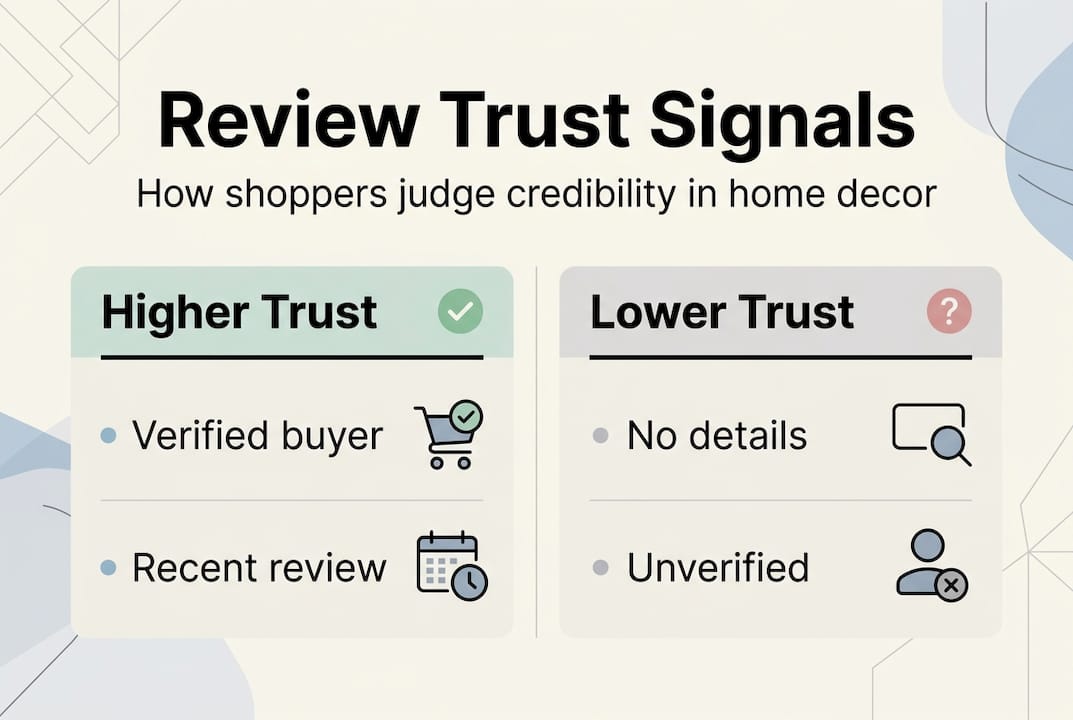
| Review feature | Higher trust | Lower trust |
|---|---|---|
| Verification | Verified buyer | Unverified account |
| Recency | Within 90 days | Over 12 months old |
| Level | Product-specific | Brand-level only |
| Detail | Mentions specifics | Generic praise |
For home accessories specifically, building trust in the home sector depends on review ecosystems that are both active and transparent. A brand that responds to reviews, positive or negative, signals accountability.
Quick trust signals worth checking before you buy:
- Is the reviewer verified as a genuine purchaser?
- Does the review mention product-specific details rather than vague praise?
- Are there recent reviews, not just a cluster from two years ago?
- Does the brand reply to criticism constructively?
When browsing best sellers in home decor, pay attention to products with a steady stream of recent, detailed reviews. That pattern is a reliable indicator of consistent quality.
The pitfalls: Negative reviews, fake feedback, and review management
Negative reviews are not the enemy. They are actually one of the most useful tools a home shopper has. That said, fake reviews are a genuine problem, and knowing how to spot them protects your wallet and your walls.
Negative reviews deter 69% of online shoppers, which sounds alarming until you consider the flip side: a product with zero negative reviews looks suspicious. A healthy mix of feedback, mostly positive with a few honest criticisms, is actually the most credible profile a product can have.
Fake reviews are a separate issue. They erode trust across entire categories, but AI and behaviour analysis tools are increasingly effective at detecting fraudulent patterns. As a shopper, you can do your own basic checks:
- Look for reviews that use identical phrasing or arrive in sudden clusters.
- Check whether the reviewer has a history of reviewing only one brand.
- Be wary of reviews that read like marketing copy rather than personal experience.
- Cross-reference feedback across multiple platforms when possible.
- Favour platforms that badge verified purchasers separately.
A product with a 4.3-star average and 200 honest reviews will serve you better than a 5-star product with 8 suspiciously glowing write-ups.
Pro Tip: Use negative reviews to set realistic expectations rather than to rule out a product entirely. If the main complaint is “delivery took longer than expected” rather than “the item broke immediately,” that is a very different risk profile.
When choosing best decor items for your home, a balanced review profile is one of the clearest signs that a product and a brand can be trusted.
How brands leverage reviews: Community and search advantage
Reviews are not just useful for shoppers. Brands that actively gather and showcase customer feedback gain real advantages in visibility and credibility.
34% of UK consumers write reviews for home and garden goods, and positive reviews directly boost search rankings, making reviewed products easier to find on Google. For smaller homeware brands, this is a significant leveller against larger competitors.
Here is how smart home brands use reviews to their advantage:
- Post-purchase emails that invite customers to share honest feedback within days of delivery.
- User-generated content (UGC) campaigns that encourage buyers to post photos of products in their actual homes.
- Review widgets on product pages that surface the most helpful and recent feedback prominently.
- Responding to criticism publicly, which signals transparency and builds confidence in new buyers.
- Featuring reviews in social content, turning customer voices into organic marketing.
For shoppers, this matters because brands that invest in genuine review ecosystems tend to care more about product quality. A brand that ignores reviews or only showcases five-star feedback is a red flag.
Keeping up with trends in home styling is easier when you can see how real customers are using products in their own spaces, not just how a brand photographs them in a studio.
A fresh perspective: Why most review advice misses the real reason they matter
Most guides on reviews focus entirely on trust and fraud prevention. That is useful, but it misses something important. For home decor enthusiasts, reviews are not just a safety net. They are a form of community.
When you read a review from someone who describes how a particular rug transformed their rented flat, or how a set of curtains finally made their bedroom feel finished, you are not just gathering data. You are connecting with someone who shares your taste, your constraints, and your aspirations. That sense of shared experience is what makes reviews so compelling in the home category specifically.
Home styling is deeply personal. It reflects how you want to live, not just what you want to own. Reviews from fellow homeowners carry emotional weight that no influencer post or brand campaign can replicate. They say: someone like you made this choice and it worked.
This is why we believe the most valuable reviews are not the most detailed or the most critical. They are the ones that paint a picture of a real home, a real person, and a real moment of satisfaction. That is what drives purchases at a deeper level than star ratings alone.
For anyone exploring room-specific decorating ideas, reading reviews with this lens transforms them from a checklist into genuine inspiration.
Find your style with trusted reviews at Homable
At Homable, every product in our collection is chosen with real homes in mind, and customer reviews are central to how we curate what we stock. When you browse our range, you are seeing items that have been tested, reviewed, and approved by homeowners just like you.
From charming accents like our woven fabric rabbit doorstop to statement pieces that anchor an entire room, our collections are shaped by the feedback of a genuine community of home enthusiasts. Free shipping on orders over £100 makes it even easier to try something new with confidence. Visit Homable and discover a curated selection where style, quality, and honest reviews come together.
Frequently asked questions
How many reviews should I read before buying home accessories online?
Reading at least five recent, verified reviews gives you a well-rounded view. 84% of shoppers read five or more reviews before buying from an unfamiliar brand.
Are negative reviews useful or should I avoid products with any bad feedback?
Negative reviews are genuinely useful for spotting recurring issues and setting realistic expectations. 32% of shoppers always seek negative reviews, while 69% are deterred by them, so context matters.
Can fake reviews mislead home shoppers in the UK?
Fake reviews exist, but you can spot many of them by checking for specific detail, verified buyer status, and consistent language. AI and behaviour analysis tools are also improving detection across major platforms.
Do reviews help small or less-known home brands?
Absolutely. Authentic reviews make smaller brands more visible and credible. Positive reviews boost search rankings and help first-time buyers feel confident choosing a brand they have not heard of before.
What trust signals should I check in a home decor review?
Focus on recency, review volume, and verified buyer status. Recency, volume, and verification are the three factors UK shoppers consistently rate as most important when judging whether feedback can be trusted.