Cart
0

TL;DR:
- Contemporary ornament design integrates decoration into structure and material using digital and AI tools. It emphasizes intrinsic approaches that serve both aesthetic and technical functions, moving away from surface addition. The trend favors restrained NeoDeco aesthetics, blending cultural motifs with generative geometry for meaningful spatial expression.
Contemporary ornament design is the practice of integrating decorative elements into objects, interiors, and architecture as structural and aesthetic components rather than surface additions. It draws on digital fabrication, AI pattern generation, and material intelligence to produce forms that were technically or economically impossible a generation ago. For design enthusiasts and students, understanding what is contemporary ornament design means grasping a field that has fundamentally shifted its own definition. Ornament is no longer something you add at the end. It is something you design from the beginning.
What is contemporary ornament design and how has it evolved?
Contemporary ornament design is defined as decoration that functions as an ordering intelligence embedded in material properties and generative digital logic. That definition separates it sharply from historical ornament, which was applied to a finished surface as a final flourish. The shift matters because it changes how designers think, plan, and build.
Modernism rejected ornament on ideological and economic grounds. The early 20th century treated decoration as dishonest, wasteful, and incompatible with industrial production. Contemporary designers have reclaimed ornament as a design property rather than a guilty addition. That reclamation is not nostalgic. It is grounded in new tools and a new understanding of what ornament can do structurally and spatially.
The term used across academic and professional contexts is ornamental design or contemporary decorative arts. Both phrases appear in architecture, product design, and interior design discourse. The SEO phrase “contemporary ornament design” captures the same territory and is used naturally throughout this article alongside the recognised terms.
How has technology transformed modern ornament design?
Technology is the single largest force reshaping ornament today. AI and additive manufacturing have reduced labour costs and enabled complex ornamentation that was previously prohibitive. That cost reduction is significant because labour expense was one of the main reasons 20th-century architecture stripped ornament away.

Digital fabrication tools, including CNC milling, laser cutting, and 3D printing, allow designers to produce intricate geometries at scale. Algorithmic design software generates patterns based on structural rules rather than manual drawing. The result is ornament that responds to load, light, airflow, or acoustic performance rather than sitting passively on a surface.
Key technologies driving this shift include:
- Additive manufacturing (3D printing): produces complex lattice structures and organic forms impossible to carve or cast traditionally
- Generative design software: uses algorithms to create pattern systems based on defined parameters such as material stress or spatial proportion
- AI pattern analysis: identifies structural affinities between transcultural motifs like the arabesque and lotus rosette, enabling their reinterpretation as spatial behaviours rather than flat images
- Robotic fabrication: applies ornamental treatments to large architectural surfaces with precision and repeatability
Pro Tip: If you are studying ornament design techniques, practise building parametric models in free tools like Grasshopper for Rhino before committing to physical fabrication. Understanding the logic behind a generated pattern gives you far more control than adjusting sliders blindly.
The practical outcome is that ornament has moved from being a luxury reserved for high-budget projects to a viable design strategy across scales and budgets. A small decorative object and a public building façade now share the same generative logic.
What are the primary methods and philosophies defining contemporary ornament?
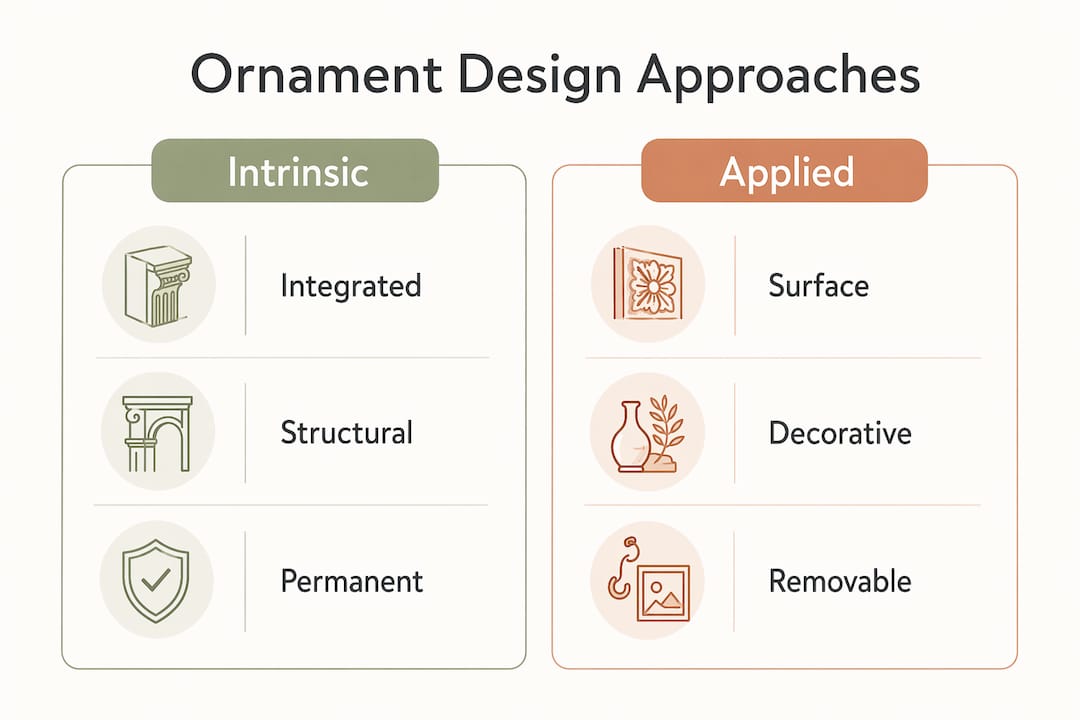
Two fundamental approaches structure the field. Intrinsic ornament is integrated within the building mass or surface itself, emerging from material behaviour or structural logic. Applied ornament is added onto a finished form as a separate layer. Both methods coexist in contemporary practice, but the philosophical weight has shifted decisively toward intrinsic approaches.
The distinction matters practically. Applied ornament can be removed without changing the object’s function. Intrinsic ornament cannot, because it is part of how the object performs. A perforated concrete façade panel that controls solar gain is intrinsic ornament. A decorative tile fixed to a flat wall is applied ornament.
The four main philosophical positions in current practice are:
- Ornament as structure: the decorative element carries load or performs a technical function, making aesthetics and engineering inseparable
- Ornament as material expression: the surface treatment reveals the material’s own properties, such as grain, texture, or reflectivity
- Ornament as spatial narrative: decoration guides movement and creates moments of engagement, acting as choreography within interiors
- Ornament as cultural dialogue: motifs migrate across traditions by structural affinity rather than imitation, creating new meanings from familiar forms
| Approach | Characteristic | Example application |
|---|---|---|
| Intrinsic ornament | Embedded in structure or material | Perforated façade panel, woven textile wall |
| Applied ornament | Added to a finished surface | Decorative moulding, printed tile |
| Generative ornament | Produced by algorithmic rules | AI-generated lattice, parametric screen |
| Narrative ornament | Guides spatial experience | Textured corridor, framed threshold detail |
The line between structure and decoration is increasingly blurred. That blurring is not a problem to solve. It is the defining condition of contemporary ornamental design.
Which aesthetic trends characterise current ornamentation?
NeoDeco is the most clearly defined aesthetic trend in ornament design right now. It favours architectural precision, restraint, and negative space over the dense, layered richness of historical Art Deco. The colour palette moves toward muted jewel tones, departing from the warm gold and ivory combinations of early 20th-century luxury. Framing uses 3–4 step intervals to create rhythm without clutter.
NeoDeco reflects a broader cultural preference for ornament that earns its presence. Every decorative element must justify itself through proportion, placement, or material quality. This connects directly to the purposeful spaces approach seen in contemporary interior design, where restraint is a deliberate aesthetic choice rather than a budget constraint.
Beyond NeoDeco, several motif families are gaining renewed relevance:
- Arabesque and geometric interlace: reinterpreted through AI analysis as generative spatial behaviours rather than flat surface patterns
- Botanical forms: lotus, leaf, and vine motifs translated into three-dimensional structural elements
- Fractals and recursive geometries: produced algorithmically, referencing natural growth patterns at multiple scales
- Negative space compositions: where the absence of material is as considered as its presence
Traditional motifs have become engines for formal innovation informed by AI-driven pattern analysis. This allows transcultural migration of motifs by structural affinity rather than imitation. A Japanese kumiko grid and an Islamic muqarnas share geometric logic that generative software can identify and recombine into entirely new forms.
How is contemporary ornament applied in interiors and architecture?
Ornament in contemporary interiors functions as spatial choreography. Texture and proportion create distinct moments of engagement, making the environment itself a decorative canvas rather than a neutral container for furniture. This approach treats the wall, floor, ceiling, and threshold as active participants in the user’s experience.
In residential settings, the most effective applications tend to be concentrated rather than distributed. A single textured feature wall, a patterned ceiling detail, or a carefully framed doorway creates more impact than ornament spread evenly across every surface. The 2026 home design trends reflect this preference for considered placement over decorative abundance.
Practical strategies for applying contemporary ornament in interiors include:
- Threshold framing: using material changes or relief patterns to mark transitions between rooms, guiding movement without signage
- Textural contrast: pairing smooth and tactile surfaces to create visual rhythm and draw attention to key areas
- Scaled motifs: repeating a single motif at different scales across a space to create visual coherence without monotony
- Lighting integration: designing ornamental surfaces to perform differently under natural and artificial light, adding temporal dimension to static decoration
In architecture, ornament now appears most frequently on façades, screens, and structural skins. Perforated metal panels, cast concrete reliefs, and ceramic cladding systems all carry ornamental logic that also performs technically. The distinction between fine arts and decorative arts is fading in public and shared venues, with bold decorative installations placed for collective experience rather than private display.
Pro Tip: When integrating ornament into a residential interior, start with ornament styling tips that focus on one surface per room. Restraint at the planning stage prevents the common mistake of over-decoration, which dilutes the impact of every individual element.
Key takeaways
Contemporary ornament design is most effective when it functions as an ordering intelligence embedded in structure and material, not as a surface addition applied after the design is complete.
| Point | Details |
|---|---|
| Ornament as system property | Contemporary ornament is intrinsic to form and material, not a detachable surface layer. |
| Technology as enabler | AI, additive manufacturing, and generative software make complex ornament viable at lower cost. |
| NeoDeco leads current trends | Architectural precision, muted jewel tones, and negative space define the dominant 2026 aesthetic. |
| Intrinsic vs applied methods | Both coexist, but intrinsic ornament carries greater philosophical and structural weight today. |
| Spatial narrative in interiors | Ornament guides movement and creates moments of pause, functioning beyond flat decoration. |
The ornament renaissance is real, but restraint is the skill
I have watched the conversation around ornament shift dramatically over the past decade. When I started paying close attention to contemporary decorative arts, ornament was still treated with suspicion in serious design circles. The Modernist hangover was real. Decoration felt like an admission of weakness.
What changed was not taste. It was capability. Once generative software and digital fabrication made complex ornament achievable without prohibitive cost, designers stopped apologising for wanting it. The philosophical rehabilitation followed the technical one.
The challenge I see most often now is not a lack of ornament. It is ornament without discipline. The same tools that make complexity possible also make excess easy. A parametric pattern generator will produce infinite variations, but knowing which one to stop at requires judgement that no algorithm provides. That judgement comes from studying historical precedent, understanding material behaviour, and spending time in spaces where ornament works well.
My honest view is that the most exciting contemporary ornament design happens at the intersection of cultural memory and structural logic. When a designer takes a motif with centuries of meaning and rebuilds it through generative geometry, the result carries both depth and novelty. That combination is rare and worth pursuing. The 2026 contemporary home trends point in this direction, and I think the best work of this decade will come from designers who treat ornament as a language rather than a decoration.
— Cristiano
Homable’s decorative pieces and contemporary ornament principles
Ornament at its best is both beautiful and considered. Homable brings that principle into everyday home styling with pieces that reflect current trends in form, material, and proportion.

The Decorative Silver Flower Candle Holder is a strong example. Its botanical form references the same motif families driving contemporary ornament discourse, translated into an object scaled for residential interiors. The piece works as a standalone focal point or as part of a layered arrangement. Homable’s full range applies the same logic: each piece is chosen for its design integrity, not just its visual appeal. Free shipping on orders over £100 makes building a considered decorative scheme more accessible.
FAQ
What is the difference between intrinsic and applied ornament?
Intrinsic ornament is embedded within the structure or material of an object and cannot be removed without altering its function. Applied ornament is added to a finished surface as a separate decorative layer.
How does AI influence contemporary ornament design?
AI analyses structural affinities between motifs from different cultural traditions, enabling designers to reinterpret forms like the arabesque as generative spatial behaviours rather than flat surface patterns.
What defines the NeoDeco aesthetic trend?
NeoDeco favours architectural precision, restrained use of ornament, negative space, and muted jewel tones, diverging from the dense, warm luxury palette of historical Art Deco.
Why did Modernism reject ornament, and why has it returned?
Modernism rejected ornament on ideological and economic grounds, treating it as dishonest and wasteful. Contemporary designers reclaimed it once digital fabrication reduced costs and generative tools gave ornament structural justification.
How can I apply contemporary ornament principles at home?
Focus ornament on one surface per room, use motifs at varied scales for coherence, and choose pieces whose form reflects material quality rather than surface printing alone.