Cart
0

TL;DR:
- Eclectic decor intentionally mixes furniture, patterns, and cultural influences to create personalized, cohesive spaces. It emphasizes deliberate curation over abundance, using unifying elements like color palettes or materials to maintain balance. Success relies on patience, thoughtful layering, and evolving a space gradually with meaningful objects.
Eclectic decor is defined as the purposeful blending of furniture, patterns, textures, and cultural influences from different periods and styles to create a cohesive, personal living space. Unlike trend-driven interiors, eclectic interior design rejects the idea that everything must match. It operates on a single, powerful principle: contrast creates character, but only when held together by a unifying thread. The result is a home that feels genuinely lived-in, layered with meaning, and impossible to replicate.
What is eclectic decor and what are its core principles?
Eclectic interior design is a curated, intentional mix of furniture, patterns, and materials from different historical periods and cultural origins, forming a cohesive personal style. The word “eclectic” comes from the Greek eklektikos, meaning “selective.” That etymology matters. This is not a style built on accident or impulse buying. Every piece is chosen with purpose, and the room as a whole tells a story about the person who lives in it.
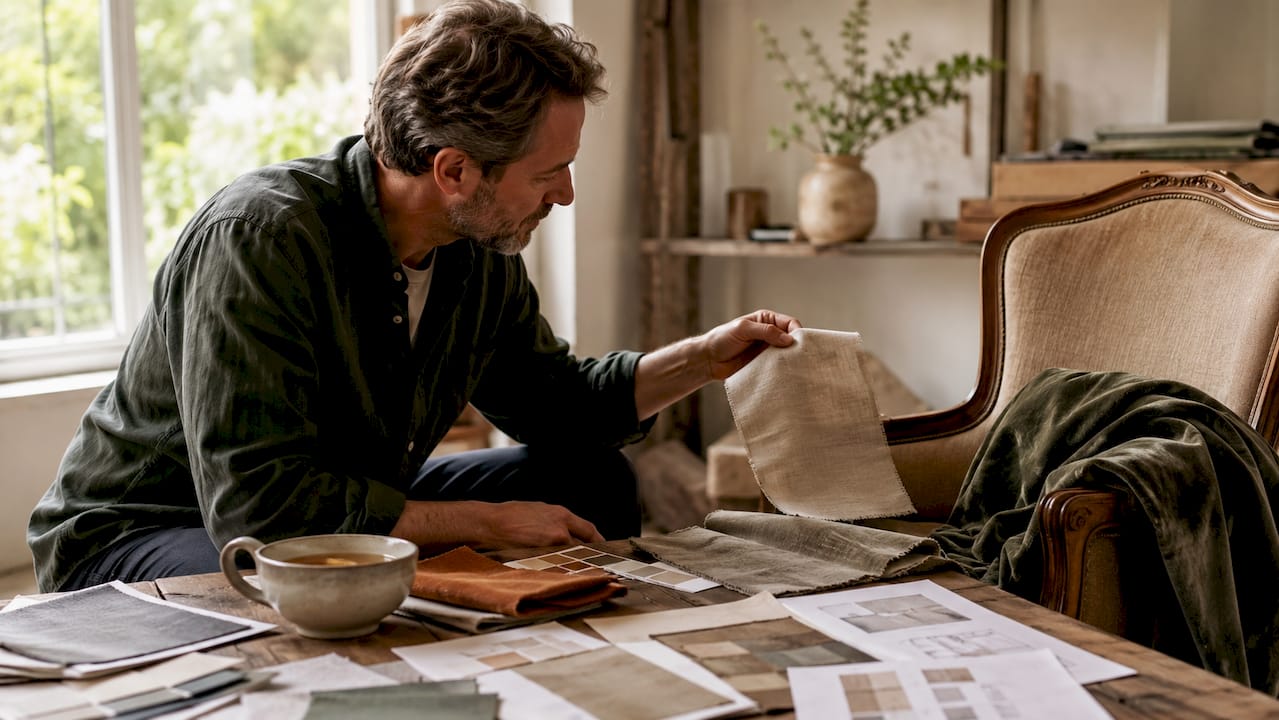
The philosophy behind eclectic decor rests on three ideas. First, originality over uniformity: a room where every item matches feels like a showroom, not a home. Second, personal expression: your grandmother’s armchair sitting beside a mid-century modern sideboard is not a mistake. It is a statement. Third, confident rule-breaking with balance. Eclectic style does not mean ignoring design principles. It means applying them creatively across mismatched sources.
Design expert Davis describes the goal as creating “tension and harmony at once”, pairing contrasting styles with a consistent undertone for rhythmic balance. That phrase captures the spirit of eclectic design better than any mood board. You want the eye to move, to be surprised, and then to feel settled.
What are the essential elements of eclectic design?
The elements of eclectic decor are not random. They follow a set of principles that separate a curated room from a cluttered one.
- Mixed furniture styles and eras. A Victorian chaise longue, a Scandinavian coffee table, and a Moroccan pouf can share a room. The key is that each piece earns its place through quality, character, or personal significance.
- Pattern and texture layering. Combine geometric prints with organic textures such as rattan, linen, and raw wood. The contrast between smooth and rough, bold and subtle, creates visual depth.
- Varied heights and depths. Vertical variation using books, risers, and overlapping artwork keeps the eye moving rather than resting on a flat, stagnant surface. A shelf that sits at one uniform height reads as dull; one that staggers objects at different levels reads as considered.
- Personal collections and meaningful objects. Travel souvenirs, inherited ceramics, and handmade pieces are the soul of eclectic decor. Designer Andreea Dima advises that eclectic design should evolve naturally from personal collections rather than be aggressively shopped all at once. This is the single most important piece of advice for anyone starting out.
- A unifying anchor. Colour palette, material, or a repeated motif ties everything together. Without it, the room falls apart.
The 60-30-10 rule is the most practical formula for maintaining balance: 60% dominant style or colour, 30% secondary, and 10% accent pieces. This ratio prevents any single influence from overwhelming the others. Think of it as the grammar of eclectic styling. You can break the rules, but you need to know them first.
Pro Tip: Before buying anything new, photograph your existing room and identify the dominant colour. Every new piece should either echo that colour or introduce a material already present in the space. This single habit prevents most eclectic decorating mistakes.
How does eclectic decor differ from maximalism and other styles?
This is where most people get confused. Eclectic decor and maximalism share visual complexity, but they operate on entirely different logic.
| Style | Core principle | Volume | Unifying element |
|---|---|---|---|
| Eclectic | Curated mix of periods and influences | Selective | Colour, material, or theme |
| Maximalism | More is more; abundance is the point | High | Pattern and layering |
| Minimalism | Reduction to essentials | Low | Negative space and form |
| Bohemian | Free-spirited, globally inspired | Medium to high | Organic textures and warmth |
| Traditional | Symmetry and period consistency | Medium | Historical style coherence |
Maximalism leans on abundance, while eclectic style centres on personal narrative and careful curation. A maximalist room fills every surface because fullness is the aesthetic. An eclectic room fills surfaces because each object has a reason to be there. Remove a piece from a maximalist room and it barely registers. Remove the right piece from an eclectic room and the whole composition shifts.
Eclectic design differs from maximalism by prioritising a curated vibe over filling every corner. It can even adopt minimalist approaches, using a restrained selection of mismatched pieces in an otherwise spare room. A single antique lamp on a clean white desk in an otherwise minimal bedroom is eclectic. It is not maximalist, and it is not purely minimalist either.
Bohemian style is the closest relative to eclectic, but bohemian leans heavily on organic textures, earthy tones, and a globally nomadic aesthetic. Eclectic has no such tonal requirement. It can be cool and industrial, warm and rustic, or sharp and contemporary, as long as the mix is intentional.
How to successfully style and layer eclectic decor in your home
Styling an eclectic interior is a process, not a shopping trip. Follow these steps to build a room that feels considered rather than chaotic.
-
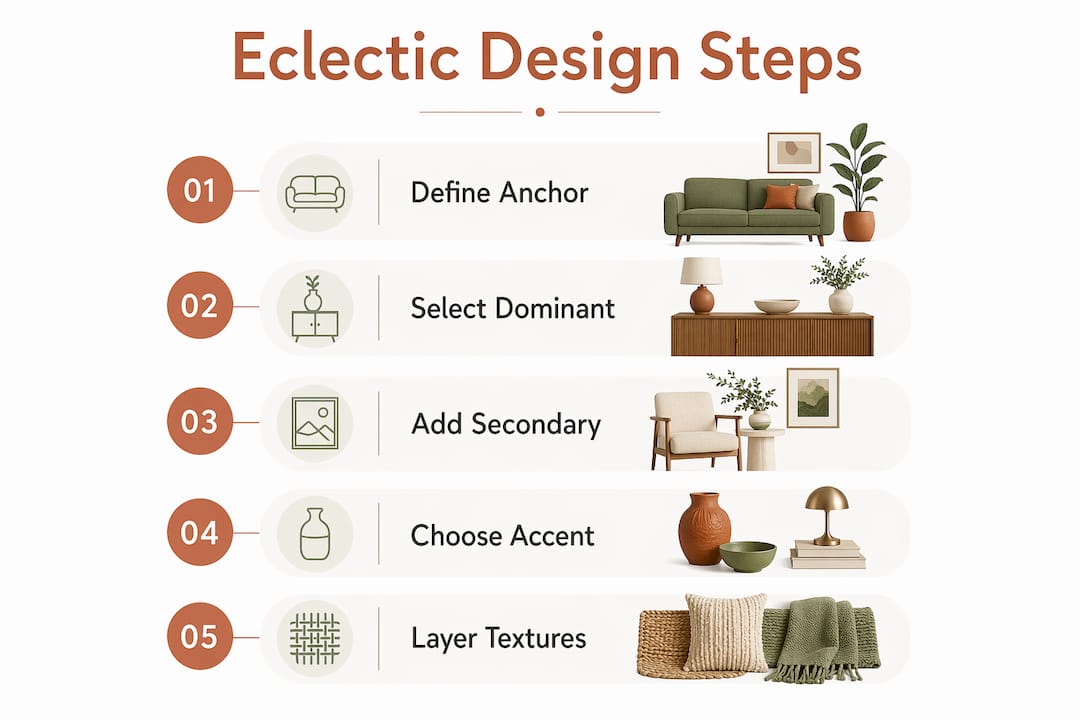
Establish your anchor first. Choose a colour palette of two to three colours before selecting any new pieces. Your anchor might also be a material, such as brass hardware, or a motif, such as botanical prints. Everything you add should connect to this anchor in at least one way. Homable’s guide to colour palette choices for modern UK homes is a practical starting point for this step.
-
Start with one statement piece. A bold vintage armchair, an oversized abstract painting, or an unusual light fitting gives the room its personality. Build outward from this piece rather than trying to assemble the room all at once.
-
Repeat colours, shapes, and materials. Repetition is what separates eclectic from random. If you introduce terracotta in a ceramic vase, echo it in a cushion or a candle holder. If you use a curved silhouette in one chair, find a curve somewhere else in the room. The eye reads repetition as intention.
-
Layer textures deliberately. Combine at least three different textures in every room: something smooth such as glass or lacquer, something woven such as a jute rug or linen throw, and something tactile such as velvet or carved wood. For bedroom spaces, blending colours and textures in the way bohemian interiors do offers a useful model for eclectic layering.
-
Vary your heights and scales. Place tall objects beside low ones. Hang artwork at different heights rather than in a rigid grid. Use books and risers on shelves to create levels. A room where everything sits at the same height reads as flat, regardless of how interesting the individual pieces are.
-
Edit ruthlessly. Once you have assembled a grouping, remove one item. If the arrangement improves or stays the same, the removed piece did not belong. This editing habit is the single most underrated skill in eclectic decorating. Statement pieces need breathing room to register as statements.
-
In smaller rooms, limit your style count. Restrict to two or three distinct styles and use a tighter colour palette to avoid visual exhaustion. A small sitting room mixing mid-century modern, industrial, and Art Deco simultaneously will feel overwhelming. Pick two and do them well.
Pro Tip: Take a black-and-white photograph of your finished arrangement. Without colour, you can see immediately whether the composition has balance, varied heights, and visual rhythm. If it looks chaotic in monochrome, it will feel chaotic in real life.
What common pitfalls should you avoid in eclectic interiors?
Most eclectic decorating failures share the same root cause: the absence of a unifying anchor. Failing to establish a common thread leads to a space that reads as a storage room rather than a curated interior. Here are the specific mistakes to watch for.
- No anchor. Mixing styles without a shared colour, material, or motif produces visual noise. Decide on your unifying element before you place a single object.
- Too many styles in one room. Four or five distinct design influences competing for attention exhaust the eye. Two or three, handled well, create richness.
- Ignoring scale and proportion. A tiny side table beside an oversized sofa looks accidental, not eclectic. Scale relationships matter as much in mixed-style rooms as in any other interior.
- Treating eclectic as a licence for clutter. Every object in an eclectic room should be there because it is beautiful, meaningful, or functional. Objects that are none of these three things are clutter, regardless of how interesting they look in isolation.
- Buying everything at once. A room assembled in a single afternoon rarely achieves the layered, personal quality that defines good eclectic decor. The best eclectic interiors accumulate over years.
Confidence plays a crucial role in how mixed pieces are perceived. When you place disparate items together with conviction, they read as intentional. Hesitation shows in the arrangement. Trust your instincts, and if something feels wrong after living with it for a week, move it.
Pro Tip: If you are unsure whether a new piece belongs, place it in the room for two weeks before committing. If you stop noticing it, it probably fits. If it continues to jar, it does not.
Key takeaways
Eclectic decor works because it combines personal meaning with deliberate design principles, using a unifying anchor to hold contrasting elements in balance.
| Point | Details |
|---|---|
| Define your anchor first | Choose a colour palette or shared material before adding any new pieces to the room. |
| Apply the 60-30-10 rule | Use 60% dominant style, 30% secondary, and 10% accent pieces to maintain visual balance. |
| Edit as much as you add | Remove one item from every grouping to give statement pieces the space they need to register. |
| Limit styles in small rooms | Restrict to two or three distinct design influences to prevent visual exhaustion in compact spaces. |
| Build collections over time | The most convincing eclectic interiors accumulate gradually from personal objects rather than a single shopping session. |
Why eclectic decor rewards patience more than any other style
I have spent years looking at residential interiors, and the rooms that stay with me are almost never the ones that were styled in a weekend. The eclectic ones, the rooms with a 1970s lamp beside a Georgian mirror and a hand-thrown ceramic from a market in Lisbon, those are the rooms that feel genuinely inhabited. They have a quality that no amount of budget can manufacture: time.
What I find most interesting about eclectic decorating is that it exposes your design confidence more than any other style. A minimalist room can hide behind restraint. A traditional room can hide behind convention. An eclectic room cannot hide behind anything. Every choice is visible, and the room either holds together or it does not. That vulnerability is exactly what makes it worth attempting.
The practical advice I return to most often is this: personalise your space around objects you already own before buying anything new. Most people already have the seeds of an eclectic interior sitting in boxes or on shelves they have stopped seeing. Start there. The anchor colour is usually already in the room. The statement piece is often already in the house.
The risk people fear with eclectic decorating is getting it wrong. But a room that reflects genuine personality and evolves over time is never truly wrong. It is just unfinished, which is exactly as it should be.
— Cristiano
Bring your eclectic vision to life with Homable
If this guide has sparked ideas for your own home, Homable’s curated collections are built for exactly this kind of intentional, personal styling. From ornaments and rugs to statement lighting and textured accessories, every product is selected with the kind of considered mix that eclectic interiors demand.
Whether you are starting from scratch or refining a room that already has character, Homable offers creative decor ideas and a broad range of home accessories to support every stage of the process. Orders over £100 include free shipping, and the full catalogue is available at Homable. Browse the new arrivals and best sellers to find the pieces that will anchor your next eclectic arrangement.
FAQ
What is eclectic decor in simple terms?
Eclectic decor is the intentional mixing of furniture, patterns, and objects from different styles, periods, and cultures to create a cohesive, personal interior. The key word is intentional: every piece is chosen with purpose, unified by a shared colour, material, or theme.
How is eclectic decor different from maximalism?
Eclectic style focuses on personal narrative and careful curation, while maximalism prioritises abundance and visual fullness. An eclectic room can be relatively spare; a maximalist room is defined by its density.
What are the most important elements of eclectic decor?
The core elements are mixed furniture styles, layered textures, varied heights, personal collections, and a unifying anchor such as a colour palette or repeated material. Without the anchor, the mix reads as clutter rather than curation.
How many styles can you mix in one eclectic room?
In most residential spaces, two to three distinct design styles work best. Introducing four or more competing influences, particularly in smaller rooms, creates visual exhaustion rather than interest.
Where do I start when styling an eclectic interior?
Start with one statement piece you already own or love, then establish a colour anchor and build outward from there. Designer Andreea Dima’s advice holds: let the collection grow over time rather than assembling the whole room at once.