Cart
0

TL;DR:
- People often approach seasonal home updates inefficiently by tackling hidden storage before visible spaces.
- Following a step-by-step process prioritizing high-traffic zones, decluttering, cleaning, and adding seasonal accents ensures a manageable, impactful refresh.
- Maintaining a routine with small, intentional swaps and regular checks sustains a calm, curated home environment year-round.
Most people approach seasonal home updates the wrong way. They dive into storage cupboards, get sidetracked cleaning things nobody sees, and end up exhausted before a single visible space has changed. A clear workflow for seasonal home updates fixes this completely. Instead of reactive scrambling every few months, you follow a sequence that delivers real visual impact fast, keeps stress low, and makes each season feel genuinely fresh. This guide gives you exactly that: a practical, step-by-step system built for real homes, real budgets, and real lives.
Table of Contents
- Key takeaways
- Before you begin: tools, materials, and mindset
- The step-by-step seasonal workflow
- Common pitfalls and how to avoid them
- Sustaining your refresh year-round
- My honest take on seasonal updates
- Refresh your space with Homable
- FAQ
Key takeaways
| Point | Details |
|---|---|
| Start with visible spaces | Focus on entry halls, living rooms, and kitchen counters first for the fastest emotional payoff. |
| Small swaps beat big overhauls | Rotating 3 to 5 curated seasonal accents avoids clutter and keeps storage manageable. |
| Build in monthly check-ins | A 10-minute monthly zone check prevents decor fatigue and stops maintenance from piling up. |
| Neutral core, seasonal layer | Keep a neutral base of evergreen pieces and swap only the top layer each season. |
| Plan before you buy | Set a budget and timeline before touching a single item to avoid impulse accumulation. |
Before you begin: tools, materials, and mindset
Getting the right things in place before your first update saves hours of backtracking. This is not about buying more; it is about being ready to work efficiently when motivation is high.
Here is what a solid home update checklist looks like before you start:
- Storage bins (clearly labelled by season and room)
- Cleaning supplies (microfibre cloths, an all-purpose spray, a vacuum with upholstery attachments)
- Basic decor staples (neutral cushion covers, a few quality candles, one or two botanical elements)
- A simple budget tracker (even a notes app works)
- A rough timeline (two to four weeks per seasonal transition is realistic)
The mindset shift matters as much as the materials. Small, intentional swaps create more emotional impact than expensive overhauls. Most people overcomplicate this. They think a seasonal refresh means repainting walls or buying new furniture. It does not. It means changing the sensory experience of a room through textiles, scent, light, and a few well-chosen objects.
A neutral base is your best friend here. If your sofa, walls, and flooring sit in muted tones, swapping a throw, a rug, or a set of cushions completely changes the room’s mood without clashing with anything. It is the difference between a wardrobe built around one key colour and one that has no consistent thread at all.
Pro Tip: Label storage bins with both the season and the room. “Autumn, living room” is far more useful than “autumn stuff”. You will thank yourself in six months.
Maintain a curated collection of roughly eight to twelve seasonal items per season. Any more and storage becomes a problem. Any fewer and the refresh feels thin.
The step-by-step seasonal workflow
This is the core of the guide. Follow these steps in order and you will avoid the most common traps of seasonal home updating.
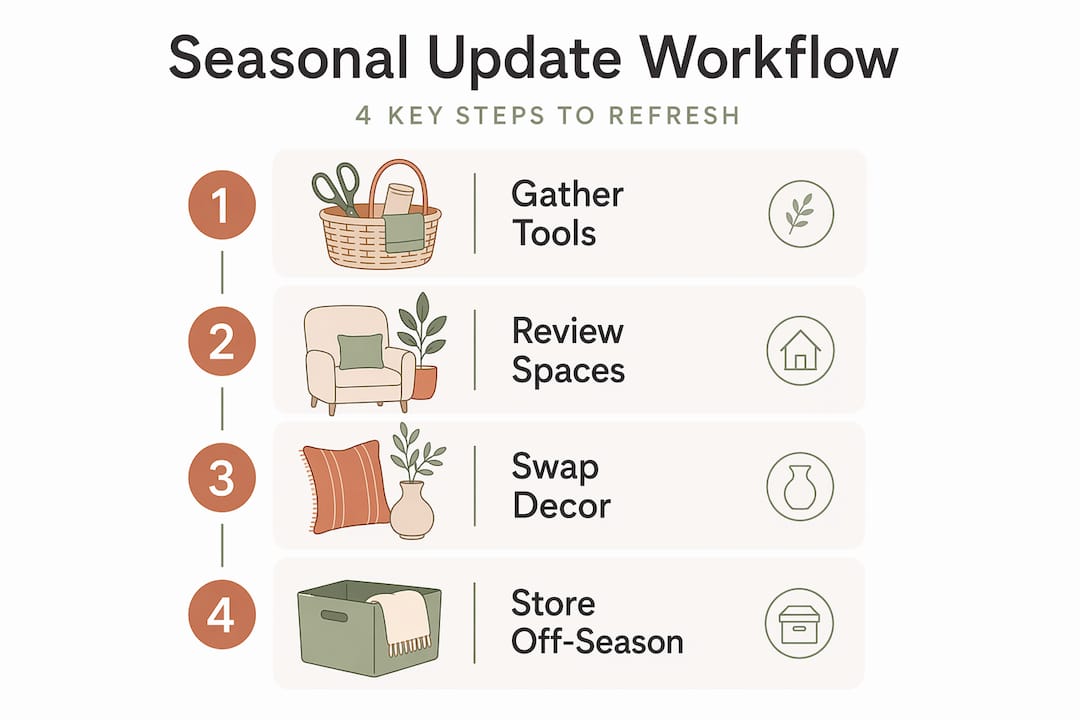
- Map your visible zones. Walk through your home and identify the three spaces you see most: usually the entry hall, the main living area, and the kitchen. These are your starting points.
- Strip out seasonal heaviness. Remove items that belong to the previous season: heavy winter throws, dark-toned cushions, or tired ornaments that have been sitting since autumn. Do not skip this step.
- Clean those key spaces. A quick wipe-down, vacuum, and declutter of surfaces makes the next steps dramatically more satisfying. Designers recommend starting here rather than with hidden storage, because the visible payoff drives momentum.
- Introduce seasonal accents. Bring in textiles (lighter throws, different cushion covers), botanical elements (fresh stems, a potted plant, a dried arrangement), and scent (a seasonal candle or diffuser blend). These three categories alone change a room’s atmosphere completely.
- Address secondary spaces. Once your main zones are done, move to bedrooms and bathrooms. These take far less time once momentum is built.
- Set a maintenance rhythm. Commit to a 10-minute monthly check-in focused on one zone. A quarterly audit of one to two hours keeps the whole system from unravelling.
- Rotate, do not accumulate. When a new seasonal piece comes in, an old one goes out or into storage. One in, one out.
For deeper inspiration on curated, affordable seasonal approaches, Homable’s guide to refreshing your interiors is worth bookmarking.
Spread steps one through four over one to two weekends rather than trying to do everything in a day. A gradual transition feels more natural and is far less exhausting. The goal is a home that shifts gently with the season, not one that gets a dramatic TV-style transformation every three months.
Pro Tip: Start with whichever room gives you the strongest emotional reaction when it looks good. For most people, that is the living room or the kitchen. Getting that space right first keeps you motivated for the rest.
Common pitfalls and how to avoid them
Even with a solid plan, certain mistakes derail seasonal updates repeatedly. Here is what to watch for.
| Common mistake | Recommended approach |
|---|---|
| Starting with hidden storage or deep cleaning | Begin with visible, high-traffic zones for immediate visual impact |
| Buying too many seasonal items | Keep to 8 to 12 pieces per season; rotate rather than accumulate |
| Attempting all tasks in a single weekend | Spread the transition over two to three weeks for a natural feel |
| Skipping maintenance tasks like gutters | Gutters need inspecting at least twice yearly; budget £80 to £400 for professional cleaning |
| Filling every surface with seasonal objects | Choose three to five high-impact pieces and leave breathing space |
| Ignoring HVAC filters | Pet owners need replacement every 30 to 60 days; other households every 90 days |
A few of these deserve more than a table row.
The storage mistake is the most common one. Many people open a cupboard on the first day of their seasonal refresh and spend three hours organising it. Nobody visiting your home will ever see that cupboard. Your living room, however, is seen every single day. Sequence matters enormously.

The accumulation trap is equally subtle. Each season you spot something in a shop that feels perfect for autumn or spring, and you buy it. Over three years you have forty seasonal items with nowhere logical to store them. Removing clutter and adding fewer, chosen pieces consistently creates more impact than filling spaces with many small objects. Less is genuinely more here, not as a design cliché but as a practical reality.
On the professional help question: some seasonal tasks genuinely need an expert. Gutter cleaning, for example, is one most homeowners and renters overlook until water damage forces the issue. Factor it into your seasonal budget and schedule.
Sustaining your refresh year-round
A seasonal update is not a one-off event. The homes that always look considered and calm are the ones where a quiet maintenance routine runs in the background.
Here is what that looks like in practice:
- A Sunday reset (15 minutes): clear surfaces, return misplaced objects, fluff cushions, replace a burned candle. This takes less time than making a cup of tea.
- A monthly zone check (10 minutes per zone): pick one area each month and ask whether it still feels fresh or whether something needs removing or swapping.
- A quarterly audit (one to two hours): review all seasonal items, decide what returns to storage, what gets donated, and what might be upgraded.
The midimalist approach gaining ground in home styling circles captures this perfectly. It sits between too sparse and too busy: soft layers, a few presence pieces, and clear surfaces. It is not about owning less for the sake of it. It is about owning the right things and giving them room to breathe.
For seasonal decor ideas that work across multiple rooms without requiring a large budget, Homable’s article on 12 creative decor ideas covers a range of accessible approaches worth exploring.
The emotional benefits of this kind of curated, sustained approach are real. A home that shifts gently with the seasons, that always feels intentional rather than chaotic, creates a measurably calmer atmosphere to live in. That is not abstract. It is the difference between dreading walking into your kitchen on a grey Tuesday and actually feeling lifted by the space you have made.
Budgeting for continuity does not mean spending heavily. Three new candles, a seasonal plant, and a cushion cover can shift a room’s atmosphere entirely. Build a modest seasonal budget into your annual finances, even something as small as £30 to £50 per season, and you will never feel the shock of an expensive one-off overhaul.
My honest take on seasonal updates
I have watched people spend entire Saturdays reorganising a loft that nobody enters, convinced they are doing a seasonal refresh. They are not. They are avoiding the visible spaces because those feel higher stakes.
What I have found, time and again, is that starting with visible zones first is the single most effective shift you can make to your seasonal update process. It is not complicated. It is just counterintuitive because tidying hidden storage feels productive without the risk of judgement.
The homes I admire most are not the ones with the most seasonal pieces. They are the ones where someone has clearly made decisions. Removed something. Chosen something else deliberately. That restraint is what gives a home its character across the seasons. And once you experience the boost of a single well-done room, you stop needing to overhaul everything at once.
My practical advice: pick your highest-traffic room, spend two hours on it this weekend, and notice how differently you feel in the house by Sunday evening. That feeling is your motivation to keep going. You do not need a grand plan on day one. You need one good room.
— Cristiano
Refresh your space with Homable

If you are ready to put your seasonal workflow into action, having the right products makes the process far easier. Homable offers a curated range of rugs, mats, and home accessories designed to slot into seasonal rotations without fuss. The natural bamboo rug set works beautifully for spring and summer refreshes, while the warm woollen Baluchi rug brings texture and depth to autumn and winter living spaces. For kitchen updates, the washable velvet kitchen rug is built for real daily use. Explore the full collection at Homable and find pieces that work across multiple seasons, not just one.
FAQ
What is the best starting point for a seasonal home update?
Start with your most-used visible spaces: the entry hall, living room, and kitchen counters. Designers consistently recommend these areas first because the immediate visual payoff keeps you motivated to continue.
How many seasonal decor items should I keep?
Aim for eight to twelve items per season and rotate rather than accumulate. Limiting seasonal pieces to a curated few keeps storage manageable and makes each item feel considered rather than lost in clutter.
How often should I do a full seasonal home audit?
Quarterly audits of one to two hours are the recommended rhythm, supported by brief 10-minute monthly check-ins focused on a single zone. This combination prevents both decor fatigue and maintenance backlogs.
Do I need to spend a lot to refresh my home each season?
No. A few textiles, a seasonal plant, and a scented candle can shift a room’s atmosphere entirely. Focus your budget on three to five high-impact swaps per season rather than buying across the board.
When should I call a professional instead of doing it myself?
Gutter cleaning is the most commonly overlooked task that genuinely requires professional help. Gutters should be inspected at least twice a year, and the cost of ignoring them far exceeds the fee for a professional clean.