Cart
0
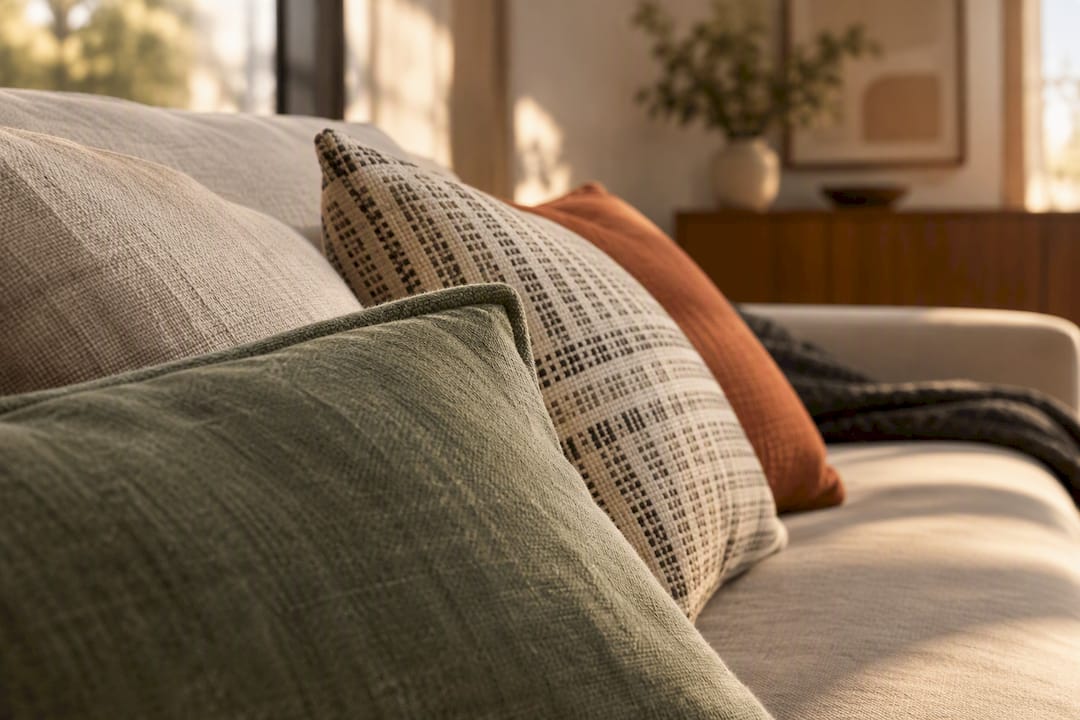
The simplest formula for throw pillow combinations is this: group them in odd numbers, pick one patterned hero, anchor it with solids and texture, and size your inserts up for a plump finish. The dependable 2-2-1 recipe (two large, two medium, one small) covers most three-seater sofas without any guesswork. Start by choosing a palette, then size up your inserts before you buy anything else.
TL;DR:
- Using the 2-2-1 arrangement with five cushions creates a balanced, symmetrical look suitable for most three-seater sofas but less effective on corner sofas.
- Choose cushion sizes based on seat depth, with 22 to 24-inch squares for deep seats and 16 to 18-inch for shallower furniture, to maintain proportion and comfort.
- Maintain color harmony by starting with a dominant room color or pattern, and avoid mixing more than three busy patterns side by side to prevent visual clutter.
- Incorporate textures such as linen, velvet, and boucle to add depth, swapping seasonal covers while keeping the inserts for affordability.
- A cushion with a size two inches larger than its cover prevents sagging, and feather or high-loft synthetic inserts are best for structure and allergy considerations.
Table of Contents
- Core styling principles for pillow combinations
- How to choose colour palettes and pattern mixes
- Textures, fabrics and seasonal swaps
- Sizes, inserts and how to size up for a plump finished look
- Arrangement recipes: 2-2-1, asymmetry and layouts for different sofas
- Room-specific combinations and quick examples to copy
- How Homable and Cristiano approach styling
- Author’s perspective: when to break the rules
- How to create these pillow combinations
- Sources
- FAQ
Core styling principles for pillow combinations
Applied to cushions, that means your base pillows are quiet solids, your middle layer introduces a secondary pattern or colour, and one small accent carries the boldest print or brightest hue in the room.
Odd numbers matter more than most people expect. Designers and styling guides commonly recommend odd-numbered groupings of three, five or seven, because they read as more dynamic and less stiff than even sets. Symmetry still has its place on a formal, matching sofa, but asymmetry (a slightly larger pillow on one side, a lumbar tucked to the other) tends to feel more lived-in.
Scale and proportion should follow the furniture, not a fixed rule. A deep-seated sofa swallows small 16-inch cushions, while a narrow loveseat looks cluttered under anything larger than 18 inches.
- Measure your seat depth before choosing cover sizes, not just the sofa’s overall width.
- Deeper sofas (over 90cm seat depth) suit 22 to 24-inch squares plus a lumbar.
- Shallower sofas and armchairs suit 16 to 18-inch squares so the seat stays usable.
Pro Tip: Lay your cushions on the floor in your planned arrangement before you commit to covers. It shows up proportion problems that are hard to picture standing over the sofa.
How to choose colour palettes and pattern mixes
Start with either the dominant colour already in your room (a rug, a wall, a piece of art) or a single hero patterned pillow, and build the rest of the combination around it. Trying to balance several unrelated patterns at once is how most pillow schemes go wrong.
There are three reliable palette routes. A tonal palette uses different shades of one hue, which reads as calm and pulled-together. A complementary palette pairs opposite colours on the wheel, such as terracotta with sage, for gentle contrast. A punchy contrast accent introduces one saturated colour against a mostly neutral base, doing the work of an entire palette with a single cushion.
Pattern pairing follows the same logic as colour. Mix a large-scale print, a medium-scale print and a small-scale print rather than three patterns of similar size, which tend to compete instead of layering. Stepwise mixing advice from top styling guides backs this up: pick your colour scheme first, vary your sizes, then mix pattern types and scales before adding solids to hold the look together.
- Never group three busy or high-contrast patterns side by side.
- Use at least one solid pillow between two patterned ones to give the eye somewhere to rest.
- Let your smallest pillow carry your boldest pattern or colour, not your largest.
Textures, fabrics and seasonal swaps
Texture does as much work as colour, often more, because it adds depth without adding visual clutter. Linen feels relaxed and breathable, velvet adds richness and catches light, boucle brings a soft, nubbly focal point, and chunky knits feel warm and tactile. Weatherproof fabrics matter for garden rooms, conservatories or covered patios where cushions face damp or direct sun.

The rule that keeps texture from turning busy: pair one tactile focal piece, a boucle or a heavy knit, with smoother solids around it. Two heavily textured pillows side by side tend to fight for attention.
Seasonal swapping is the cheapest way to refresh a room. Move to linen covers and lighter fills through spring and summer, then bring back velvet and chunky knits for autumn and winter. Current pillow trends for 2026 lean heavily on this idea, with terracotta shades, sage green linens and boucle textures used as seasonal accent swaps rather than a full pillow overhaul.
- Linen and lighter fills suit warmer months and brighter, airier rooms.
- Velvet and chunky knits suit colder months and rooms that need warmth.
- Swap only the covers, not the inserts, to keep seasonal refreshes affordable.
Sizes, inserts and how to size up for a plump finished look
Standard cover sizes run 16x16, 18x18, 20x20, 22x22 and 24x24 inches, with lumbar cushions typically 12x20 or 14x22 inches for lower-back support. Most sofas do well starting at 20 to 22 inches for the base layer, scaling up for deeper seats and down for armchairs.

The detail that separates a professional-looking sofa from a flat one is the insert. Styling professionals advise using an insert roughly two inches larger than the cover, so a 24-inch cover gets a 26-inch insert, to keep corners full and avoid sagging.
Insert quality matters as much as size. Feather and down blends hold structure and plump back up after being squashed, while high-loft synthetic fills suit allergy-sensitive households and hold their shape without natural fill.
- Choose an insert two inches larger than the cover on every size, not just the largest cushions.
- Feather and down blends give the crisp, structured look designers favour.
- High-loft synthetic fills are the practical choice for allergy-friendly homes.
Small mistakes in sizing are easy to avoid once you know the fix, and the common home styling mistakes worth checking include flat inserts and mismatched proportions.
Arrangement recipes: 2-2-1, asymmetry and layouts for different sofas
The 2-2-1 rule is the easiest arrangement to copy, because it removes the guesswork of where each cushion goes. It arranges five cushions symmetrically: two large cushions at each end, two medium cushions layered in front of them, and one statement cushion centred between the pair. It suits a symmetrical three-seater sofa well but works less naturally on a corner sofa, where there’s no true centre to anchor.
- Place your two largest cushions in the back corners, angled slightly inward.
- Layer two medium cushions in front, offset so the corner colours still show.
- Add one small statement cushion centred in front, carrying your boldest pattern.
- On a corner sofa or chaise, drop the strict symmetry and cluster three cushions at the main seating end, then float one or two along the chaise for balance.
- On a loveseat, skip the centre pillow altogether and use two matching corners instead.
Comfort should decide the final count as much as looks. A small settee suits two to three cushions, a two-seater suits three to four, a standard three-seater suits three to five, and a large sofa or corner suits five to seven, spread so there’s still room to sit back comfortably.
Pro Tip: If anyone in the house actually uses the sofa to nap or lounge, keep the total count toward the lower end of the range so cushions don’t end up on the floor within a day.
Room-specific combinations and quick examples to copy
Sofa: sage linen anchors, a terracotta velvet hero, and a cream boucle accent. Swap the velvet for a lighter cotton print in summer.
Bed: two large neutral linen Euro shams, a medium patterned pair in front, and one small lumbar in a saturated accent colour, mirroring the 2-2-1 logic across a headboard instead of a sofa back.
Armchair: a single oversized 24-inch square in a bold print, paired with nothing else, works when the chair sits alone as a statement piece. For a chair beside a window seat or cosy reading corner, add one small knit cushion for warmth.
Window seat: three to five mixed-size cushions in a tonal palette, since window seats read best when the pillows feel like a continuous run of colour rather than separate statements.
- Budget swaps: change one cushion cover rather than the full set to shift a room’s mood cheaply.
- Pair pillow palettes with existing rug placement so the two layers work together rather than clashing.
- Look to living room accent ideas for pieces that echo your pillow palette elsewhere in the room.
How Homable and Cristiano approach styling
Our approach comes down to three layers: an anchor solid, a patterned hero, and a textural accent, in that order, every time. It’s the same logic behind the 60-30-10 split and the 2-2-1 rule, just simplified into three decisions instead of five.
Readers building a scheme from scratch can pair this guide with our modern home accessories tips for a broader styling checklist, then browse Homable’s decorative collections to source anchors, hero prints and textured accents in one place.
Author’s perspective: when to break the rules
Rules like 2-2-1 are a safety net, not a ceiling. A maximalist cluster of seven mismatched patterns can outshine a tidy five-cushion set if the colours share one thread. Break proportion before you break comfort: a room that looks styled but can’t be sat on has failed at its one job.
— Cristiano
How to create these pillow combinations
Collections can be built around the anchor, hero and accent logic this guide covers, so building a scheme means sourcing pieces that sit well together rather than hunting across dozens of sites. Free shipping may apply on larger orders, and the full range can span beyond cushions into rugs, curtains and storage for the rest of the room.

| Layer | Role | Where to look on Homable |
|---|---|---|
| Anchor solid | Sets the 60% base tone | Bamboo rugs and curtains for matching room tones |
| Textural accent | Adds tactile interest | Home decor collections |
| Finishing touches | Ties the room together | Ornaments and accessories |
Browse the full range on Homable to start building your own combination.
Sources
- How many sofa cushions should you have? | Ideal Home
- Pillow insert size guide | Colin & Finn
- 14 trendy throw pillow covers you’ll love in 2026 | Leafy Haven Home
FAQ
What is the 2-2-1 throw pillow rule?
The 2-2-1 rule arranges five cushions symmetrically: two large cushions in the back corners, two medium cushions layered in front, and one statement cushion centred between them. It works best on a symmetrical three-seater sofa rather than a corner sofa or chaise.
What should throw pillows match?
Throw pillows should pick up a colour already in the room, such as a rug, artwork or accent wall, rather than matching the sofa fabric itself. One patterned hero pillow can set the palette, with solids and textures built around it.
What are the throw pillow trends for 2026?
Current trends favour terracotta shades, sage green linens, boucle textures and abstract art prints used as accent pieces within a wider neutral palette. Texture, particularly boucle and chunky knit, is doing much of the seasonal styling work.
What are some good colour combinations for throw pillows?
Tonal combinations, using different shades of the same hue, tend to read as calm and cohesive. Complementary pairings such as terracotta and sage, or a single punchy accent colour against a mostly neutral base, both work well when kept to one or two extra hues.
How many cushions suit a standard sofa?
A three-seater sofa generally suits three to five cushions, while a small settee suits two to three and a large corner sofa can carry five to seven. The right count also depends on how much seating space needs to stay free for actually sitting down.