Cart
0
TL;DR:
- Understanding professional interior accent terminology enables homeowners to make deliberate, impactful decorating choices.
- Accents involve contrast in colour, material, or placement, serving to draw the eye and add visual interest to a room.
Most UK homeowners think of “accents” as a chunky cushion thrown on a sofa or a bright blanket draped over an armchair. Bold? Yes. But that’s barely scratching the surface. Interior design has a rich, specific vocabulary around accents — one that professionals use every single day to specify, order, and layer elements with precision. Once you understand that language, you stop guessing and start making choices that genuinely transform a room.
Table of Contents
- What does ‘accent’ mean in interiors?
- Essential accent terms every homeowner should know
- Grouping and applying accent terms for real rooms
- The nuance of contrast: colour, material, and placement in accent terminology
- Expert lessons: what industry vocabulary unlocks for your home
- Discover and apply accent vocabulary with Homable
- Frequently asked questions
Key Takeaways
| Point | Details |
|---|---|
| Accent definition matters | Knowing the difference between accents and primary furnishings is key to smart styling choices. |
| Learn the technical terms | Understanding terms like piping and flange makes it easier to specify and customise accents. |
| Use grouping for better results | Organising accents by room function ensures stylish, practical outcomes and easier shopping. |
| Contrast techniques elevate style | Layering colour, material, and placement is central to creating modern, standout interiors. |
| Correct language prevents mistakes | Applying industry vocabulary improves communication with retailers and decorators. |
What does ‘accent’ mean in interiors?
Having established why vocabulary matters, let’s clarify what the word “accent” means to design professionals.
In everyday speech, “accent” suggests something decorative and secondary. In professional interiors, it means something far more deliberate. Interior design terminology defines an accent as a design element that adds contrast and visual interest — and that covers a surprisingly broad range of items, from a statement chair to a single pendant light to one dramatically painted wall.
The key distinction professionals draw is between accent elements and primary furnishings. A sofa is a primary furnishing — it anchors the room, serves a function, and rarely demands attention beyond its size. An accent chair beside it, however, earns its place by being different: a contrasting fabric, an unexpected shape, or a bold colour that pulls the eye across the space. That act of “pulling the eye” is what designers mean when they talk about accents drawing the eye and creating visual interest.
Understanding this difference changes how you shop. You stop asking “does this chair match?” and start asking “does this chair contrast enough to do its job?”
| Accent element | Primary furnishing |
|---|---|
| Accent chair | Main sofa |
| Pendant or table lamp | Ceiling light fitting |
| Accent wall (single bold colour) | Neutral room walls |
| Decorative rug | Primary flooring |
| Statement mirror or artwork | Built-in shelving |
| Scatter cushions with contrast piping | Main upholstered furniture |
Accents appear in virtually every zone of a well-styled room. You’ll find them in:
- Lighting: A sculptural floor lamp or a cluster of pendant lights above a dining table
- Walls: A single painted or wallpapered surface used to frame a bed or fireplace
- Furniture: A velvet accent chair in an otherwise neutral living room
- Textiles: Cushions, throws, and curtains with contrast trims or statement prints
- Decorative objects: Ornaments, vases, and art that add personality without overpowering
For a broader look at how these pieces come together, our room accents guide walks through real examples for UK living spaces. It’s also worth understanding how accents elevate interiors from a structural design point of view — because placement and proportion matter just as much as the items you choose.
“Accent features are stand-out elements used to draw the eye and create visual interest — they are always contrasted against the primary furnishings that anchor the space.”
Essential accent terms every homeowner should know
With the core concept unpacked, let’s decode the technical terms that help you shop and style with confidence.
Walk into any upholstery showroom or browse a professional interior catalogue and you’ll encounter words that stop most people in their tracks. Flange. Contrast piping. Double piping. Pipeless. These are not complicated concepts once explained, but without them you simply cannot specify what you want — which means you often end up with something that’s “almost right” rather than exactly right.
The upholstery glossary from House & Garden defines the key terms clearly. A flange is a strip of fabric that extends beyond a seam — typically on a cushion — to create a neat, tailored soft border around the edge. It adds a subtle frame that lifts a simple cushion into something that looks considered and custom-made. Piping refers to a cord covered in fabric that runs along a seam, giving it definition and structure. Variants include self piping (same fabric as the item), contrast piping (a different, often bolder fabric), double piping (two parallel lines for added detail), and pipeless piping (a modern, minimal finish with no visible cord but a clean seam edge).
Beyond soft furnishings, two other terms come up constantly:
- Accent lighting: Directional light used specifically to highlight a feature — a painting, a textured wall, or a display shelf. It is distinct from ambient (general) or task (functional) lighting.
- Accent wall: A single surface treated differently from the other walls — with a contrasting paint colour, wallpaper, or panelling — to create a focal point in the room.
| Term | Description | Where you’ll find it |
|---|---|---|
| Flange | Fabric border extending beyond a cushion seam | Cushions, headboards, soft furnishings |
| Self piping | Piping covered in the same fabric as the item | Classic sofas, formal dining chairs |
| Contrast piping | Piping in a different, contrasting fabric or colour | Contemporary cushions, statement chairs |
| Double piping | Two parallel piping lines on a seam | High-end upholstery, bespoke pieces |
| Pipeless piping | Clean seam finish without a visible cord | Minimal, modern interiors |
| Accent lighting | Directional light to highlight a feature | Alcoves, artwork, display shelving |
| Accent wall | Single bold surface for visual focus | Behind beds, fireplaces, dining areas |
Here is how to spot and specify these details when you’re shopping or briefing a supplier:
- Identify the seam lines on any upholstered piece — cushion edges, chair backs, sofa arms. This is where piping or flange will sit.
- Decide on self or contrast based on how bold you want the finish. Contrast piping is one of the most cost-effective ways to add a custom look.
- Check the accent lighting position relative to what you want to highlight. Angle and distance determine whether the light flatters or flattens.
- Confirm your accent wall choice before committing to a full paint order — test a large swatch in different lighting conditions throughout the day.
Pro Tip: Don’t overlook piping and flange options when buying cushions or upholstered furniture. Choosing contrast piping in a shade that picks up another element in the room — a rug, a lampshade, a piece of art — is one of the most affordable ways to make a space feel genuinely tailored.
Our room-specific accent guide breaks down which terms apply where, and if you’re working on a budget, our affordable decor ideas blog shows how to apply these details without spending a fortune.
Grouping and applying accent terms for real rooms
Now that you know individual terms, let’s see how the pros sort and apply them for efficient, stunning results.
Knowing individual terms is useful. Knowing how designers organise them is what makes the real difference. Professional decorators rarely think about accents in isolation — they group them by function and placement, which means they can quickly identify what a room needs and what it doesn’t.
A practical systems view of home decor terminology groups terms by function across interiors, covering floor finishes, curtain styles, rug placement and layout, and colour psychology. This grouping is not just academic — it directly affects how you select and specify items without making costly errors.
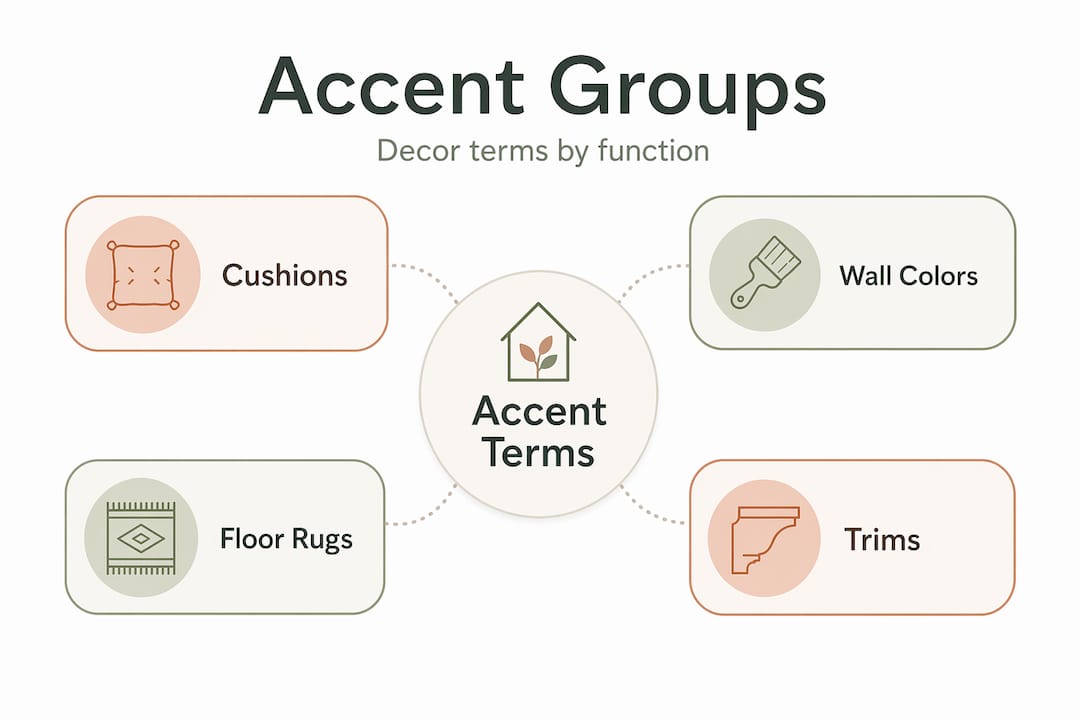
Think about it this way. In a bedroom, the relevant accent terms cluster around textiles and lighting: curtain heading styles (pinch pleat, eyelet, wave), blackout versus sheer linings, and accent lighting positioned to flatter rather than glare. In a living room, the conversation shifts to rug anchoring (ensuring a rug is large enough to sit under the front legs of all key furniture), colour contrast in cushion trims, and statement furniture placement.
Here are the main functional categories designers use when grouping accent terminology:
- Surface finishes: Wall treatments, paint finishes (matt, satin, eggshell), wallpaper types, panelling styles
- Lighting: Ambient, task, and accent layers; lamp types; directional versus diffused
- Textiles: Curtain heading and lining styles, rug materials and pile heights, cushion trims and fills
- Storage: Decorative storage solutions that serve as accents — open shelving, woven baskets, display cabinets
- Colour and pattern: Colour psychology terms, tonal palettes, contrast ratios between accents and primary furnishings
Grouping terms this way prevents a very common mistake: choosing an accent for how it looks in isolation rather than how it functions in the room. A stunning woven basket looks purposeful in a living room but muddled in a minimalist kitchen. The right term in the right category keeps you on track.
Pro Tip: When contacting a supplier or ordering online, use the category and term together — for example, “contrast piping on a feather-fill scatter cushion” rather than “cushion with a darker edge.” Precision gets you exactly what you picture. It also signals that you know what you’re talking about, which tends to result in better service and fewer miscommunications.
For colour-led decisions, our colour palette examples guide is an excellent reference. And if you’re thinking about storage as part of your accent layering, our decorative storage solutions guide covers beautifully functional options.
The nuance of contrast: colour, material, and placement in accent terminology
With your growing vocabulary, it’s time to add a layer of sophistication: the art of using contrast for impact.
Here is something that surprises most homeowners when they first encounter it: “accent” is not simply a category of object. It is a method. Specifically, it is a method of specifying contrast through colour, material, texture, or placement to direct a viewer’s focus. You can turn almost any element into an accent by deploying it with enough contrast against its surroundings.
That is why two identical sofas in the same room, but with different piping colours, create entirely different visual effects. The self-piped sofa settles into the background. The contrast-piped sofa — particularly with a piping colour that matches an accent wall or a pendant lamp — becomes part of a deliberate visual conversation.
Creating a focal point using proper accent methodology does not need to be expensive or dramatic. Follow these steps:
- Choose your focal surface. Pick one wall, a fireplace breast, or the wall behind your bed. Apply a bold or deeply saturated paint colour, or use wallpaper with an architectural pattern.
- Specify contrast piping or trim on the upholstery or cushions closest to that surface. The contrast colour should pull one shade from the wall treatment.
- Position accent lighting to wash over the focal surface — a pair of wall lights, a picture light, or directional ceiling spots work well.
- Place a decorative object at eye level within the focal zone: a sculptural vase, a statement artwork, or a grouped arrangement of ornaments in complementary materials.
- Step back and assess whether the eye travels to the focal point first, then moves naturally around the room. If it doesn’t, increase the contrast on one element.
“Accent is not only about the type of object you choose — it is about how you specify contrast through colour, material, and placement to deliberately guide where a person looks first.”
The layering of contrast piping on upholstery with a contrasting wall behind it and a well-placed light is a classic professional move. It feels sophisticated because every element is speaking the same language. Our modern styling steps guide covers the layering sequence in detail, and our creative decor ideas blog shows how real UK homes have applied these principles affordably.
Expert lessons: what industry vocabulary unlocks for your home

Here is something the interior design world rarely says plainly: learning the terminology is not about being elite or showing off. It is about getting exactly what you want rather than settling for “close enough.”
Most homeowners walk into a furniture showroom or browse an online catalogue and describe what they want in approximate terms. “Something with a bit of detail on the edge.” “A chair that stands out a bit.” “Lighting that makes the alcove look nice.” Those descriptions lead to approximate results. The salesperson or supplier does their best to interpret the brief, but without shared language, there is always a gap between what you imagined and what arrives.
Now consider what happens when you say: “I’d like a feather-fill scatter cushion in a plain linen, with contrast piping in a dark navy to match the accent wall.” That is an instruction that cannot be misunderstood. Suppliers respond to it immediately. Orders get fulfilled correctly. Returns drop. Time spent going back and forth drops. And the final result looks exactly like the room in your head.
This matters even more in renovation projects. When specifying a fitted wardrobe with integrated lighting, knowing the difference between accent lighting and ambient lighting means you get the gentle highlighting of a beautiful interior rather than a harshly lit cupboard. When choosing curtains, knowing what a pinch pleat heading looks like versus a wave heading means you get the silhouette you actually want.
Budget projects benefit enormously from this clarity too. When you know that a simple contrast piping upgrade adds custom impact for a fraction of the cost of a new cushion, you spend money strategically rather than buying more things hoping something will finally look right.
Pro Tip: Whenever you are sourcing fabric, trims, or upholstered pieces, always ask for samples labelled with the technical accent terminology. If a retailer or supplier can hand you a swatch labelled “contrast piping — double” alongside a “self piping” sample, you can hold them together, compare them in your own light, and make a genuinely informed decision. Our style accessory tips blog has more on this approach.
Discover and apply accent vocabulary with Homable
Ready to bring your new skills to life? Here’s how Homable makes it easy.
At Homable, we’ve built our product catalogue and content library around the same professional vocabulary you’ve just learned. That means when you search for cushions with contrast piping, accent lighting solutions, or statement decorative objects, you’ll find them described in terms you now recognise. No guesswork. No approximate descriptions.
Whether you’re starting from scratch or adding finishing layers to a room that’s almost there, our curated collections are organised to help you apply accent terminology directly to your shopping decisions. Browse our affordable UK decor ideas for inspiration that works within real budgets, or revisit our elegant room accents guide to see how each piece fits into the bigger picture. Free UK shipping on orders over £100 and secure payment make it easy to experiment without risk.
Frequently asked questions
What is the difference between an accent and a primary furnishing?
An accent feature is a stand-out element used to draw the eye and create visual interest, whereas a primary furnishing is a main, functional piece such as a sofa, bed, or dining table that anchors the space.
How can I use piping and flange in my home accents?
Piping and flange add tailored detail along the edges of cushions and upholstery — choosing contrast piping in a different colour creates an affordable, custom-looking finish without replacing the whole piece.
Why does knowing industry accent terms matter when shopping?
Using accurate terminology helps you communicate precisely with suppliers, reduces the risk of costly ordering mistakes, and means you decode product catalogues quickly rather than guessing at descriptions.
Are accent walls still a trend in the UK for 2026?
Accent walls remain firmly on trend in UK interiors for 2026, particularly in contemporary living rooms and bedrooms where a single bold or deeply textured surface adds focus without overwhelming the rest of the scheme.